Parshat Vezot Haberakhah6 min read

Moses Argues at the Border That He Sinned Less Than Adam

At the border he will never cross, Moses tells God that Adam broke one command and died, while he broke none. So why must he die too?

Curated by Arthur · Told by Maggid ·
Table of Contents
  1. The Old Man Files His Brief
  2. God Names the Dead
  3. The Last Card
  4. The Question Turned Back
  5. I Caused It Myself

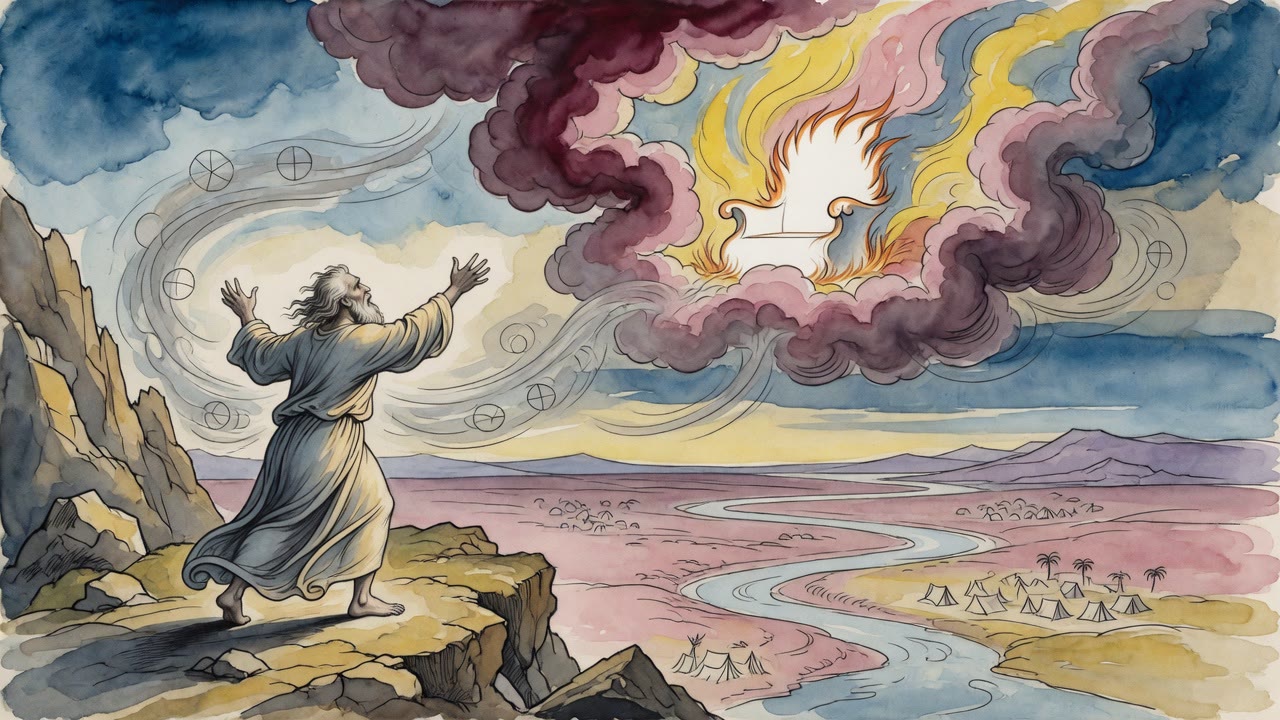
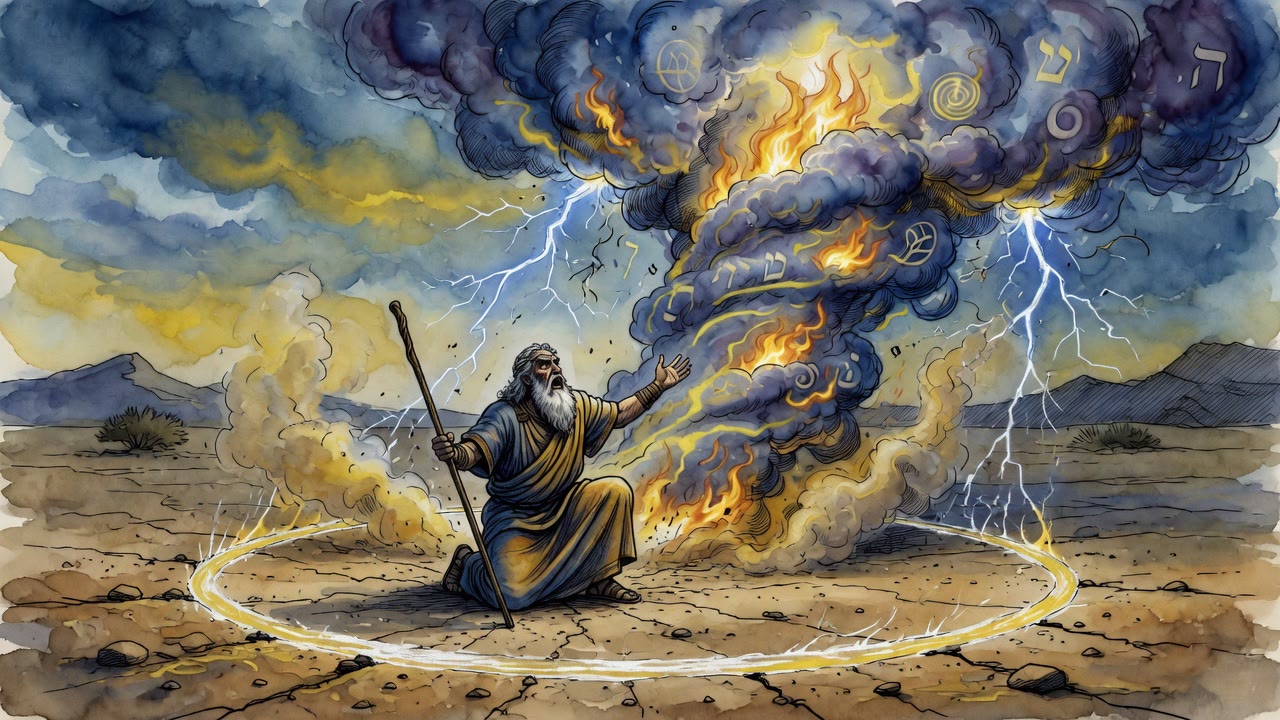
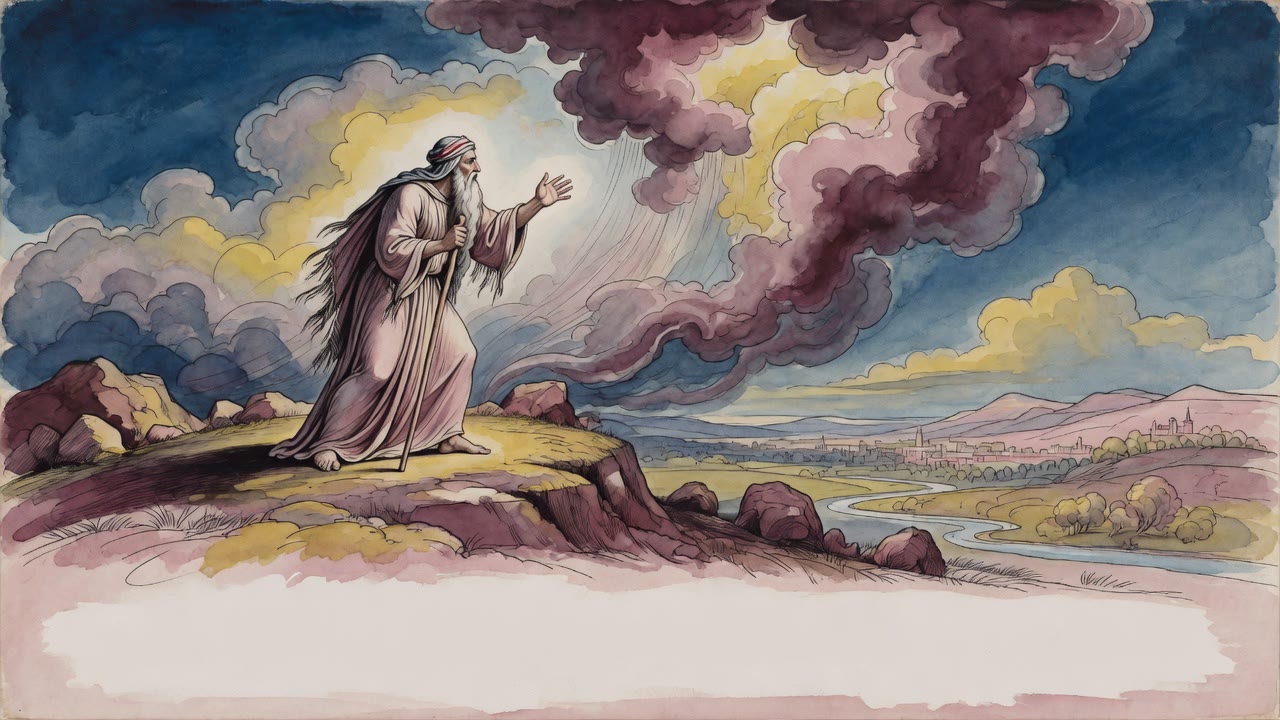
The wind came off the river and carried the smell of the land he would never walk. Moses stood on the eastern slope above the valley, an old man with strong eyes, and below him spread the country promised to people he had carried out of slavery and would now hand to someone else. He did not weep. He had argued his way through forty years of complaint and plague and stone, and he had one argument left.
The Old Man Files His Brief

He did not bow. He spoke the way a man speaks who has stood at the top of a mountain inside a cloud and lived.

"Master of the world," he said, and the wind took the words out toward the water. "To the first man You gave one command. One. He could have kept it with his eyes closed. He broke it, and for that he earned death."

He let that sit. The silence over the valley was the silence of a court waiting.

"I have not broken one of Your commandments," Moses said. "Not one. So tell me why the sentence on him and the sentence on me are written in the same hand."

It was not a prayer. It was the closing of a case. Adam ate the fruit; I did not eat. Adam was driven from a garden; I am to be driven from a land I can see. The same death for both. He waited for the verdict.

God Names the Dead

The answer came low, almost gentle, the way a judge speaks when the law is settled and the prisoner is loved.

"Look at Abraham, who made My name holy in the world. He died."

Moses did not yield. A good advocate never yields to the first name.

"From Abraham came Ishmael," he said, "and from Ishmael will come people who set Your anger burning. His house was not clean. Mine is."

"Look at Isaac," God answered, "who stretched out his own neck on the wood at Moriah and offered himself to Me."

"And from Isaac came Esau," Moses shot back, "whose children will one day pull down the house built for Your name. The branch failed. I did not fail."

The man was fast. He had spent decades in the gap between a furious people and a patient God, and he knew how to take a name and turn it.

The Last Card

"Look at Jacob," God said, "father of the twelve tribes, the whole house of Israel out of one body."

Here Moses leaned in, and his voice came faster, because this was the floor of his case, the thing under everything else he had said.

"Jacob did not climb into heaven," he said. "Jacob did not set his feet on the clouds. Jacob did not take the words of Your teaching out of Your own hand. I did. I walked into the dark where You were and came back carrying stone. Only me. No man before me, no man after. If only I did those things, then surely only I should be kept alive to finish them."

That was the whole brief in one breath. The others died because each of them had a flaw, a son gone wrong, a thing left undone. He had no son gone wrong. He had nothing undone but the crossing itself. By his own accounting the ledger could not justify killing him.

The Question Turned Back

God did not answer the brief with a brief. God asked the old man a question instead, the way a teacher cuts a tangle with one clean line.

"Moses. Who kept you from the land? Was it I who did this to you?"

The wind dropped. The valley went still. And the man who had argued with Pharaoh, with the people, with the angel of death, with God Himself, stood with the whole machinery of his defense laid out before him and felt it come apart in his hands.

Because he knew the answer. He had struck the rock when he had been told to speak to it. He had let his own anger speak where a quiet word would have served. No one had forced his arm.

I Caused It Myself

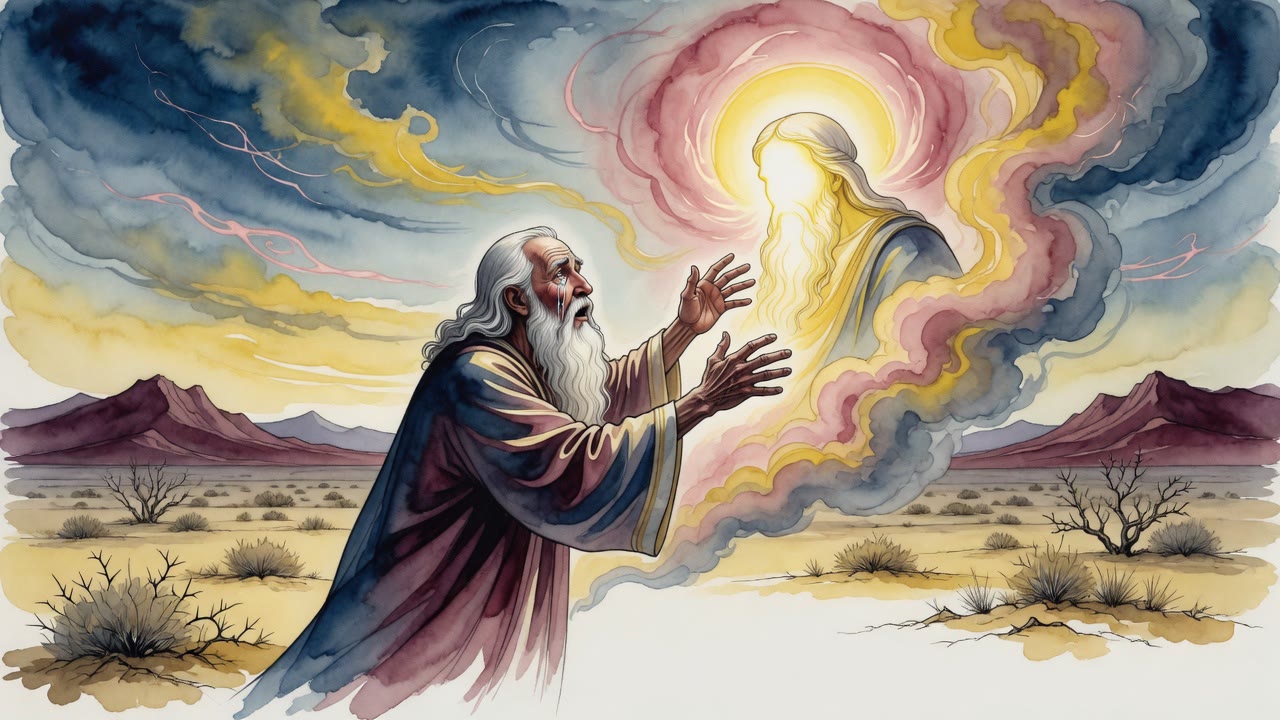
"I caused it myself," Moses said.

The words cost him everything and freed him at the same time. He was not the spotless exception to a cruel rule. He was a man who had slipped, once, in a place where slipping mattered, and the same justice that bound Adam bound him too, and that justice was clean.

"God forbid that anyone say otherwise," he went on, his voice steadier now. "He is the Rock, His work is perfect, all His ways are justice, a God of faithfulness without wrong, righteous and upright is He" (Deuteronomy 32:4). The verse he himself would sing over the people before the end. The God who acquits and the God who convicts, He said, is one God, and He is just in both.

He had come to win an acquittal. He left the argument having confessed the charge and praised the court. The border was still there. The land below was still closed. And the man stopped pleading, because he had finally proven the one thing he came to disprove, which was that the sentence was earned and the Judge was right.

He looked once more at the river and the hills beyond it. Then he turned to climb, alone, to the mountain where he would die.


← All myths
From the tradition

Sources

4 sources

The texts this telling draws on, in full. Open a card to read inline, or expand it for a wider, quieter read.

Midrash Tehillim 92:10Midrash Tehillim

It throws a curveball right from the start, challenging our easy assumptions about divine justice. It all revolves around the phrase "God is just." Sounds straightforward. But the Sages see something deeper, something more nuanced.

The Midrash (rabbinic interpretive commentary) presents a series of pointed questions and answers. First, they turn to Moses. Remember, Moses, the leader who brought the Israelites to the very edge of the Promised Land, only to be denied entry himself. They ask him: "Who caused you not to enter the land?" Did God do this to you?

Moses, in a moment of profound self-awareness, replies, "I caused it myself." He takes responsibility. "God forbid!" he declares, distancing himself from the notion that God is simply punishing him. "Even you can see that God justifies the wicked and obligates the righteous," he says, quoting (Deuteronomy 32:4). It's a complex idea, hinting that divine justice isn't always a simple equation of reward and punishment.

Then, the Midrash turns to Adam. They ask him: "Who caused you to die?" Again, the question is loaded. Isn't it obvious? Didn't God decree death as a consequence for eating from the Tree of Knowledge?

But Adam, echoing Moses, says, "I caused it myself." Again, he rejects the easy answer. He acknowledges his own role in his fate.

The Midrash then offers a parable: Imagine a sick person lying in bed, visited by a doctor. The doctor gives clear instructions: "Don't eat this; don't eat that. It's harmful and dangerous to your life." But the patient ignores the advice. They eat what they were told not to, and their condition worsens.

Who's to blame? Did the doctor cause the illness? Of course not! The patient brought it upon themself by disregarding the doctor's warning.

This, the Midrash suggests, is analogous to God's instruction to Adam: "But of the tree of the knowledge of good and evil you shall not eat, for on the day that you eat of it you shall surely die" (Genesis 2:17). It wasn't an arbitrary decree, but a warning about the consequences of a particular action.

The passage concludes with a powerful statement: "For the ways of the Lord are right" (Hosea 14:10). But then comes the kicker: "Woe to those who say that 'God is just,' for they will be held accountable." Wait, what? Isn't God just?

Here's where it gets really interesting. The Midrash isn't denying God's justice. It's challenging our simplistic understanding of it. It's warning against using "God is just" as a pat answer, a way to avoid taking responsibility for our own actions. To simply say "God is just" can be a cop-out, a way of avoiding personal accountability.

Instead, the Midrash offers a different path, quoting (Zephaniah 3:13): "The remnant of Israel shall not do wrong." The true path, it suggests, lies in striving to live righteously, in taking responsibility for our choices, and in recognizing that our actions have consequences.

So, what does this all mean for us? It means that blaming God for our misfortunes is often a way of avoiding our own culpability. It means that true faith requires us to look inward, to examine our own choices, and to strive to live in accordance with God's teachings. It's a call to radical self-awareness and personal responsibility. Are we listening?

Full source
Legends of the Jews 4:112Legends of the Jews

The ancient stories certainly resonate with that feeling. a powerful moment in the relationship between God and the Israelites after the Exodus, a moment filled with disappointment, anger, and ultimately, a plea for mercy.

God, having just delivered the Israelites from slavery in Egypt, is understandably frustrated. He appears to Moses, not with praise, but with a heavy heart. It’s like a parent saying, "I’m not angry, I’m just disappointed."

The Zohar tells us that God begins by recounting their ingratitude, almost point by point. "You kindle My anger on account of the very benefits I conferred upon you," He says. It’s a litany of complaints, each highlighting a perceived flaw in their character. God parted the Red Sea, but they complained that they were still walking on muddy ground, just like in Egypt. According to Ginzberg's retelling in Legends of the Jews, God provided manna, that miraculous food from heaven, but they grumbled that it wasn’t substantial enough, fearing they would starve. Even when God orchestrated events to protect the spies sent to scout the land of Canaan, they returned with a negative report, declaring, "The land through which we have gone to search it, is a land that eateth up the inhabitants thereof." (Numbers 13:32).

The Torah! The very gift of divine law, meant to elevate them, was seemingly not enough to change their hearts. God laments that He had hoped they would live eternally, like the angels, but instead, they behaved like Adam, breaking the covenant and bringing mortality upon themselves. "You are angels," God says, "but you conducted yourselves like Adam in your sins, and hence like Adam you must die."

It's a stark comparison. God had hoped they would emulate the righteous Patriarchs, but instead, they acted like the wicked inhabitants of Sodom. It’s a devastating assessment.

Then comes the threat. God, addressing Moses, makes it clear He doesn’t need weapons to destroy them. "As through the word I created the world, so can I destroy the world by it," He declares. He even offers to start over with Moses, promising to make him a "greater nation and mightier than they."

But Moses, ever the advocate, steps in. He doesn’t shy away from the gravity of the situation, but he argues for mercy. His response is a masterpiece of diplomacy and faith.

Moses begins by deflecting the offer of replacing the Israelites, essentially saying, "If the great Patriarchs couldn't withstand your wrath, what hope do I have?" But he doesn't stop there. He appeals to God's reputation. He argues that if God destroys Israel, the surrounding nations will mock Him, saying He was simply unable to sustain His people. They would claim that the gods of Canaan were stronger, that God had only triumphed over the "river gods" of Egypt, not the "rain gods" of Canaan.

As we find in Midrash Rabbah, Moses even accuses God of cruelty, saying the nations would compare Him to Lilith, a figure from folklore who harms her own children when she can’t find others to target. "So did He slay His own son," Moses argues, referring to Israel as God's "firstborn son" (Exodus 4:22). It’s a bold and provocative statement.

Then comes the heart of Moses's plea. He reminds God that every pious person cultivates a special virtue. He asks God, "Do Thou also in this instance bring Thy special virtue to bear." And what is that virtue? "Long-suffering, love, and mercy." Moses urges God to temper justice with mercy, to give His children "justice in small measure only, but mercy in great measure."

This exchange is so powerful because it highlights the tension between divine justice and divine mercy. It's a reminder that even when we fall short, even when we disappoint, there is always the possibility of redemption, the hope for forgiveness.

What does this ancient story tell us today? Perhaps it reminds us to be mindful of the blessings in our own lives, to cultivate gratitude rather than complaint. Maybe it challenges us to strive to live up to our potential, to not repeat the mistakes of the past. And perhaps most importantly, it reminds us of the power of compassion, the importance of extending mercy, both to ourselves and to others, even when it seems undeserved.

Because ultimately, aren't we all just trying to navigate this world, striving to be better, hoping for a little grace along the way?

Full source
Vayikra Rabbah 1:9Vayikra Rabbah

The very first verse of the Book of Leviticus – Vayikra in Hebrew – begins with God calling out to Moses. It seems straightforward enough. But the Rabbis of the Midrash (rabbinic interpretive commentary), those ancient interpreters of our sacred texts, never let anything sit The first reading. They always ask, "Why this? Why now? What's the deeper meaning?"

So, they ask a simple but profound question: "He called to Moses – did He not call to Adam?" Isn't it already stated in (Genesis 3:9), "The Lord God called to the man?" (Vayikra Rabbah 1). It seems like a fair point. God spoke to Adam, so what makes the call to Moses so special?

The Midrash provides a beautiful, almost poetic answer: "There is no disgrace in a king speaking to his sharecropper." Adam, in this context, is seen as God's sharecropper because, as (Genesis 2:15) tells us, God placed Adam in the Garden of Eden "to cultivate it and to safeguard it." He had a job to do.

The questioning continues. "The Lord spoke to him – did He not speak with Noah?" Again, we find in (Genesis 8:15), "God spoke to Noah." So, what’s different this time? The response: "There is no disgrace in a king speaking to his shepherd." Noah, tending to the animals after the flood, is seen as God's shepherd.

And then, "He called to Moses – did He not call to Abraham?" In (Genesis 22:15), we read, "The angel of the Lord called to Abraham." The Midrash answers, “There is no disgrace in a king speaking to his innkeeper.” Abraham, renowned for his hospitality, provided lodging and comfort, much like an innkeeper.

But here's where it gets really interesting. The Midrash distinguishes between the call to Abraham and the call to Moses. Regarding Abraham, it says, "The angel of the Lord called to Abraham – the angel called, and the divine speech spoke." (Vayikra Rabbah 1). There was an intermediary, a messenger.

However, when it comes to Moses, Rabbi Avin says something powerful: "The Holy One blessed be He said: It is I who calls, and it is I who speaks." It’s direct, unmediated. As it says in (Isaiah 48:15), "I, it is I, who has spoken, I also have called him; I brought him, and his way is successful." (Vayikra Rabbah 1). God Himself is making the call.

So, what's the takeaway here? It's not just about who God calls, but how God calls. With Adam, Noah, and Abraham, there's a sense of God engaging with them in their roles, within the context of their service. But with Moses, there's a directness, an intimacy, a sense of God reaching out personally, without any filters.

This passage from Vayikra Rabbah invites us to consider our own relationship with the Divine. Are we relating to God through our "roles" – our jobs, our responsibilities, our service? Or are we open to hearing God's direct call, a call that transcends our daily lives and speaks to the very core of our being? What does it mean to be called directly? And more importantly, are we listening?

Full source
Yalkut Shimoni on Torah 763:12Yalkut Shimoni on Torah

“Take the staff…” (Bamidbar 20:8) This is what the scripture says “The staff of your might the Lord will send from Zion…” (Psalms 110:2) This is the staff which was in the hand of our father Yaakov, as it says “…for with my staff I crossed…” (Genesis 32:11) And it is the staff which was in the hand of Yehudah, as it says “Your signet, your cloak, and the staff that is in your hand.” (Genesis 38:18) And it was in the hand of Moshe, as it says “And you shall take this staff in your hand…” (Exodus 4:17) And it was in the hand of Aharon, as it says “Aaron cast his staff…” (Exodus 7:10) And it was in the hand of David, as it says “And he took his staff in his hand…” (Samuel I 17:40) And it was in the hand of every king until the Holy Temple was destroyed, and so in the future that very staff will be given to the King Messiah and with it he will rule over the nations of the world in the future. Therefore it says “The staff of your might the Lord will send from Zion…” (Psalms 110:2)…

Full source