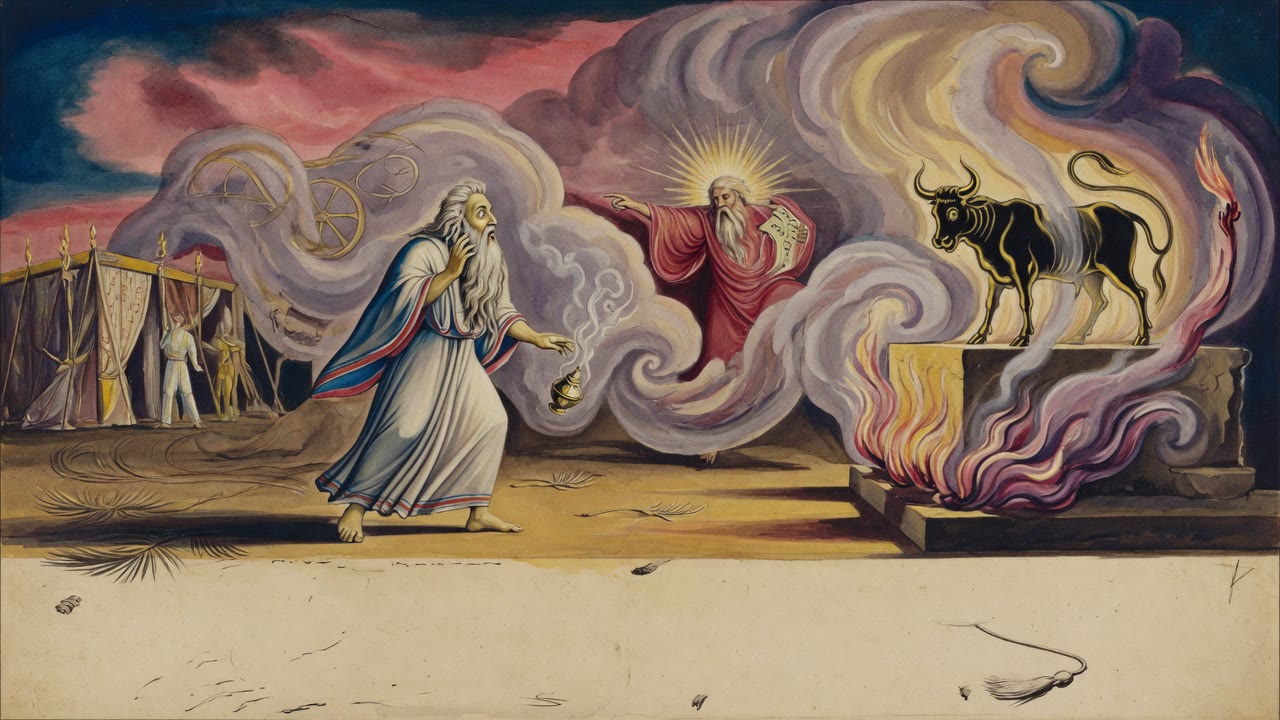
Moses Saw the Chieftains' Wagons and Feared That God Had Replaced Him
The oxen stamped. Officers waited for a nod Moses would not give. Other men were rolling holiness toward the Tent without his word.
Table of Contents
 Click for full size
Wagons Moses Did Not Order
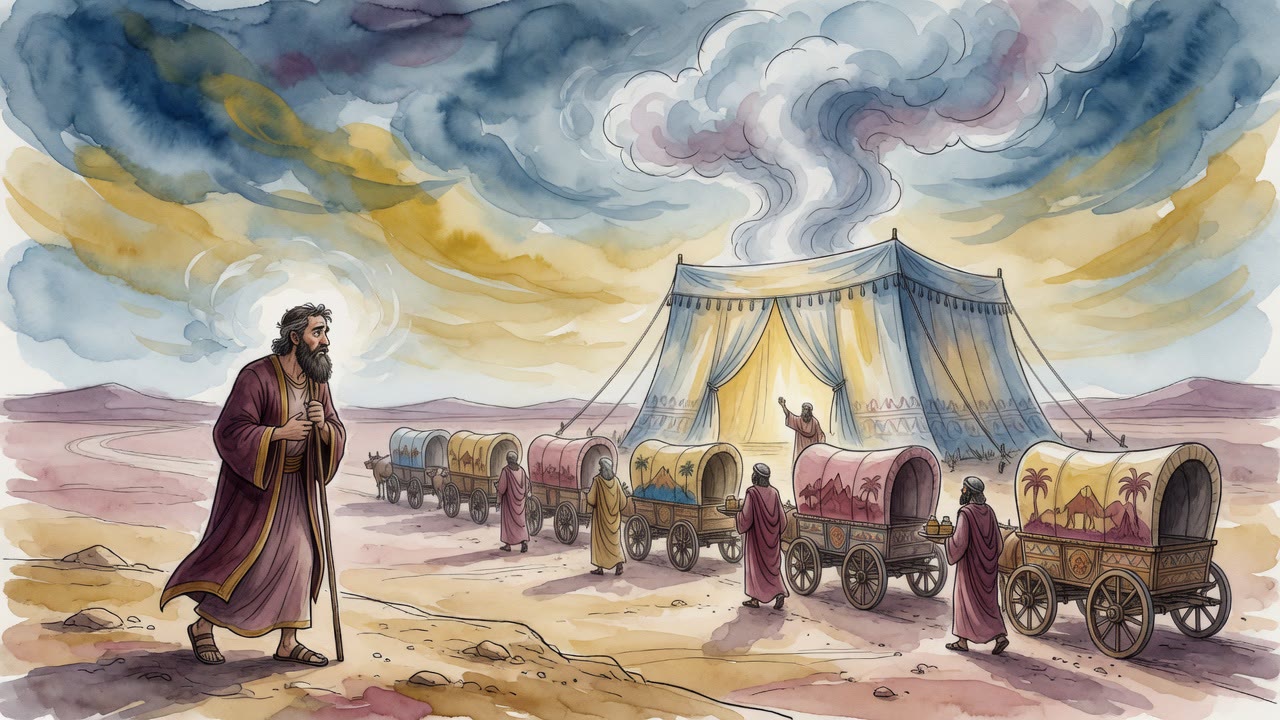
Six covered wagons rolled out of the tribal camps with dust boiling under the wheels and twelve oxen leaning into the yokes. The word for those wagons was tzav (צב), striped like a turtle's shell in one reading, arched like a covered litter in another. Paint caught the sun. Wood creaked. The chieftains of Israel were bringing a gift Moses had never ordered.
He stood near the Tent of Meeting and did not step forward. Officers waited for a nod. The oxen stamped. Moses felt the old cold climb his spine, the fear that arrives when other men move toward holiness without his mouth giving the signal.
The painted covers came closer. Load lines showed in the wood. Froth stood at the bits. A gift can be correct and still arrive as an insult to the man who thought he was the only door.
The Fear That Other Ears Had Been Chosen
God had already said, go out and speak encouragement to them. Moses hesitated. Perhaps the Holy Spirit had left his shoulders and settled on the tribal heads. Perhaps the man who had climbed Sinai was being quietly replaced by men who could fund wagons. A leader can survive open revolt. A leader dies slowly from the suspicion that heaven has chosen other ears.
God answered without thunder. "If I had wanted to instruct them to bring offerings, I would have told you to tell them. I did not. The initiative came from them. Your job now is to take what they have brought." The verse is blunt: "Take it from them" (Numbers 7:5). Not invent it. Not resent it. Receive it.
Moses's hands opened. The cold did not leave all at once. Authority that must take a gift it did not design feels like a demotion until the taking itself becomes the command. His name was still the name heaven used. The quiet sideline had been a fear, not a decree.
Issachar Will Not Let the Tent Hover
Who put the wagons in the chieftains' heads? The tribe of Issachar, men who understood the signs of the times, seasons and calendar, two hundred heads of the Sanhedrin in the later memory of their line. Their brothers followed their rulings. They reasoned aloud in the camp the way men reason when holiness must cross sand.
"Does the Tent of Meeting hover in the air?"
No. Then make wagons to carry it. Boards, sockets, curtains, and the weight of a portable palace needed axles. Piety without carts is a speech. Issachar supplied the carts.
Moses heard the logic and still saw splinters. The Tent would have to move when the cloud lifted. Paint does not keep a wheel from dying in a rut. He had taken the gift with his hands. His second fear was already walking beside the first.
The Promise That Wheels Would Hold
What if a wagon shatters on desert stone? What if one of the twelve oxen falls in harness and the offering turns into a carcass and a broken axle? Would the chieftains' dedication be ruined? Would the painted pride become a liability the whole camp would remember whenever the Tent had to move?
God's promise met the desert in full. The wagons would not break. The oxen would not die under that load. They would not rot. They would not age. They would serve until, in later tellings, they were counted among the thousands Solomon offered when the Temple was dedicated. Moses exhaled and finally moved. He took the offerings. He assigned the wagons and the cattle to the Levites according to their service. Gershon and Merari received what their shoulders had always known they would need. Kohath still carried the holiest things on the frame of the body, because some weight refuses a cart.
Dust settled on the fresh paint. The chieftains stepped back. The Spirit had not relocated. It had simply refused to make Moses the only man allowed to invent a good idea.
A Partition for a Grown People
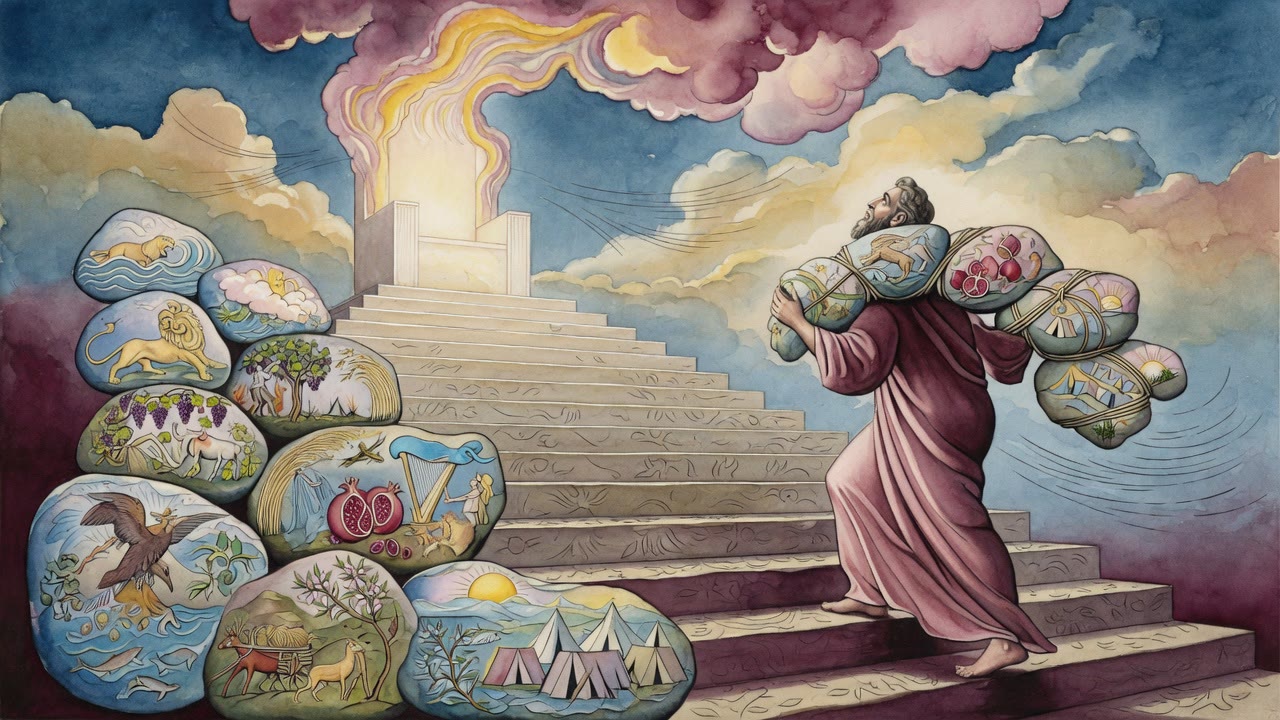
While the wagons waited in their new order, another change of intimacy finished settling over the camp. When Israel was small, God met the people in open places. In Egypt He passed through the land (Exodus 12:12). At the Sea they saw the great hand (Exodus 14:31). At Sinai He spoke face to face (Deuteronomy 5:4). "When Israel was a youth, then I loved him" (Hosea 11:1).
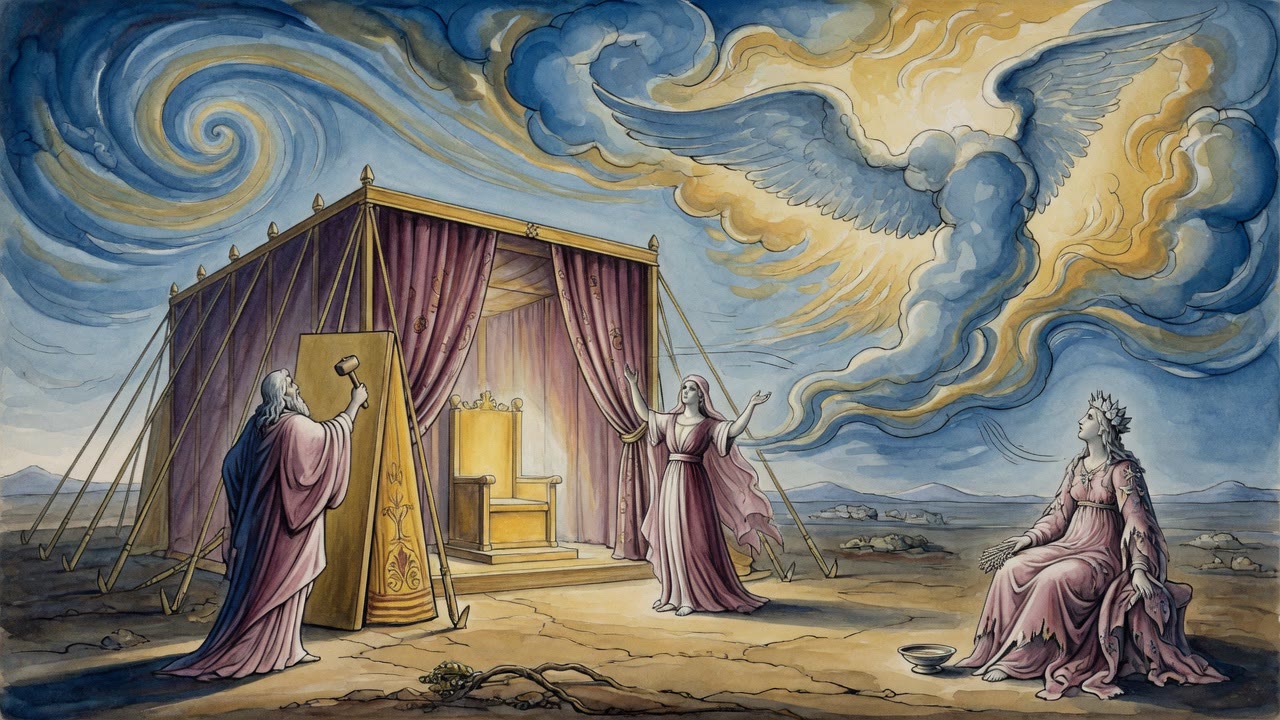
A king once had a little daughter. He spoke with her in the marketplace and the alley without shame. When she grew, he said it was no longer fitting to hold that talk in public. Build a partition. I will speak from behind it. Israel, whole now with Torah, sheleimah, needed the same shift. "Make for Me a dwelling, and I will speak from within it." So Moses, when he entered the Tent of Meeting, heard the voice from above the cover (Numbers 7:89).
Song of Songs calls it Solomon's palanquin (Song of Songs 3:9), and the King is the One who owns peace itself. Wood of Lebanon becomes acacia boards. Silver posts become hooks. Purple becomes the curtain. Inside, the join is love: the Shekhinah (שכינה), God's indwelling presence, in one reading. The Tent is not a demotion of nearness. It is nearness that learned manners after the people grew up.
Moses laid his palm on a wagon rail still warm from the sun. The partition stood. The voice would come from within. The chieftains' initiative had not stolen his office. It had given the portable palace wheels so the partition could travel when the cloud lifted. That night the oxen slept in their lines. A single wheel settled with a soft knock against its pin and did not split. Moses heard it from his place near the Tent and did not rise. The gift had held. The quiet sideline had been a shadow, not a sentence. In the morning the cloud would decide whether the wagons rolled or the camp stayed, and either way the voice would still know his name from behind the cover.
← All myths