Parshat Naso6 min read

The Voice That Could Break Cedars Entered Only One Ear

Moses stepped into the finished Tent, and a Voice that could shatter cedars narrowed to a stream and entered no ear in the camp but his.

Curated by Arthur · Told by Maggid ·
Table of Contents
  1. The Tent Stood Finished and Empty
  2. A Voice That Had Broken the Cedars
  3. The Sound Stopped at the Curtains
  4. The Circle Narrowed Until One Name Was Called
  5. The Stream That Poured Into a Single Ear
The Voice That Could Break Cedars Entered Only One Ear Click for full size

The Tent Stood Finished and Empty

The last cord was tied, the last curtain hung straight, and then nobody moved. Moses stood at the entrance of the Tent of Meeting with the smell of fresh dye and beaten gold still hanging in the air. Past the screen, the Ark waited under its lid of pure gold, and on that lid two cherubim faced each other with their wings arched high, hammered out of a single block, one wingtip almost grazing the other. Between them there was nothing. Only air, and the shadow the wings laid down across it.

He had built the room before he had ever heard the Voice speak inside it. Now he lifted the screen and stepped through, and the empty air between the two golden figures began to speak his name.

A Voice That Had Broken the Cedars

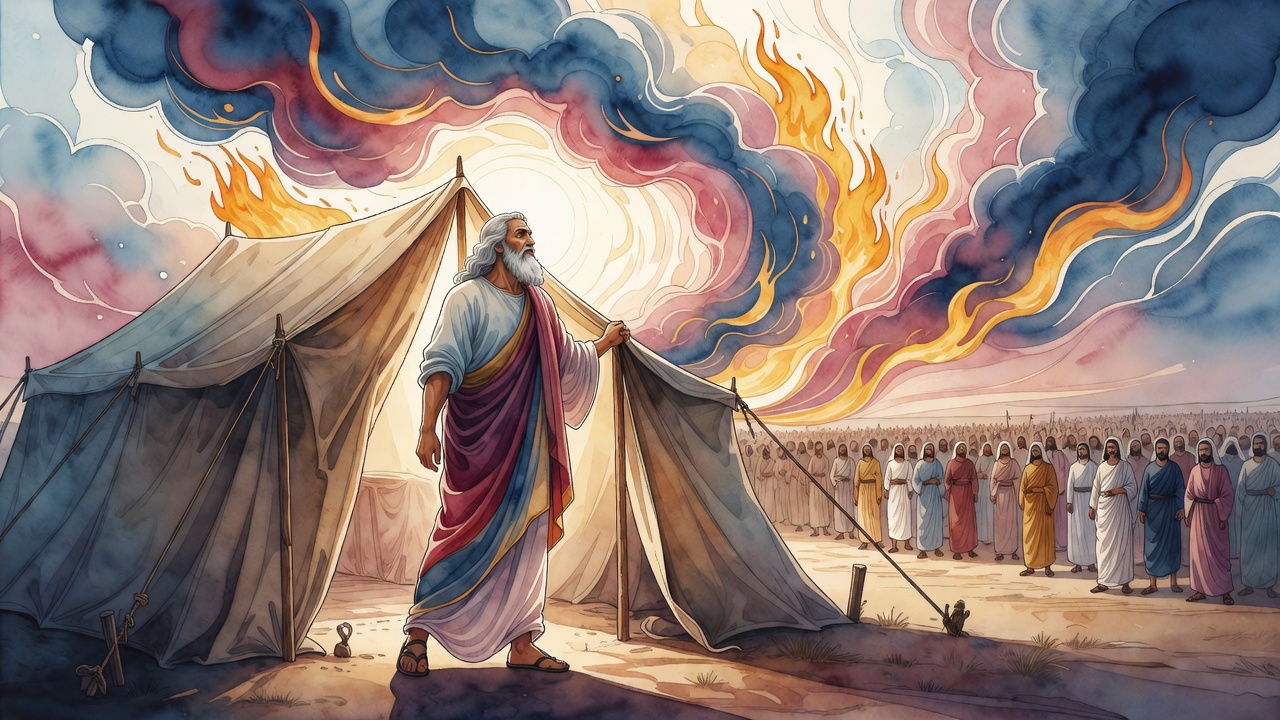
He knew what this Voice could do. He had felt it. This was the Voice that snapped the cedars of Lebanon like dry reeds, that cut flames of fire loose from the sky, that shook the wilderness until the ground trembled and the wild does went into labor from fear. It was not one voice among many. It was the Voice, ha-kol, the same power that had come down on Sinai and left a whole nation flat on the sand, screaming for it to stop before it finished them.

That power was in the small room with him now, folded into a hand's width of air above the Ark, close enough to breathe on. And it did not break him. It did not split the boards or snuff the lamps or throw him against the far wall of cloth. It spoke to him quietly, the way a man speaks across a table to a friend.

The Sound Stopped at the Curtains

Outside, the camp heard nothing.

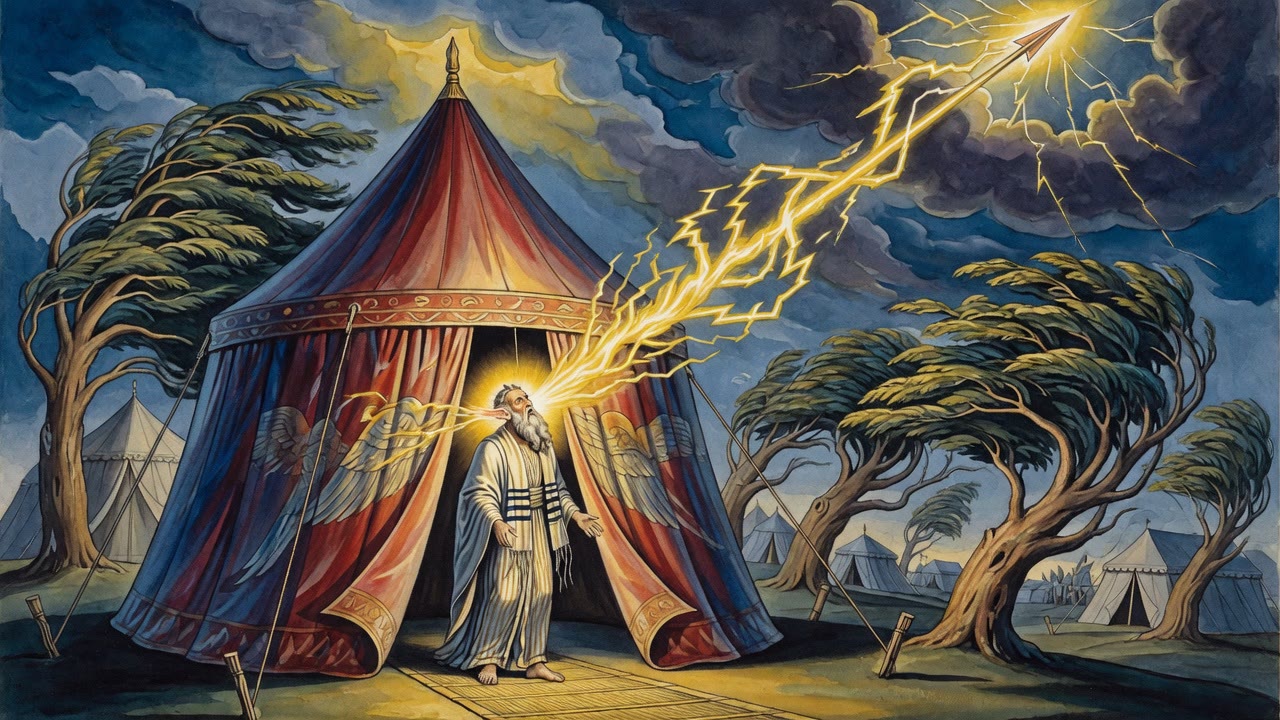
Six hundred thousand people were camped within a stone's throw of that Voice, and not one of them caught a single word. The sound rose to its full and terrible height inside the Tent, and then, at the line of the curtains, it stopped, as if the woven walls were the edge of creation itself. Aaron stood near the entrance. The elders stood in their ranks. Aaron's own sons stood in their priestly white. What reached their ears was wind moving over cloth, a child crying somewhere in the camp, a goat, the ordinary noise of a hundred thousand tents. Nothing more.

Long after, another man, the prophet Ezekiel, would hear the wings of the cherubim beating in a vision and mark how the sound carried only as far as the outer courtyard and no farther. This was narrower even than that. The Voice reached the curtains of the Tent and died there, sealed inside, meant for one set of ears.

The Circle Narrowed Until One Name Was Called

It could have gone out to all of them. It could have addressed the whole nation at once, the way it had at the mountain, or spoken to the seventy elders, or at least to Aaron and his sons who served an arm's length from the Ark. Instead it had said, long before, "I will meet with you there, and I will speak with you." With Moses. Not with them.

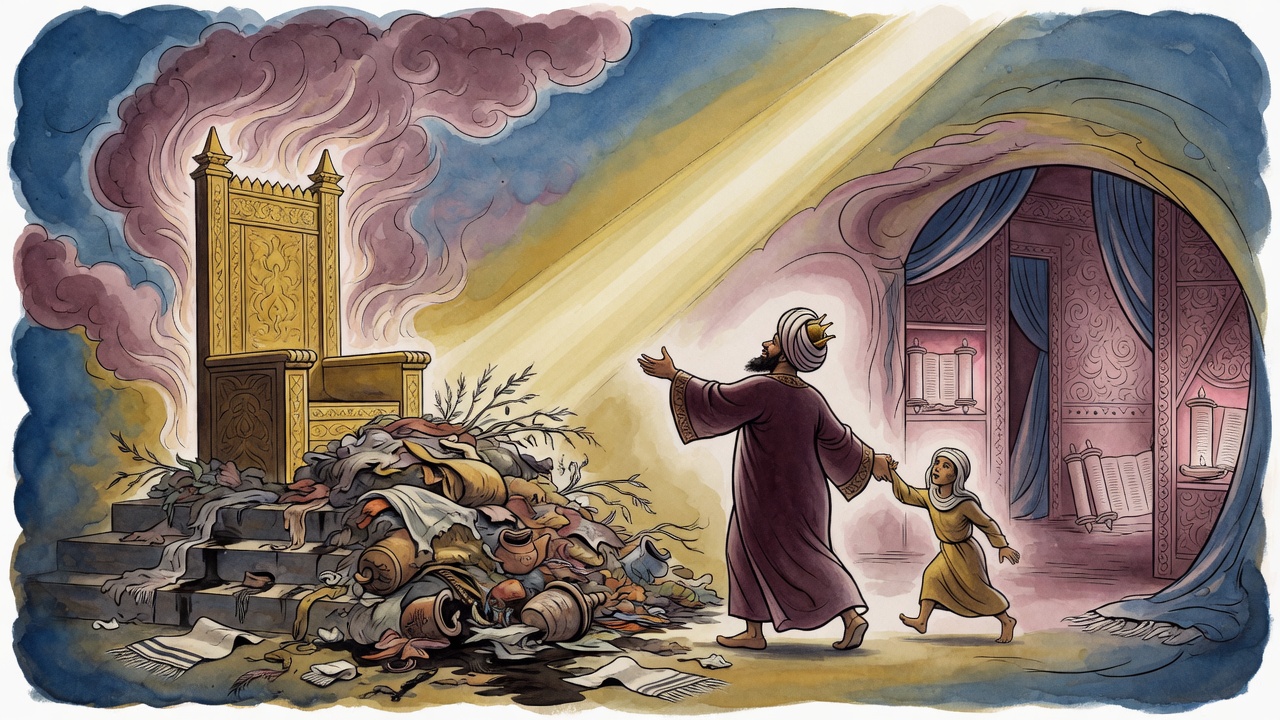
And it did not simply start talking. Before a word of instruction, the Voice called him by name, the way a person of decency does not speak to another until he has first called to him and been answered. "Moses, Moses," it said, twice, the doubled name it had used for Abraham at the altar, for Jacob going down into Egypt, for the boy Samuel in the dark of the sanctuary. A name said twice is love, and it is urgency. Then the Voice spoke, and between one matter and the next it left silences, gaps of quiet, so that a mortal man could turn each thing over in his mind before the next thing arrived.

The Stream That Poured Into a Single Ear

Where exactly did it come from, that Voice in the empty air? Generations later two sages stood over the question. Rabbi Akiva said it plainly. "From between the two cherubim." From that hand's breadth of shadow above the Ark cover, and nowhere else. Shimon ben Azai answered him carefully. "I am not rebutting my teacher," he said. "I am adding to his words." Does the Holy One not fill the heavens and the earth? He does. And yet He had pressed all of that immensity down into the narrow air over the Ark, between two hammered wings, for the sake of Israel.

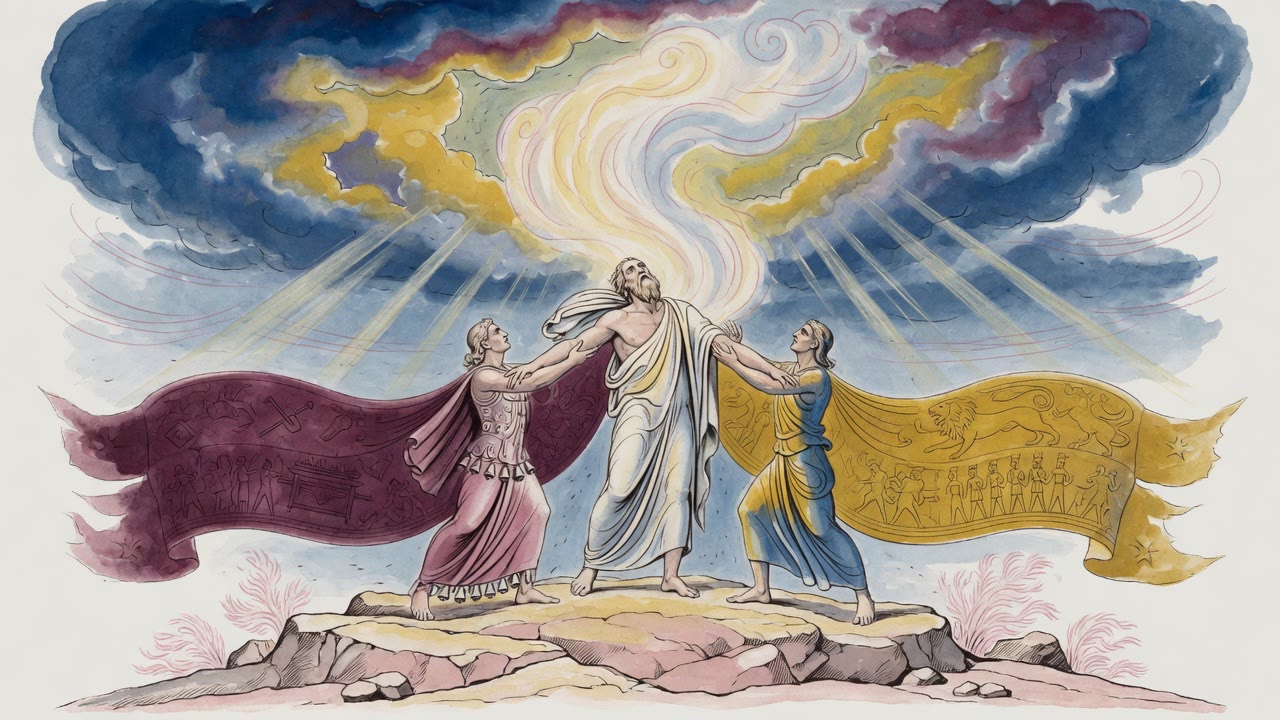
No one alive could look full into that Glory and go on living. Only past the edge of death, the sages said, does a man so much as glimpse it, and not even the deathless angels who carry the Throne had ever seen it whole. And that same Glory now bent low over the Ark and spoke. The Voice came out of the mouth of the Holy One and ran into the ear of Moses like a stream poured straight from its spring, touching nothing on the way. The ministering angels were in the Tent. They stood and they watched, and the Voice was not for them. It thundered wondrously and it entered one ear as a whisper.

When it finished, Moses turned, lifted the screen, and walked back out into the plain daylight of the camp. He had heard what no other ear would ever hear. And he was the same man walking out that he had been walking in. Moses before the Voice, and Moses after it, with nothing in him swollen by the sound.


← All myths
From the tradition

Sources

2 sources

The texts behind this telling. Some cards carry a translation of the source; others are our own retelling of it, and each card says which. Every card links out to the original.

Bamidbar Rabbah 14:21Bamidbar Rabbah

Retold in our words. Read the original at the link below.The Sefaria Midrash Rabbah, 2022 · CC-BY

These are the kinds of questions that ripple through the ancient texts.

In Bamidbar Rabbah, we find a fascinating exploration of the verse, "He heard the Voice speaking with him" (Numbers 7:89). It's not just any "voice," the text emphasizes, but "the Voice", ha-kol in Hebrew. So, what exactly is this Voice?

The Midrash (rabbinic interpretive commentary) directs us to Psalm 29, where we find a powerful description: “The voice of the Lord is mighty; the voice of the Lord is majestic. The voice of the Lord breaks cedars… The voice of the Lord hews flames of fire. The voice of the Lord makes the desert tremble.” (Psalms 29:4-5, 7-9). This is the Voice of creation, a force of nature.

Here's the really intriguing part. Was this earth-shattering Voice broadcast for all to hear? The text immediately qualifies that. “The Lord spoke to him from the Tent of Meeting," it says, teaching us "that the Voice would cease and would not emerge outside the Tent." It was contained. Like the sound of the cherubim's wings in Ezekiel's vision, which "was heard until the outer courtyard" (Ezekiel 10:5), but then stopped, God's voice was localized. Intimate.

So, who did hear it? Was it just Moses? This is where the Midrash gets delightfully argumentative, in that characteristic rabbinic way. It systematically excludes groups: not all of Israel, not just the elders, not even just Aaron’s sons. “The verse states: ‘I will commune with you there’ (Exodus 25:22) – the communion was with you, but for all of them there was no communion.” It keeps narrowing the circle until only Moses remains.

But wait, there's more! Even Moses, the text implies, wasn't just casually addressed. The verse states: “[The Lord] called to Moses, and spoke” (Leviticus 1:1) – He had the call precede the speech." The Midrash then makes a beautiful point: "It is common courtesy that a person should not speak to another unless he calls him first." Even the Almighty follows protocols of respect.

The Midrash asks, was this calling unique to this specific instance? No! Rabbi Shimon explains that the seemingly extra word "and He spoke" includes even sayings and commands. But not pauses! Why pauses? "It was to provide respite for Moses to deliberate between one portion and another and between one matter and another." The Torah, even when divinely dictated, requires thoughtful consideration.

And how did God call out? "Moses, Moses!" Like Abraham, Jacob, and Samuel, the doubled name is "an expression of love and an expression of urging." Or, as the Midrash offers another interpretation, "he was Moses before He spoke with him, and Moses after He spoke with him." Moses wasn't changed by the encounter, he remained true to himself, a lesson in humility.

This passage from Bamidbar Rabbah isn't just about acoustics or divine etiquette. It’s about the nature of revelation itself. The Voice is powerful, yes, but it’s also intimate, directed, and respectful.

Full source
Bamidbar Rabbah 14:22Bamidbar Rabbah

Retold in our words. Read the original at the link below.The Sefaria Midrash Rabbah, 2022 · CC-BY

Bamidbar Rabbah, that incredible collection of Midrashic (rabbinic interpretive commentary) teachings on the Book of Numbers, dives deep into this very question. It’s not just a matter of geography, is it? It’s about understanding the intimacy, the incredibly focused point of connection between the Divine and the human.

The Torah says, "The Lord spoke with him from the Tent of Meeting" (Leviticus 1:1). But Bamidbar Rabbah 14 asks: From where in the Tent? The whole thing? That seems… expansive.

So, to narrow it down, the verse clarifies: "From above the Ark cover that was upon the Ark of the Testimony." Okay, that's more specific. But even the kapporet, the Ark cover, isn't tiny. Is it from anywhere above the kapporet?

Rabbi Akiva steps in: "From between the two cherubim!" Those golden angelic figures perched atop the Ark. That pinpoint focus. That’s the place.

But then, Rabbi Shimon ben Azai, with characteristic humility, adds something profound. He says, "I am not as one who is rebutting the statement of my teacher, but rather, as one adding to his statement." Isn't that beautiful? Such respect, such a desire to build upon wisdom, not tear it down.

So, what does he add? He reminds us of the sheer immensity of God. "Do I not fill the heavens and the earth, the utterance of the Lord?" (Jeremiah 23:24). Yet, this vast, infinite Glory constricted itself, focused itself, to speak from that tiny space above the Ark, between the two cherubim, for the sake of Israel. What an act of love!

And it gets even more. Rabbi Dosa brings in another layer of understanding. We know the verse, "For man cannot see Me and live" (Exodus 33:20). Rabbi Dosa interprets this to mean that only in death can we glimpse the Divine. Likewise we see, "All who descend to the dust will kneel before Him, those to whose soul He has not given life" (Psalms 22:30).

Rabbi Akiva takes it a step further. Even the beings that bear God's throne, the angels, haven't fully seen the Glory!

And Rabbi Shimon ben Azai, again adding to his teacher's wisdom, says that not even the ministering angels, whose life is eternal, fully perceive the Divine Glory. The text continues, "And He spoke to him – but not to the ministering angels who were there." God spoke directly to Moses. The verse tells us that the Voice emerged from the mouth of God, blessed be He, like a stream flowing directly into Moses' ear. The angels were present, witnessing, but the communication was specifically and intimately between God and Moses. As it says, "God thunders wondrously with His voice" (Job 37:5). That is, "and He spoke to him.”

What does this all mean? Perhaps it’s a reminder that even within the vastness of the Divine, there is a place for intimate connection. That even though we may never fully grasp the Glory of God, we can still be touched by the Divine voice, if we listen closely enough. Maybe that "place between the cherubim" exists not just in the Tent of Meeting, but also within our own hearts.

Full source