6 min read

Moses Walked Through Seven Heavens and Came Back Changed

Moses ascends through seven celestial realms, sees angels made of fire and snow, nearly falls meeting Sandalfon, and asks God why the righteous suffer.

Curated by Arthur · Told by Maggid ·
Table of Contents
  1. The Cloud That Did Not Stop at the Surface
  2. Angels That Should Not Be Possible
  3. Sandalfon and the Nearly Falling
  4. The Guided Tour of the Heavenly Temple
  5. The Two Angels of Anger and Wrath in the Seventh Heaven
  6. The Question Moses Could Not Stop Asking

The Cloud That Did Not Stop at the Surface

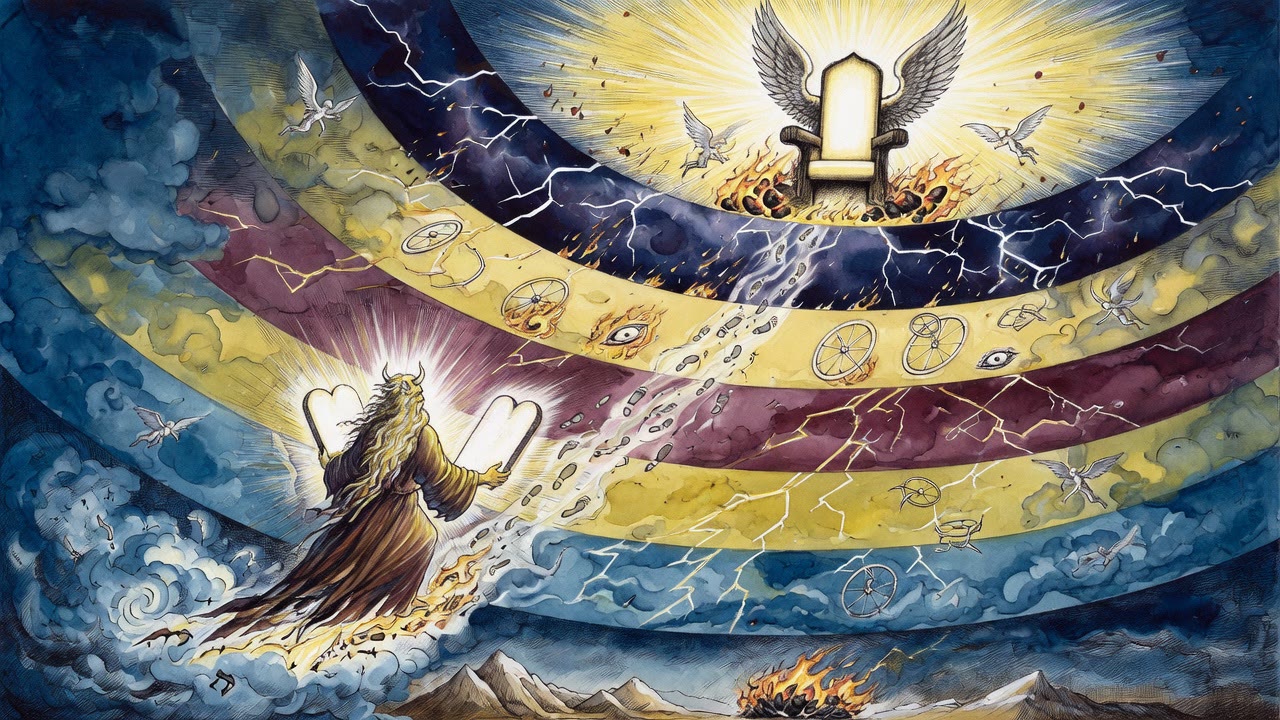
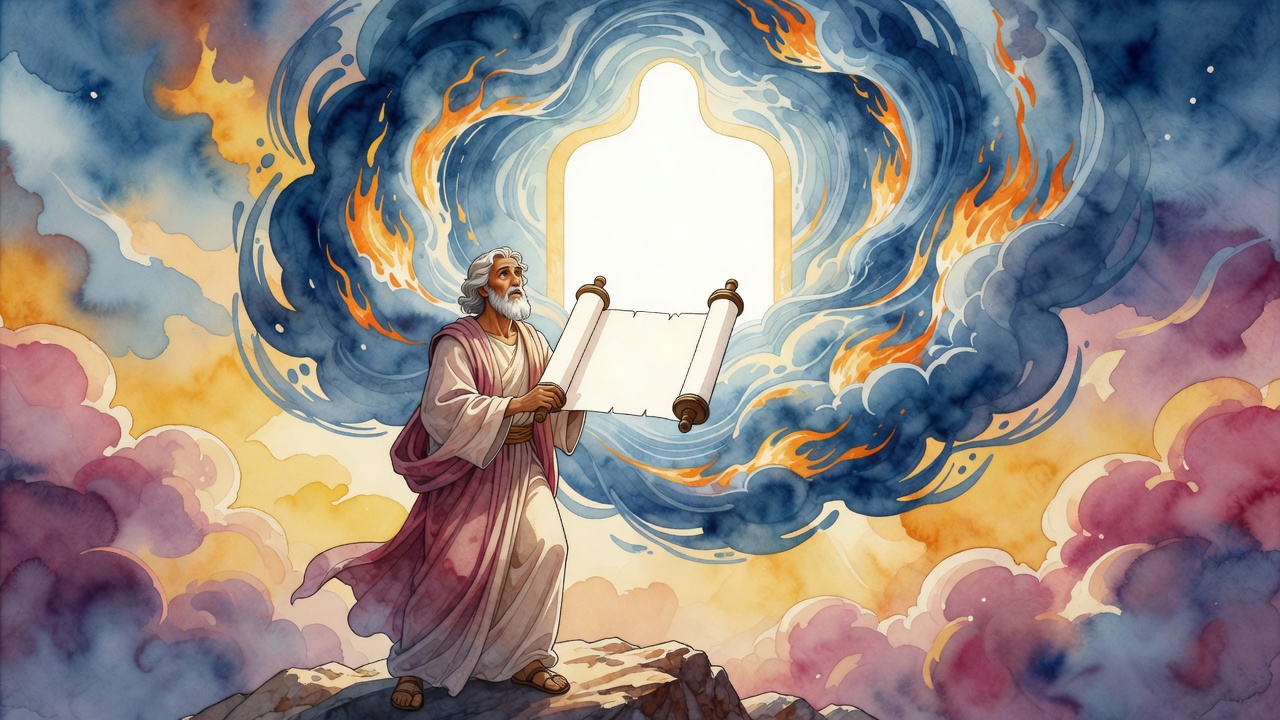
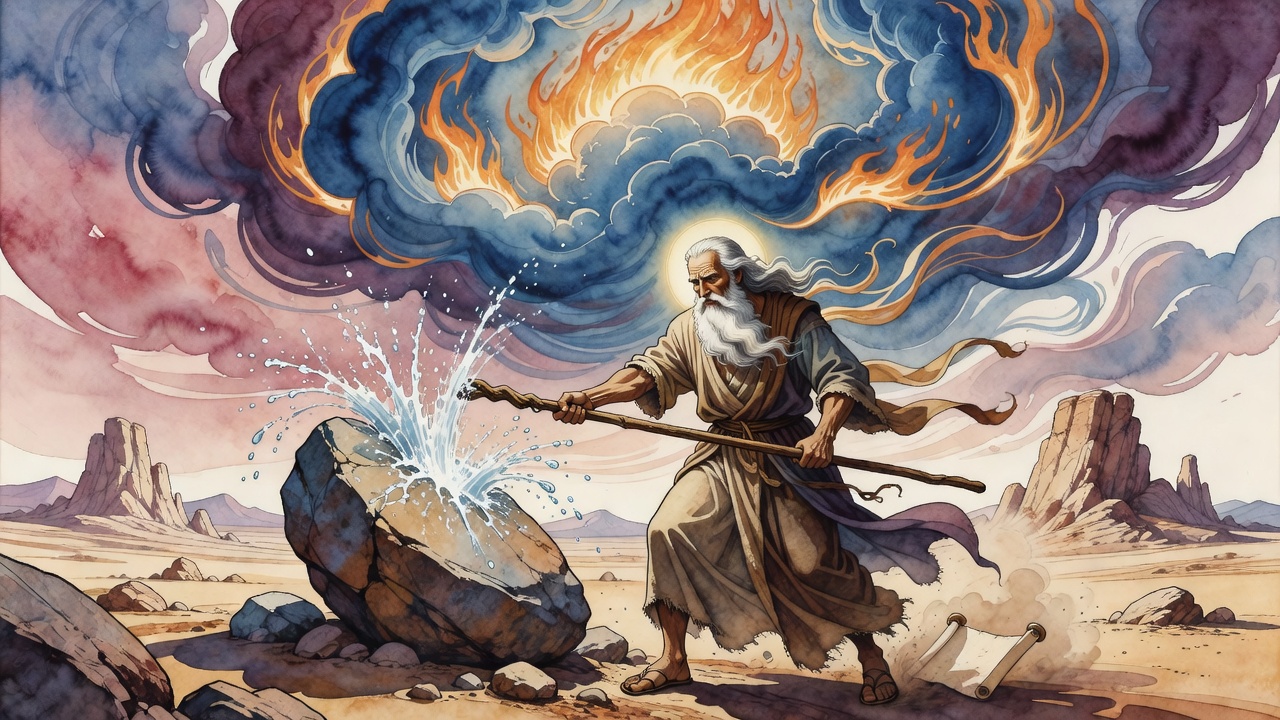
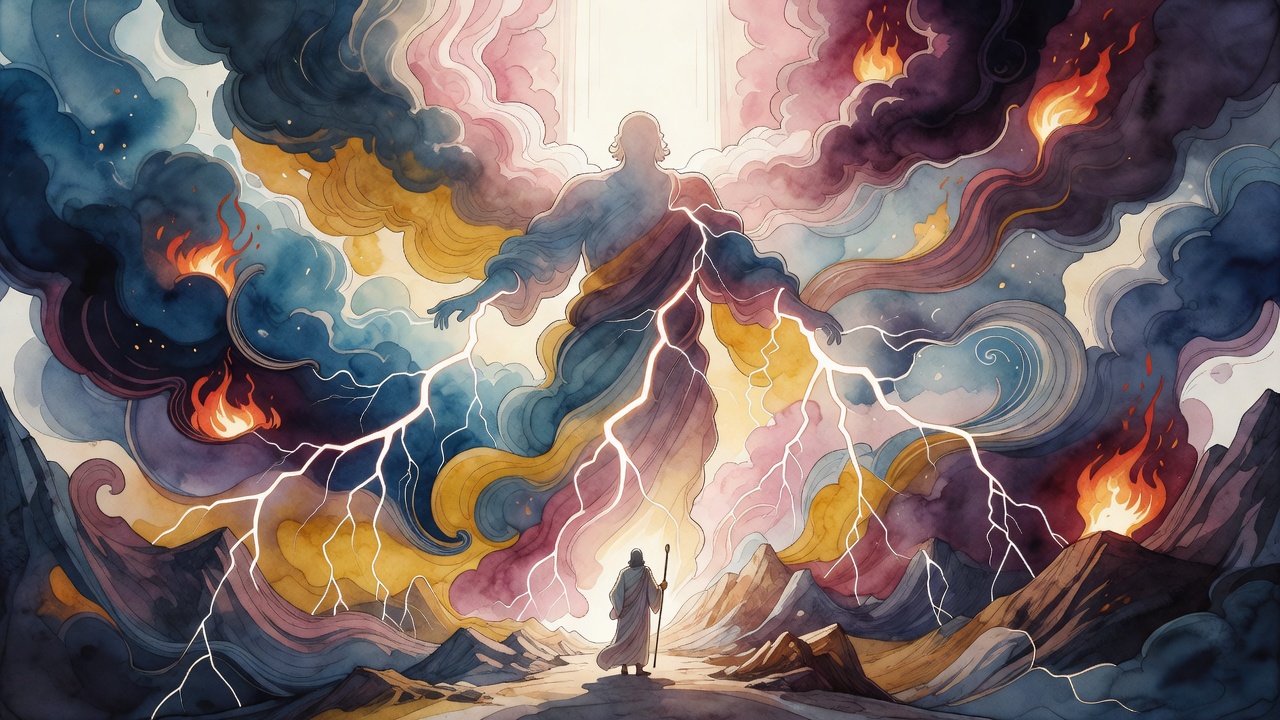
Exodus says Moses entered the cloud. The cloud settled on Mount Sinai for six days and on the seventh day God called to Moses from inside it. Moses went in, and for forty days and forty nights he was in the cloud, receiving what he had come to receive.

The tradition that grew up around those forty days refused to leave them blank. It filled them with specificity: Moses did not sit in one place and listen. He traveled. He walked through seven heavens, each one built to a different specification, each one containing presences that altered his understanding of what he had understood before. He came back down carrying tablets of fire and a comprehension of the structure of the universe that no human being before him had possessed.

In the fifth heaven he stopped and stared.

Angels That Should Not Be Possible

The angels of the fifth heaven were unlike anything Moses had seen in the lower heavens. Their lower halves were made of snow. Their upper halves were blazing fire. Not metaphorically, not described as if they were fire and ice: literally composed of snow below and flame above, the two substances sharing a body without either of them destroying the other. The snow did not melt. The fire was not extinguished. The laws that governed matter at every level of the earth below simply did not apply to these presences.

The tradition explains this as a visual representation of a principle: God can hold opposites together without resolving them into each other. Fire and snow in a single body is a statement about divine power, not a paradox to be resolved. Moses stood in front of angels that demonstrated, by existing, that the categories he had used to understand the world were too small.

Sandalfon and the Nearly Falling

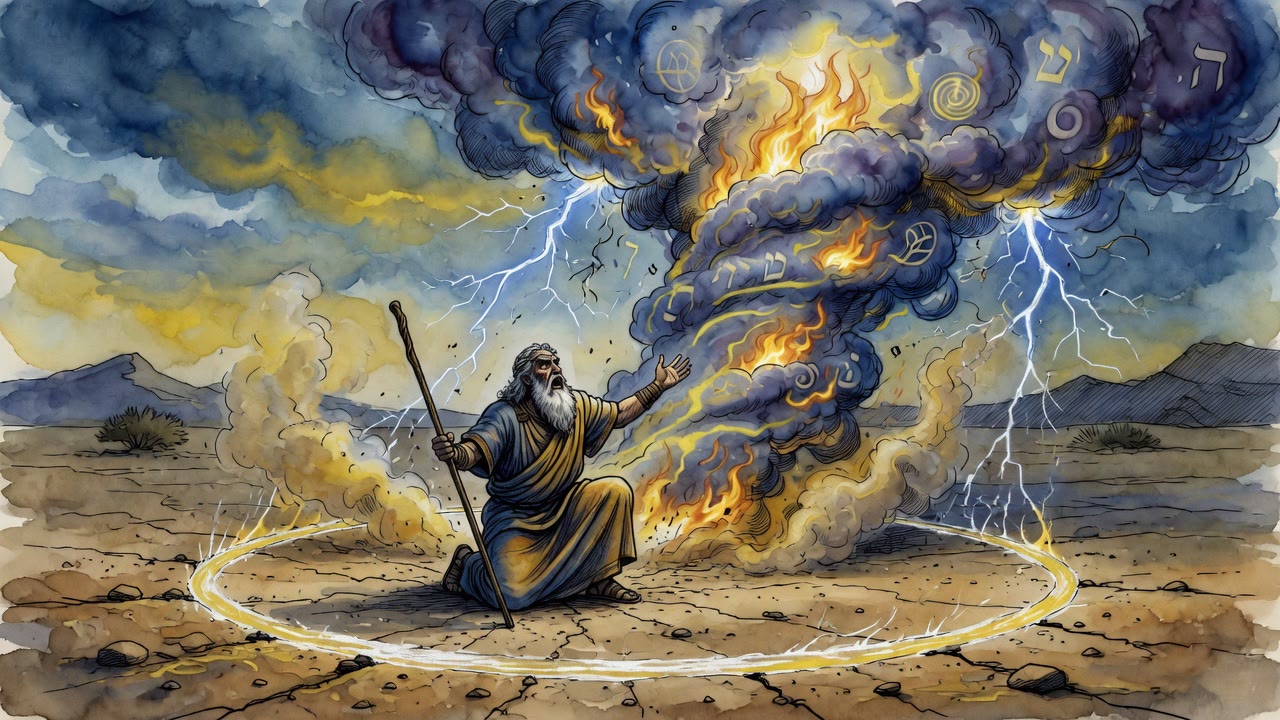
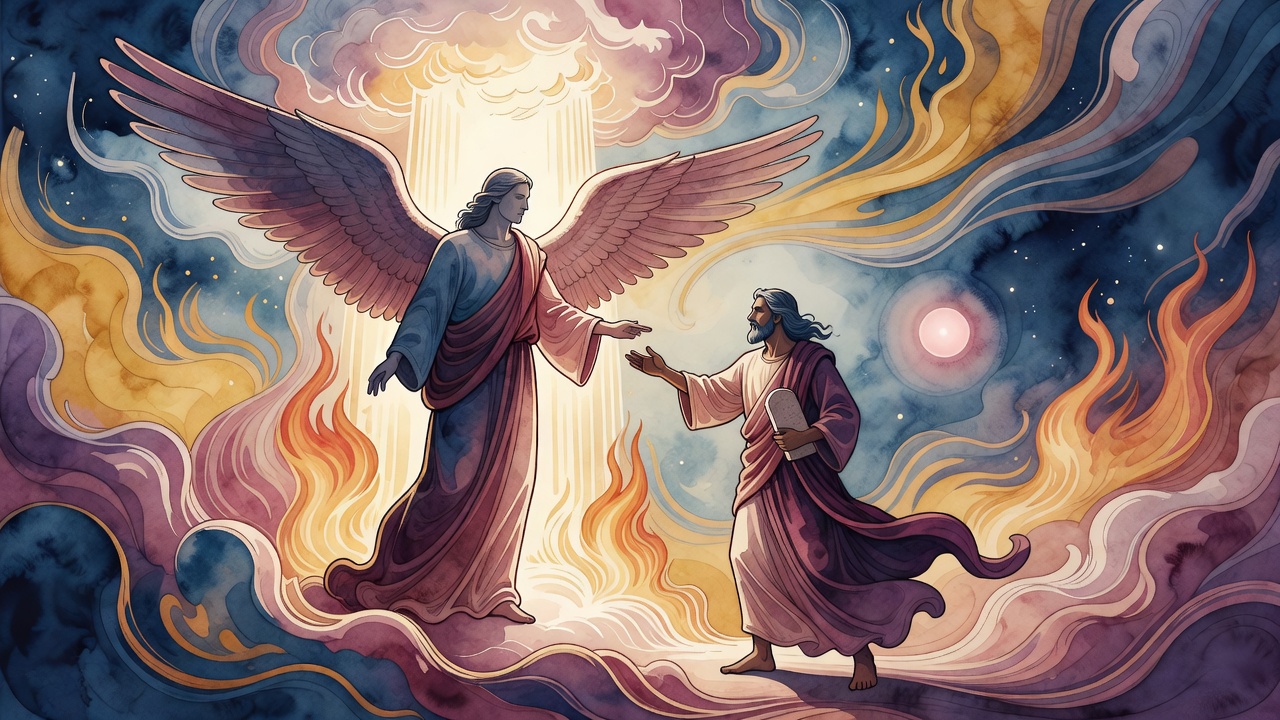
In the sixth heaven, Moses met Sandalfon, the angel who weaves the prayers of Israel into crowns for God. Sandalfon was so immense and so intensely present that Moses, standing before him, lost his balance. The tradition says he nearly fell out of the cloud entirely, that the encounter was of such magnitude it threatened to unmake him physically.

God reached out a hand and held him.

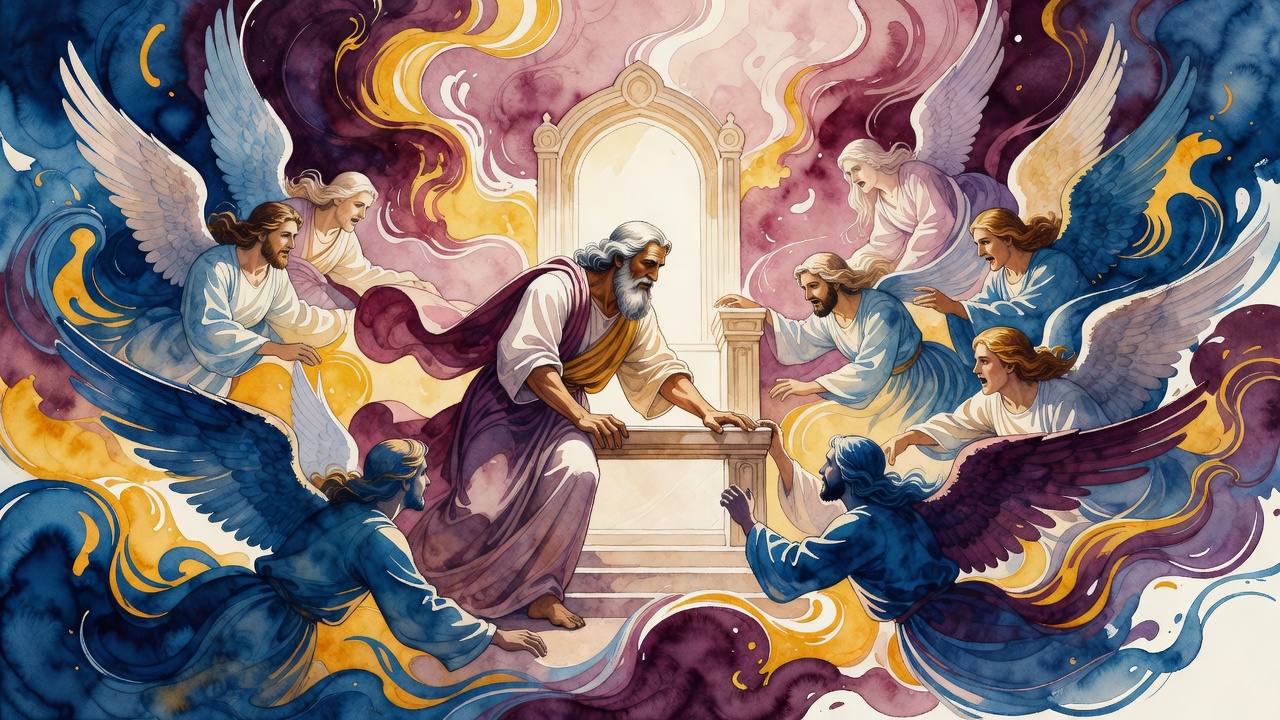
This is a detail that does not appear in Exodus, and its insertion into the account of Sinai says something specific: Moses going into the cloud was not a protected journey through a landscape designed for human traversal. It was a passage through presences that could have destroyed him, and what kept him alive was not his own strength or virtue but God holding him through the parts where he nearly fell.

He continued upward.

The Guided Tour of the Heavenly Temple

In what the tradition calls the fourth heaven, Moses found a Temple. Not a building constructed to earthly specifications. A Temple made entirely of fire. Red fire for the pillars. Green fire for the staves, the poles that would normally be made of wood. White fire for the thresholds. Gates like carbuncle, pinnacles of ruby. The service inside this Temple was ongoing: angels at altars that were themselves fire, offering what could be offered in a sanctuary built from the substance of divine fury and divine light simultaneously.

God showed Moses this Temple explicitly, as a pattern. The Tabernacle he would build in the wilderness would be a copy of it, a human-scale approximation made of acacia wood and hammered gold instead of colored fire. Moses was being shown the original so that the copy he made would carry something of the original's purpose even if it could not reproduce its material.

The Two Angels of Anger and Wrath in the Seventh Heaven

At the top, in the seventh heaven, Moses encountered Af and Hemah. Anger and Wrath. Each five hundred parasangs tall, forged from chains of black and red fire, created at the beginning of time to serve as the instruments of divine fury when divine fury was finally deployed. They stood in the seventh heaven waiting. They had been waiting since the beginning of creation.

Moses nearly fell again. God held him again.

These angels would be released at the Reed Sea to act against the Egyptian army. Moses had seen them before any of that happened. He had seen what was being kept in reserve. When he stood at the shore of the sea later and raised his staff, he knew something about what was about to be released that no one around him knew.

The Question Moses Could Not Stop Asking

Somewhere in the forty days, Moses asked God why the righteous suffer and the wicked prosper. He had pressed against that question. He had seen the entire structure of the heavens, the fire-and-snow angels, the temples of colored flame, the massive presences waiting to be deployed. He had seen that there was an order to things that operated at a scale beyond human comprehension. And still the question would not leave him: why do good people suffer? What is the justice in that?

God answered him, but the answer the tradition preserves is not a full explanation. God told Moses that there are some things that cannot be fully explained from inside a human life. Moses understood, and the tradition records that he accepted the answer. But it also records that he had asked, and that the asking was part of what the forty days were for.


← All myths
From the tradition

Sources

6 sources

The texts this telling draws on, in full. Open a card to read inline, or expand it for a wider, quieter read.

Legends of the Jews 4:170Legends of the Jews

Legends of the Jews turns to Moses Visits the Fifth Heaven of Fire and Snow Angels.

Moses, during his ascent, arrives at the fifth heaven. What does he see? Hosts upon hosts of angels, described in a way that defies earthly logic. Their lower halves are made of snow, yet their upper halves are blazing fire! How can this be? The snow doesn't melt, and the fire isn’t extinguished. It's because, in God’s infinite wisdom, perfect harmony has been established between these seemingly opposing elements.

These angels are called the Ishim. According to Legends of the Jews, as retold by Louis Ginzberg, these beings have one singular purpose: to praise and extol the Lord. That’s it. From the moment of their creation, their existence is dedicated to this divine song. What must that sound like?

The celestial wonders don't stop there.

Moses continues his ascent, reaching the sixth heaven. Here, the scale of things becomes even more staggering. Millions upon millions of angels fill this realm, each praising God in their unique way. These angels are known as the Irin and kadishin – "Watchers" and "Holy Ones." It’s a powerful image, isn't it?

And then there’s their chief. Can you picture this? He is made of hail, and he's so incredibly tall that it would take five hundred years to walk a distance equal to his height! Five hundred years! That's a scale that's almost impossible for our human minds to grasp. What does it mean that he is made of hail, though? Is it a reflection of his strength and solidity, of the power of the natural world bowing down to something greater? We can only speculate.

These descriptions, drawn from sources like the Talmudic and Midrashic (rabbinic interpretive commentary) traditions, offer us a glimpse into the awe-inspiring grandeur of the heavens. They remind us that there are realms beyond our comprehension, filled with beings dedicated to serving and praising the divine. It makes you think, doesn't it? What is our purpose here on Earth, compared to these celestial choirs? Perhaps, in our own way, we too can strive to bring harmony and praise into the world, even if we aren't made of fire and snow, or hail and holiness.

Full source
Legends of the Jews 2:82Legends of the Jews

That’s a glimpse into what Moses experienced on his journey to receive the Torah.

In Legends of the Jews, the encounter with the angel Sandalphon was so intense that Moses nearly lost his balance and fell out of the very cloud he was traversing! This was a brush with the divine of such magnitude it threatened to unmake him.

This teaching paints a vivid picture. Moses, overwhelmed by what he saw, begged God for mercy, crying out in desperation. Can you imagine the scene? The leader of the Israelites, the man who parted the Red Sea, reduced to tears before the sheer power of the celestial realm. It's a reminder that even the greatest among us are vulnerable when confronted with the truly awesome.

What was God’s response? In His "bountiful love of Israel," God Himself descended from His Throne of Glory and stood before Moses. He shielded Moses from the overwhelming flames of Sandalphon. Think about the implications of that image for a moment. God’s personal intervention, a evidence of His commitment to His people, and to Moses.

But the journey wasn’t over yet. After passing Sandalphon, Moses had to cross Rigyon, a stream of fire.

Rigyon isn't just any fire; it’s fire that burns even the angels! Ginzberg tells us that the angels dip into these coals every morning. They are burned and then reborn. This stream, we learn, originates beneath the Throne of Glory, formed from the perspiration of the holy Hayyot– the living creatures, who exude fire from their fear of God. The image is staggering. Imagine the intensity of that heat, the palpable sense of divine power.

Again, divine intervention saves Moses. God quickly drew him across Rigyon, protecting him from harm.

What are we to make of this? It's more than just a thrilling adventure story. It’s a profound meditation on divine protection, on the overwhelming power of the divine, and on the vulnerability even the most righteous individuals experience on their spiritual journeys. Moses, despite his immense stature, needed God’s direct intervention. And that, perhaps, is a lesson for us all. Even when facing our own metaphorical Sandalphon and Rigyon, we are not alone.

Full source
Legends of the Jews 2:91Legends of the Jews

Legends of the Jews turns to God Gave Moses a Guided Tour of the Heavenly Temple.

Well, according to Legends of the Jews, Ginzberg's masterful compilation of rabbinic lore, God didn't just hand Moses tablets of stone. He gave him a guided tour!

During his extended stay, God showed Moses all seven heavens! Can you imagine? A breathtaking vista of celestial realms unfolding before his very eyes. And more than that, he was shown the celestial temple, the divine blueprint for the Mishkan he was tasked with building back on earth.

Here's where it gets really interesting. The text specifies that God showed Moses the four colors he was to use in the Tabernacle. Now, imagine being presented with colors that are so divinely vibrant, so unlike anything you've ever seen, that you struggle to even grasp them. That's precisely what happened to Moses.

Moses struggled to remember the colors. So, God, in His infinite patience, helped him out. "Turn to the right," God instructed. As Moses turned, he saw a host of angels arrayed in garments the color of the sea. "This," God declared, "is violet." A deep, ocean-like hue.

Then, God directed Moses to turn to the left. And there, he saw angels dressed in red. But not just any red. This was argaman, royal purple, a color associated with kingship and majesty. "This is royal purple," God said.

Next, Moses turned to the rear. He saw angels robed in a color unlike either purple or violet. A unique shade. God identified it as sheni tolaat, crimson. "This color is crimson," God told him.

Finally, Moses turned around fully and saw angels robed in white. Pure, pristine, radiant white. "This," God revealed, "is the color of twisted linen."

This short passage, tucked away within the larger narrative of Moses's time on Sinai, offers a powerful glimpse into the richness of Jewish tradition. It's not just about receiving laws; it's about experiencing the divine, being shown the celestial realm, and understanding the profound symbolism woven into every detail of the Mishkan. It makes us wonder what other secrets and mysteries are hidden within the vast pattern of Jewish lore, waiting to be discovered. Perhaps, like Moses, we just need to turn our gaze in the right direction.

Full source
Legends of the Jews 1:9Legends of the Jews

In Legends of the Jews, the heavens are arranged so mercy stands near the Throne while destruction is kept at the edge.

Ginzberg, in his wonderful compilation Legends of the Jews, shares a captivating story of how God was about to create the world, not with a big bang, but with His very word. Imagine this: the twenty-two letters of the Hebrew alphabet, the very building blocks of language and meaning, descending from God's crown. These aren’t just any letters; they’re engraved with a pen of flaming fire!

Each letter, eager to be the chosen one, steps forward to plead its case: "Create the world through me!"

First up is the letter Taw (ת). This letter argues, "O Lord of the world! May it be Thy will to create Thy world through me, seeing that it is through me that Thou wilt give the Torah (תורה), the sacred teachings, to Israel by the hand of Moses, as it is written, 'Moses commanded us the Torah.'" A pretty strong argument. Taw is associated with the Torah itself!

But God says, "No!" Can you imagine the disappointment? Taw asks, naturally, "Why not?" And God's answer is striking: "Because in days to come I shall place thee as a sign of death upon the foreheads of men."

Whoa.

As soon as Taw hears these words, it retreats, dejected and crestfallen. It's a powerful moment. The letter associated with the gift of the Torah is also associated with mortality. It highlights the complex relationship between life, death, and divine purpose.

So, what does this all mean? Why begin the creation story with a rejection? Perhaps it’s a reminder that even the most sacred things can have a shadow side. That even in creation, there's an awareness of limitation, of mortality. And maybe, just maybe, that awareness is what makes the beauty and goodness of the world all the more precious.

Full source
Legends of the Jews 2:118Legends of the Jews

Even MOSES, the great lawgiver himself, wrestled with this. According to Ginzberg's retelling in Legends of the Jews, Moses needed to understand why the righteous weren't always rewarded, and, just as perplexingly, why the wicked sometimes prospered. He wanted to know the ins and outs of divine justice.

MOSES, standing before God, asking the tough questions we all ponder. God assured him that the pious would indeed receive their just rewards. But here's the kicker: God didn't fully explain why the undeserving sometimes experience happiness. He simply stated that He also shows kindness to those who don't necessarily deserve it. No "why" was given, no "wherefore" revealed. Frustrating. And even when it came to the righteous, the reward wasn't fully disclosed. MOSES got a glimpse of the delights of Paradise, the Gan Eden, the beautiful garden where the righteous souls would partake in a glorious feast. A taste of heavenly pleasures.

This is a big but, the real reward remained hidden. As (Isaiah 64:4) tells us, "eye hath not seen, beside the Lord, what He hath prepared for him that waiteth for Him." The ultimate reward, the true and complete joy reserved for those who trust in God, is beyond human comprehension. It’s something so profound, so utterly magnificent, that our earthly senses simply can't grasp it.

So, what are we left with? A sense of mystery, perhaps. An acknowledgement that divine justice isn't always straightforward or easily understood. It suggests that while we can glimpse aspects of reward and punishment, the complete picture remains a divine secret. Maybe that's the point. Maybe the key is faith, trusting that there is a deeper, more intricate plan at work, even when we can’t see it. Maybe the true reward is the waiting, the faith itself.

Full source
Devarim Rabbah 9:5Devarim Rabbah

Death is often remembered as the great leveler, the fate that awaits us all. But Jewish tradition suggests that for some, like Moses, the end is… different. Special. Moses, the man who spoke to God face-to-face, who led the Israelites out of slavery, who received the Torah on Mount Sinai. Surely his departure couldn't be ordinary?

Devarim Rabbah, a collection of homiletical teachings on the Book of Deuteronomy, gives us a glimpse into the extraordinary nature of Moses' passing. It paints a picture far removed from the typical mourning scene.

God saying to Moses, as this passage suggests, "All the people descend to the grave and their eyes dim; you, your eyes did not dim." It's a powerful image, isn't it? A contrast drawn between the common fate and Moses' unique experience. While the eyes of ordinary mortals fade with death, Moses' remained bright, undimmed. It speaks to a life lived with exceptional clarity and purpose.

The differences don't stop there. The text continues, "All the people tend to utensils crafted by flesh and blood, a coffin, bier, and shroud, but you are in shrouds crafted by Heaven, a coffin crafted by Heaven, a bier crafted in Heaven."

Think about the implications of that. Ordinary people are buried in earthly shrouds, prepared by human hands. But Moses? He’s enshrouded in heavenly garments, placed in a heavenly coffin, carried on a heavenly bier. It's as if the very fabric of his burial is woven from the divine.

But the most striking image comes next: "Another matter, all the people, when they die, their relatives and neighbors tend to them, but you, I and My entourage tend to you."

Wow.

Instead of grieving relatives and neighbors, God Himself, along with His celestial entourage, attends to Moses. It’s an astounding image of divine honor and care. It emphasizes the special relationship Moses had with God.

Where do we find this idea in the Bible itself? The passage points us to (Deuteronomy 34:6), "He buried him in the valley." The Hebrew is ambiguous. Who buried him? The verse doesn't explicitly say. The Rabbis of the Midrash (rabbinic interpretive commentary) see in that ambiguity a hint of the divine involvement. "He" – God – buried him.

So, what does this all mean? Is it meant to be taken literally? Perhaps. But it also serves as a powerful metaphor for the reward and recognition that awaits those who live a life of extraordinary righteousness and service. It reminds us that even in death, there can be a profound difference between the ordinary and the exceptional. It’s a comforting thought, isn't it? That dedication and devotion to God will be recognized, even in the face of death.

Full source