4 min read

Moses Drew a Circle on the Ground and Refused to Die

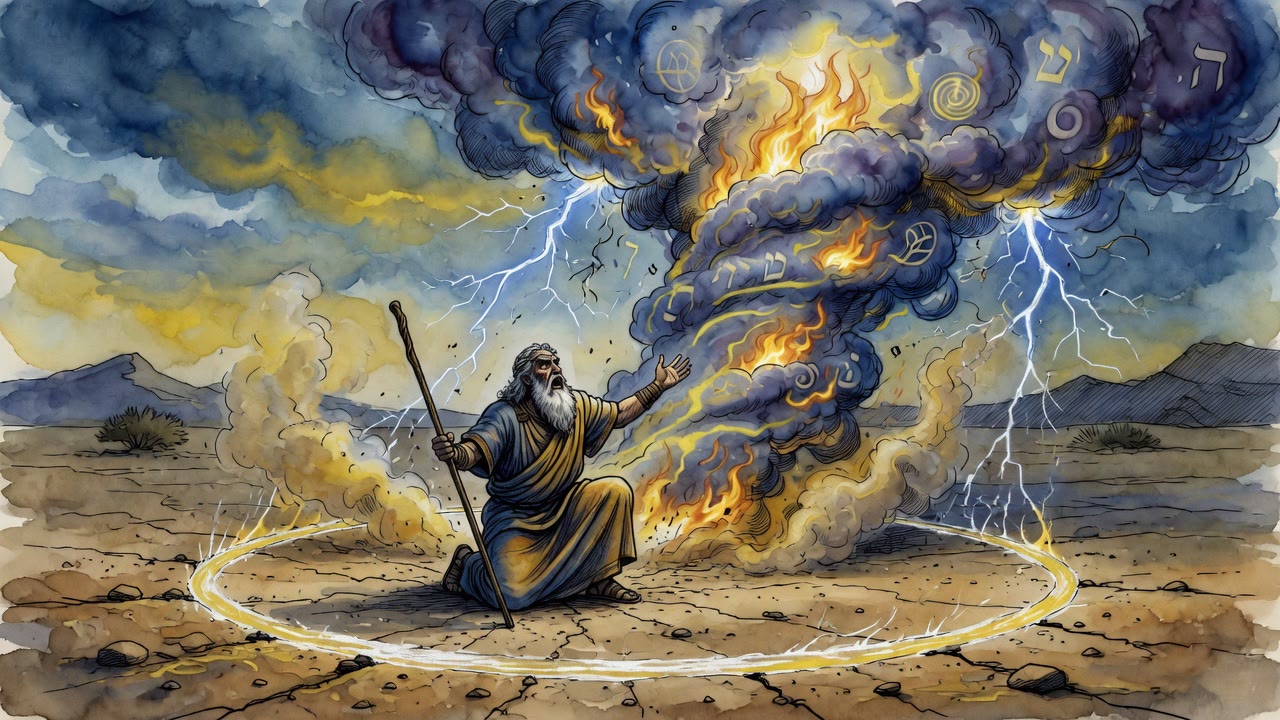
When God told Moses his time had come, Moses stepped inside a circle he drew on the ground and prayed until heaven and earth shook.

Curated by Arthur · Told by Maggid ·
Table of Contents
  1. The Circle on the Ground
  2. Five Hundred and Fifteen Prayers
  3. What Moses Saw Before He Died
  4. The Angel Who Would Not Touch Him

The Circle on the Ground

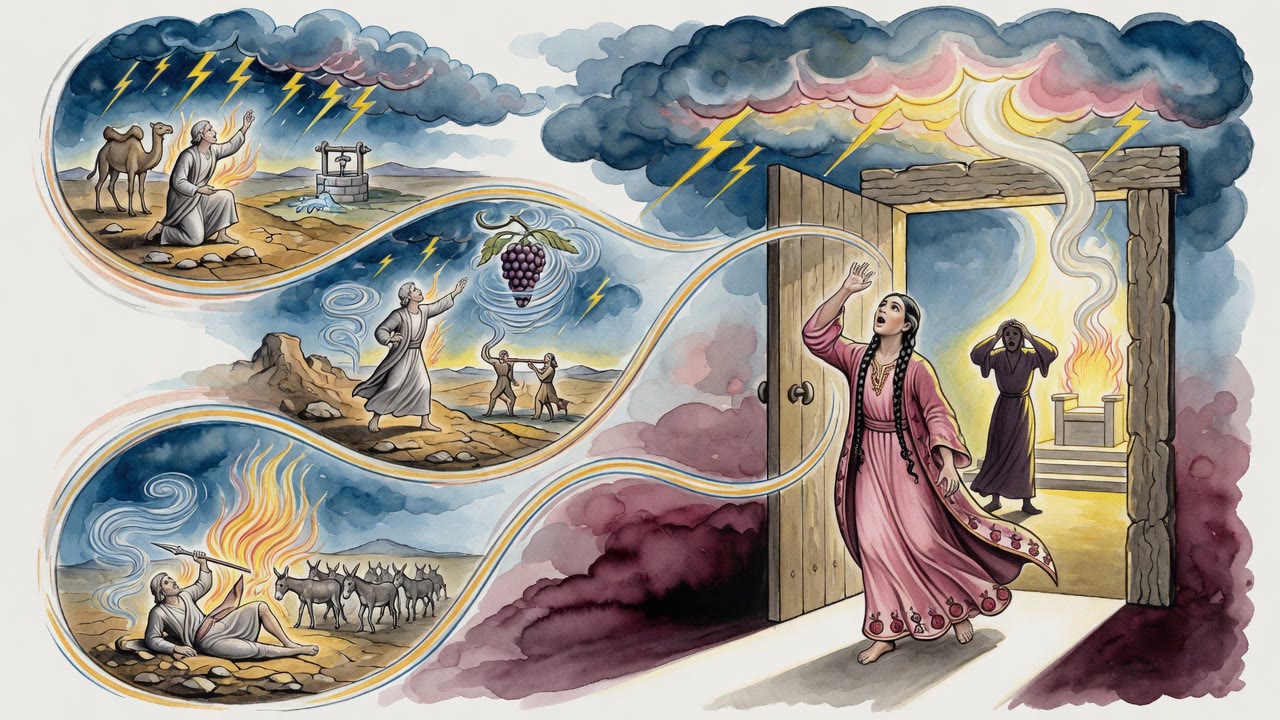
God told Moses his time had come. Moses drew a circle on the ground, stepped inside it, scattered ashes on his head, put on sackcloth, and said: I will not move from this place until the decree is annulled.

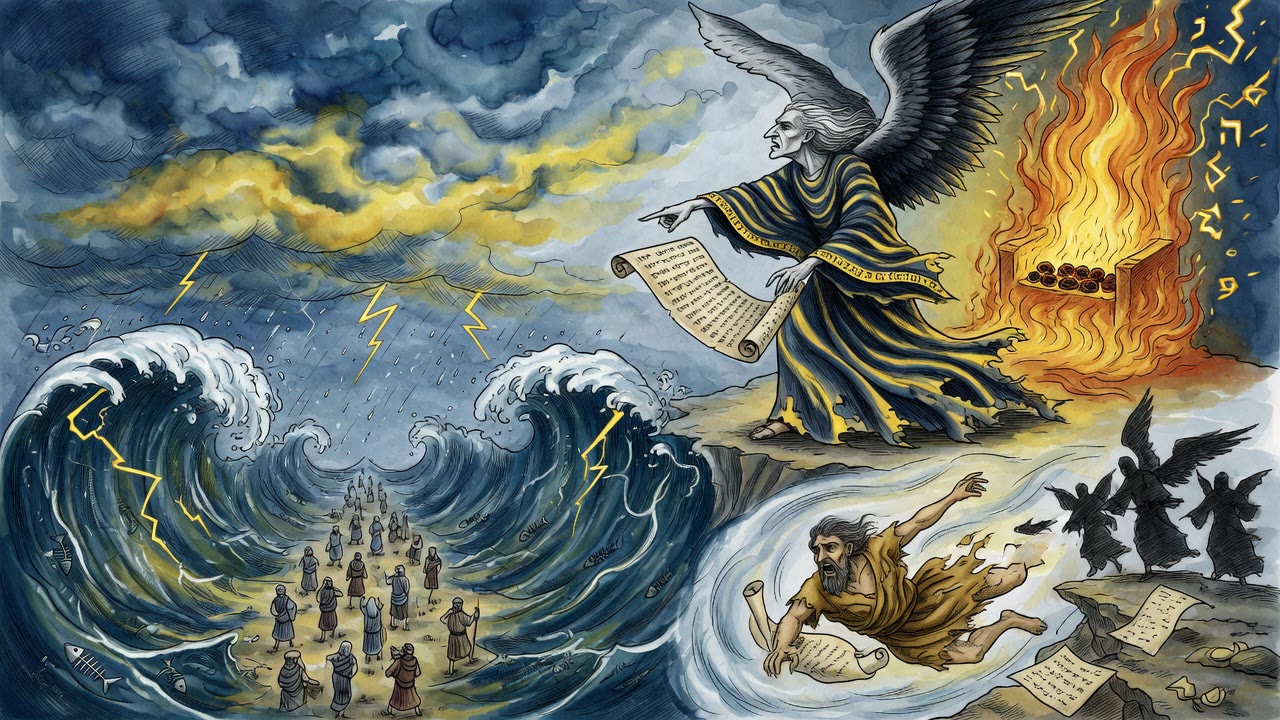
What followed was not resignation. It was argument, prolonged, desperate, shaking the structure of the cosmos with its force. The Chronicles of Jerahmeel, a medieval Hebrew anthology preserving earlier traditions, describes prayers so powerful that the angels themselves trembled. Heaven and earth stopped in their courses. The seas drew back from their shores. Creation held its breath while Moses pleaded from inside his circle.

Five Hundred and Fifteen Prayers

Moses had been praying about this since before he reached the circle. The number the rabbis count is five hundred and fifteen prayers on the subject of entering the Promised Land, each one distinct, each one refused, each refusal met with another attempt. He had led the people through forty years of wilderness. He had spoken face to face with God more intimately than any human being in the tradition. He had broken the tablets, interceded after the golden calf, pleaded for water and food and survival through crises that would have destroyed lesser leaders. The land he could see from the mountain's summit was the thing he wanted most.

God's refusal was final and blunt: do not speak to me anymore about this matter. The decree was sealed. But Moses was still inside his circle.

What Moses Saw Before He Died

God relented in a different direction. Moses would not cross the Jordan, but he would see what lay beyond it. A divine light opened his vision, and from the summit of Pisgah he saw not just Canaan but everything, the entire Land of Israel from its northern borders to the Negev, and beyond that, the throne of the patriarchs, and beyond that, the Garden of Eden, and beyond that, the punishments awaiting the wicked, and then the reward of the righteous in the world to come. The tour was not consolation. It was a form of completion. Moses saw, with the eyes of a dying prophet, the full scope of what his life had been placed in the middle of.

Before he died, a divine voice spoke to him. It called him the servant of God, the highest title in the tradition. It told him he had gone up to die on the mountain in the same way that Aaron had died on his mountain: peacefully, by divine kiss, taken without the violence of the usual angel of death. Moses had argued furiously against dying, but the manner of his death was, in the end, a gift.

The Angel Who Would Not Touch Him

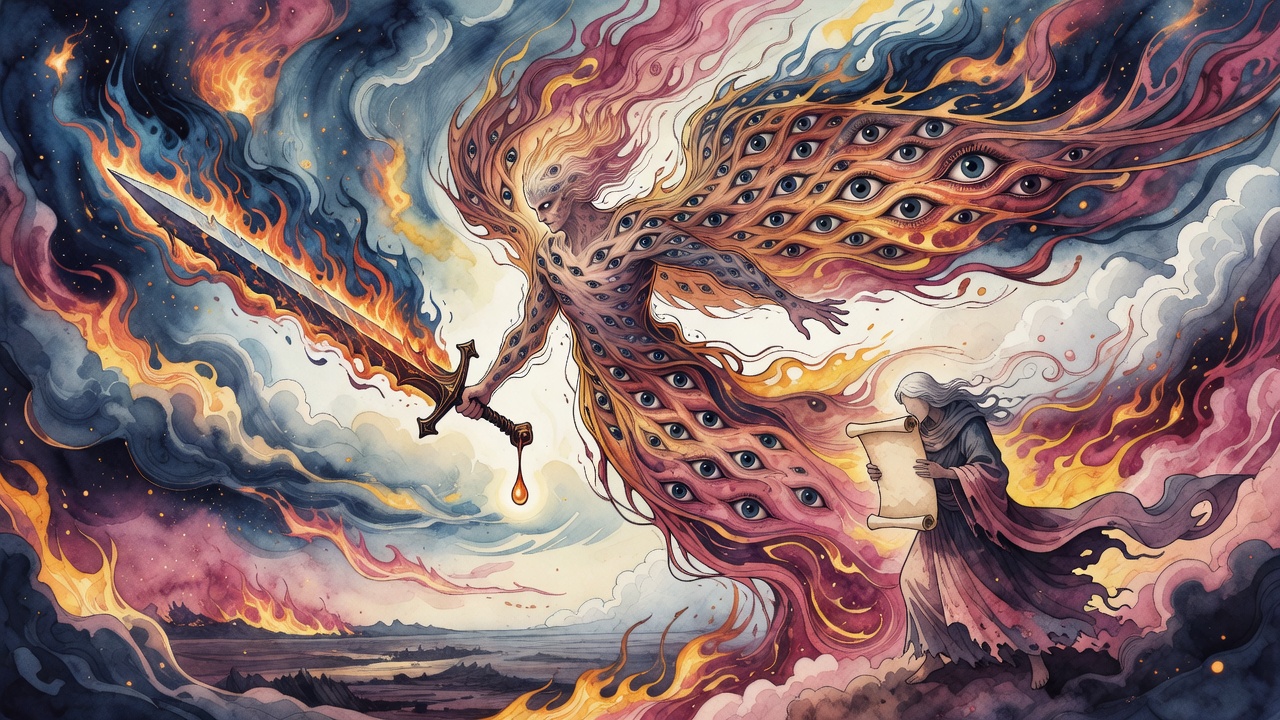
The angel of death came. The Chronicles of Jerahmeel and the traditions it preserves say that when Moses met him, something unusual happened: the angel could not complete his task. The face of God's presence still rested on Moses from their years of intimate speech, and that divine residue repelled what death ordinarily does to human beings. God himself had to come, in the end, to receive Moses's soul, not with force but with a breath, a kiss at the mouth, the soul drawn out so gently that Moses did not register the moment of its departure.

His burial place was hidden from all human knowledge, and the tradition has always understood why: a tomb of Moses would become a destination, a site of petition and pilgrimage, the fixed address for a man who had spent forty years refusing to let the people stand still.


← All myths

From the tradition

Sources

5 sources

The texts this telling draws on, in full. Open a card to read inline, or expand it for a wider, quieter read.

Chronicles of Jerahmeel LChronicles of Jerahmeel (Gaster, 1899)

When God told Moses that his time had come, Moses refused to accept it. He drew a circle on the ground, stood inside it, and declared: "I will not move from this place until the decree is annulled." He put on sackcloth, scattered ashes on his head, and prayed with such force that heaven and earth shook. Creation itself trembled, wondering if God was about to remake the world.

God ordered every gate of heaven sealed against Moses' prayer. But the prayer was unstoppable, it cut through the firmaments like a sword, powered by the Ineffable Name that Moses had learned from Zagzagel, the heavenly scribe. Moses begged for any alternative. Let me live as a beast that eats grass. Let me fly as a bird. Let me be an eye behind a door, just alive. To every plea, God answered: "You ask too much."

Meanwhile, Samael (the angel of death), chief of the accusing angels, had been waiting eagerly for this moment, asking every hour: "When does Moses die so I can take his soul?" God sent Gabriel first, then Michael, neither could bear to look upon the death of Moses. So God sent Samael, who girded himself with a sword and went looking for a fight. But when Samael saw Moses writing the Ineffable Name, radiating light like the sun and resembling an angel of the Lord, he was seized with terror.

Moses confronted him: "There is no peace for the wicked. What are you doing here?" He listed his accomplishments, born circumcised, walked and spoke as a newborn, received the Torah from the fiery throne, split the sea, conquered Sihon and Og. "Who in the world can do what I have done? Get away from me." When Samael returned with his sword drawn, Moses took the staff of God and beat him, stripping away the horn of his glory and blinding him.

Finally, according to the Chronicles of Jerahmeel, a 12th-century Hebrew chronicle translated by Moses Gaster in 1899, God Himself descended from the highest heavens with Michael, Gabriel, and Zagzagel. Michael arranged the bed. Gabriel spread linen at his head. God spoke to Moses' soul directly, coaxing it to leave. The soul protested, no body had ever been purer. God promised to place it beneath His throne, among the Cherubim and Seraphim. Moses died by the kiss of God, and heaven and earth wept together.

Full source
Legends of the Jews, IV. Moses In Egypt, The Ascension Of MosesLegends of the Jews

The stories surrounding Moses, our great leader and prophet, offer glimpses into just such an experience. It's more than just receiving the Ten Commandments; it's about a complete transformation and a journey into the heart of the Divine.

In Legends of the Jews, the encounter at the burning bush was a deeply personal one. While the other shepherds saw nothing, Moses alone witnessed the vision. He took just five steps closer, and God, seeing his distress over the suffering of Israel, recognized his worthiness.

God considered this carefully. Too loud, and Moses would be frightened. Too soft, and he wouldn't grasp the gravity of the moment. So, God spoke in the voice of Moses' father, Amram. Imagine the relief Moses must have felt, believing his father was still alive!

"Here am I! What is my father's wish?" he replied.

But it wasn't Amram. "I am not thy father," God said, "I but desired to refrain from terrifying thee, therefore I spoke with thy father's voice. I am the God of thy father, the God of Abraham, the God of Isaac, and the God of Jacob."

What a powerful moment! God invoking the patriarchs! And, interestingly, placing Amram's name before theirs! According to Ginzberg's retelling of the Midrash (rabbinic interpretive commentary), it was as if Amram ranked even higher. Moses, overcome with reverence, covered his face.

When God revealed his mission – to free the Israelites from Egypt – Moses responded with humility, "Who am I, that I should go unto Pharaoh, and bring forth the children of Israel out of Egypt?"

God reassured him, promising to deliver Egypt into his hands and, incredibly, to allow him to ascend to the throne of glory, to gaze upon the angels.

This is where the story takes an extraordinary turn.

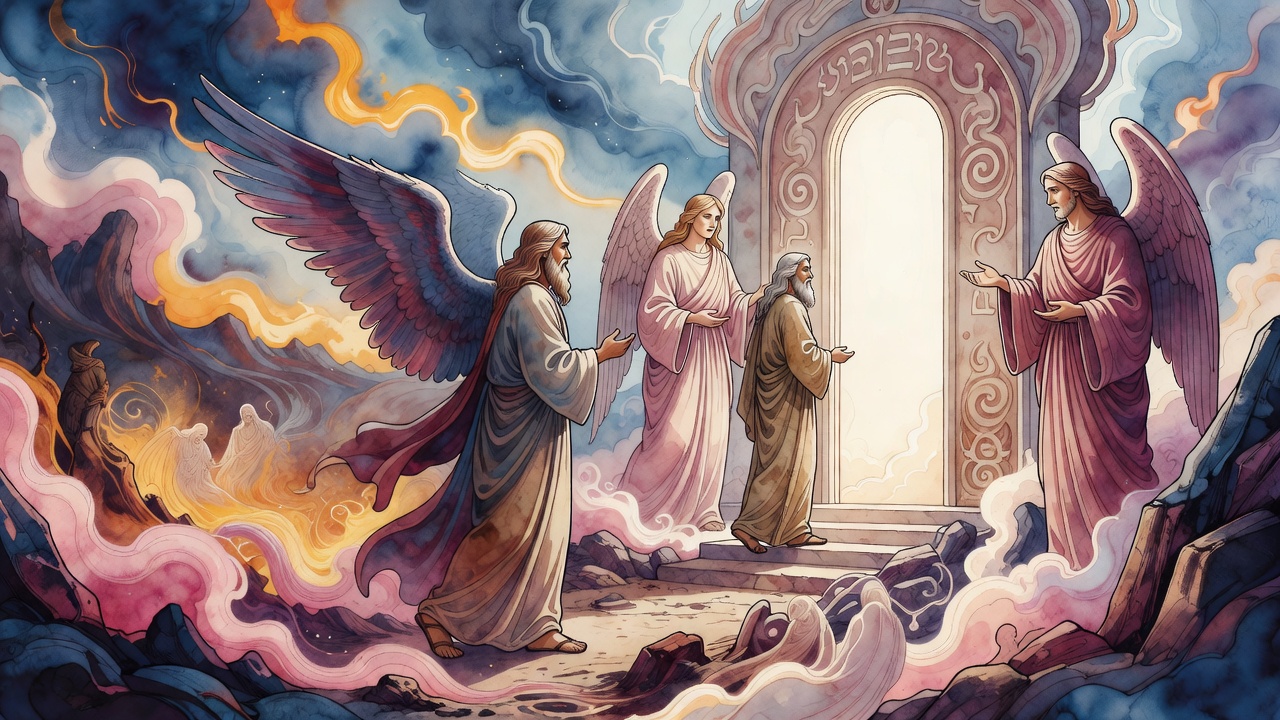
God commanded Metatron, the Angel of the Face, to escort Moses to the heavens, accompanied by music, song, and a bodyguard of thirty thousand angels! Can you picture that procession?

Understandably, Moses was terrified. "Who art thou?" he asked Metatron.

"I am Enoch, the son of Jared, thy ancestor," the angel replied, "and God has charged me to accompany thee to His throne." Enoch, as in, the Enoch who, Genesis tells us, "walked with God: and he was not; for God took him." (Genesis 5:24)

But Moses protested, "I am but flesh and blood, and I cannot look upon the countenance of an angel."

So Metatron transformed him! According to the story, Moses' flesh became torches of fire, his eyes became Merkabah (the Divine Chariot) wheels (referencing the Divine chariot described by the prophet Ezekiel), his strength became angelic, and his tongue a flame. He ascended, surrounded by his celestial escort.

The journey through the seven heavens is a breathtaking vision.

In the first heaven, Moses saw streams of water and countless windows, each overseen by angels. Metatron identified them: the window of prayer, of supplication, of weeping, of joy, plenitude, starvation, war, peace, and so on. Every aspect of human experience, it seems, has a celestial counterpart.

In the second heaven, he encountered the angel Nuriel, towering three hundred parasangs (an ancient unit of distance) high, surrounded by fifty myriads of angels made of water and fire, all praising God.

The third heaven revealed an angel so immense it would take five hundred years to climb to his height, with seventy thousand heads, each with mouths and tongues, all extolling the Lord. These were the Erelim, appointed over the natural world.

The fourth heaven held a Temple built of fire and precious stones, where angels sang praises to God. Here, Moses learned of the purpose of Venus and Mars: Venus cools the sun, while Mars warms the moon.

In the fifth heaven, he saw the Ishim, angels of snow and fire in perfect harmony, whose sole purpose was to praise God.

The sixth heaven housed the Irin ve-kadishin, "Watchers" and "Holy Ones," led by an angel made of hail.

Finally, in the seventh heaven, Moses encountered the terrifying angels Af ("Anger") and Hemah ("Wrath"), forged from black and red fire, created to execute God's will. Metatron reassured Moses, calming his fears.

He also saw Samael, the angel of death, and prayed not to fall into his hands. He beheld the seraphim with their six wings, covering their faces and feet in humility before the Shekhinah (Divine Presence), and singing, "Holy, holy, holy is the Lord of hosts; the whole earth is full of His glory."

And he saw the Hayyot, the holy creatures supporting God's throne, and Zagzagel, the prince of the Torah and wisdom, who teaches the Torah in seventy languages. According to the tradition, it was from this angel that Moses learned the ten mysteries!

After witnessing all this, Moses declared, "I will not leave the heavens unless Thou grantest me a gift."

And God replied, "I will give thee the Torah, and men shall call it the Law of Moses."

So, what are we to make of this incredible journey? It’s more than just a fantastical tale. It's a powerful metaphor for spiritual transformation, for overcoming our human limitations to encounter the Divine. Moses’ ascent wasn't just a physical journey; it was a journey of the soul, a preparation for receiving the Torah and leading his people. It reminds us that even in our own lives, we have the potential to rise above our limitations and connect with something greater than ourselves.

Full source
Jasher 70Book of Jasher

The familiar story centers on his dramatic rescue as a baby, floating down the Nile in a basket. But what happened next, after he was adopted by Pharaoh's daughter? The Book of Jasher, an ancient Hebrew text of uncertain origin, fills in some fascinating details, painting a vivid picture of Moses's early years.

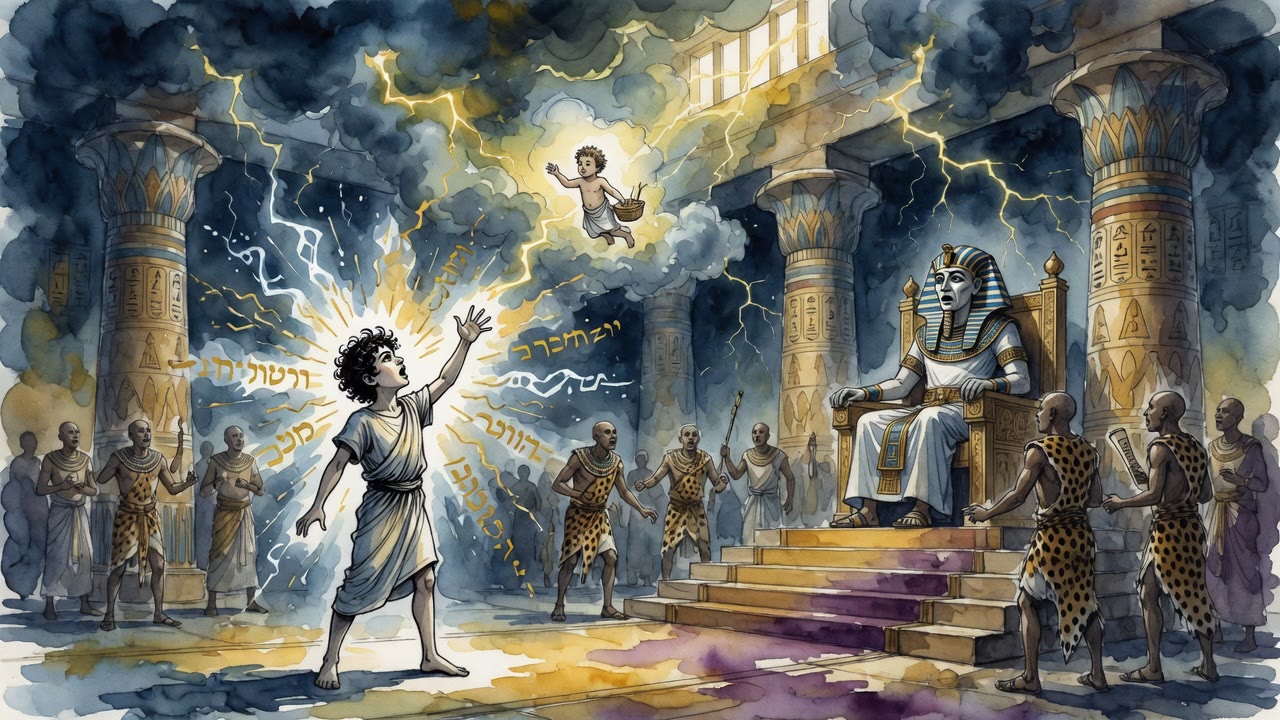
In Jasher, in the third year after Moses's birth, a rather… eventful banquet took place. Pharaoh was holding court, with his queen Alparanith on one side and Bathia, Moses’s adoptive mother, on the other. The young Moses was there, nestled in Bathia's lap. And then, something extraordinary happened: the toddler reached out and grabbed the crown right off Pharaoh's head, placing it on his own!

The scene! The king and princes were, understandably, terrified. What did this mean? Was this an omen? They turned to Balaam, the son of Beor, a well-known magician, for his interpretation. Remember Balaam? He pops up later in the Torah, too.

Balaam, ever the opportunist, seized the moment. He warned Pharaoh that this was no accident. "This is a Hebrew boy," he declared, "in whom is the spirit of God!" He went on to accuse the Hebrews of a long history of trickery, citing Abraham, Isaac, and Jacob as examples of those who "deceived kings" to get their way. He even brought up Joseph, saying the Hebrews bought the Egyptians as slaves. Balaam's solution? Kill the boy before he grows up and takes over the kingdom. But Pharaoh, thankfully, didn't immediately order Moses's execution. Instead, he consulted with the wise men of Egypt. Now, here’s where things get interesting. An angel of the Lord, disguised as one of the wise men, suggested a test. They proposed placing an onyx stone and a burning coal before the child. If Moses reached for the onyx, it would prove he acted with knowledge and should be put to death. But if he grabbed the coal, it would indicate he didn't understand what he was doing, and his life should be spared.

So, they presented the items to Moses. He instinctively reached for the onyx, but the angel intervened, guiding his hand to the burning coal. Moses grabbed the coal, burning his mouth and tongue. This explains, according to Jasher, why Moses later had a speech impediment.

The king and princes, seeing this, concluded that Moses hadn't acted deliberately, and spared his life. Moses remained in Pharaoh's house, growing up in royal purple, favored by Bathia and feared by the Egyptians.

But Moses didn't forget his people. He visited them in Goshen, the land where the Israelites were living, and witnessed their suffering under Pharaoh's harsh rule. He learned about the cruel decrees and the evil counsel of Balaam. This, understandably, ignited his anger. He sought to kill Balaam, who, fearing for his life, fled to the land of Cush.

One day, Moses approached Pharaoh with a humble request: "Let there be given unto thy servants the children of Israel who are in Goshen, one day to rest therein from their labor." And Pharaoh, remarkably, agreed! He issued a proclamation granting the Israelites a day of rest every seventh day.

Jasher tells us that "this thing was from the Lord to the children of Israel, for the Lord had begun to remember the children of Israel to save them for the sake of their fathers." This act of compassion, securing a day of rest for his brethren, marked the beginning of Moses's journey toward becoming the leader who would ultimately lead them out of slavery. And it all started with a toddler, a crown, and a burning coal.

It's a compelling story, isn't it? It reminds us that even in the midst of privilege and power, a connection to one's roots and a sense of justice can bloom, setting the stage for extraordinary acts of leadership and liberation. What do you think this story adds to our understanding of Moses's character and his eventual role as the liberator of the Israelites?

Full source
Legends of the Jews, IV. Moses In Egypt, Moses Visits Paradise And HellLegends of the Jews

Legends of the Jews (Ginzberg) turns to Moses Visits Paradise And Hell.

The story goes that as Moses was preparing to leave heaven, a divine voice declared, "Moses, you have seen the throne of My glory. Now you shall see also Paradise and hell." (Ginzberg, Legends of the Jews) God then sent Gabriel to guide him on this incredible, terrifying tour.

The first stop? Hell.

As Moses approached, the fiery gates of Gehenna (hell) were so overwhelming that he hesitated. But the angel reassured him, explaining that a special fire, one that both burns and consumes, would protect him from the inferno. Think of it as divine fireproofing. With this assurance, Moses stepped into the depths. The fire, as promised, receded, creating a safe passage.

There, Nasargiel, the Angel of Hell, greeted him. He questioned Moses’ presence, but Moses explained he was there to witness God's power. God then instructed Nasargiel to show Moses the torments of the wicked. What Moses saw was a vivid, gruesome pattern of suffering.

Men were suspended by their eyelids, ears, hands, and tongues, each punishment tailored to their earthly sins. Women were similarly suspended by their hair and breasts. Nasargiel explained that these were the consequences of lustful gazes, listening to gossip, slanderous speech, thievery, and inciting sin. As we find in Midrash Rabbah, sins against others and against the community are particularly grievous.

Hell itself cried out in hunger, demanding the souls of the pious. But, of course, the Holy One would not allow such a thing.

Moses witnessed sinners suspended upside down, their bodies covered in worms each five hundred parasangs (an ancient Persian unit of distance) long. Others were tormented by scorpions with thousands of venomous stings. These were the fate of those who swore falsely, profaned the Sabbath, disrespected scholars, wronged the vulnerable, and denied the Torah. As the Talmud (Nedarim 22a) reminds us, the consequences of our actions resonate far beyond our immediate experience.

He saw yet another place, Tit ba-Yawen, where sinners stood in mud, lashed with fiery chains, their teeth broken repeatedly with fiery stones. These were the punishments for consuming forbidden foods, practicing usury, misusing God’s name, using false weights, stealing, and desecrating sacred days.

Finally, Moses witnessed sinners burned, one half of their bodies in fire, the other in snow, tormented by worms and beaten by Angels of Destruction. These were those who committed incest, murder, idolatry, and cursed their parents and teachers – those who, like Nimrod, arrogantly declared themselves gods.

As Moses departed this terrifying realm, he prayed for deliverance from such a fate for himself and the people of Israel. But God's response was unwavering: "Before Me there is no respecting of persons and no taking of gifts. Whoever does good deeds enters Paradise, and he that does evil must go to hell." In other words, our actions have consequences.

Next, Gabriel led Moses to Paradise.

Imagine the relief. Upon entering, two angels greeted him, acknowledging his worthiness while reminding him that his time had not yet come. Moses clarified that he was there to witness the reward of the righteous.

Under the Tree of Life, Moses met Shamshiel, the prince of Paradise, who guided him through its wonders. He saw seventy thrones made of precious stones, each surrounded by angels. One throne, larger than the rest and encircled by one hundred and twenty angels, belonged to Abraham. Abraham, upon seeing Moses, praised God.

Moses inquired about the size of Paradise, but even Shamshiel, its prince, could not answer. Paradise is beyond measure, beyond comprehension. According to the Zohar, its beauty and bounty are limitless.

The thrones, Shamshiel explained, varied in material according to the deeds of their occupants: pearls for Torah scholars, precious stones for the pious, rubies for the just, gold for the repentant, and silver for righteous proselytes. Even a sinner with a pious son would receive a copper throne, a evidence of the power of inherited merit.

Moses saw a spring of living water flowing from under the Tree of Life, dividing into four rivers of honey, milk, wine, and balsam, each flowing beneath the thrones of the pious. Overwhelmed by the beauty and bounty, Moses exclaimed, "Oh, how great is Thy goodness, which Thou hast laid up for them that fear Thee!" (Psalm 31:19)

As Moses left Paradise, a heavenly voice declared that he would also be worthy of seeing the future world, the rebuilding of the Temple, and the coming of the Messiah. In that future time, Moses would continue to teach Torah, even after others sought instruction from Abraham, Isaac, and Jacob. Moses, having been taught by God Himself, would remain the ultimate teacher. And in the Messianic era, Moses would be one of the seven shepherds leading Israel.

What does this all mean? Perhaps it's a reminder that our choices matter, that the consequences of our actions extend beyond this life. Or maybe it's an invitation to imagine the boundless rewards that await those who live righteously. Either way, the story of Moses's journey through Paradise and hell is a powerful reminder of the stakes, and the incredible potential, of human existence.

Full source
Devarim Rabbah 9:5Devarim Rabbah

Death is often remembered as the great leveler, the fate that awaits us all. But Jewish tradition suggests that for some, like Moses, the end is… different. Special. Moses, the man who spoke to God face-to-face, who led the Israelites out of slavery, who received the Torah on Mount Sinai. Surely his departure couldn't be ordinary?

Devarim Rabbah, a collection of homiletical teachings on the Book of Deuteronomy, gives us a glimpse into the extraordinary nature of Moses' passing. It paints a picture far removed from the typical mourning scene.

God saying to Moses, as this passage suggests, "All the people descend to the grave and their eyes dim; you, your eyes did not dim." It's a powerful image, isn't it? A contrast drawn between the common fate and Moses' unique experience. While the eyes of ordinary mortals fade with death, Moses' remained bright, undimmed. It speaks to a life lived with exceptional clarity and purpose.

The differences don't stop there. The text continues, "All the people tend to utensils crafted by flesh and blood, a coffin, bier, and shroud, but you are in shrouds crafted by Heaven, a coffin crafted by Heaven, a bier crafted in Heaven."

Think about the implications of that. Ordinary people are buried in earthly shrouds, prepared by human hands. But Moses? He’s enshrouded in heavenly garments, placed in a heavenly coffin, carried on a heavenly bier. It's as if the very fabric of his burial is woven from the divine.

But the most striking image comes next: "Another matter, all the people, when they die, their relatives and neighbors tend to them, but you, I and My entourage tend to you."

Wow.

Instead of grieving relatives and neighbors, God Himself, along with His celestial entourage, attends to Moses. It’s an astounding image of divine honor and care. It emphasizes the special relationship Moses had with God.

Where do we find this idea in the Bible itself? The passage points us to (Deuteronomy 34:6), "He buried him in the valley." The Hebrew is ambiguous. Who buried him? The verse doesn't explicitly say. The Rabbis of the Midrash (rabbinic interpretive commentary) see in that ambiguity a hint of the divine involvement. "He" – God – buried him.

So, what does this all mean? Is it meant to be taken literally? Perhaps. But it also serves as a powerful metaphor for the reward and recognition that awaits those who live a life of extraordinary righteousness and service. It reminds us that even in death, there can be a profound difference between the ordinary and the exceptional. It’s a comforting thought, isn't it? That dedication and devotion to God will be recognized, even in the face of death.

Full source