Parshat Noach5 min read

Noah Told Japheth to Study in His Brother's Schools

When Noah divided the world between his three sons, Japheth's blessing surprised everyone - his beauty would lead him into the academies of Shem.

Curated by Arthur · Told by Maggid ·
Table of Contents
  1. Three Sons on Wet Ground
  2. The Blessing That Puzzled Everyone
  3. What the Divine Presence Requires
  4. The Kabbalists Read the Threshold

Three Sons on Wet Ground

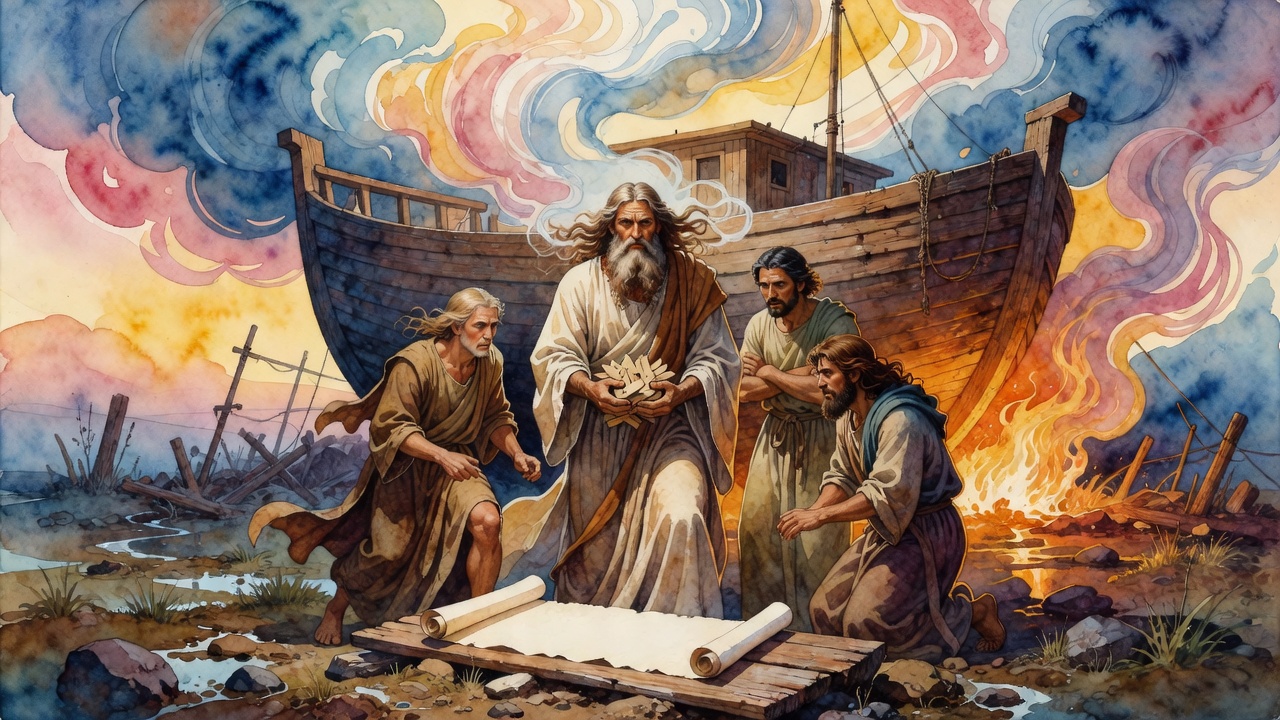
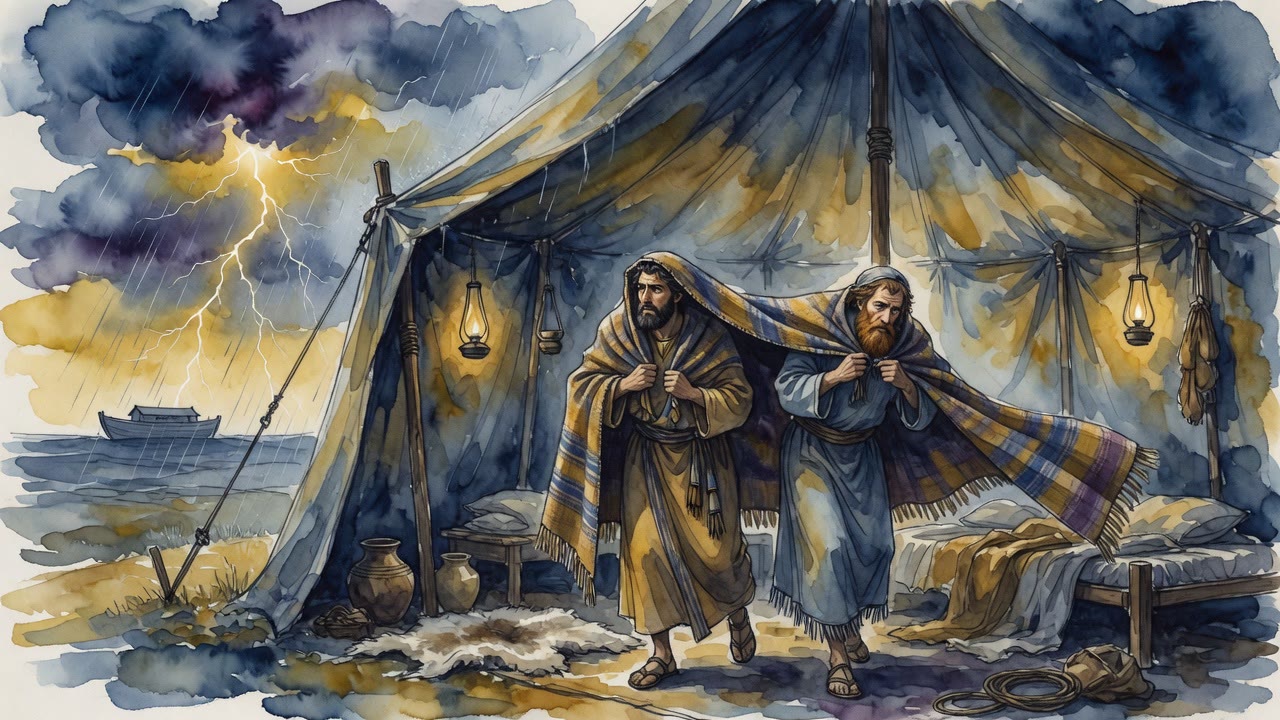
The ark had come to rest and the waters had receded and Noah stepped onto ground that was still soft with the memory of all that rain. He had three sons. He had a world to divide between them, or rather he had three destinies to name, because the world would arrange itself around those names whether he chose carefully or not. He had already seen what happened when Ham looked at him on the night Noah drank too much wine and lay uncovered in his tent. He had already named the consequences for that. Now he turned to the other two.

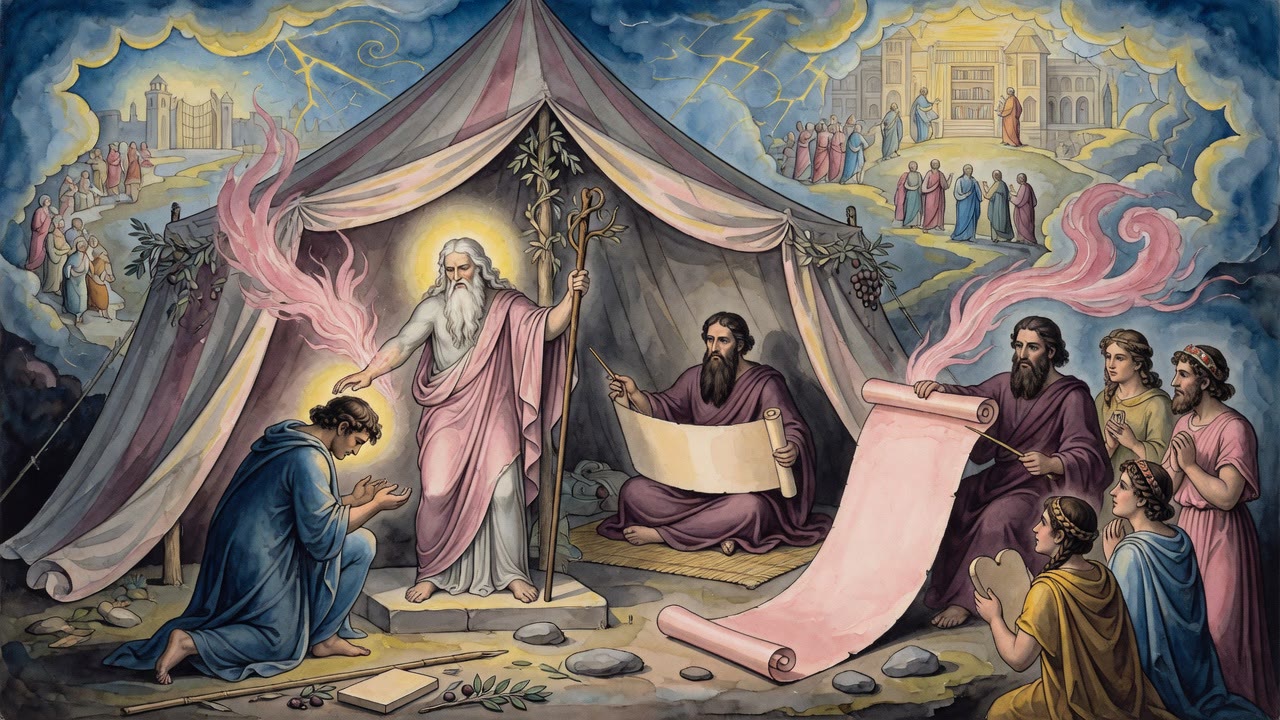
Shem received the first and most specific blessing. The divine presence would dwell in Shem's tents. God would be the God of Shem. From Shem would come the line of Abraham and Isaac and Jacob, the Torah and the priesthood and the entire tradition of study and prophecy that would hold the world together across generations of exile and return. This much was already settled when Noah spoke.

The Blessing That Puzzled Everyone

What Noah said about Japheth took more explanation. God would enlarge Japheth, give him beauty, expand his territory across the face of the earth. Japheth's descendants would be numerous and his lands would be wide and the world would have room for them. But then Noah added the phrase that the interpreters could not leave alone: Japheth would dwell in the tents of Shem.

What does that mean, exactly? The Legends of the Jews, drawing on the accumulated midrashic tradition, gives it a specific shape. The sons of Japheth, blessed with worldly beauty and wide territories, would find themselves drawn to what Shem's household carried. They would come as students to the academies where Shem's descendents studied. They would be proselytes, learners, people who had everything the world could give them but who kept turning toward the place where Torah was being transmitted. The blessing was not inferior to Shem's. It was different. It was the blessing of the one who searches rather than the one who inherits.

What the Divine Presence Requires

Noah's words also contained an implicit theology of presence. The Shekhinah, the divine presence, would not dwell in Japheth's tents. It would dwell in Shem's. But Japheth could enter Shem's tents and find it there. The divine presence was not mobile in the way a man is mobile. It settled somewhere and waited, and those who wanted to encounter it had to come to where it had settled.

This is what made Japheth's path in some ways harder than Shem's. Shem was heir to the presence by inheritance. Japheth had to choose it. He had to look at the wide beautiful territories God had given him, all of Germania and Makedonia and Asia and Africa spread out before him, and decide that something in Shem's academies mattered more than the full enjoyment of his own inheritance. That choice, made again in every generation, is what Noah's blessing required of Japheth's children.

The Kabbalists Read the Threshold

The Tikkunei Zohar, the kabbalistic commentary that takes apart each letter and name in the Torah to find its hidden structure, reads Japheth's blessing through a different lens. It sees the threshold of the academy, the door between the outside world and the inside of Shem's spiritual transmission, as a place of constant traffic. As some exit, others are already knocking, yearning to enter. These are described as masters of the arms, people who have exhausted everything else the world offers and have arrived at the door of the one thing that cannot be bought or inherited by blood. They stand there and call on the divine name. They wait for the door to open.

The keepers of the threshold announce to God that these seekers are waiting. There is a protocol. There is a process. Japheth's descendants, the ones who take the blessing seriously, are among those waiting at the door in every generation, the beautiful people of the wide lands, standing outside Shem's tents with the word of the Psalms on their lips and something they cannot quite name pulling them forward.


← All myths

From the tradition

Sources

5 sources

The texts this telling draws on, in full. Open a card to read inline, or expand it for a wider, quieter read.

Legends of the Jews 4:81Legends of the Jews

The familiar telling remembers Shem, Ham, and Japheth, but what were their lives really like after they stepped off the ark?

The blessing Noah bestowed upon them speaks volumes. It hints at a unique dynamic, a destiny intertwined. "God will grant a land of beauty to Japheth," Noah proclaimed, "and his sons will be proselytes dwelling in the academies of Shem." (Ginzberg, Legends of the Jews). It's not just about land or lineage. It's about a spiritual partnership, a sharing of wisdom. The descendants of Japheth, blessed with worldly beauty, would find themselves drawn to the spiritual depth of Shem's teachings, studying in his academies.

There's a deeper layer still. Noah's words also implied something about the Shekhinah (שכינה), the Divine Presence. The Divine Presence, Noah suggested, would only dwell in the First Temple, built by Solomon, a descendant of Shem. But not in the Second Temple, which was built by Cyrus, who descended from Japheth. What does that tell us about the relationship between these brothers and their destinies? It's a subtle, powerful statement about lineage, holiness, and the unfolding of God's plan.

What of Ham? How did he react to his father’s curse? According to Legends of the Jews, shame consumed him. He fled, building a city for himself and his family, naming it Neelatamauk after his wife. It’s a poignant image: a man driven by shame to create his own world, separate from his father and brothers.

Japheth, too, felt the pull to create his own space. Perhaps driven by a jealousy similar to Ham's, or maybe simply wanting to establish his own identity, he built a city and named it Adataneses after his wife. We see here, perhaps, the seeds of future divisions, the natural human desire for independence and recognition.

Only Shem remained near his father, building his city, Zedeketelbab, close to Noah's home by Mount Lubar – the very mountain where the ark had rested. Imagine that: the ark, the symbol of survival and renewal, looming over their lives. These three cities, each representing a different path, a different response to the world after the flood, were all situated around Mount Lubar: Neelatamauk to the south, Adataneses to the west, and Zedeketelbab to the east.

What does it all mean? This isn't just a story about three brothers. It's a reflection on human nature, on the choices we make, and on the enduring power of family, legacy, and the Divine Presence in our lives. It's a reminder that even in the wake of destruction, the seeds of new beginnings, new conflicts, and new connections are always being sown.

Full source
Tikkunei Zohar 73:14Tikkunei Zohar

The Tikkunei (spiritual repair) Zohar, a central work of Kabbalah, paints a picture of just that moment, but on a cosmic scale.

A constant flow, a procession at the entrance to something… sacred. According to the Tikkunei Zohar, as some exit, others are already there, knocking, yearning to enter. And who are these hopefuls? They’re described as "masters of the arms," and their plea echoes the words of King David in (Psalm 51:17): "ADNY! Open my lips.." Adonai, often shortened to ADNY, is one of the names we use to refer to God.

It’s not so simple as just knocking and asking. There are gatekeepers, guardians of this sacred space. They announce to the "Master of the Universe" that these "masters of the arms" are waiting. There's a sense of protocol, of a process that must be followed.

Then, a voice rings out. It identifies these "masters of the arms" not just by their plea, but by something more: their tefillin, their phylacteries. Tefillin are those small leather boxes containing scriptural passages, bound to the arm and head during prayer. They are a tangible sign of our commitment, a physical manifestation of our intention.

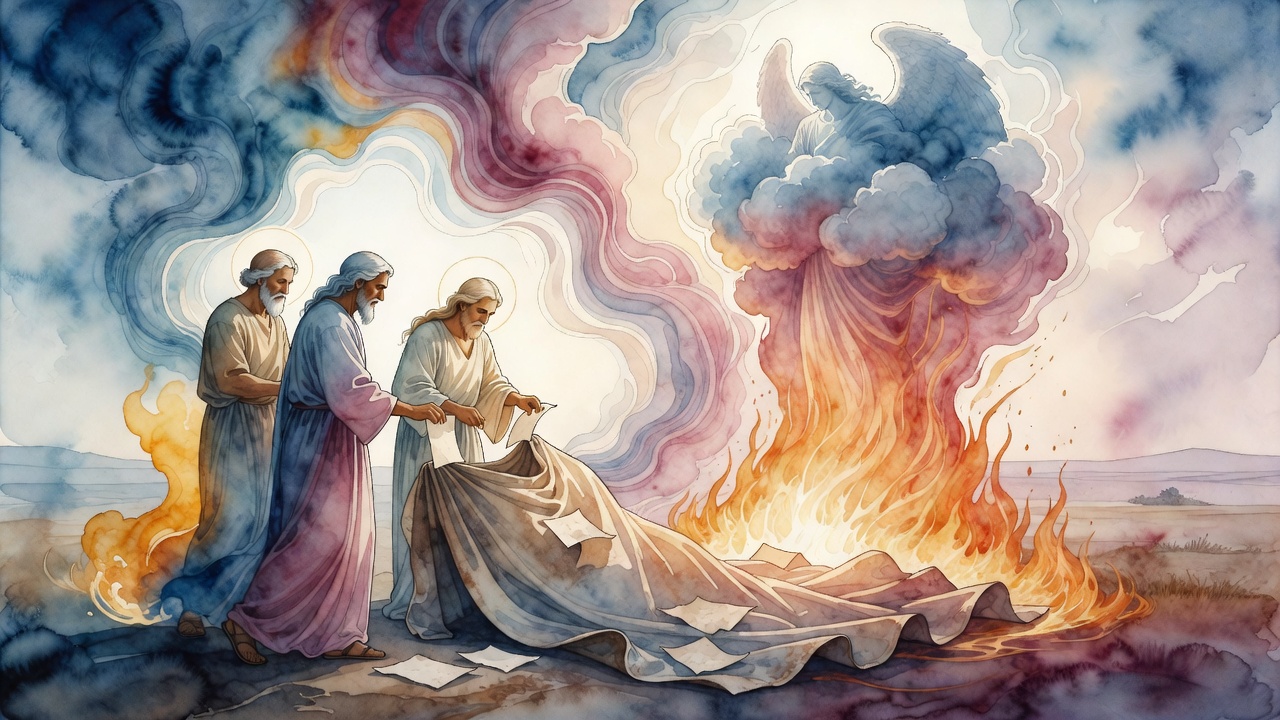
But the voice adds another layer: "the wrapping of precept." This is where it gets really interesting. The Tikkunei Zohar connects this act of "wrapping" to a story from Genesis, a story about Noah and his sons, Shem and Japheth. Remember that tale? Noah, in his… shall we say, less-than-dignified moment, is found uncovered. Shem and Japheth, showing respect and covering their father without looking upon his 'ervah – his nakedness, his obscenity – become the model.

The text emphasizes: "...and they placed it upon the shoulder of both-of-them... Like Shem and Japheth, of whom it is stated: And Shem and Japheth took the cloak... etc.... and the’ervah of their father they did not see..."

Why this connection? What does covering Noah's nakedness have to do with opening our lips in prayer? The Tikkunei Zohar seems to be telling us that true prayer, true connection with the Divine, requires humility, respect, and a willingness to cover the imperfections of others. It's not just about the words we say, but the actions we take, the way we treat each other. It's about approaching the sacred with a sense of responsibility and reverence.

So, the next time you feel like you're standing at that gate, remember the "masters of the arms." Remember the tefillin, the outward sign of commitment. But most importantly, remember the lesson of Shem and Japheth. Remember that true entry requires not just the right words, but the right heart. It requires covering the 'ervah, the flaws and vulnerabilities, of the world around us. Perhaps, only then, will the gates truly open.

Full source
Yalkut Shimoni on Torah 61:14Yalkut Shimoni on Torah

Another interpretation: "You prevented me from raising up a fourth son; therefore your fourth son is cursed. You prevented me from doing a thing that is done in darkness; therefore that man shall be ugly and blackened." Ham and the dog mated in the ark; therefore Ham came out blackened and the dog came out exposed in its mating. Rav Levi said: this is like one who minted his own coin within the king's tent. The king said, "I decree that his face be blackened and his coin be invalidated."

"May God enlarge Japheth, and may He dwell in the tents of Shem" (Genesis 9:27). This is Cyrus, who decreed that the Temple be built; even so, "and may He dwell in the tents of Shem," for the Divine Presence rests only in the tents of Shem. Bar Kappara said: let words of Torah be spoken in the language of Japheth within the tents of Shem. Rabbi Yudan says: from here is the basis for translation [Targum] from the Torah, and so it says, "And they read in the book, in the Torah of God" (Nehemiah 8:8), this is the Scripture; "distinctly," this is the translation; "and gave the sense," these are the cantillation accents; "and they understood the reading," these are the verse divisions. Rabbi Huna ben Lulianus says: these are the rulings and proofs. The rabbis of Caesarea say: from here is the basis for the Masorah. Rabbi Zeira and Rabbi Chananel in the name of Rabbi: even a person as expert in the Torah as Ezra may not read from his memory and write it down. But it was taught: it once happened that Rabbi Meir was in Asia and there was no scroll of Esther there, and he read it from his memory and wrote it. There they say: he wrote two scrolls; he stored away the first and kept the second. Rabban Shimon ben Gamliel says: even the scrolls were permitted to be written only in Greek, as it is said, "May God enlarge Japheth," the things of Japheth shall be in the tents of Shem. If so, Gomer and Magog also? Rather, this is what it says: the beauty of Japheth shall be in the tents of Shem.

Full source
Targum Pseudo-Jonathan on Genesis 9:27Targum Pseudo-Jonathan on Genesis

Targum Pseudo-Jonathan on (Genesis 9:27) turns a brief blessing into a vision of the whole future of learning. The Lord shall beautify the borders of Japhet, and his sons shall be proselyted and dwell in the schools of Shem, and Kenaan shall be a servant to them.

Read what the Targum sees coming. The descendants of Japheth, the Aramaic will later identify them with the Greeks, the Romans, the peoples of the west, will not remain locked in their own culture. They will be drawn toward the Holy One, converted, and they will dwell in the schools of Shem. The batei midrash of Shem's line, the study houses of Abraham, Isaac, and Jacob, will one day hold the students from every distant people.

This is astonishing Jewish universalism sitting quietly inside a blessing on Noah's sons. The Torah is not a closed club. The Targum is saying that Japheth's beauty, his philosophy, his architecture, his aesthetic power, is only truly completed when it learns to sit on a study bench beside Shem.

Notice: Shem does not go out to Japheth. Japheth comes to Shem. The schools stay rooted. The teachers do not leave home. The world comes to the Torah, not the other way around.

The takeaway the Maggid leaves on this verse: Torah was always meant to be a lamp on a hill. Your job is to keep the lamp burning. The wanderers, when they are ready, will find their own way up.

Full source
Bereshit Rabbah 36:8Bereshit Rabbah

Bereshit Rabbah turns to Noah's Transgression of Shem.

“Blessed be the Lord, God of Shem, and Canaan shall be their servant… May God expand Yefet, and he shall dwell in the tents of Shem, and Canaan shall be their servant.”

The first reading, it But our sages, poring over every word, found layers of meaning.

Reish Lakish, for instance, saw in this verse an inclusion. “From Yefet, as well, there were those who stood in the tents of Shem,” he taught. What does that mean? According to Bereshit Rabbah 36, some descendants of Yefet joined the Jewish people, entering the "tent of Shem" – which is understood to be the Temple in Jerusalem. – the idea that even from distant lineages, people could find their place within the sacred space of Judaism.

But the story doesn't stop there. The passage continues, "Blessed be the Lord, God of Shem, and Canaan shall be…may God expand Yefet.” Here, the rabbis saw a reference to Cyrus, the king of Persia. According to (Genesis 10:2), the nation of Madai were descendants of Yefet. Cyrus, this descendant of Yefet, famously decreed that the Second Temple should be built.

Yet, there's a subtle distinction. While Cyrus facilitated the Temple's construction, the Shechinah, the Divine Presence, rested fully only in the tents of Shem, specifically in the Temple built by Solomon, a descendant of Shem. It is as if to say the Divine Presence was more fully present in the First Temple.

Bereshit Rabbah 36 goes on to explore even more fascinating ideas, venturing into the world of language itself. Bar Kappara declared that "the words of the Torah will be said in the Greek language in the tents of Shem." Considering that Greece (Yavan) is also considered a descendant of Yefet, according to (Genesis 10:2), this is a pretty radical statement! It seems to suggest that even translations of the Torah – specifically the Greek translation – could find a place within the sacred sphere. The Mishna Megillah 1:8 later authorized the reading of the Greek translation of the Torah in the synagogue.

And Rabbi Yudan takes it a step further, arguing that this verse provides a source in the Torah itself for translations. He connects it to (Nehemiah 8:8): “They read in the scroll of the Torah of God, [meforash, explicated, providing insight, and they elucidated the reading].” Rabbi Yudan equates "explicated" with translation.

The passage goes on to dissect that verse from Nehemiah even further, attributing the cantillation notes (providing insight) and verse demarcations (and they elucidated the reading) to the rabbinic tradition. Even the Masoret, the body of work that establishes the correct pronunciation and spelling for each word of the Torah, finds its roots in this verse, according to the Rabbis of Caesarea.

Finally, Bereshit Rabbah 36 touches upon the meticulous nature of Torah scroll writing. Rabbi Ze’ira and Rabbi Hananel, in the name of Rabbi, emphasize that even someone as learned as Ezra shouldn't recite the Torah orally while writing a scroll. A scribe must always copy from another scroll, ensuring the utmost accuracy. Even if Rabbi Meir once had to write a Scroll of Esther from memory, as the story goes, he still created a second scroll copied from the first to ensure its validity.

So, what do we take away from all this? It's more than just ancient history. It's about inclusion, about finding the Divine even in unexpected places and languages, and about the immense care and dedication that goes into preserving our sacred texts. It prompts us to consider: How do we create space for diverse voices and perspectives within our own "tents of Shem?" And how do we balance innovation with the preservation of tradition? Food for thought,.

Full source