Parshat Noach5 min read

Noah Saw Envy Rise Before the Flood Mud Dried

After the flood Noah warned his sons they already walked toward ruin. Ham left cursed and built a city; Japheth saw it and built in envy.

Curated by Arthur · Told by Maggid ·
Table of Contents
  1. The World Washed Clean
  2. A Father's Hard Vision
  3. Ham Walks Away
  4. Japheth Builds for Envy
  5. Law for the Next Planting
Noah Saw Envy Rise Before the Flood Mud Dried Click for full size

The World Washed Clean

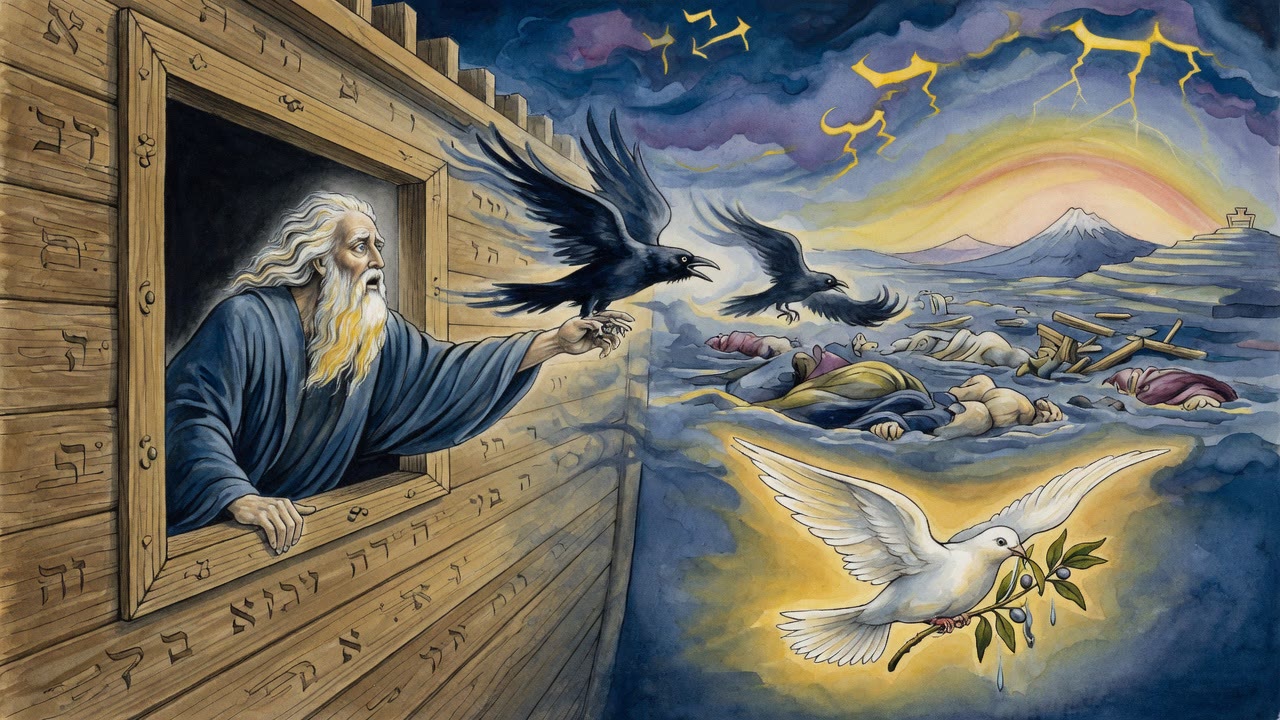
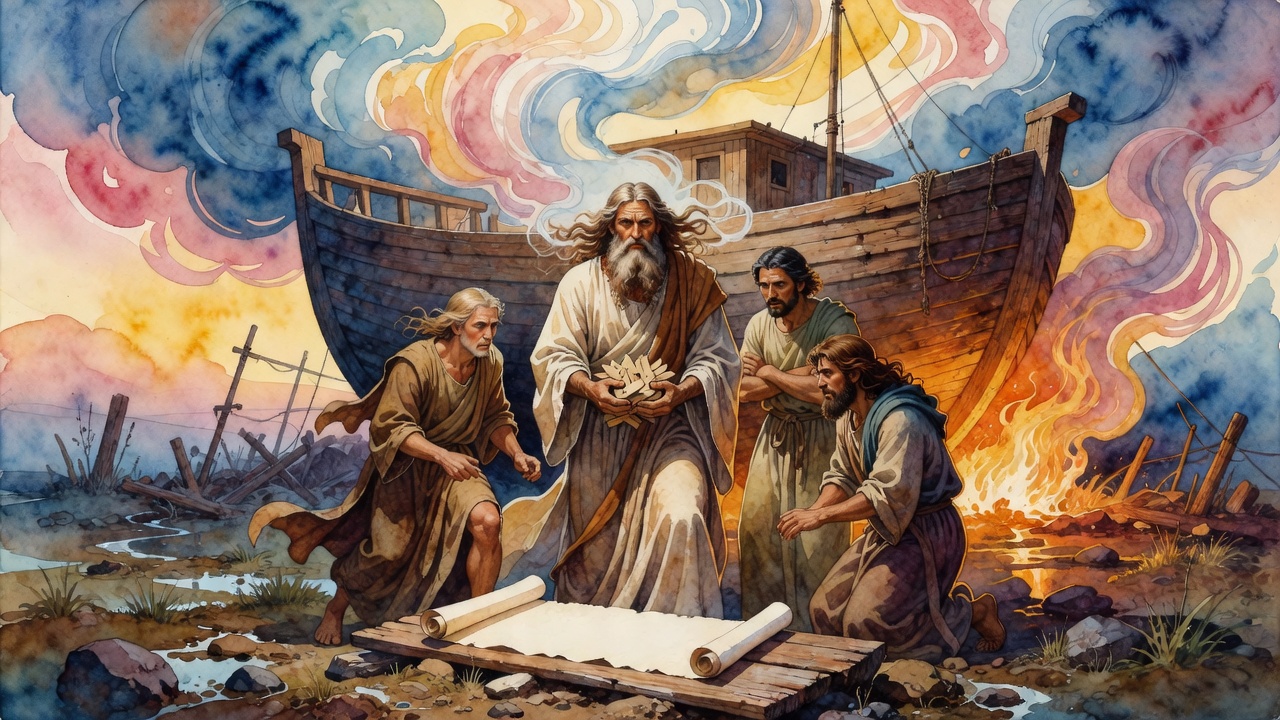
The Lord had destroyed everything from the face of the earth for wickedness and for blood shed in the midst of the land. Cities that had laughed at a long boat were now silt and rumor. When the ark rested, the silence was larger than any field Noah had known before the first drop. He stood with his sons on a world without neighbors and named the fact without comfort. "And we were left, I and you, my sons, and everything that entered with us into the ark."

They were the new beginning, eight souls and the animals that had breathed through the dark months. The mud still held the shape of the old world under their feet, bones and broken thresholds under a skin of wet earth. Survival tasted like responsibility, not festival.

A Father's Hard Vision

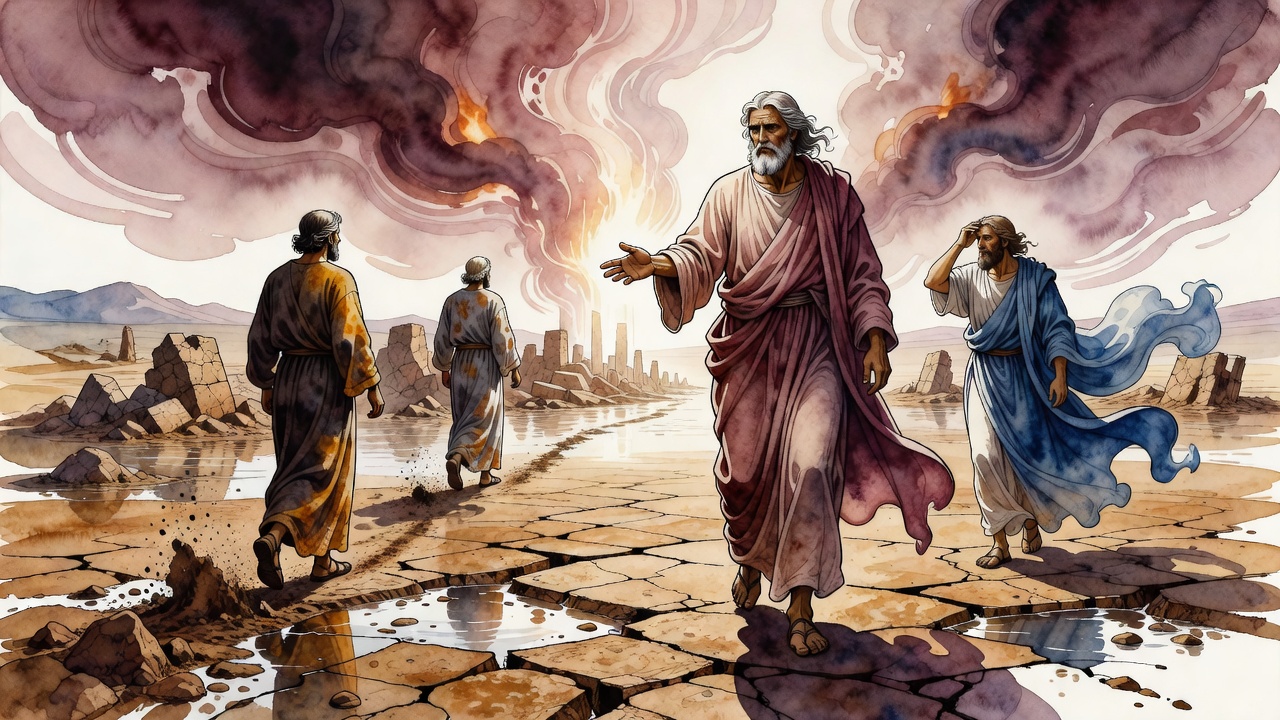
Noah looked at the works of his sons in the first days after landing and did not flatter them. "Behold I see your works before me that ye do not walk in righteousness; for in the path of destruction ye have begun to walk." The flood had not washed the will clean. Water can remove bodies. It cannot by itself remove envy. "Ye are parting one from another, and are envious one of another, and so it cometh that ye are not in harmony, my sons, each with his brother."

Survival had already frayed into rivalry. The man who had hammered an ark against a world's laughter now hammered words against his own blood. He had seen a planet die for violence. He would not pretend the seed of that violence was absent from the only family left.

Ham Walks Away

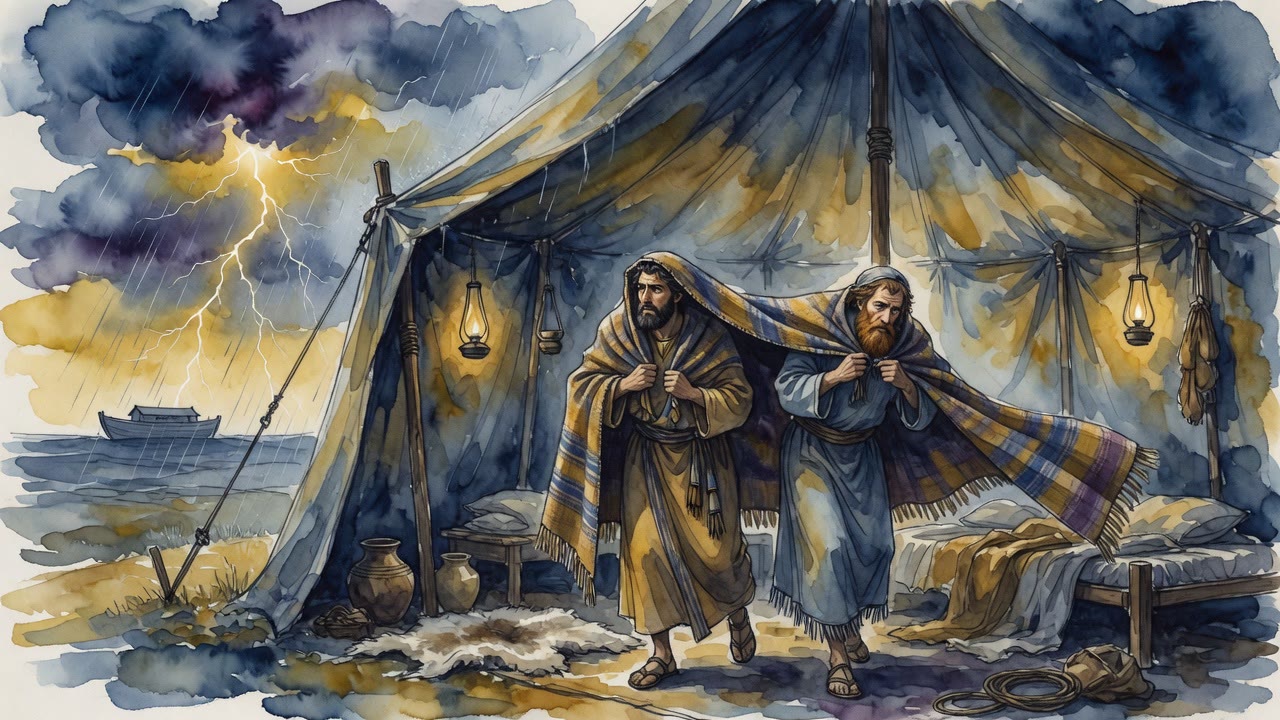
The shame in the tent came, wine and nakedness and a son's gaze that turned private weakness into public sport, and the curse fell on Canaan. "God shall enlarge Japheth, and God shall dwell in the dwelling of Shem, and Canaan shall be his servant." The words rearranged the future of peoples while the ground was still soft. Ham was displeased that his father had cursed his son. Displeasure became distance. He parted from Noah with Cush and Mizraim and Put and Canaan, a whole branch leaving the trunk while the trunk still lived.

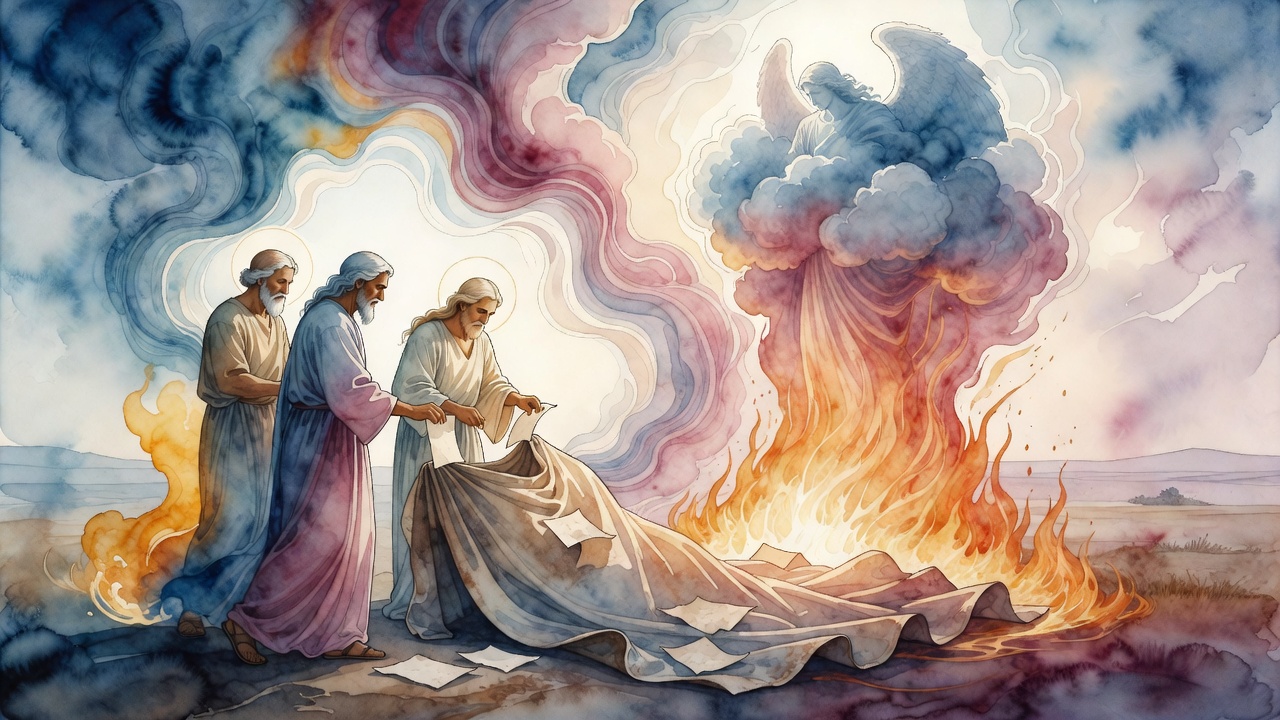
He built a city and named it after his wife, Nê'êlâtamâ'ûk. The first city after the water rose from a wound, not from a feast of reconciliation. Jubilees later hardens the line further: owing to Ham's transgression Canaan erred, and the seed of idolaters would find no hope in the land of the living, descending to Sheol (the underworld of the dead) and the place of condemnation, remembrance cut off from the earth. The family split wrote theology into geography and geography into doom songs.

Japheth Builds for Envy

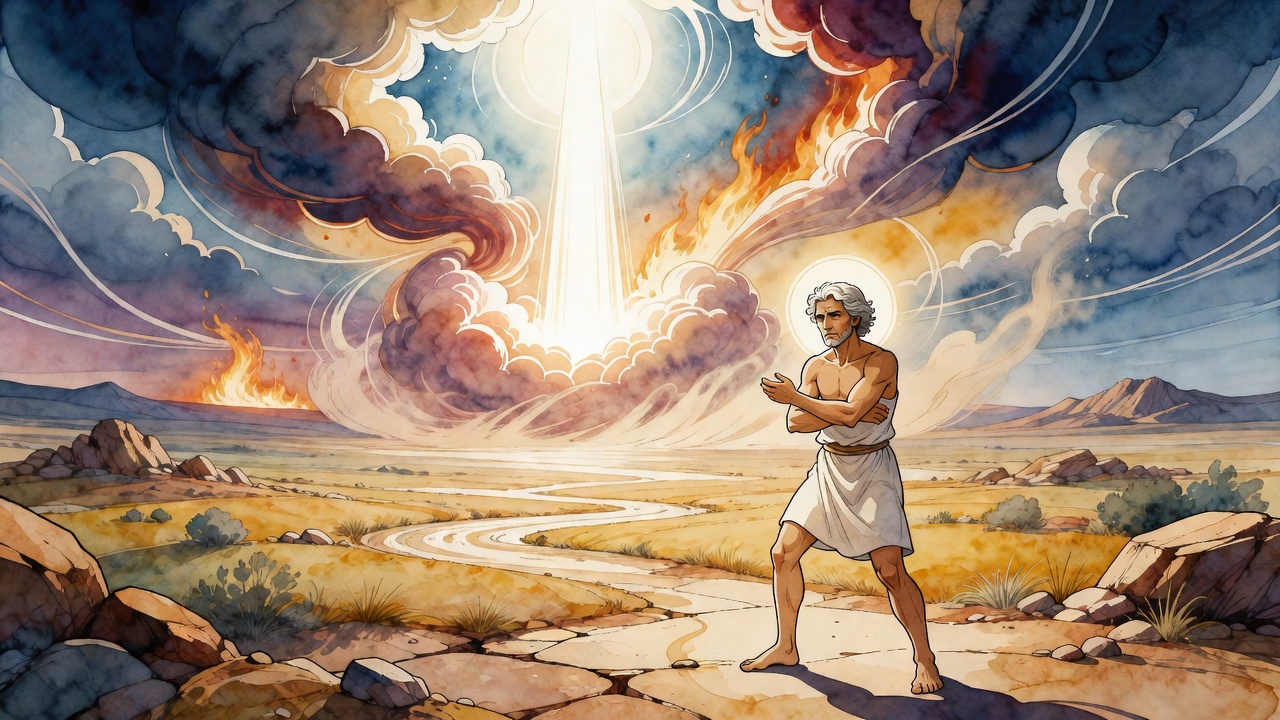
Japheth saw his brother's city rise, walls where there had been only mud and mutual need. Envy took him the way floodwater had taken valleys, sudden and complete. He built a city of his own and called it after his wife as well, imitation as architecture. Two brothers, two walls, two names of women set on stone because one curse and one glance could not sit still in the same camp.

Noah had said they were parting and envying. The cities proved him right before the fields had fully dried, before the first full harvest of a cleansed earth. The rainbow still stood as sign, and already men built against each other under it.

Law for the Next Planting

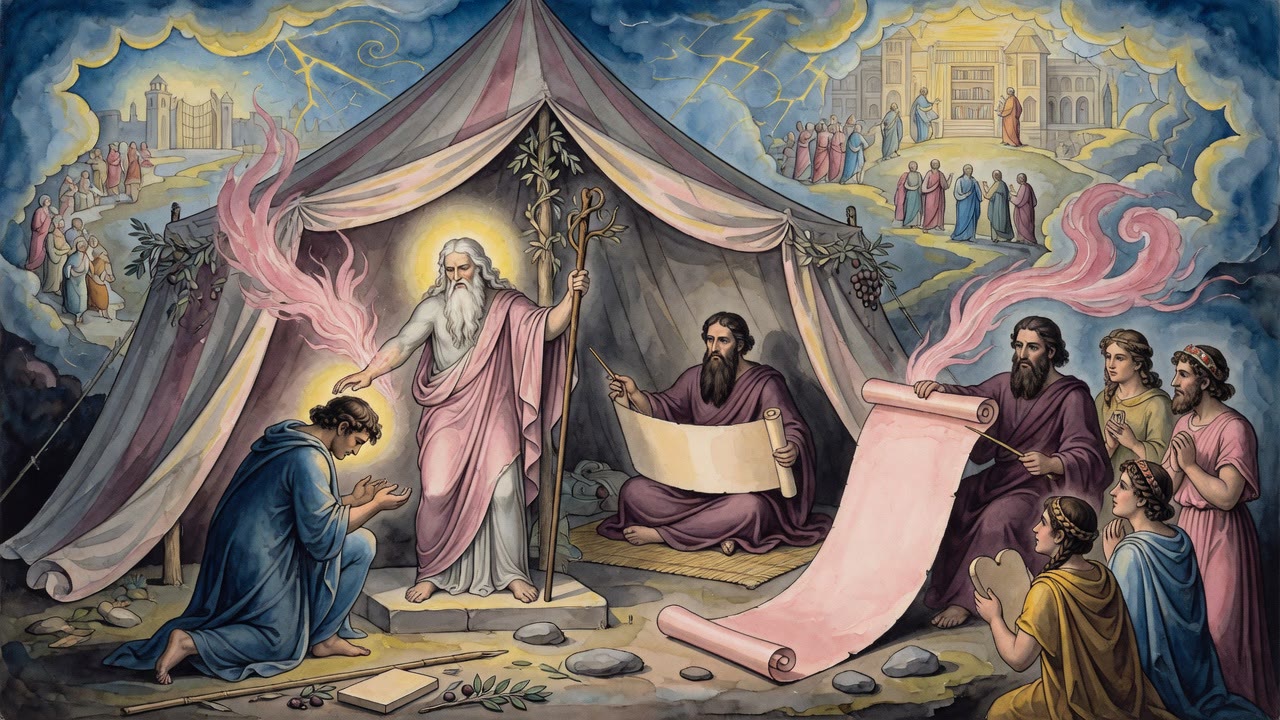
Noah also gave instructions for the world they would plant, as if law could outrun jealousy. They would go and build cities and set every plant and fruit tree in them. For three years the fruit of new trees would not be eaten, hands forced to wait while branches learned their work. In the fourth year the fruit would be holy, firstfruits acceptable before the Most High who made heaven and earth and all things. Wine and oil in abundance would rise as offering, not only as private sweetness.

The law tried to teach patience to men who had already raced to raise walls against each other. Orlah after the flood was not only agriculture. It was a brake on hands that grabbed too fast, a training in delay after a generation that had grabbed blood. Noah had seen the old world die for violence poured out like water. He tried to bind the new world with restraint, offering, and a warning that envy was already sprouting in the first cities of the survivors.

The ark had saved eight souls. The mud received their arguments all the same, and the first skylines of the new earth were monuments to a father's unheeded fear.


← All myths

From the tradition

Sources

4 sources

The texts behind this telling. Some cards carry a translation of the source; others are our own retelling of it, and each card says which. Every card links out to the original.

Book of Jubilees 7:18Book of Jubilees

Retold in our words. Read the original at the link below.Sefaria Community Translation · CC-BY

It all goes back to a rather dramatic episode after the flood, as recounted in the Book of Jubilees.

We know the story: Noah's son, Ham, sees his father in a… well, let’s just say less than dignified state. And then, famously, Noah curses Canaan, Ham’s son. But the Book of Jubilees, an ancient Jewish text that expands on the stories in Genesis, gives us a little more context, a little more nuance to this pivotal moment.

"God shall enlarge Japheth, and God shall dwell in the dwelling of Shem, and Canaan shall be his servant." That's the prophecy laid out in Jubilees 7, echoing the blessing (and curse) we find in Genesis. But the Jubilees doesn't just leave it there. It dives into the feelings, the fallout.

Ham, according to Jubilees, wasn't exactly thrilled that his father cursed his son. Can you blame him? Imagine the family dinner conversation! He "was displeased that he had cursed his son, and he parted from his father, he and his sons with him, Cush and Mizraim and Put and Canaan." He takes his family and essentially says, "We're out of here."

And what does he do? He builds a city. Because that’s what you do when you’re trying to make a fresh start. He names it after his wife, Nê’êlâtamâ’ûk. We don’t know much about her, but clearly, she was important to him. It's a small detail, but it makes the story feel so much more human These aren’t just figures in a dusty old book. They’re people with families, with wives they love, with grudges they hold.

But the story doesn't end there. Japheth, Noah's other son, sees Ham's new city, and what happens? Envy. Pure, unadulterated sibling rivalry. The Book of Jubilees tells us that Japheth "became envious of his brother, and he too built for himself a city, and he called its name after the name of his wife ’Adâtanêsês." So, now we have two cities, born out of disagreement and envy, each named after the builders’ wives.

What does this all mean? Well, it gives us a glimpse into how ancient storytellers understood the origins of nations and their relationships. The Book of Jubilees paints a picture of a world shaped not just by divine decree, but by very human emotions: disappointment, ambition, and good old-fashioned sibling rivalry.

These weren’t just abstract ancestors; they were fathers, husbands, builders. And their choices, driven by pride and resentment, rippled outwards, shaping the world their descendants would inhabit. So, the next time you hear about the sons of Noah, remember that behind the grand narratives of nations, there were real people, dealing with real family drama, one city – and one cursed grandchild – at a time.

Full source
Book of Jubilees 7:34Book of Jubilees

Retold in our words. Read the original at the link below.Sefaria Community Translation · CC-BY

Book of Jubilees turns to Noah's Burden After Surviving the Flood.

Well, the Book of Jubilees gives us a glimpse into that moment, a peak into Noah's heart. It's not quite the Tanakh (Hebrew Bible) but it's considered canonical by some denominations and provides a fascinating expansion on the stories we know. What does it tell us?

It starts starkly: "And the Lord destroyed everything from off the face of the earth; because of the wickedness of their deeds, and because of the blood which they had shed in the midst of the earth He destroyed everything." It’s a blunt reminder of the devastation, the reason for it all. A complete reset.

Then, Noah turns to his sons. And this is where it gets really interesting. "And we were left, I and you, my sons, and everything that entered with us into the ark." Pause for a moment. The enormity of their survival? They are the new Adam and Eve, tasked with rebuilding civilization.

But Noah isn't exactly optimistic. He continues, "and behold I see your works before me that ye do not walk in righteousness; for in the path of destruction ye have begun to walk." Ouch. Talk about a parental disappointment. After witnessing the destruction of the entire world, his sons are still messing up. It seems humanity's proclivity for trouble is, sadly, irrepressible.

And it gets worse. "and ye are parting one from another, and are envious one of another, and (so it cometh) that ye are not in harmony, my sons, each with his brother." Internal strife, jealousy, disharmony. Sound familiar? Even after a global catastrophe, human nature remains stubbornly, frustratingly… human.

So, what do we take away from this little snippet from the Book of Jubilees? Perhaps it's a reminder that starting over, even with a clean slate, doesn't guarantee a better future. It’s a call to action, a challenge to confront those deeply ingrained flaws within ourselves and strive for something… more.

Because, as Noah clearly saw, simply surviving isn’t enough. We have to learn to live together, in righteousness, and in harmony. And maybe, just maybe, avoid another flood.

Full source
Book of Jubilees 22:30Book of Jubilees

Retold in our words. Read the original at the link below.Sefaria Community Translation · CC-BY

The Book of Jubilees, an ancient Jewish text, certainly does. to a fascinating, and frankly, a bit unsettling passage from Chapter 22.

This section focuses on the consequences of transgression, particularly the transgression of Ham, one of Noah’s sons. You remember Noah. The ark, the flood? Well, according to Jubilees, Ham's actions had a devastating impact on his son, Canaan.

The verse reads, "For, owing to the transgression of Ham, Canaan erred, And all his seed will be destroyed from off the earth and all the residue thereof, And none springing from him will be saved on the day of judgment." Heavy stuff. It suggests that Canaan's descendants are doomed because of Ham’s sin.

Why such a harsh judgment? What did Ham do? Well, the Book of Genesis (9:20-27) tells us that Ham saw Noah naked in his tent and told his brothers about it. Noah, upon waking, cursed Canaan, Ham's son, declaring that he would be a servant to his brothers.

The Book of Jubilees takes this story a step further, interpreting Ham's transgression as leading Canaan into error, specifically, into the realm of idolatry and profane behavior. The consequences, as Jubilees paints them, are absolute destruction and eternal damnation for Canaan's lineage.

But it doesn't stop there. The passage broadens its scope to include "all the worshippers of idols and the profane." It says, "There will be no hope for them in the land of the living; And there will be no remembrance of them on the earth; For they will descend into Sheol, And into the place of condemnation will they go."

Sheol, in this context, refers to the underworld, the destination of the dead. It’s a place of darkness and oblivion, where there's no hope or remembrance.

The final verse drives the point home with a chilling comparison: "As the children of Sodom were taken away from the earth So will all those who worship idols be taken away." The destruction of Sodom, a city renowned for its wickedness, serves as a chilling precedent for the fate awaiting idol worshippers.

So, what does this all mean? Well, on a simple level, the passage warns against idolatry and profanity, emphasizing the severe consequences of straying from the path of righteousness. But it also raises deeper questions about inherited guilt and the lasting impact of our ancestors' actions.

Is it fair for Canaan's descendants to suffer for Ham's sin? Is there room for redemption, or are they irrevocably doomed? These are uncomfortable questions, and the Book of Jubilees doesn't offer easy answers. Instead, it challenges us to consider the weight of our choices and the potential ramifications for generations to come. It prompts us to reflect on our own actions and the legacy we want to leave behind.

Full source
Book of Jubilees 7:50Book of Jubilees

Retold in our words. Read the original at the link below.Sefaria Community Translation · CC-BY

The Book of Jubilees, sometimes called Lesser Genesis, is an ancient Jewish religious work of 2nd century BC origin. It retells parts of Genesis and Exodus, but with a unique spin, offering a different perspective on the history of the world and the laws given to Moses.

Chapter 7 of Jubilees gives us a glimpse into instructions given (supposedly) to Noah and his descendants after the flood. It speaks of a time when humanity would once again build cities and cultivate the earth. "And behold, ye will go and build for yourselves cities, and plant in them all the plants that are upon the earth, and moreover all fruit-bearing trees." Sounds idyllic. But there's a catch, a divine rhythm to be observed.

The text outlines a specific agricultural practice. For the first three years after planting, the fruit of these trees was not to be harvested. Three years of nurturing, tending, and watching the fruit grow, only to leave it on the branches.

Why? What’s the purpose of this waiting game? This reminds me of the concept of orlah, the prohibition on eating the fruit of a tree during its first three years after planting, which we find in (Leviticus 19:23-25). It’s as if the Book of Jubilees is expanding on this idea, giving it a narrative and historical context.

Then comes the fourth year. "…its fruit will be accounted holy [and they will offer the first-fruits], acceptable before the Most High God, who created heaven and earth and all things." Finally, a harvest! But this wasn't just any harvest. It was an offering, a recognition of the divine source of all abundance. The first fruits were considered holy, set apart for a sacred purpose.

The text continues, "Let them offer in abundance the first of the wine and oil (as) first-fruits on the altar of the Lord, who receiveth it." Wine and oil, staples of ancient life, were also to be offered as first fruits. This act of offering wasn't just a ritual; it was a profound expression of gratitude, a way of acknowledging that everything we have comes from a higher power.: this practice instilled a deep sense of connection to the land and a recognition of the divine in the cycle of growth and harvest. The Book of Jubilees presents a vision of a society rooted in gratitude, where the first fruits are offered in abundance, evidence of the goodness of creation.

What does this ancient practice mean for us today? Perhaps it's a call to cultivate a greater sense of gratitude for the food we eat, to be mindful of the resources we use, and to remember the divine source of all blessings. Maybe it's a nudge to support sustainable agriculture, to honor the land, and to give back to our communities.

Full source