Parshat Noach5 min read

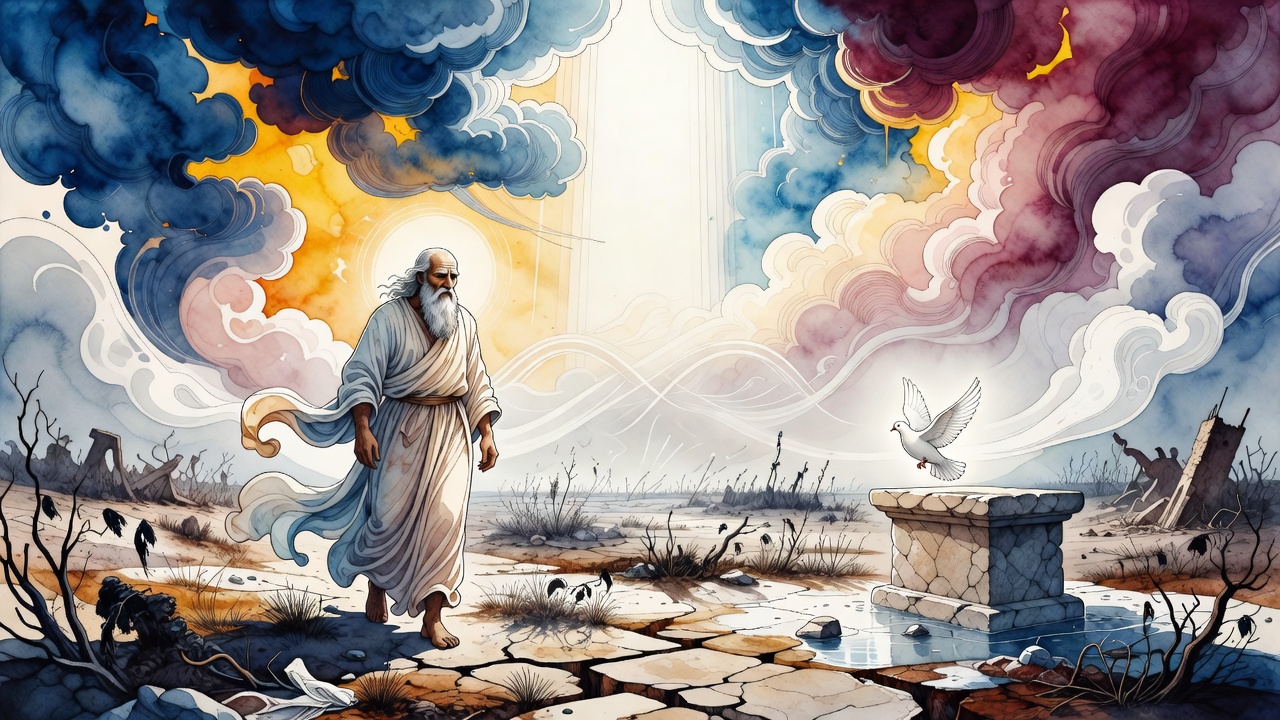
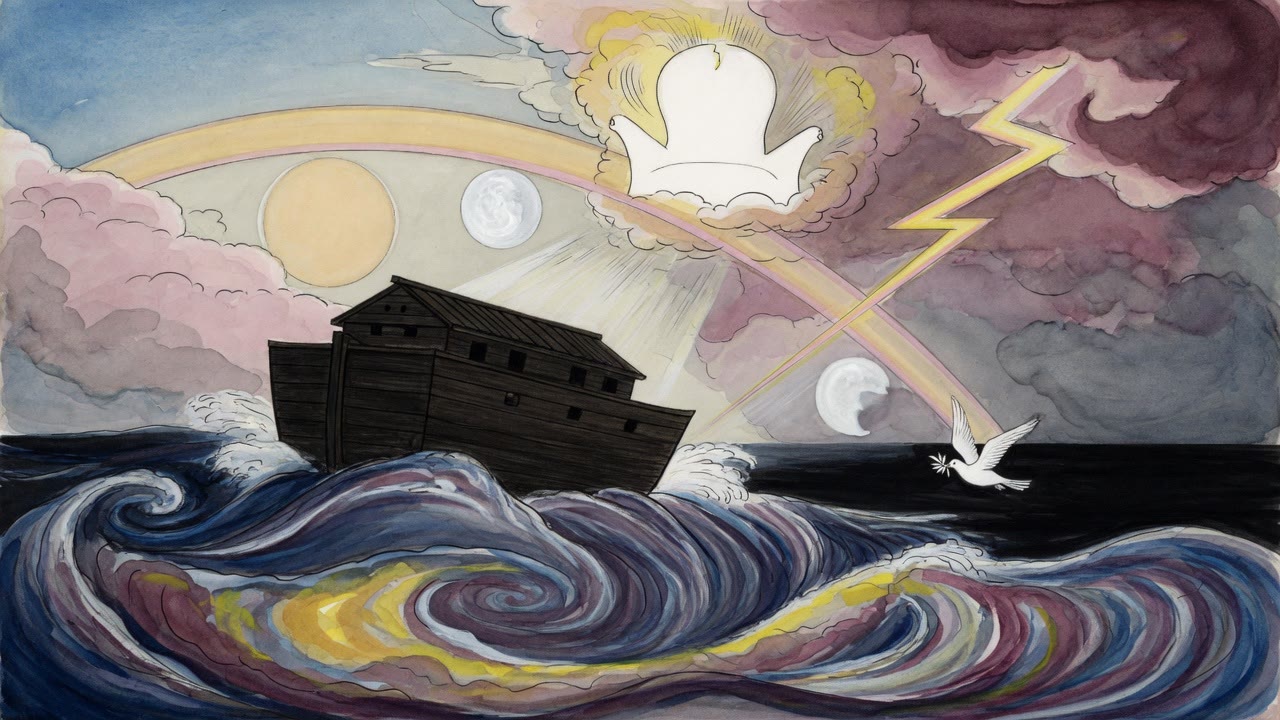
Noah Walks Alone as the Whole World Rots

The neighbors laughed while he measured beams, and their children threw stones at the hull. The sky stayed blue long enough to make him look foolish.

Curated by Arthur · Told by Maggid ·
Table of Contents
  1. The Street Before the Rain
  2. Noah, Noah
  3. Wood, Animals, and the Wait
  4. Raven, Dove, and the Clean Bird
  5. Equal Among the Called
Noah Walks Alone as the Whole World Rots Click for full size

The Street Before the Rain

Noah walked through a world that had decided violence was weather. Men took what they wanted and called the taking strength. Markets sold more than grain; they sold people in small ways and large. The earth itself seemed to bruise under footprints. Scripture would say all flesh corrupted its way (Genesis 6:12). Noah already smelled the rot without needing the verse.

He was not pure by accident. He was pure against a current. Loneliness stuck to righteousness like pitch to wood. Neighbors laughed when he measured beams. Children threw stones at the rising hull and learned from adults that mockery is free entertainment.

Noah kept cutting wood. The sky stayed blue long enough to make him look foolish. Foolishness in the service of a warning is still a kind of faith.

Noah, Noah

"These are the generations of Noah; Noah..." The name doubled, and heaven refused to let the echo be a scribe's slip. Neyaḥa, neyaḥa: relief, relief. Double comfort in an age that manufactured none. Some would later whisper he was righteous only by comparison, a tall man among people who had chosen to crawl. The Torah says his name twice to stop that whisper. Before God he stands equal to Abraham, crowned with the same doubled call that will one day find Abraham at the binding, Jacob in the night, Moses at the bush, Samuel in the dark.

The repeated name is not flattery. It is a legal seal on a lonely verdict: this one is mine while the rest drown their chances. Noah heard his name that way in the quiet between hammer blows, as if heaven were practicing how to address him when the rain began.

Relief for the animals that would live. Relief for a world that would need a restart. Relief that stretches, in later hearing, toward final repair still awaited by every generation that knows how close water can come.

Wood, Animals, and the Wait

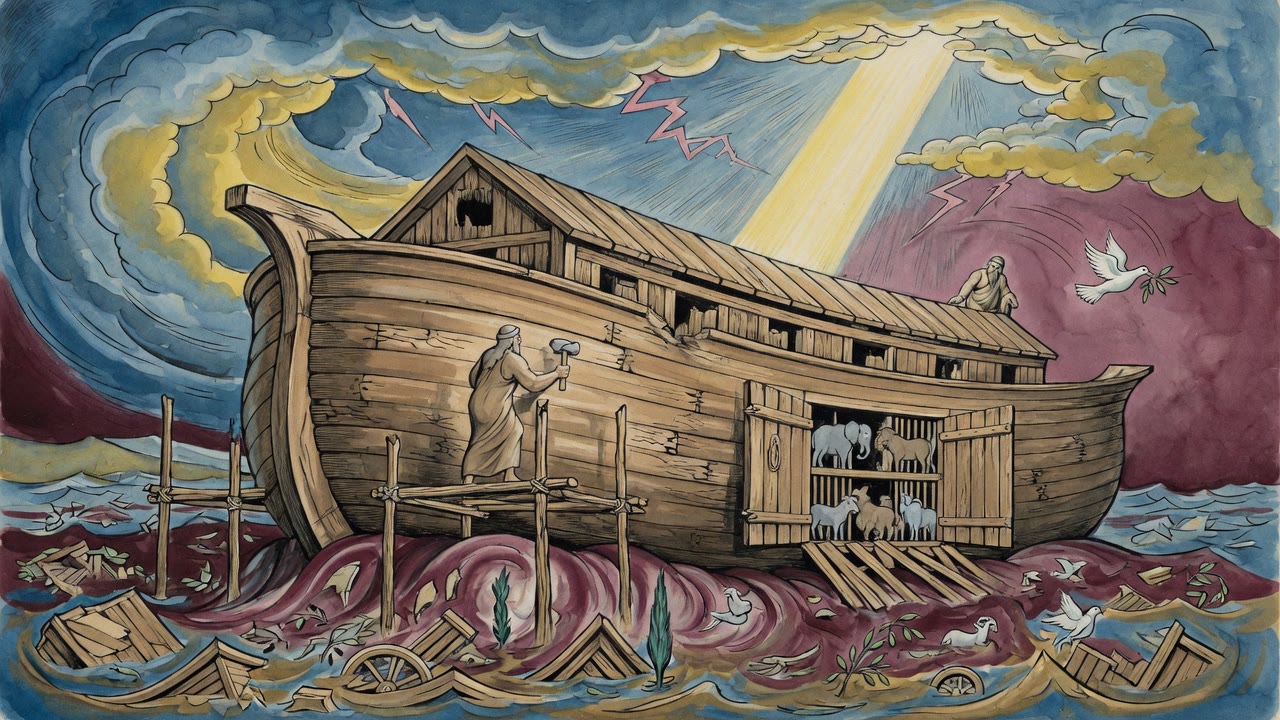
The ark rose in a neighborhood that laughed. Hammers answered mockery. Pitch sealed seams against a storm no cloud still advertised. When the door finally closed, the world outside became sound: water, collapse, the end of arguments that had seemed permanent.

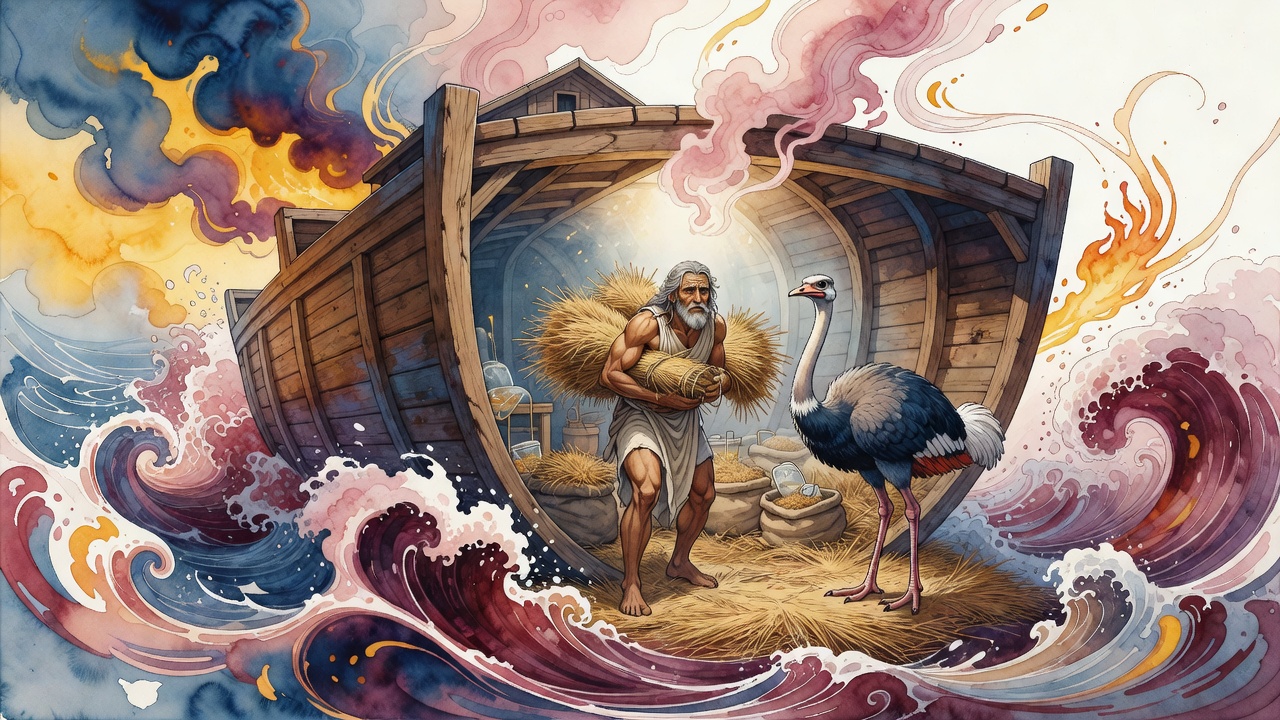
Inside, time was measured in feeding troughs and restless wings. Lions breathed near lambs because there was no room for old hunts. Noah's family spoke softly, as if loud voices might crack the miracle. He waited not only for dry ground. He waited as a man whose doubled name had already named him comfort while comfort was still invisible.

On the ark's third watch of a black night, Noah checked a seam by touch and found it holding. He whispered thanks without audience. The doubled name worked in him like a second heartbeat. Days stacked. Faith became chore charts and the refusal to open the door early.

Raven, Dove, and the Clean Bird

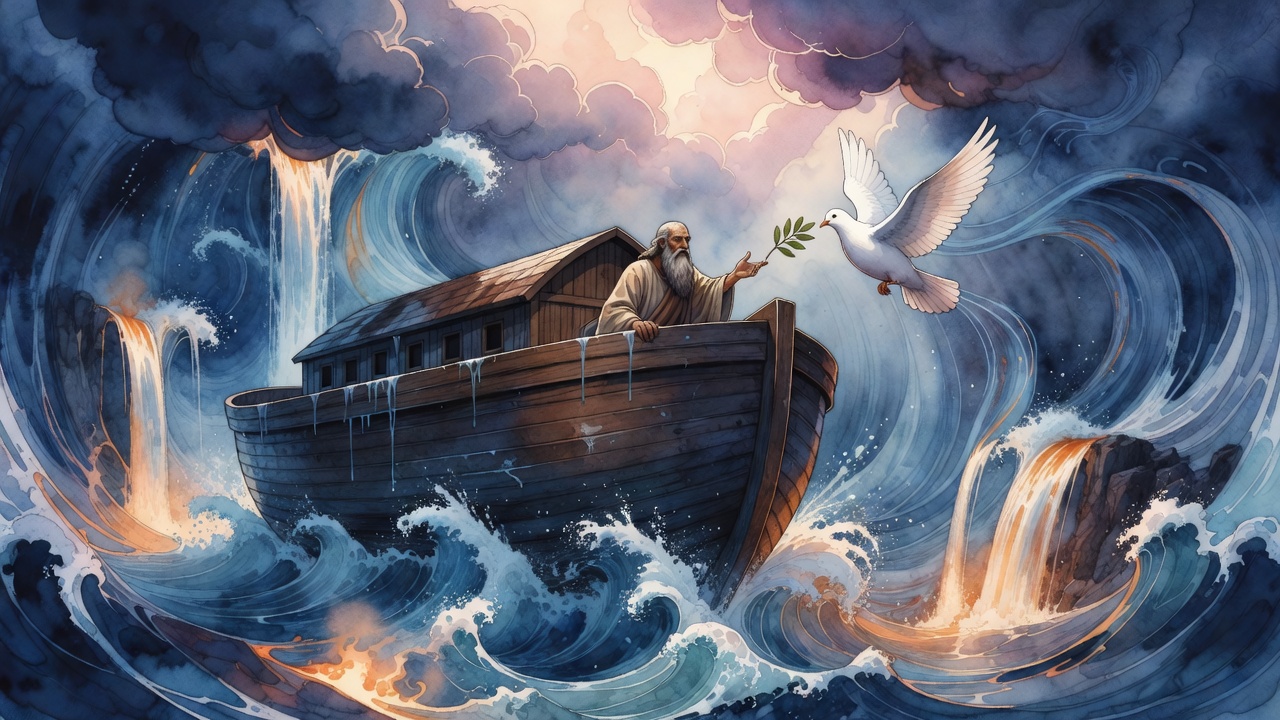
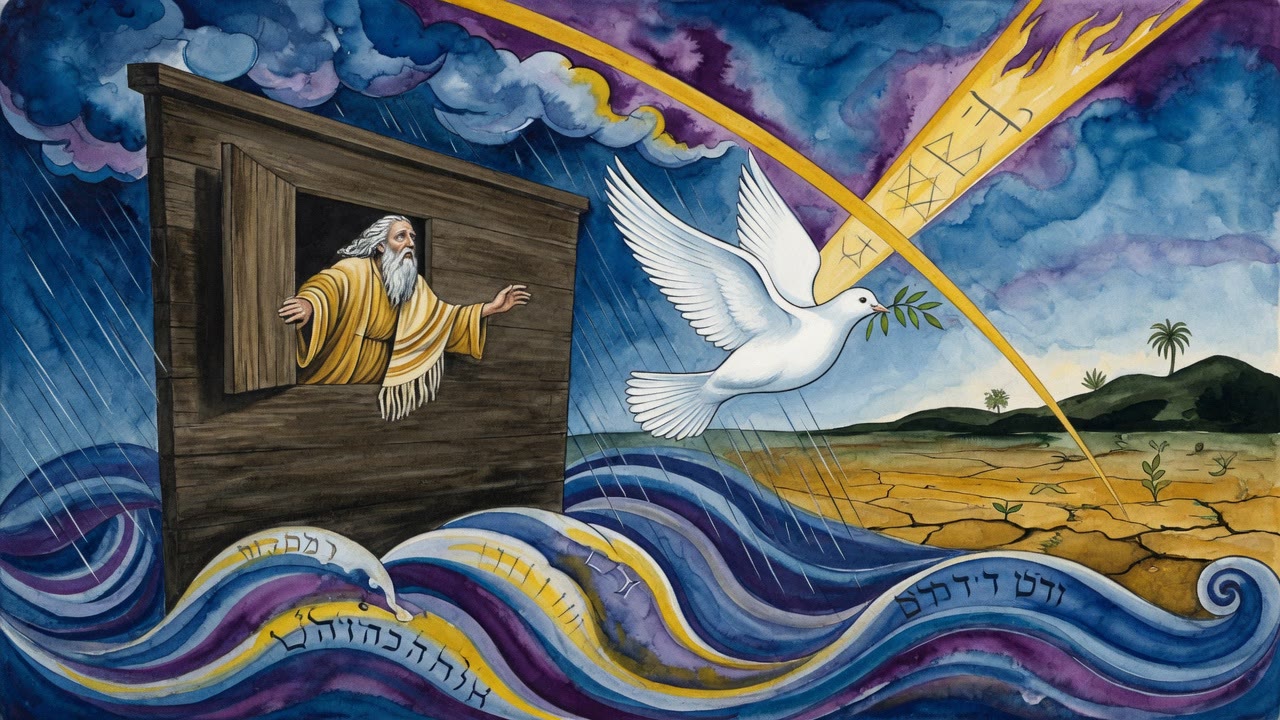
When the ark grounded, Noah opened a window on a washed ruin. He sent a raven, a bird that can live on the leftover death of a drowned world. Then he sent a dove, clean, tame, a creature that seeks human company and can approach an altar without insulting it. The dove's return with olive was not only botany. It was a vote for civilization after chaos, for a bird that knows how to live with people rather than on corpses.

Noah's hands, when they built an altar, already understood the difference. Sacrifice after survival is not payment for ticket price. It is the first sentence spoken in the new grammar of the world. Smoke rose straight in air that had learned to be empty of screams. God smelled the offering and spoke covenant while the ground still drained.

When the dove finally stayed gone, he knew the leaf had been a first word and absence a second. He waited seven more measures of patience, then opened what God alone had closed. The new ground smelled of mud and promise.

Equal Among the Called

The flood ended. The covenant bow hung. Noah planted and also stumbled, because survival does not automate perfection. Still the doubled name remained in the scroll, a permanent answer to the sneer that he was only "good for his time." Heaven had ranked him with the ones it calls twice.

He walks our memory alone on a street that no longer exists, pitch under his nails, animals breathing in the dark, while the Torah refuses to let later ages shrink him. Relief, relief. The world rotted. He built. The waters rose. He waited. The dove found a leaf. He offered.

Somewhere the olive tree that fed the dove kept growing in a world that had almost ended. Somewhere the doubled name still does its quiet work against the old whisper that goodness is only relative. Noah walks on in the telling, not because he was soft, but because he was solid when solidity was rare. His first steps on new soil were careful, as if the ground might remember drowning and refuse weight.


← All myths
From the tradition

Sources

3 sources

The texts behind this telling. Some cards carry a translation of the source; others are our own retelling of it, and each card says which. Every card links out to the original.

Bereshit Rabbah 30:5Bereshit Rabbah

Retold in our words. Read the original at the link below.The Sefaria Midrash Rabbah, 2022 · CC-BY

In a fascinating passage from Bereshit Rabbah, the ancient rabbinic commentary on Genesis, we find the figure of Noah held up as a source of just that: double relief.

It starts with a bit of a puzzle. The verse reads: "These are the offspring of Noah; Noah.." (Genesis 6:9). Seems a little redundant. Why repeat Noah's name like that? Shouldn’t it have just launched into listing his sons – Shem, Ham, and Japheth?

The rabbis of the Bereshit Rabbah weren’t ones to let a perceived redundancy pass by without digging deeper. They saw in this repetition a profound truth about Noah's role, not just as a father, but as a savior. The doubling of his name becomes "neyaḥa, neyaḥa" – relief, relief. A double dose of comfort in a world desperately in need of it.

Relief for whom, exactly? Here's where it gets really beautiful. According to this Midrash (rabbinic interpretive commentary), Noah brought relief on multiple levels.

First, relief for himself. Imagine the burden he carried: tasked with building the ark, gathering the animals, and weathering the storm, all while knowing the destruction that awaited the world. He was a righteous man in a deeply flawed generation. Finding his own peace amidst that chaos was no small feat.

Then, relief for the whole world. Pretty self-explanatory. He literally saved all living creatures from utter annihilation!

But it doesn't stop there. The text goes on: a relief for the ancestors. This is a particularly poignant idea. Apparently, until Noah's time, the remains of the dead were constantly disturbed in their graves (as we find in Bereshit Rabba 25:2). Can you imagine the unrest? Noah’s actions, in some way, brought peace even to those who had passed on.

And, of course, relief for their descendants – for us! Without Noah, there would be no future generations.

The scope widens even further: relief for the heavenly and relief for the earthly. According to some interpretations, he saved the entire universe from destruction. Noah's actions rippled outwards, impacting all of creation.

Finally, Bereshit Rabbah concludes: relief in this world and relief in the World to Come. A complete and total salvation, extending beyond the immediate crisis and into eternity.

So, what does all this mean for us? It's easy to see Noah as a distant figure, a hero of ancient times. But perhaps the Bereshit Rabbah is inviting us to see a little bit of Noah in ourselves. To ask ourselves: Where can we bring relief? To whom? Maybe it's a small act of kindness, a word of comfort, or a commitment to a more just world. Maybe, just maybe, we can each offer our own "neyaḥa" to a world still very much in need.

Full source
Midrash Tanchuma Buber, Noach 6:3Midrash Tanchuma Buber, Noach

Translation of the source text.Midrash Tanchuma (Buber), Public Domain, on Sefaria · CC-BY-SA

Ten people were born circumcised.

Another interpretation of (Gen. 6:9), "These are the generations of Noah, Noah": Why two times? The Holy One, blessed be He, said: It was in order to appease all who come into the world, lest they ponder, saying that he was righteous only in his generation. The Holy One, blessed be He, said: He is equal before Me to Abraham.

Rabbi Judah bar Shallum [the Levite] said: It is stated two times, "Abraham, Abraham" (Gen. 22:11), and likewise with Jacob, and likewise with Moses, and likewise with Samuel, and likewise "Noah, Noah", in order to make the righteous ones equal.

Full source
The Midrash of Philo 8:2The Midrash of Philo

Retold in our words. Read the original at the link below.The Works of Philo Judaeus, trans. C. D. Yonge, London, H. G. Bohn, 1854-1890 · Public Domain

Philo of Alexandria was a Jewish philosopher who lived way back in the first century. He tried to bridge the gap between Greek philosophy and Jewish tradition, and his writings offer some pretty unique interpretations of the Torah.

Here, Philo looks at the story of Noah and the flood. Remember that after the ark landed, Noah sent out birds to see if the waters had receded? First, he sent a raven, and then a dove. Philo asks, why these birds in particular?

His answer is really quite insightful. He points out that the dove is a "clean animal." In other words, it's ritually pure, suitable for sacrifice. And that's important! It shows the dove has a special connection to the sacred. He also says the dove is "tame, civilized, and one which associates with mankind." It’s a creature that seeks connection, seeks community. It's not solitary or aggressive. Because of these qualities, Philo argues, it’s been given the honor of being offered on the altar.

There's more to it than just that. Philo sees the raven and the dove as symbols: wickedness and virtue. The raven, he says, has "no house, nor habitation, nor city." It's an "insolent unsociable bird." for a second. The raven represents someone who is isolated, disconnected, maybe even a little arrogant. The opposite of that is the dove.

The dove, "namely virtue," has "a regard to humanity, and to the public good." This is huge! The dove isn't just about personal piety; it's about caring for others, contributing to the community, working for the common good. So, when Noah – representing righteous humanity – sends out the dove, he's sending out an ambassador of virtue. He's seeking "desirable information" and hoping to avoid what's hurtful and embrace what's useful.

The dove, in Philo's interpretation, isn’t just a bird; it's a symbol of our deepest aspirations. It represents our desire for connection, our commitment to community, and our pursuit of virtue in a world that often feels chaotic and uncertain. So, the next time you see a dove, remember Philo's words and think about the kind of ambassador you want to be in the world.

Full source