6 min read

The Noblewoman Who Forced a Thousand Marriages

She paired a thousand slaves in a single night to mock divine matchmaking. By morning the courtyard rang with broken bones and refusals.

Curated by Arthur · Told by Maggid ·
Table of Contents
  1. Morning in the Courtyard
  2. The Seat Left Empty
  3. Moses Hides His Face
  4. What Would Not Stay Forced

The noblewoman laughed in Rabbi Yosei bar Ḥalafta's face. Six days for creation, she said. What has God been doing since? The rabbi answered without theater. God arranges marriages. He pairs this man with that woman, this house with that dowry. He weighs temperaments the way a merchant weighs coin. The work never ends.
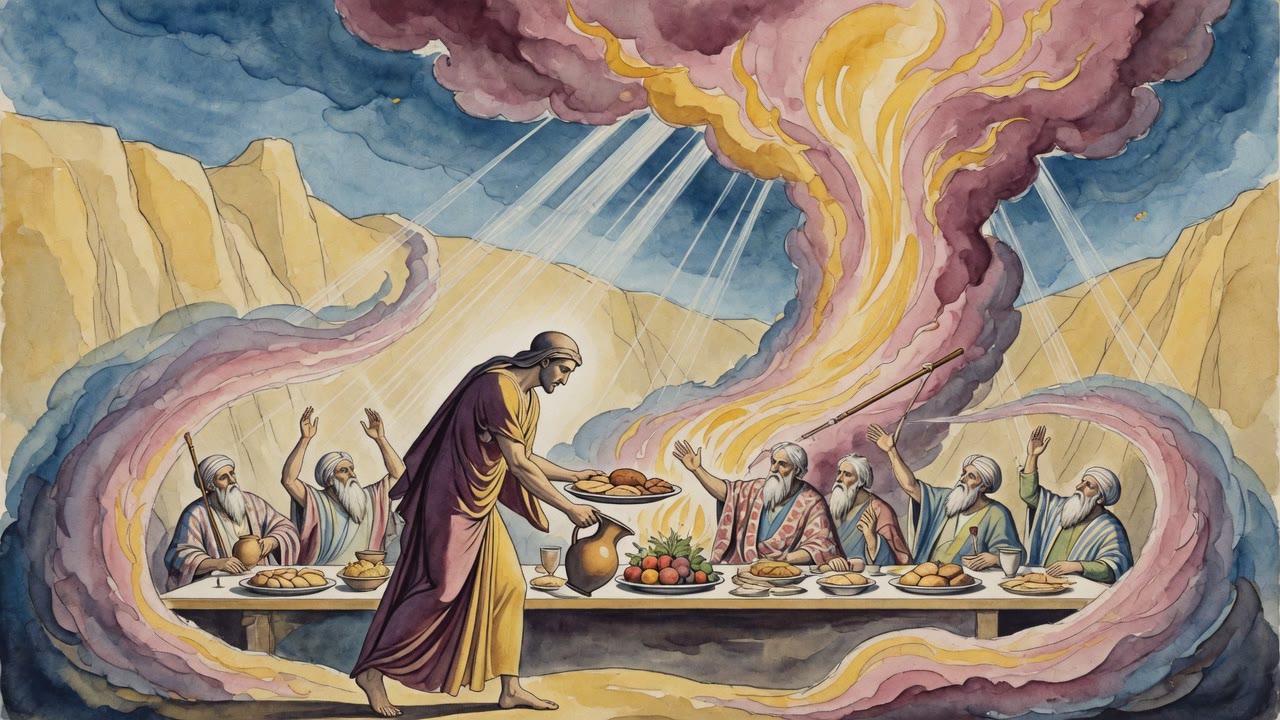
The Noblewoman Who Forced a Thousand Marriages Click for full size

"Is that all?" she said. She owned a thousand male slaves and a thousand maidservants. If matchmaking were the labor of heaven, she would finish it before dawn and still have time to sleep.

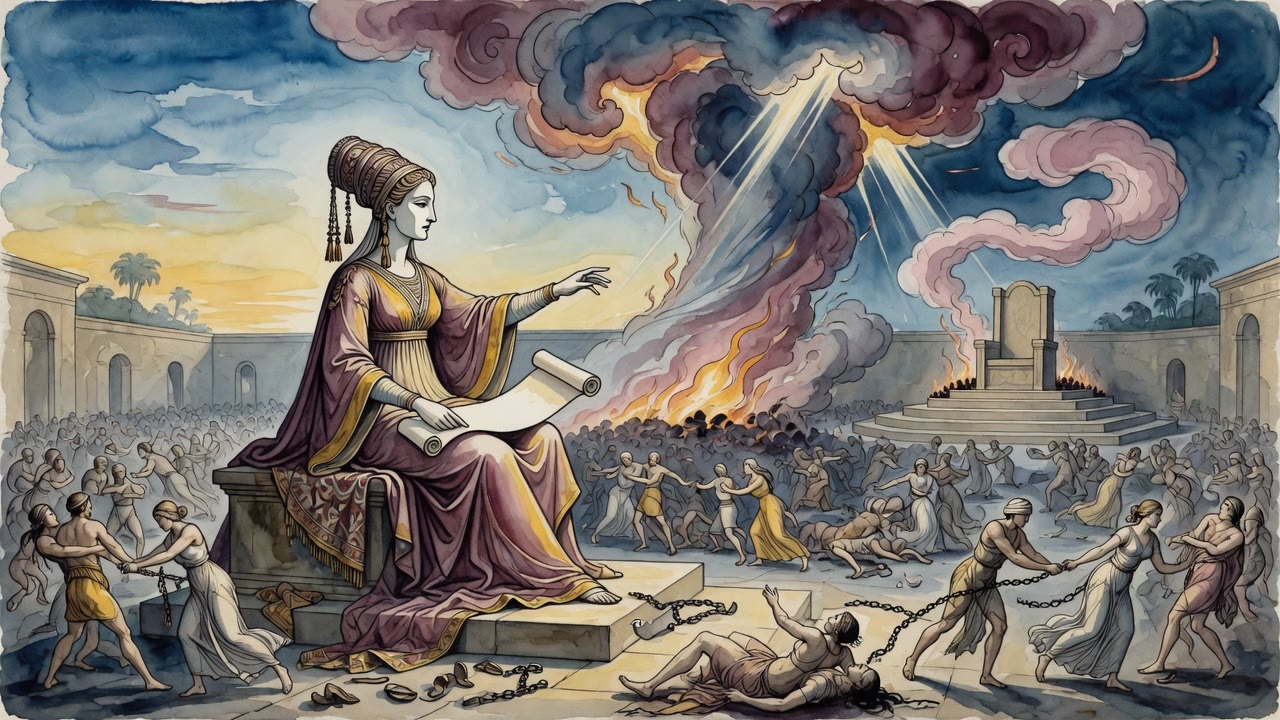
Rabbi Yosei warned her. What looks simple to a human eye is, before the Holy One, as hard as the parting of the Red Sea. She waved the warning off like smoke. She lined the courtyard by torchlight, called names, pointed fingers, and forced the pairs. One night. Two thousand people shoved into marriage by a woman who wanted to prove the sky was idle. Some of them cried. Some of them stared at the dirt. None of them were asked.

Morning in the Courtyard

By first light the compound sounded like a market after a fight. One man's head was open and sticky with blood. Another's eye would not open. An elbow hung wrong. A leg would not take weight. A woman sat on the ground with her hands over her ears. Voices cut across one another in the same raw sentence. "I don't want this one." "I don't want that one." The marriages had held long enough to bruise and not long enough to bind.

She sent for Rabbi Yosei. The confidence had left her mouth. Servants cleared a path through the wreckage. "Rabbi," she said, "your Torah is true. Everything you said was right."

He did not gloat. He did not smile. He repeated the line he had already given her. If it appears simple in your eyes, before the Holy One it is as difficult as the splitting of the sea. Then he set a verse under the wreckage. "God settles the solitary in a home; He liberates prisoners bound in fetters" (Psalms 68:7). In those fetters the verse carries two sounds at once, weeping and song, because a true joining can arrive either way, and a false one arrives only as weeping. The courtyard that morning had only the first sound.

The Seat Left Empty

The same teaching that humbled her house also taught how to enter a room. Rabbi Yehoshua of Sikhnin, in the name of Rabbi Levi, cited the proverb. Better to hear "Come up here" than to be demeaned before a prince (Proverbs 25:7). Rabbi Akiva, in the name of Rabbi Shimon ben Azai, went further. Leave two or three seats between yourself and the place you think you deserve. Wait until they call you forward. Sit lower than your hunger. "Ascend, ascend" is a blessing spoken by other mouths. "Descend, descend" is a public wound no clever speech can dress.

Hillel put the whole ladder into one paradox. My lowering is my elevation. My elevation is my lowering. The proof he offered was not a court custom but a psalm. "Who sits on high, who looks down to see" (Psalm 113:5-6). The One who is highest bends lowest. Anyone who grabs the top seat first is fighting the grain of that heaven. The noblewoman had grabbed two thousand lives the way a guest grabs the head of the table. Morning rearranged the seating for her.

Moses Hides His Face

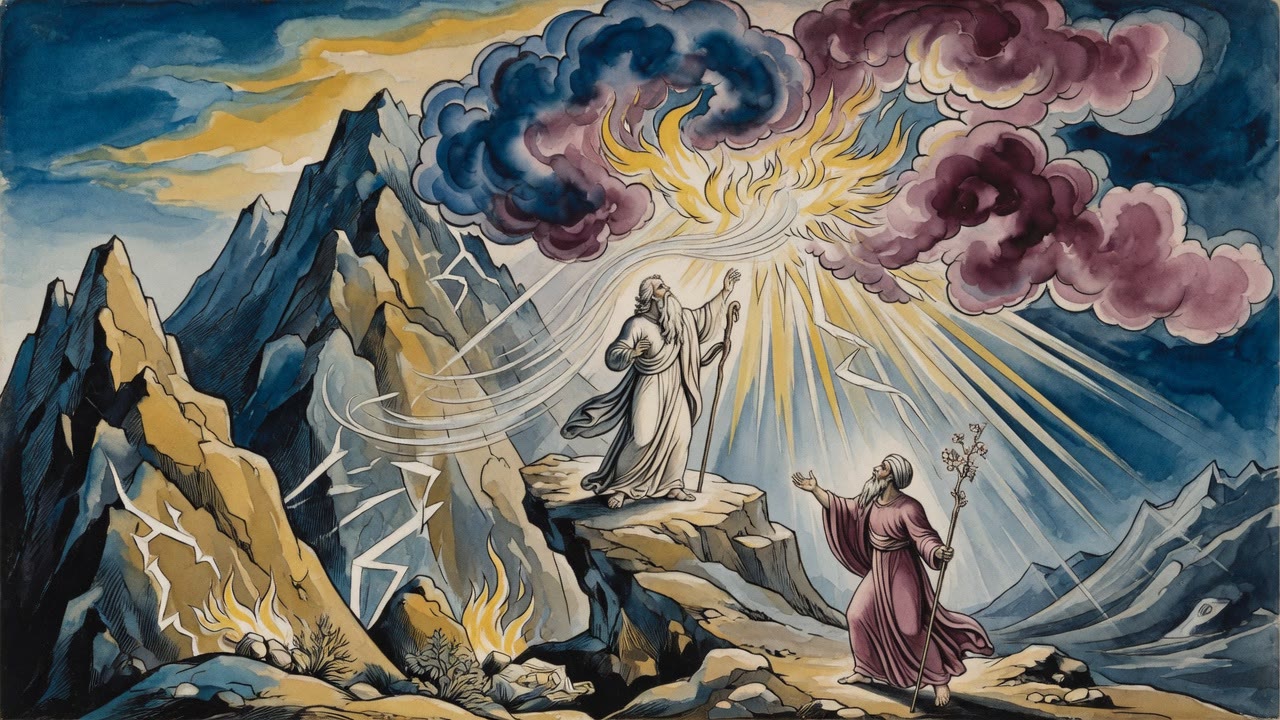
Moses learned the same motion at the bush. Fire held in a thorn without eating it, and he hid his face in the heat of that light. He did not stride into the flame as a man owed a mission. Sand stuck to his knees. When God sent him to Pharaoh, the Hebrew did not only say lekh, go. It said lekha, go for you, go as the one this task fits. Rabbi Elazar heard the edge in it. If you do not redeem them, no one else will. The call did not flatter him into a higher chair. It pressed a whole people onto a man who had just covered his eyes.

That is the opposite of the noblewoman's night. She seized two thousand lives and forced the pattern she wanted before the torches burned down. Moses lowered himself until the pattern found him. One act filled a courtyard with blood and refusals. The other opened a path through a sea that keeps being named whenever a human being pretends pairing is easy, or redemption is a favor a proud mouth can assign.

What Would Not Stay Forced

The slaves did not become a lesson by speech. They became a lesson by limping. The noblewoman had wanted a proof that heaven's work was trivial. She received a proof that will would not stick where fit was missing. Bodies refused the names she had assigned them. Couples that looked neat on a list tore at each other before the sun cleared the wall. The sea she thought she could part with a clap of her hands closed over her certainty instead.

Rabbi Yosei left her with the verse and the warning intact. God was still matchmaking. The work that looked like nothing from a palace balcony had broken a thousand forced doors in a single night. Somewhere beyond that courtyard, the same patience that seats a person two chairs lower was still arranging houses that would hold, slowly, with weeping and with song in their right seasons.

She had wanted to finish God's labor before dawn. Dawn finished her argument instead, and the injured kept saying the only sentence that still made sense in that yard.


← All myths

From the tradition

Sources

2 sources

The texts behind this telling. Some cards carry a translation of the source; others are our own retelling of it, and each card says which. Every card links out to the original.

Vayikra Rabbah 8:1Vayikra Rabbah

Retold in our words. Read the original at the link below.The Sefaria Midrash Rabbah, 2022 · CC-BY

Vayikra Rabbah turns to Aaron's Daily Offering of Fine Flour That Never Ceased.

Then the story really takes off..

A noblewoman, clearly not lacking in confidence, challenges Rabbi Yosei bar Ḥalafta. She asks him a pretty direct question: God created the world in six days, but what's He been up to since then?

Rabbi Yosei, without missing a beat, tells her that God is busy with matchmaking. He’s arranging marriages, deciding who gets which dowry – basically, the divine version of a dating app.

The noblewoman scoffs. “Is that all?” she asks, thinking she can do better. She boasts about her own vast household of slaves and maidservants, claiming she could arrange marriages between them in no time.

Rabbi Yosei, with a touch of knowing wisdom, warns her: "If it appears simple in your eyes, before the Holy One blessed be He it is as difficult as the parting of the Red Sea." Big words. He basically tells her that what seems easy to her is incredibly complex in the grand scheme of things.

Of course, she doesn't listen. She gathers her thousand slaves and thousand maidservants, pairs them up, and forces them into marriage – all in one night!

The next morning? Chaos. Absolute chaos.

People are injured, resentful, and absolutely miserable. One's head is wounded, another's eye is gouged out, someone else's elbow is shattered, and yet another's leg is broken. Everyone is yelling, "I don't want this one!" and "I don't want that one!"

Humiliated, she calls Rabbi Yosei back. "Rabbi," she admits, "your Torah is true. Everything you said was right."

Rabbi Yosei, vindicated, replies, "Is that not what I said to you? If it appears simple in your eyes, before the Holy One blessed be He it is as difficult as the parting of the Red Sea!" He then quotes (Psalms 68:7): "God settles the individuals in a home; He liberates prisoners bound in fetters [bakosharot]."

Now, bakosharot is interesting. The Midrash (rabbinic interpretive commentary) interprets it as "with weeping [bekhi] and with song [veshirot]." Meaning, some matches bring joy, others bring sorrow. As the Matnot Kehuna commentary puts it, even when it's not to their liking, God sometimes matches people up and ensures that they remain together. Rabbi Yosei implies that God’s matchmaking isn’t just about pairing people, but about the whole messy, complicated journey of relationships.

Rabbi Berekhya adds another layer to the interpretation. He says that Rabbi Yosei told her, "The Holy One blessed be He sits and crafts ladders; He elevates this one and humbles that one," quoting (Psalms 75:8) again: "For God is judge; He humbles this one and elevates that one."

And finally, Rabbi Yona Botzri interprets the verse in relation to the people of Israel and Aaron, using the word "this." They were humbled by the term "this" when they said, "For this [man] Moses [who brought us up from the land of Egypt, we do not know what became of him]" (Exodus 32:1) right before creating the Golden Calf. But they were elevated by the term "this" in the commandment "This they shall give, everyone who passes [among the counted: Half a shekel in the sacred shekel]" (Exodus 30:13), referring to the donations for the Tabernacle.

Similarly, the Rabbis interpret that Aaron was humbled by "this" when he said, "I cast it into the fire and this calf emerged" (Exodus 32:24), but he was elevated by "this" in the verse, "This is the offering of Aaron and his sons..."

So, what does it all mean? Is God really just a cosmic matchmaker? Perhaps. But more profoundly, this passage suggests that God is involved in the intricate details of our lives, even the ones that seem mundane. It highlights the complexity of human relationships and the idea that even in our successes and failures, there's a divine hand at work, humbling us and elevating us, shaping us into who we are meant to be. And maybe, just maybe, finding us the right match along the way, whether we like it or not.

Full source
Vayikra Rabbah 1:5Vayikra Rabbah

Retold in our words. Read the original at the link below.The Sefaria Midrash Rabbah, 2022 · CC-BY

It turns out, our tradition has some pretty profound things to say about it.

Vayikra Rabbah, a collection of Midrashic (rabbinic interpretive commentary) interpretations on the Book of Leviticus (Vayikra in Hebrew), dives right into this very human experience.

Rabbi Akiva, in the name of Rabbi Shimon ben Azai, takes it a step further. He suggests keeping two or three seats between you and where you think you should be. Wait. Be patient. Let them ask you to come forward. Because, as he puts it, it's preferable that they say, "Ascend, ascend," rather than "Descend, descend." Ouch. Nobody wants that.

Hillel, of "on one foot" fame, chimes in with a paradox: "My lowering is my elevation; my elevation is my lowering." So, where does this seemingly upside-down wisdom come from? The source, according to the Midrash, is (Psalm 113:5-6): "Who sits on High, who looks down to see." It's a reminder that true greatness often involves humility.

But what does this look like in practice? The Midrash brings Moses into the picture. And who better to illustrate humility than the man who spoke to God face-to-face?

We're told that when God first revealed Himself to Moses in the burning bush, Moses hid his face. He was overwhelmed, perhaps even afraid. And God’s response? "Lekha, go, and I will send you to Pharaoh…" (Exodus 3:10).

Now, Rabbi Elazar points out something fascinating here. The word "go" is usually lekh in Hebrew. But here, it's lekha, which can also mean "for you." The Midrash interprets this to mean that Moses was uniquely suited, perhaps even the only one, who could fulfill this mission. "If you do not redeem them," God implies, "no one else will."

We see this pattern repeated throughout Moses's life. At the Red Sea, he held back. God said, "You, raise your staff…and split it" (Exodus 14:16). Again, that emphasis on "you." At Sinai, he stood to the side. God called, "Ascend to God, you" (Exodus 24:1). And at the Tent of Meeting, Moses hesitated, and God essentially said, "What are you waiting for? The hour awaits only you."

The ultimate proof? “He called to Moses.” From all of them, the divine speech called only to Moses.

The Zohar, the foundational text of Kabbalah, often speaks of the importance of bittul, self-nullification. It's not about being a doormat, but rather about recognizing that we are part of something larger than ourselves. True leadership, true greatness, comes from a place of humility, from recognizing that sometimes, the most powerful thing we can do is to step back and listen for the call.

So, the next time you find yourself wondering if you're in the right seat, remember Moses, remember Hillel's paradox, and remember that sometimes, lowering ourselves is the surest path to elevation. What do you think?

Full source