6 min read

Pharaoh Searched His Book for the Living Lord

On coronation day Moses and Aaron came empty-handed. Pharaoh scanned his register of gods, found no LORD, and sneered until plagues rewrote the list.

Curated by Arthur · Told by Maggid ·
Table of Contents
  1. Empty Hands at a Festival of Crowns
  2. The Charge With Two Faces
  3. Judgment, Then Mercy, in One Breath
  4. What the Register Could Not Hold
Pharaoh Searched His Book for the Living Lord Click for full size

Empty Hands at a Festival of Crowns

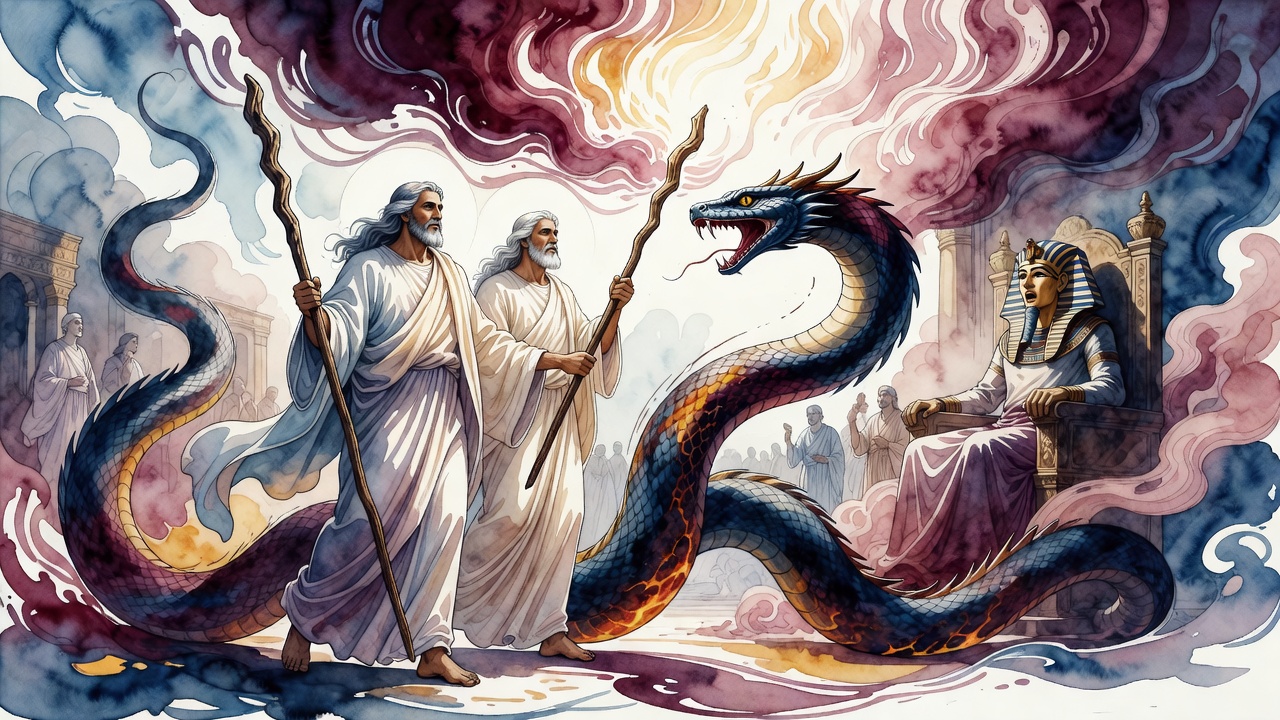
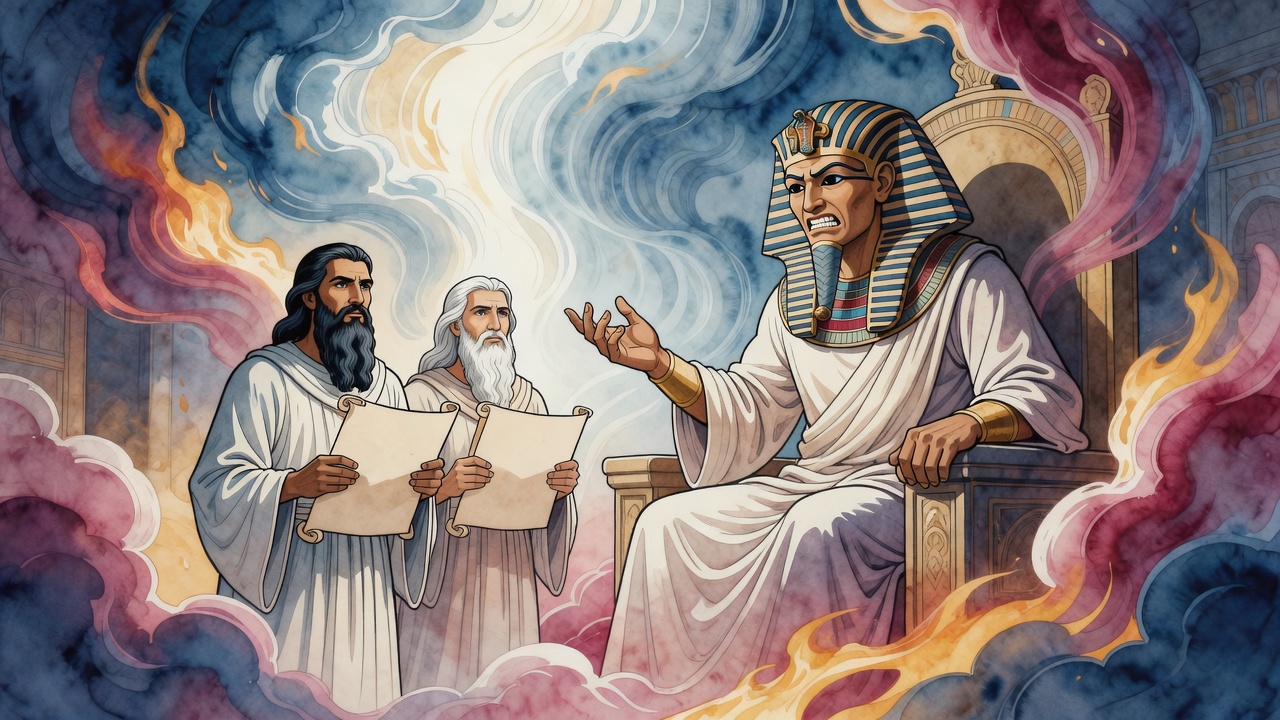
Kings arrived with glittering tribute to crown the world-ruler. Moses and Aaron stood at the palace gate with nothing in their hands. Attendants reported two old men waiting. Pharaoh's first question was whether they carried crowns. Told they did not, he sneered: let them in last. The festival throng parted for gold and closed again on the brothers like water over stones.
When they finally stood before him and declared that the God of the Hebrews demanded His people for worship in the wilderness, Pharaoh threw back the line that still stings: "Who is the LORD, that I should heed His voice?" He could not even send me a crown, the king scoffed, but comes with mere words. In a room built to worship power, words without tribute sounded like insult.

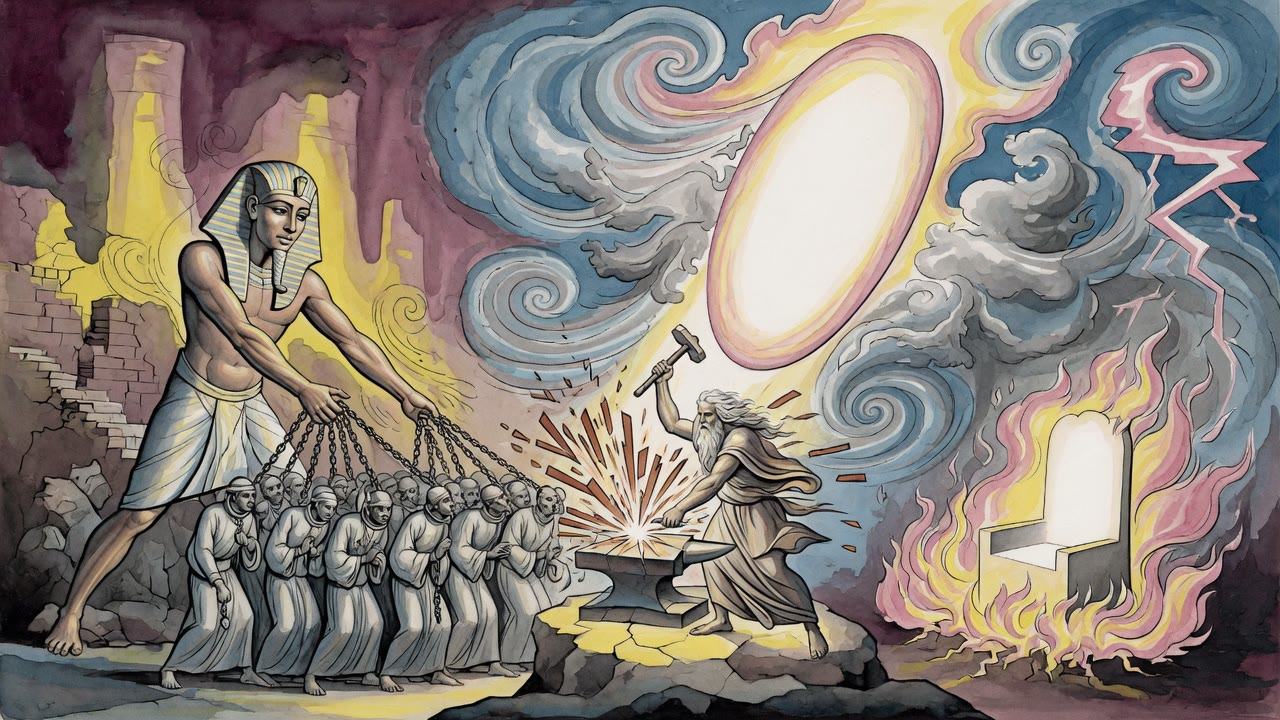
Rabbi Levi pictured Pharaoh fetching his register of gods and reading down the list: the god of Edom, of Moab, of Sidon. Then the announcement, smug as a clerk: I have searched and your God is not here. Moses' reply cut. Fool of the world, the gods on your list are dead, but our God is living and enduring. Looking for the living God among dead idols, Rabbi Levi said, is like a slave hunting his master among graves, only to be asked whether he expects a living man in a cemetery.

The court laughed the way courts laugh when the king has already decided the joke. Moses did not laugh. Aaron did not laugh. The register closed with a soft sound that would soon be answered by a river turning red.

The Charge With Two Faces

The charge God gave the brothers had two edges. Break with idolatry. Honor the crown enough not to strip kingship of its last public dignity even while breaking its power. The midrash holds both without sanding either. Idolatry must fall. A king, even a wicked one, is still addressed with a care that refuses cheap humiliation as a spiritual goal.

Rabbi Yehudah ben Beteira presses why enslaved Israel sometimes failed to rejoice at news of freedom. Tell a man his master is setting him free while the lash still falls, and joy can choke. The people needed more than a slogan. They needed a God who would prove Himself against the register Pharaoh trusted. Shortness of spirit and hard labor made even good news hard to hear.

Moses left that first audience with worse conditions on his people, not better. Bricks without straw. Quotas unchanged. The living God had been named, and the dead list had laughed. Overseers beat men who could not invent clay from dust on command. The brothers walked out under a sky that looked unchanged and a history that had just turned a corner.

Moses turned upward with a complaint sharp enough to put him on trial. Why have You brought harm on this people? Why did You send me? The questions were not polished. They were the questions of a man who had believed the arrow of speech and then watched the wounds multiply.

Judgment, Then Mercy, in One Breath

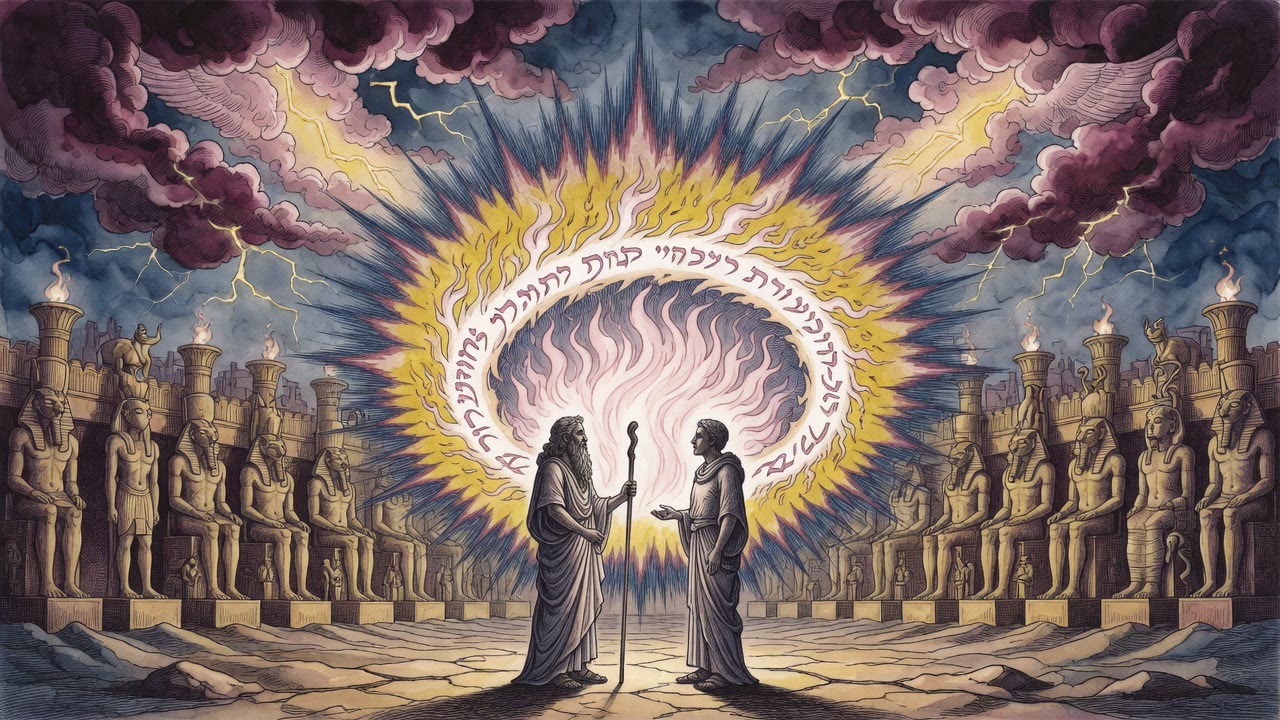
Va'era opens: "And God spoke to Moses and said to him, I am the LORD." Two names in a single breath. Elohim signals the Judge. The four-letter Name signals mercy. Why was Moses on trial? Because after Pharaoh only deepened the suffering, Moses demanded an accounting. Ecclesiastes is cited: oppression can make even a wise man foolish. Even Moses faltered under the weight. Worldly trouble can pull a person away from the gift of Torah. The midrash does not hide the falter.

The verse stages a heavenly tribunal. When it says God spoke, the Judge took His seat. Then a defending advocate argued for mercy. That is why the verse continues, "I am the LORD," the Name later proclaimed as merciful and gracious. Judgment rose. Compassion answered inside the same sentence. The courtroom did not adjourn between the two. It changed mode without changing the Speaker.

The man who had mocked a dead register would now watch living plagues rewrite the list. The man who had questioned Heaven would be held and then held up. Mercy did not cancel the mission. It restored the messenger to the mission with a Name that could carry both justice and pity into Egypt's streets.

Now you shall see, Heaven had said in another breath of insistence. Seeing would cost Egypt its water, its livestock, its firstborn. Seeing would also cost Moses his last illusions about easy redemption.

What the Register Could Not Hold

Pharaoh's book was long. It was also a cemetery catalog. Every name on it could be filed, ranked, and ignored when convenient. The God who sent two empty-handed brothers would not fit a line item between Moab and Sidon. Living presence refuses a slot on a dead list.

Moses learned that day that coronation gold is not the same as authority. Aaron learned that last place in a festival line can be first place in a longer story. Israel learned, slowly, through worse labor and then through blood and frogs, that the cemetery search had been the king's confession of blindness. Who is the LORD? The question was meant as contempt. It became the title of the war.

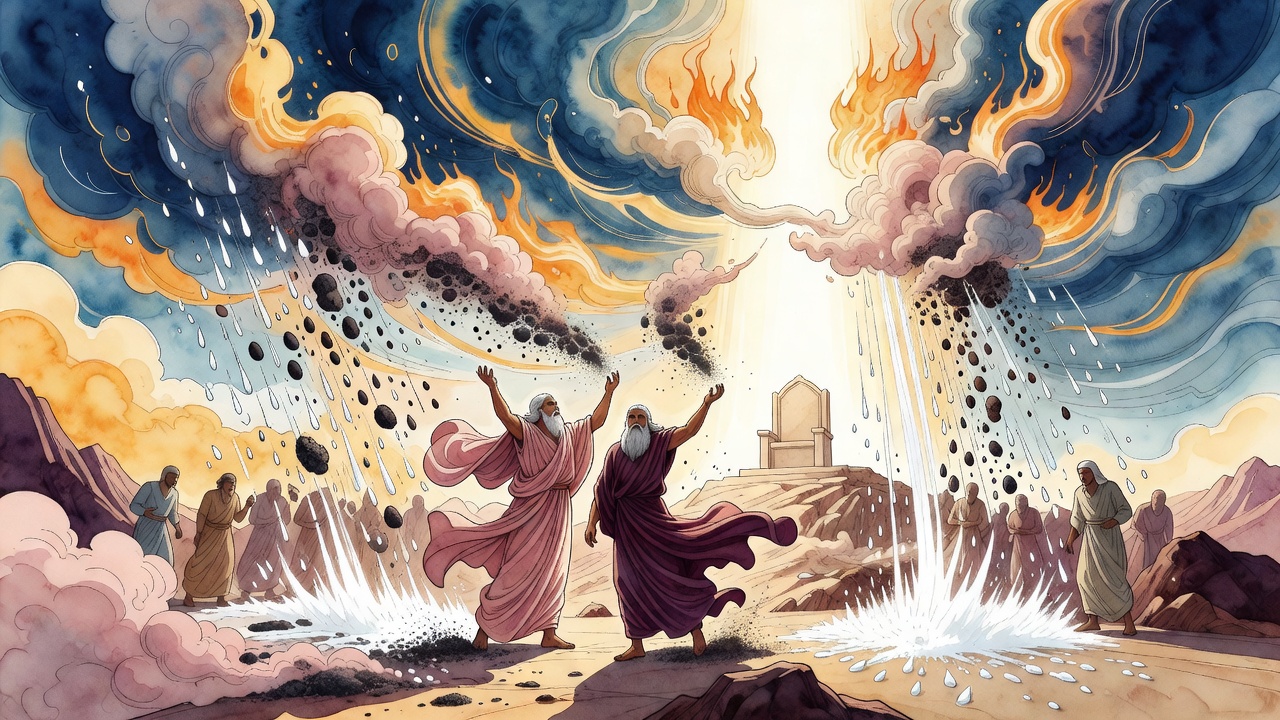
The register closed. The river opened its mouth. Mercy and judgment, still braided from Va'era's first verse, walked into Egypt together. Pharaoh would keep asking for signs as if signs were tribute. The brothers would keep coming without crowns, carrying only a Name that no clerk could find among the graves.

Empty hands had been the correct offering all along. The festival of crowns had mistaken weight for worth. By the time the last plague fell, the only crown that mattered was the one Pharaoh could not keep on his head in the midnight streets.


← All myths
From the tradition

Sources

3 sources

The texts behind this telling. Some cards carry a translation of the source; others are our own retelling of it, and each card says which. Every card links out to the original.

Yalkut Shimoni on Torah 175:1Yalkut Shimoni on Torah

Translation of the source text.Torat Emet (Yalkut Shimoni) · CC-BY-NC

Rabbi Chiyya bar Abba said: it was a coronation day [yom genusya], and all the kings were coming and crowning him, for he was a world-ruler, and Moses and Aaron were standing at the entrance of the palace. They entered to Pharaoh and said to him, "Two old men are standing at the entrance of your palace." He said to them, "Do they have crowns in their hands?" They said to him, "No." He said to them, "Let them enter last." They entered to Pharaoh. He said to them, "What do you seek?" They said to him, "The God of the Hebrews has sent me to you" (Exodus 7:16), "Send out My people that they may celebrate a feast to Me in the wilderness." He said to them, "Who is the LORD that I should heed His voice" (Exodus 5:2), and He did not even know how to send me a crown of His own, but came to me only with words? "Who is the LORD that I should heed His voice?" Rabbi Levi said: at that hour he brought out the register [diftera] of deities and read out, "the god of Edom, Moab, and Sidon," and said to them, "Behold, I have read and I do not find what you speak of." Rabbi Levi said: to what is the matter comparable? To a priest who had a slave. The priest went out from the province, and his slave went to seek him among the graves. He began to cry out, "My master! My master!" They said to him, "Who is your master?" He said to them, "So-and-so the priest." They said to him, "Fool of the world, do you seek a priest in a cemetery?" So Pharaoh said to Moses, "Who is the LORD? I have brought out the register of deities and sought Him within it and did not find Him." He said to him, "Fool of the world, the deities in your hand are dead, but our God is living and enduring," as it is said (Jeremiah 10:10), "But the LORD God is truth; He is the living God and the everlasting King."

Full source
Yalkut Shimoni on Torah 176:6Yalkut Shimoni on Torah

Translation of the source text.Torat Emet (Yalkut Shimoni) · CC-BY-NC

Parashat Va'era. "And God spoke to Moses and said to him, I am the LORD" (Exodus 6:2). This is what Scripture says: "Hear, My people, and I will speak; O Israel, and I will testify against you; God, your God, am I" (Psalms 50:7). Rav Pinchas the Priest son of Chama said: The Holy One, blessed be He, said to Moses, Because I called you God, as it is said, "See, I have made you a god to Pharaoh" (Exodus 7:1), I am your God; and therefore it is said, "And God spoke to Moses." This is what Scripture says: "For oppression makes a wise man foolish" (Ecclesiastes 7:7) -- when a wise man busies himself with affairs, they confuse him away from wisdom; "and a gift destroys the heart" -- away from the Torah, which is called a gift, as it is said, "and from Mattanah [gift] to Nahaliel" (Numbers 21:19). Even Moses: as it is said, "And Moses returned to the LORD and said, Lord, why have You dealt ill with this people, and from the time I came to Pharaoh" (Exodus 5:22-23). And the LORD said to Moses, "Now you shall see" what I do to Pharaoh and to Egypt you will see, but you will not see, and so on.

At that moment the Holy One, blessed be He, sought to sit in judgment over him. From where? As it is said, "And God spoke to Moses," and "God" means nothing other than a judge, as it is said, "You shall not curse the judges [Elohim]" (Exodus 22:27). Then advocacy entered and pleaded merit on his behalf, as it is said, "And He said, I am the LORD"; and "the LORD" means nothing other than mercy, as it is said, "The LORD, the LORD, God merciful and gracious" (Exodus 34:6).

Full source
Yalkut Shimoni on Torah 178:2Yalkut Shimoni on Torah

Translation of the source text.Torat Emet (Yalkut Shimoni) · CC-BY-NC

Another interpretation: "And He charged them." He charged them to separate from idolatry. Rabbi Yehudah ben Beteira says: Behold it says, "And they did not listen to Moses because of shortness of spirit" (Exodus 6:9). Now, is there a man who is told good news and does not rejoice? A male child has been born to you, your master is setting you free, and he does not rejoice? If so, what does Scripture mean by "and they did not listen to Moses"? Rather, it was hard in their eyes to separate from idolatry. And so it says, "And I said to them, Cast away, every man, the detestable things of his eyes, and do not defile yourselves with the idols of Egypt; but they rebelled against Me and would not listen to Me. Yet I acted for My name's sake, that it should not be profaned" (Ezekiel 20:7-9). And so it says, "Draw out and take for yourselves" (Exodus 12:21): draw your hands away from idolatry and cling to the commandments.

"And He charged them concerning the children of Israel and concerning Pharaoh king of Egypt": He charged them to show honor to the kingdom. And so, "And all these your servants shall come down to me" (Exodus 11:8); there is no need to say "these," except that it was Pharaoh himself who would in the end come down, but Moses showed honor to the kingdom. So too we find with Joseph, who showed honor to the kingdom, as it is said, "Without me, God will answer for the welfare of Pharaoh" (Genesis 41:16). So too we find with Jacob, who showed honor to the kingdom, "And Israel strengthened himself and sat upon the bed" (Genesis 48:2). So too we find with Elijah, who showed honor to the kingdom, as it is said, "And the hand of the LORD was upon Elijah, and he girded up his loins and ran before Ahab" (1 Kings 18:46). So too we find with Hananiah, Mishael, and Azariah, who showed honor to the kingdom, as it is said, "Then Nebuchadnezzar drew near to the door of the burning fiery furnace." So too we find with Daniel, who showed honor to the kingdom, as it is said, "And when he came to the den, he cried out to Daniel with a grieved voice" (Daniel 6:21); what does Daniel say? "Then Daniel spoke with the king, O king, live forever" (Daniel 6:22).

Rabbi Akiva says: Every chapter that is adjacent to its neighbor learns from it, as it is said, "And Israel dwelt in Shittim" (Numbers 25:1). Rabbi says: Chapters are placed next to one another yet are as far from one another as east is from west. Similarly you say, "Behold, the children of Israel have not listened to me," yet the Omnipresent had said to him, "And they will listen to your voice" (Exodus 3:18). Similarly you say, "And the daughter of a priest, when she profanes herself by harlotry" (Leviticus 21:9), and "the priest who is highest among his brethren" (Leviticus 21:10); and what has this matter to do with that, is he too to be burned? A parable: to what is the matter like? To an officer who completed his years of service and did not fulfill his office but fled and went off. The king sent and brought him and sentenced him to have his head cut off. Before he went out to be executed, the king said: Fill a measure with gold dinars and carry it before him, and say, Had you done as your fathers did, you would have received a measure of gold dinars; now you have lost your life and lost your money. So with the daughter of a priest who committed harlotry: the High Priest goes out before her and says to her, Had you acted as your mother acted, you would have merited that a High Priest like me should come forth from you; now you have destroyed yourself and destroyed your honor.

Similarly you say, "For you are not My people" (Hosea 1:9), and it says, "And the number of the children of Israel shall be as the sand of the sea" (Hosea 2:1); and what has this to do with that? A parable: to a king who became angry with his wife and sent for his scribe to come and write her a bill of divorce; but before the scribe came, the king was reconciled to his wife. The king said: Is it possible that this scribe should go out from here empty-handed? Rather he said to him, Come, for I am doubling her marriage settlement. Similarly you say, "Samaria shall bear her guilt, for she has rebelled against her God" (Hosea 14:1), and it says, "Return, O Israel, to the LORD" and so forth; and what has this to do with that? A parable: to a province that rebelled against the king. He sent a commander to destroy it. That commander was experienced and level-headed. He said to them, Take for yourselves days to return to the king; and if not, behold I will do to you as I did to such-and-such a province and its neighbors, and to such-and-such a prefecture and its neighbors. Therefore it says, "Samaria shall bear her guilt; return, O Israel."

Full source