5 min read

God Struck Pharaoh's Hunters Mute, Deaf, and Blind

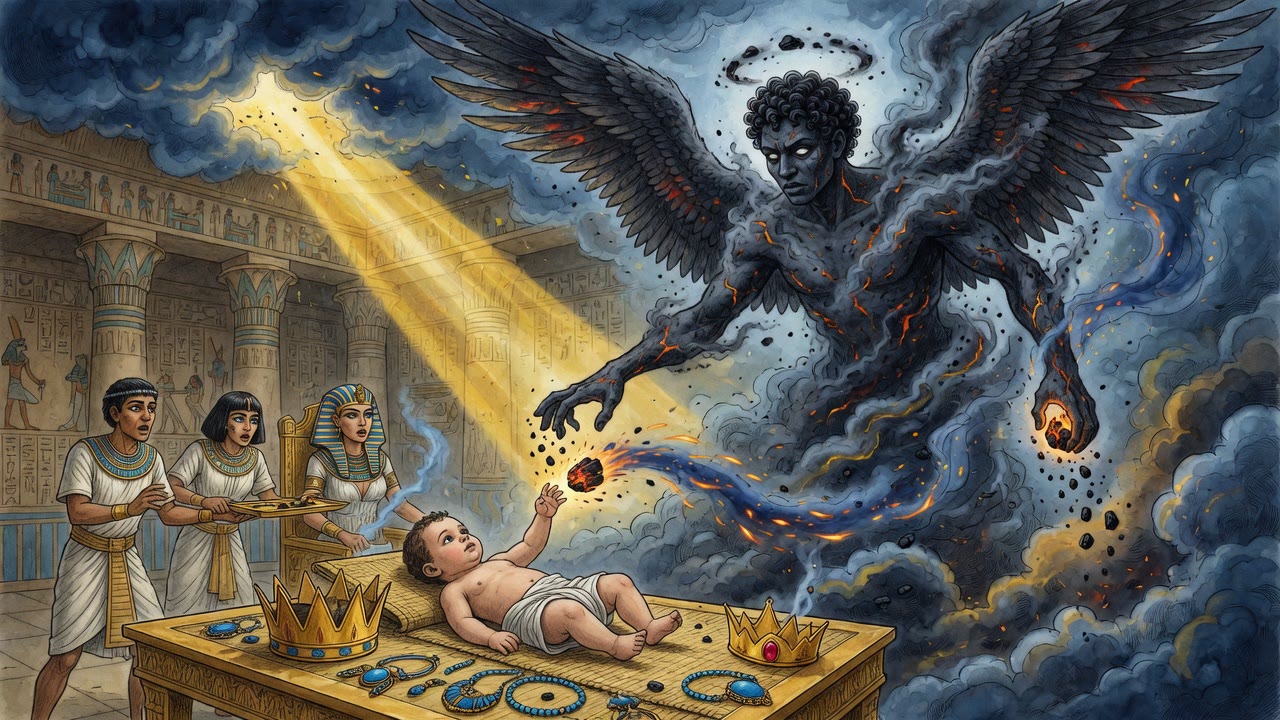
After Moses struck the taskmaster, Pharaohs hunters closed in. God did not kill them. He emptied their mouths, ears, and eyes mid-chase.

Curated by Arthur · Told by Maggid ·
Table of Contents
  1. Mouths Went Empty on the Road
  2. Ears and Eyes Closed in Order
  3. Blood for You as a Sign
  4. When Waters Everywhere Split and Two Seas Met

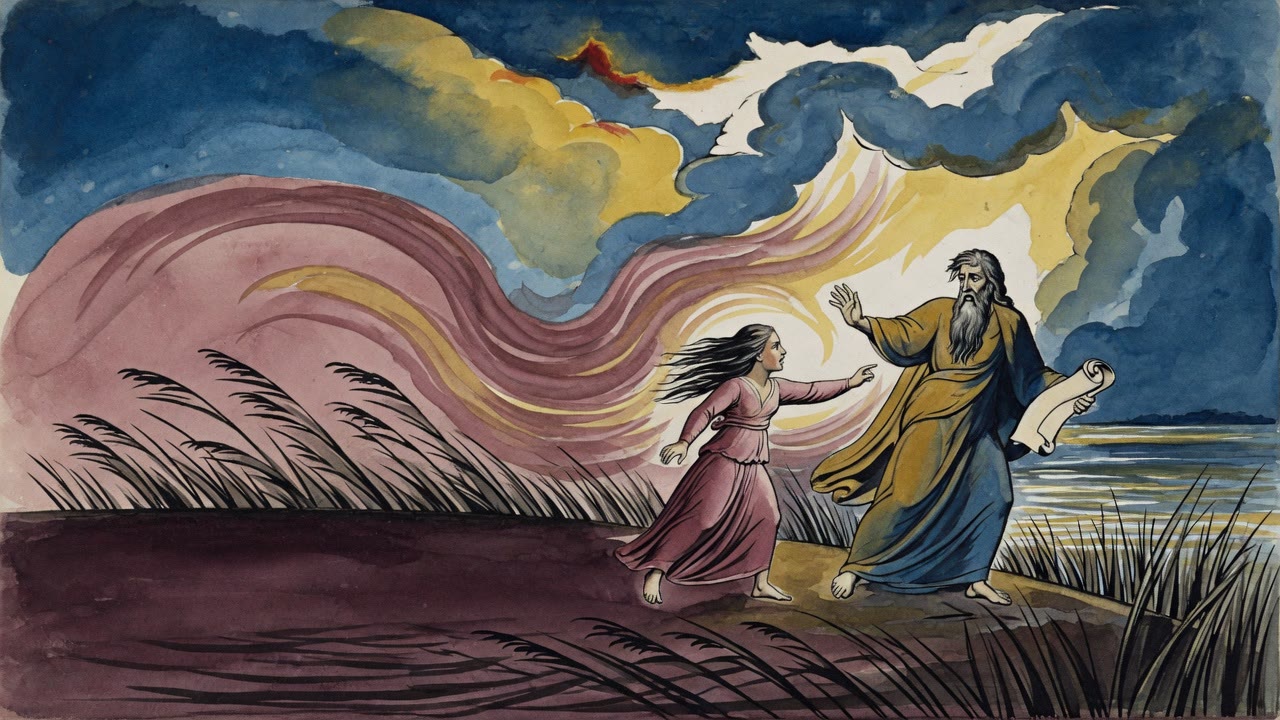
The Egyptian hit the sand and did not rise. Moses looked at his own hands as if they belonged to someone else, then ran before the shout could travel from field to palace. Dust stuck to the blood on his sleeve. By nightfall the story had already reached men who hunted for Pharaoh.
God Struck Pharaoh's Hunters Mute, Deaf, and Blind Click for full size

They came in groups, trained to close roads and question faces. One carried a cord. One carried the authority of the palace in the way he set his feet. Moses was one man with a crime and a future he could not yet name. He cut through a lane of drying flax, vaulted a low wall, and felt his lungs tear with the run. The desert edge offered no courtroom. Only flight.

Mouths Went Empty on the Road

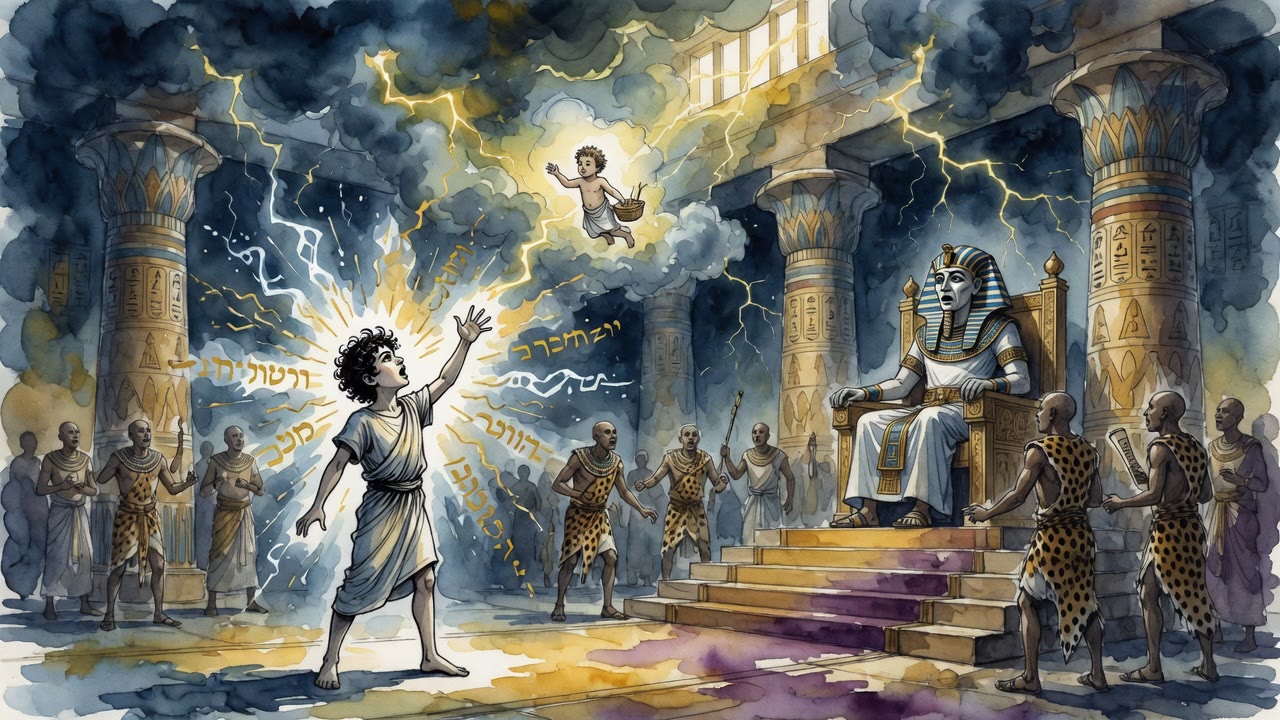
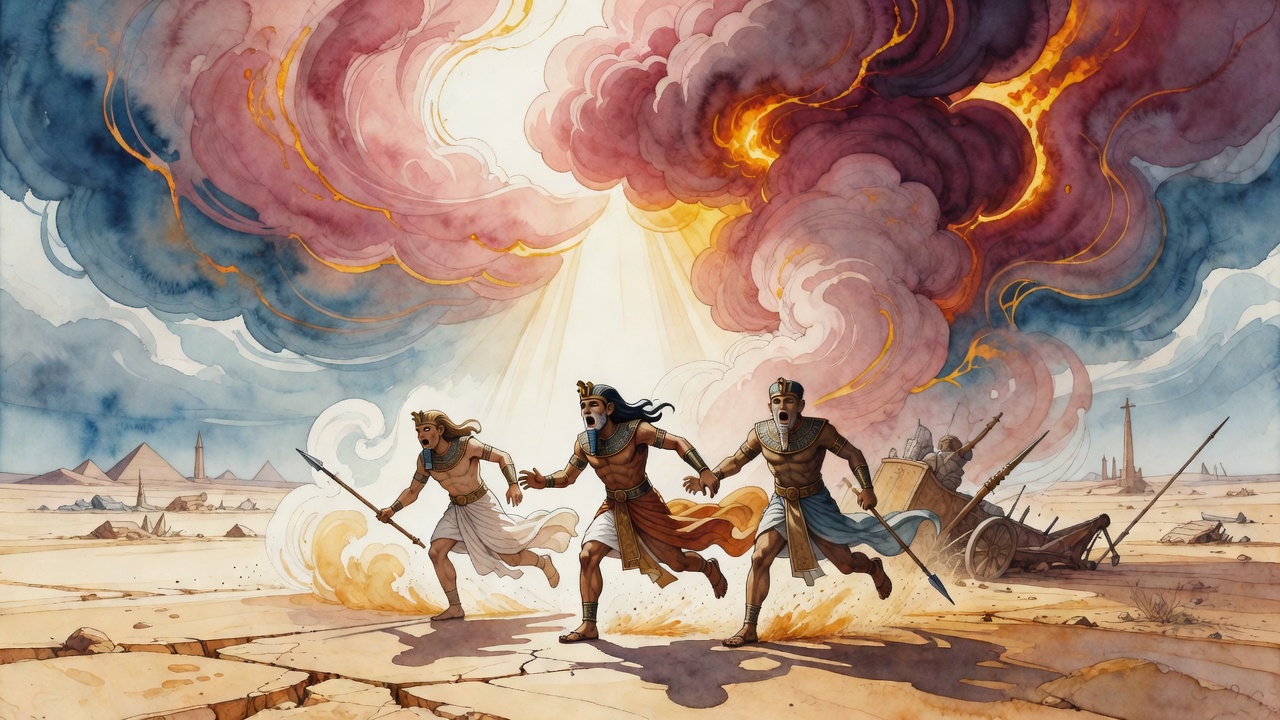
God did not drop fire on the pursuers. He reached for the tools they trusted most. Speech first. Men who still had eyes ran up to companions whose mouths had gone slack and useless. "Where is Moses?" The mutes stared back. No answer left a throat. The question hung in the air like a spear that never left the hand.

The hunters turned on each other in frustration. Gesture replaced words and failed. A whole unit that had left the city confident now stood in the road making shapes with fingers while their quarry put more distance between his heels and Egypt.

Moses did not see the miracle land. He only felt the road stay empty behind him longer than it should have. Twice he dropped behind a thorn bush and waited for boots. Twice the boots never arrived in the pattern a hunt requires. Help arrived as absence. The God of his father was his help, not with thunder, but with a quiet sabotage of the chase that left him shaking and alive in the same instant.

Ears and Eyes Closed in Order

The ones who could still speak shouted toward the deaf. The deaf felt the vibration of boots and the shove of shoulders, but the names and directions never entered. They pointed wildly at the blind, who faced the wrong horizon and walked into scrub as if a map still lived in front of them.

Sight without hearing. Hearing without speech. Speech without sight. Every combination that makes a hunt possible broke in sequence. The party dissolved into three useless kinds of men, each missing the faculty the next one needed.

No corpses lined the road. Pharaoh did not receive a tally of dead agents. He received confusion. Moses slipped the net because the net forgot how to close.

Years later the same God would ask Moses, at a bush that burned without ash, who makes a mouth for man, or who makes one mute or deaf or seeing or blind (Exodus 4:11). The question was not abstract. Moses had already watched the answer work on men who wanted him bound.

Blood for You as a Sign

When Moses returned under a harder commission, Israel faced a different night. Lamb blood marked doorways. Some held that the sign belonged on the inside, "for you," a private mark between household and heaven, hidden from Egyptian eyes. Others insisted the blood must sit outside so Egypt would see its own sacred beast slaughtered and feel its insides tear.

Either way, the mark was not decoration. It was a threshold under pressure. Death moved through Egypt looking for houses without the sign. Children of Israel stayed behind wood that had been painted with a courage their grandparents had lacked when idols still owned the shelves.

Moses, who had once fled through a road emptied of working senses, now walked streets where blood spoke louder than any shout the hunters had tried to form.

When Waters Everywhere Split and Two Seas Met

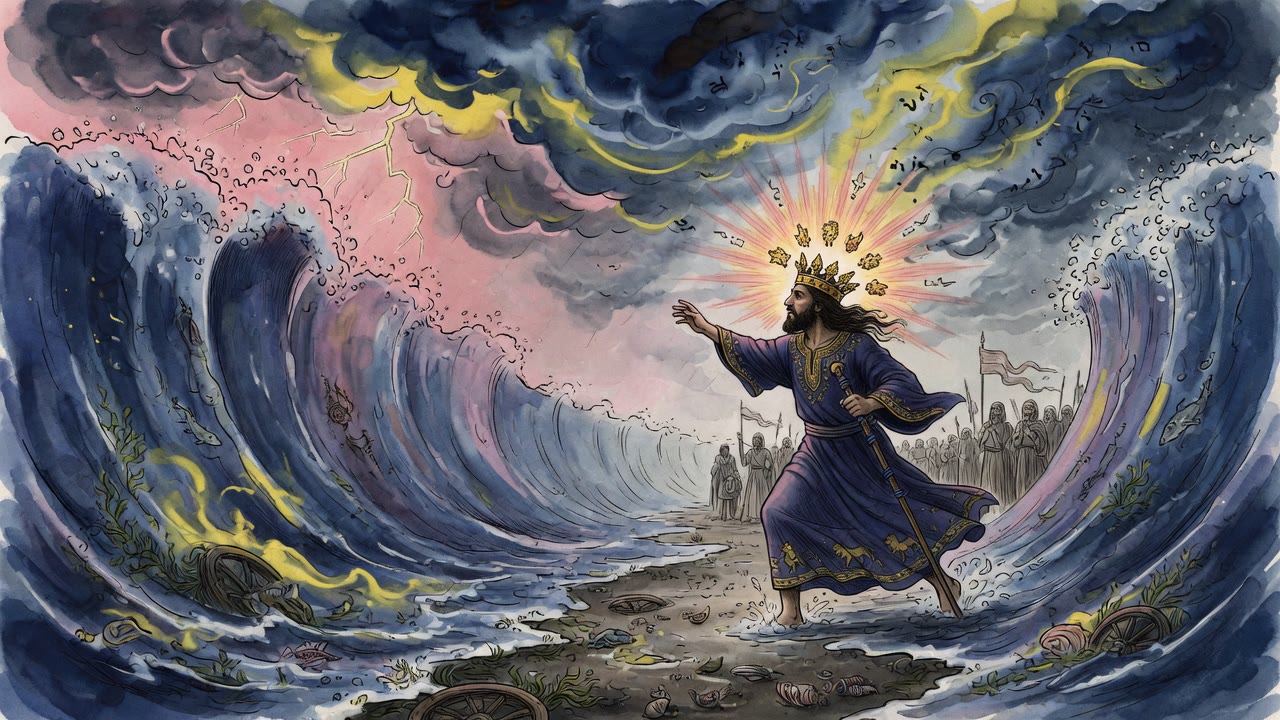
At the sea the scale changed. God split not only the channel under Israel's feet. "The waters were split" (Exodus 14:21), waters, not merely sea. Pits, caves, pitchers, cups, casks, and glasses answered. Household water divided in the same hour the corridor opened. The element itself obeyed, wherever it sat.

Egypt followed into the dry path and met a judgment with extra geography. The Great Sea burst into the Red Sea. Whirlpools, metzulot, opened where solid ground had been moments before. Two bodies of water collided on a road that had looked safe to chariots. The Egyptians descended into churn that should not have existed on a seabed Israel had just crossed dry-shod.

The men who once lost Moses to silence and blindness now lost an army to water that hunted from the sides, from below, and from a second sea entirely. Moses stretched his hand. The same sovereignty that empties a mouth can empty a kingdom into foam.

On the far shore he stood with salt drying on his skin and knew the help that began on a dusty road had never been small. It had only been precise. The same hand that empties a mouth can empty a sea-road under an army. The same precision that spared hunters their lives while stealing their chase now refused to spare a throne that would not let Israel go.

Moses flexed his fingers as if checking that speech and sight still answered him. They did. Behind him the water smoothed over names Egypt would not recover. Ahead of him a nation walked free because, long before the sea, a fugitive had been allowed to keep running.


← All myths
From the tradition

Sources

4 sources

The texts behind this telling. Some cards carry a translation of the source; others are our own retelling of it, and each card says which. Every card links out to the original.

Mekhilta Tractate Amalek 3:27Mekhilta DeRabbi Yishmael

Retold in our words. Read the original at the link below.Mechilta, translated by Rabbi Shraga Silverstein · CC-BY

When Pharaoh sent soldiers to hunt down Moses after the slaying of the Egyptian taskmaster, God intervened in a way no one expected. Rather than striking the pursuers dead or sending a plague, the Almighty turned them into groups of mutes, deaf ones, and blind ones, each affliction perfectly chosen to thwart their mission.

The soldiers who could still see ran up to the mutes and demanded: "Where is Moses?" But the mutes could not speak a word in reply. They turned to the deaf, shouting their questions. But the deaf could not hear what was being asked. They pointed and gestured to the blind, but the blind could not see which direction to go. Every avenue of pursuit collapsed into confusion and futility.

The Mekhilta roots this miracle in a deeper theological point. As it is written (Exodus 4:11): "Who made a mouth for man, or who makes one mute or deaf or seeing or blind? Is it not I, the Lord?" The very faculties that humans take for granted, speech, hearing, sight, belong to God alone. He grants them, and He can withdraw them in an instant.

This is why Moses later declared, "The God of my father was my help." He did not say God fought for him or destroyed his enemies. He said God helped him, quietly, decisively, by rearranging the basic capacities of those who meant him harm. The pursuers were not killed. They were simply rendered unable to pursue.

Full source
Mekhilta Tractate Shirah 5:4Mekhilta DeRabbi Yishmael

Retold in our words. Read the original at the link below.Mechilta, translated by Rabbi Shraga Silverstein · CC-BY

The Mekhilta asks another of its characteristically sharp questions about the Red Sea crossing. The verse says the Egyptians "descended into the metzulot", the whirlpools or churning depths (Exodus 15:5). But are there really metzulot at the bottom of the sea? The Israelites had just walked across on dry land. The seabed was solid ground. Where did these violent whirlpools come from?

The answer reveals yet another dimension of the miracle. According to the Mekhilta, the Great Sea, the Mediterranean, burst into the Red Sea at the moment of judgment. The two bodies of water, normally separated, merged in a catastrophic collision. The Mediterranean's torrents flooded into the exposed channel of the Red Sea and embattled the Egyptians with a force they could not have anticipated.

This transforms the geography of the miracle. The Egyptians were not simply caught when the walls of the Red Sea collapsed back together. They were attacked by a second sea entirely, the Mediterranean rushing in from the north or west, creating metzulot (whirlpools) where two massive bodies of water collided on what had been, moments earlier, dry ground.

God marshaled the waters of multiple seas against Pharaoh's army. The Red Sea came from the sides. The subterranean depths rose from below. And the Great Sea burst in from beyond. The Mekhilta paints a picture of total aquatic annihilation, the entire hydrological system of the earth conscripted into divine service, converging on one army, in one place, at one devastating moment.

Full source
Mekhilta Tractate Vayehi Beshalach 5:18Mekhilta DeRabbi Yishmael

Retold in our words. Read the original at the link below.Mechilta, translated by Rabbi Shraga Silverstein · CC-BY

When God split the Red Sea for the Israelites, the miracle did not stop at a single body of water. The Mekhilta asks a pointed question: what about the waters in pits, cavities, caves, pitchers, cups, casks, and glasses? The answer comes from a close reading of the verse itself. Scripture says "and the waters were split" (Exodus 14:21), not "the sea was split," but "the waters." Every drop of water on earth, no matter where it was contained, split at the same moment.

The rabbis note that the Torah already states "and He made the sea into dry land," which would seem sufficient to describe the miracle. So why add the detail about the waters splitting? To teach something far more dramatic. The splitting was not a local event confined to the shores of the sea. It was a cosmic transformation. Water in underground caves cracked apart. Water sitting in household vessels divided. The entire element of water, everywhere in the world, responded simultaneously to the divine command.

This reading reveals the rabbinic understanding of how miracles work. God does not tinker with one small corner of creation. When He acts, the whole natural order bends in response. The splitting of the Red Sea was not merely an escape route for a fleeing nation, it was a declaration that every molecule of water in existence answered to the same Creator who commanded the sea to part.

Full source
Mekhilta Tractate Pischa 6:4Mekhilta DeRabbi Yishmael

Retold in our words. Read the original at the link below.Mechilta, translated by Rabbi Shraga Silverstein · CC-BY

The debate over where the Israelites placed the Passover blood continues in the Mekhilta, and Rabbi Nathan and Rabbi Yitzchak stake out dramatically different positions, each revealing a distinct theology of what the blood meant.

Rabbi Nathan agrees with Rabbi Yishmael that the blood went on the inside of the doorframe. His proof text is slightly different: "The blood will be for you as a sign" (Exodus 12:13). The key words are "for you." The blood was a sign for the Israelites, not for anyone else. It was a private marker of covenantal identity, hidden from Egyptian eyes, meaningful only to the people who placed it there and the God who commanded it.

Then Rabbi Yitzchak disagrees, forcefully. He insists the blood went on the outside. Why? So that the Egyptians would see it. And not just see it, but understand what it meant. The Passover lamb was an Egyptian sacred animal. Its blood smeared publicly on Israelite doorposts was a declaration of independence from Egyptian religion, an act of spiritual defiance painted in broad strokes for every passing Egyptian to witness. Rabbi Yitzchak's language is visceral: the Egyptians should see their gods being slaughtered, "and their insides be ripped apart."

The contrast between these two readings is extraordinary. For Rabbi Nathan, the blood is about faith, quiet, private, directed toward God. For Rabbi Yitzchak, the blood is about confrontation, loud, public, directed at Egypt. Both readings are preserved side by side in the Mekhilta, because the rabbis understood that redemption requires both: the intimate trust that God sees what is hidden, and the public courage to break with everything that once enslaved you.

Full source