6 min read

Pupils Showed the Sheltered Son a Market of Trials

A scholar raised his son indoors. The father's students took the boy to sea and left him there, and he came home with a princess hidden in a ship.

Curated by Arthur · Told by Maggid ·
Table of Contents
  1. A Son Locked Inside Books
  2. Burial Money and an Empty Ship
  3. Chicken, Pigeons, and a Claim
  4. Wisdom That Eats at the Table
  5. What Fathers Cannot Fence
  6. Jealousy Wears a Friendly Cloak
Pupils Showed the Sheltered Son a Market of Trials Click for full size

A Son Locked Inside Books

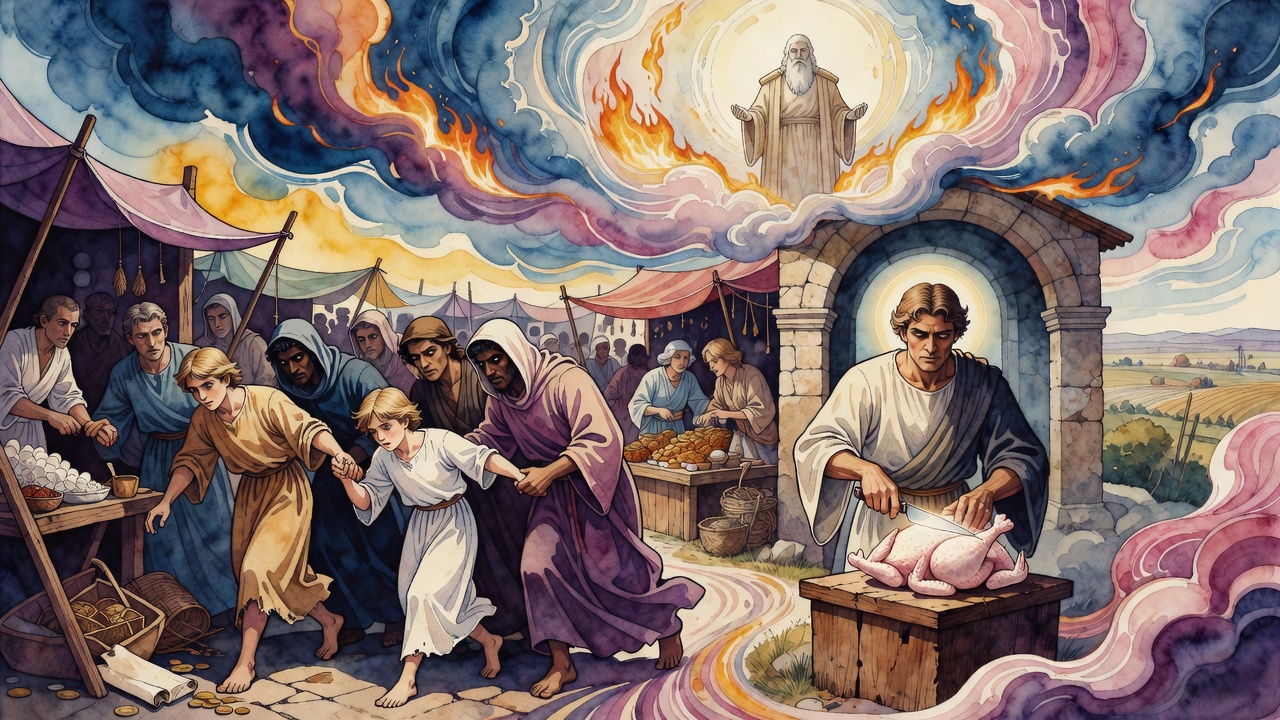
A great scholar received a son in his old age and kept the boy inside the house as if walls could raise a man. Pupils came daily to study, but the father's eyes followed the child. Jealousy grew among the students the way mold grows in a closed room. One day they took the boy out and showed him streets, stalls, animals, and faces he had never been allowed to see. When he returned he reproached his father, and the father finally walked him through the world.

That was only the first opening. The pupils traded abroad one month each year and lived on the profit for the rest. They persuaded the young man to sail with them. The father gave him a thousand dinars. In the foreign city the companions vanished, leaving him alone with coin and no map.

Burial Money and an Empty Ship

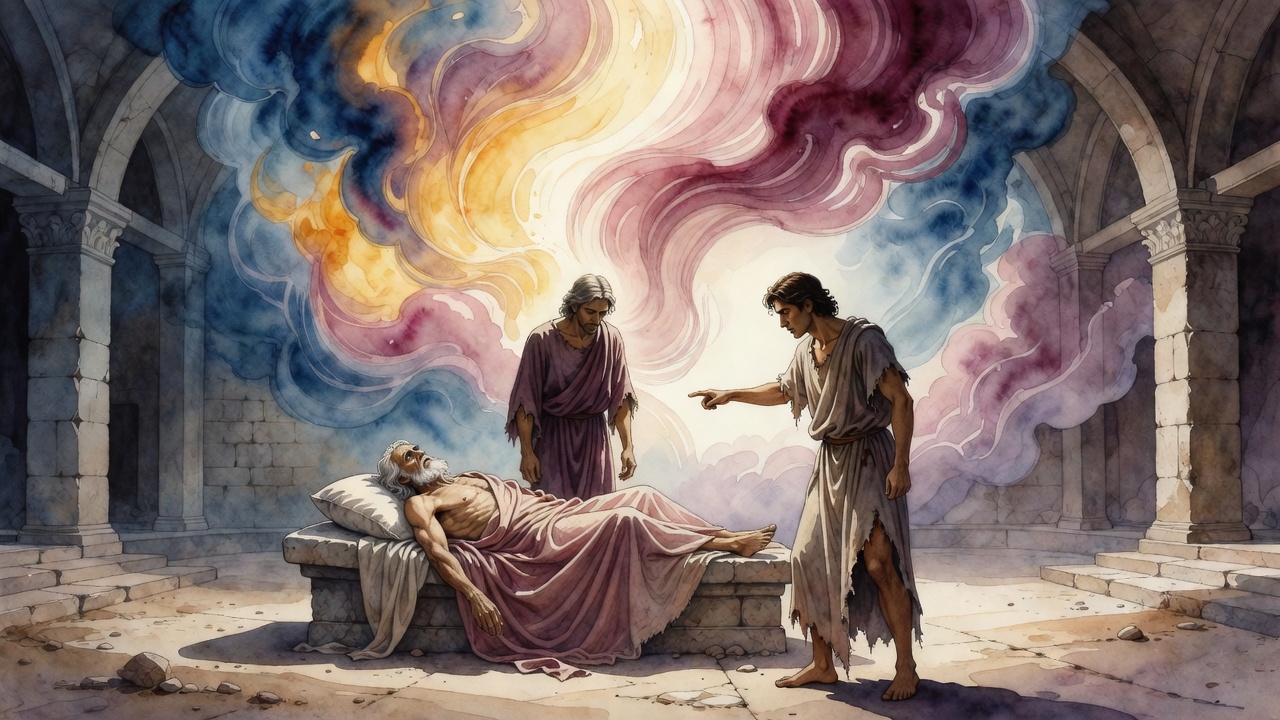
A merchant took him in. At dawn the market roared with grief: a rabbi had died, and the sultan would not permit burial until the Jews paid a debt of a thousand dinars. The young man went before the sultan, found favor, paid the sum, and secured the burial. When word reached home, the father was satisfied. Mercy had spent the boy's first fortune better than trade.

The next year the pupils urged him again. He took ten thousand dinars. Again they abandoned him. Again the merchant sheltered him. In the market he bought at auction a captured Spanish ship sold as it stood, no one knowing if anything lay inside. The hold looked empty until a panel opened and a young woman cried out. She was a princess of Spain, hidden with jewels sealed in wine bottles when war came. The crowd jeered at his empty purchase. He hired sailors and sailed home rich in secret, marrying the princess after his father smuggled the bottles inland by night under the cover of pretended madness.

Chicken, Pigeons, and a Claim

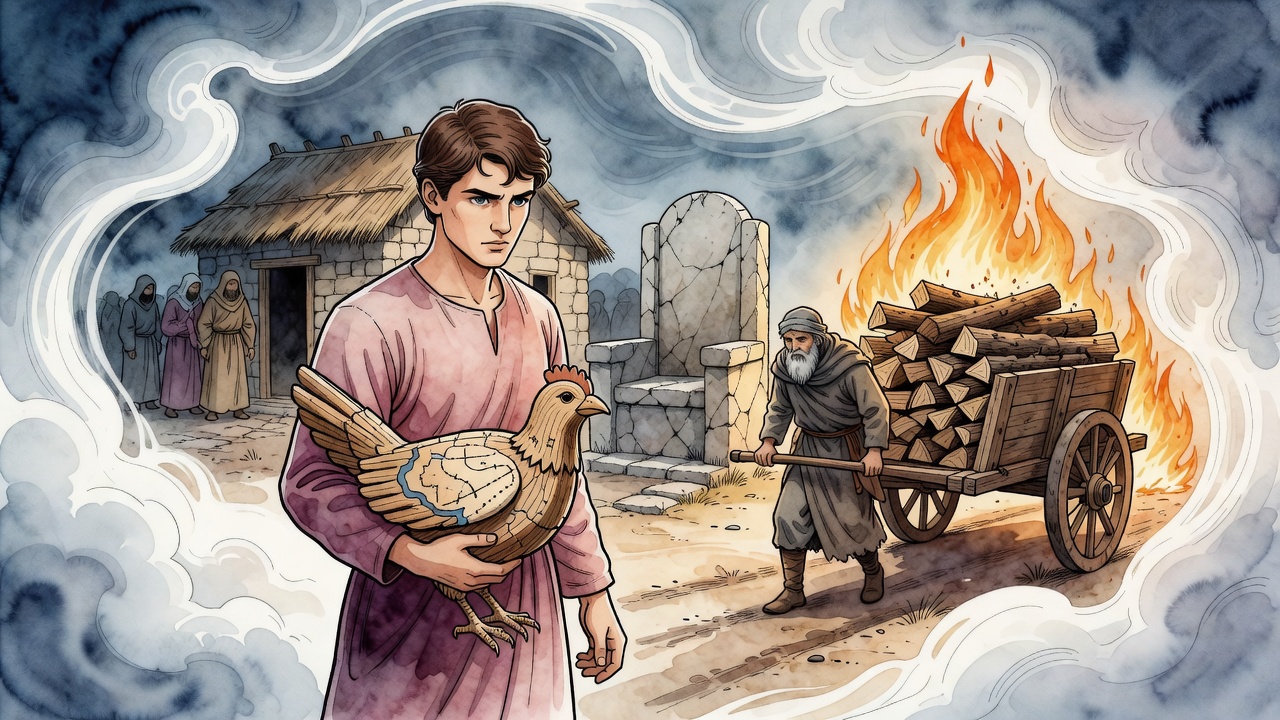
Another son traveled a different road of inheritance. A Jewish merchant had died abroad in a stranger's house. Years later the grown son arrived seeking his father's property, and the host who held the house was reluctant to yield. One evening the host set dinner: one chicken, five pigeons, eight people at table. He handed the carving knife to the visitor and told him, half-testing, half-mocking, to divide the meal fairly.

The young man answered calmly. Yourself, your wife, and one pigeon: three. Your two sons and one pigeon: three. Your two daughters and one pigeon: three. Myself and two pigeons: three also. Then the chicken. He gave the host and his wife the head, because they were heads of the family. He gave each son a leg, because sons are pillars. He gave each daughter a wing, because daughters marry and take wing. He took the body for himself, because the body looks like a ship, and it was in a ship that he came, and in a ship he hoped to return. He looked the host in the eye. I am the son of the merchant who died in your house. Give me the property of my dead father.

Wisdom That Eats at the Table

Justice rode into the room on the back of a joke. The host could not refuse a division that made every portion equal and every symbol true. The sheltered scholar's son learned abroad that companions can steal more than money: they can steal a father's trust by using a boy's hunger for the world. The merchant's son learned that a dinner knife can open a locked estate if the mind behind it is sharper than the host's greed.

Both stories refuse the fantasy that inheritance is only ledgers and bloodlines. Inheritance is also courage at a sultan's gate, patience with a sealed ship, and the nerve to carve a chicken so cleanly that a liar's house cracks open.

What Fathers Cannot Fence

The old scholar tried to keep his son from the market. The market came anyway, wearing the faces of jealous pupils. The merchant died far from home, and home had to be argued back into being at a stranger's table. Sons inherit danger along with gold. The ones who rise do not rise by remaining children of the study house alone. They rise by spending, carving, risking, and speaking when the room expects silence.

Jealousy Wears a Friendly Cloak

The pupils did not announce their envy. They announced education. Come see the world, they said, as if the father's walls were the only danger. The world they showed him included abandonment on foreign docks and the sudden need to spend a fortune on a stranger's burial. It also included a sealed ship that looked empty to every laughing bidder. Envy can be a brutal teacher. It pushes a sheltered son into waters where only mercy and nerve keep him floating.

The merchant's son at the dinner table faces a quieter cruelty: a host who smiles while holding another family's property. His answer is not a lawsuit first. It is a carving that makes every symbol confess. Heads, legs, wings, ship-body. By the time he names his father, the room already knows he is not a fool to be fed scraps and sent away. Wisdom, in both tales, is not a scroll on a shelf. It is action under insult.

Fathers who lock sons indoors create one kind of danger. Hosts who lock estates behind hospitality create another. The tradition keeps both stories because Jewish life has always needed men and women who can pay a sultan for a burial and divide a chicken so justly that theft has nowhere left to sit.


← All myths
From the tradition

Sources

2 sources

The texts behind this telling. Some cards carry a translation of the source; others are our own retelling of it, and each card says which. Every card links out to the original.

Exempla of the Rabbis, No. 440Exempla of the Rabbis (Gaster, 1924)

Retold in our words. Read the original at the link below.The Exempla of the Rabbis, Moses Gaster (1924) · Public Domain

[Another variant.]

A great scholar, who spent his time studying with his pupils, got a son in his old age. He kept him in the house, never allowing him to go out but gave him more and more of his time. The pupils became jealous of the young boy and one day they took him out of his father’s house and showed him the world of which he knew nothing. On his return, he reproached his father who henceforth went out with him and showed him everything. The students used to go to a distant country to trade for a month every year, and with the profit they made they used to live for the remaining n months. They persuaded the young man to go with them. The father gave him 1000 dinars, and no sooner had they reached the foreign country, than they left him. He wandered about in search of his companions. A merchant took him in and the next morning he saw a great commotion in the market-place. The rabbi had died and the sultan would not allow the burial unless the Jews paid him a debt of 1000 dinars. The young man went to the sultan, found favour in his eyes, paid the money and obtained permission to bury the rabbi. The father was greatly satisfied. Next year, again urged by his father’s pupils, the young man asked for 10,000 dinars. They left him again and again the merchant took him. The next morning, he bought by auction for 10,000 dinars a Spanish

174 -

ship captured by the sultan’s ships. It was sold as it stood, no one knowing whether anything was in it. He found it quite empty when suddently he heard a voice crying. A panel opened and he found a small room and in it a young beautiful girl. She told him that she was the daughter of the king of Spain. War had broken out and not knowing what would be the outcome of it she had manned the ship with provisions and had hidden there. Now she was a prisoner. She also told him that she had taken a large amount of jewels and precious stones hidden in wine bottles some of them filled with wine. The people jeered at him, thinking the ship was empty but he hired sailors and returned home. His father came on board and learnt what had happened and was advised to tell the governor that the son had gone mad and spent 10,000 dinars on an empty ship and bottles of wine, and in order to cover his madness, to ask permission to carry the bottles home secretly in the dead of night which he did. Thus no one knew of the great treasures. The princess married him and they had two sons. She was very clever and made some tapestry and embroidery, unknown in that country. A merchant took advantage of the young man’s ignorance of the value of the tapestry, bought them and sold them in distant lands. Some reached Spain and the king saw and recognised in them the work of his daughter, found out where they had come from and disguising himself, came to that country. There he paid a higher price for them than the merchant, won the confidence of the young man and invited himself to his house. One day he sent the young man out, made himself known to his daughter and forced her to flee with him and her children to Spain. The young man in despair went to the harbour and found there a boat with two men in it. They promised to take him to Spain and to help him on condition that afterwards they would share everything equally. He consented and was quickly transported to Spain. Outside the town where the king’s palace was there was a large heap of refuse as big as a hill. Advised by the boatmen, the young men bought

175 -

the refuse heap to the great surprise of the king. On the morrow a huge palace with magnificent gardens stood in its place. The people wondered, went there to see it, and the princess heard of it and also went there after having obtained permission from her father who had kept her locked up in the palace. She recognised her husband and promised to flee with him. After 30 days she was able to bring her two children and a large amount of treasure. The boatmen waited for them and then carried them swiftly home. In the morning the people found that the palace and gardens had disappeared and the refuse heap was again there. When they approached the port, the two boatmen asked the young man to divide the spoils according to arrangement. He was to take one, either the treasure, or the wife or children; the other two belonged to them. He willingly gave up the treasure, but neither wife nor children.

When they saw his despair, they comforted him and told him that he could keep all; they had only put him to the test and would take nothing, for one of the boatmen was the dead rabbi whom he had ransomed from the Sultan and brought to honourable burial and the other, his companion, was none other than the prophet Elijah who had been allowed by God to accompany him and reward him for his pious deeds. It was he who had built the palace and then made it disappear again. Henceforth, the young man his wife and children all lived happily together.

441a. A man carrying a jug of milk heard a snake crying. It was thirsty. The man gave it to drink and the snake promised him a treasure. After it had drunk it showed him a spot under a stone where the man found a great treasure. Then the snake coiled itself round his neck and wanted to kill him, because he had robbed it of its treasure. They came to Solomon for judgment. The snake pleaded justification by referring to the words in Scripture, “Thou shalt bruise his heel/' Solomon ordered it to get down as they must both be standing equal in the court. When the snake

176,

got down, Solomon told the man to “bruise its head” and the man killed it on the spot.

441b. A man found a snake frozen on the ground and picked it up and put it in his bosom. The snake, quickened to life through the warmth, coiled itself round the man and tried to kill him. To requite evil for good, the shake said, was the way of the world. They brought the case before King David. On the way they met an ox, who decided in favour of the snake. So also did an ass and finally King David did likewise, for it is written that the ‘Snake shall bruise the heel’. When they left the court, they found Solomon, still a lad, playing near the well. His stick had fallen into the water and no one could succeed in getting it. Solomon then ordered his servants to widen the conduit; thus the water would fill the well. It rose and they were able to take the stick. Greatly impressed, the old man aske Solomon for advice. He obtained the permission of David to judge the case. Asked by Solomon, the snake replied that it had acted according to the word of the Lord and then Solomon said, “Abide by the Word of the Lord,” which commands the two parties to stand before the judge. The snake was to uncoil itself and stand apart from the old man on the ground before him. The snake did so and Solomon told the old man to “bruise its head” with the stick which he was holding, for so it was written in the Law. He did so and killed the snake.

Full source
Hebraic Literature (1901), Proverbial Sayings and TraditionsHebraic Literature (1901)

Retold in our words. Read the original at the link below.Project Gutenberg eBook #14368, Hebraic Literature · PD-US-pre-1929

A Jewish merchant died abroad, far from his family, in the house of a stranger. Years later, his grown son traveled to find the merchant's hidden property. But the man who had inherited custody of the house was reluctant to give anything back.

One evening, the host set a small dinner for his own family and this visiting young man. On the table: one chicken, five pigeons, and the host, his wife, two sons, and two daughters, eight people in all. The host handed the carving knife to the young stranger and, half-testing, half-mocking, told him to divide the meal fairly.

The young man, preserved in the 1901 anthology Hebraic Literature, answered calmly. "I told you it was not my place to serve the food, but since you insist, I did the best I could. Notice: yourself, your wife, and one pigeon, that is three. Your two sons and one pigeon, three. Your two daughters and one pigeon, three. Myself and two pigeons, three also. Every group numbers three. It is fair."

Then he turned to the chicken. "I gave you and your wife the head, because you are the heads of the family. I gave each of your sons a leg, because sons are pillars, they hold up the family name. I gave each of your daughters a wing, because daughters, in time, marry and take wing and fly from the home-nest. I took the body of the chicken for myself, because the body looks like a ship, and it was in a ship that I came here, and in a ship I hope to return." He looked his host in the eye. "I am the son of the merchant who died in your house. Give me the property of my dead father."

The story, a ma'aseh of the sort collected throughout the Talmud and later Midrashim, is a Jewish version of a motif that appears worldwide. But the Rabbis tell it with a particular edge. Wisdom is not abstract. Wisdom, in this tale, is a chicken on a plate, carved so cleverly that the host cannot refuse him. Justice rides into the room on the back of a joke.

Full source