6 min read

The Son Who Chose the Slave and Won Everything

A father's will leaves everything to his slave and one choice to his son. In court the son names the slave himself, and the whole estate follows.

Curated by Arthur · Told by Maggid ·
Table of Contents
  1. The Slave Crosses the Sea
  2. One Question in the Study Hall
  3. Choose the Slave
  4. Kings Quarrel for Abraham

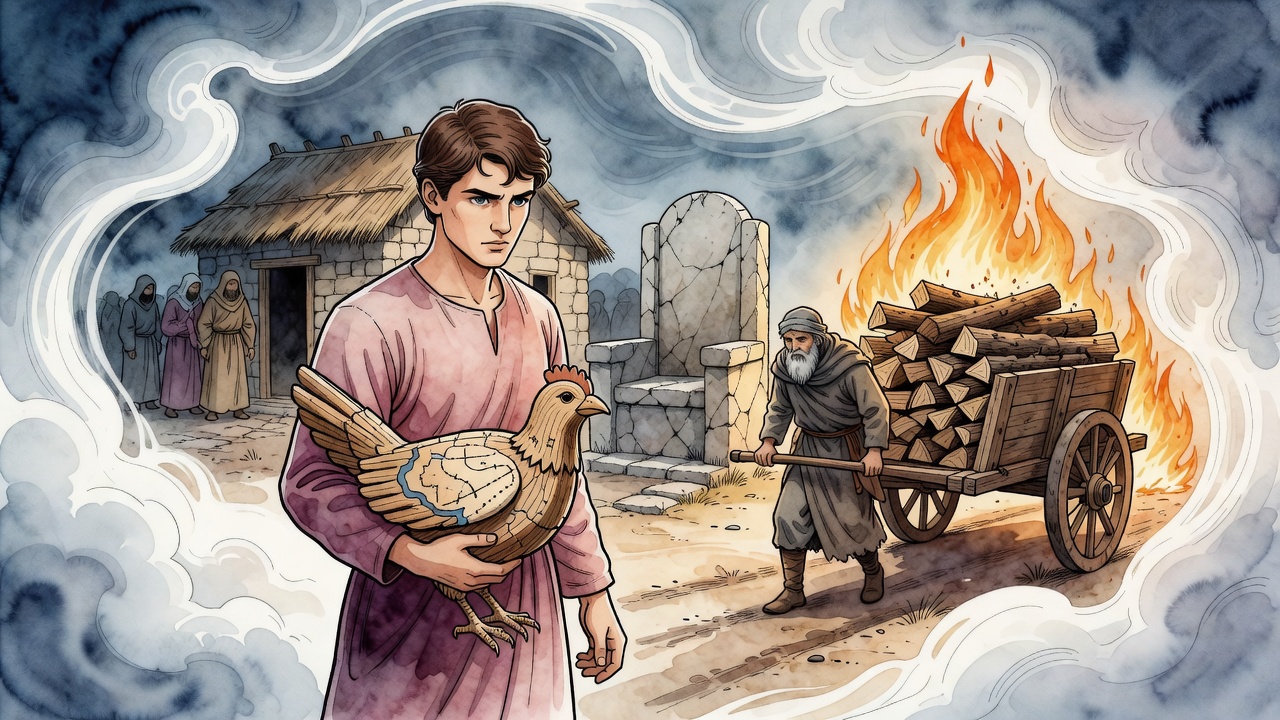
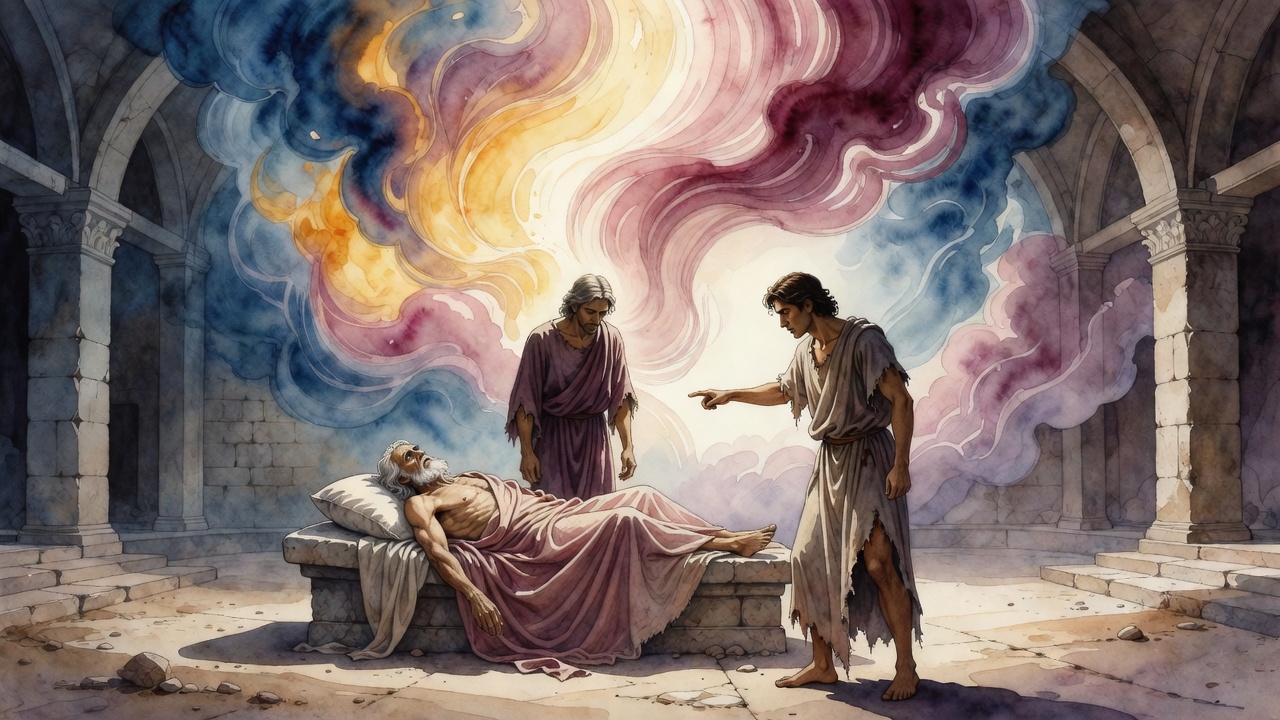
A merchant left the Land of Israel for a distant island, and the sea kept him there. His son stayed behind in the study house, learning Torah while letters came rarely and coin came when the winds allowed. When death found the father far from home, he called for ink and wrote a will that read like a theft from his own blood. The entire estate went to his slave. The son received one right only: to choose a single item from among the possessions and take it.
The Son Who Chose the Slave and Won Everything Click for full size

The Slave Crosses the Sea

The slave gathered every coin, deed, and chest with careful hands, sailed to the Land of Israel, and found the young man among his books. "Your father is dead," he said, holding the document like a shield. "He has left me all his possessions, except for any one thing you desire to select." The words were polite. The trap was complete. Pick a chest and lose the house. Pick a field and lose the rest. Pick a jewel and starve beside it.

The room went cold. Grief and arithmetic arrived together. Neighbors whispered that the father had gone mad or cruel. Who disinherits a child for a servant? The slave refused to hand over so much as a cup, and why should he? The writing said the fortune was his, and in a city far from a father's love, writing can be louder than blood.

One Question in the Study Hall

The son carried the will to his teacher, the parchment still warm from the slave's grip. The teacher read it and smiled the way a man smiles when he recognizes another man's cunning across a generation. "Your father was wise in the law," he said. "He asked himself what would happen if he simply left his property in the slave's keeping. The slave would abscond with it and squander it on the road. So he gave it to him outright, and the slave guarded the fortune with the fury of sudden ownership, fighting off thieves and clerks all the way across the sea. To you he left the choosing."

Then the teacher gave him the sentence to say in court, each word a key. "Say to the judges: my father gave me the right to select the one thing I desire most from all his property. The only thing I desire is this slave."

The son repeated it until it sat in his mouth without shaking.

Choose the Slave

They stood before the court. The slave arrived confident in the logic of paper and laid the will before the judges. The son spoke his one sentence. Silence took the chamber for a breath, and the slave's small smile thinned, because the judges understood at once. The law holds that whatever a slave acquires belongs to his master, the slave along with it. Choose the slave, and every coin and courtyard the slave held came with him. The estate swung back in one motion.

The father had not abandoned his son. He had hidden the inheritance inside the one piece of property the slave could never refuse to deliver: himself. Solomon's line settled over the scene like a seal: to the man who is good in God's sight He gives wisdom, and to the sinner He gives the task of gathering and heaping up, that he may leave it to the one who is good before God (Ecclesiastes 2:26). The slave had gathered. The son received. The last letter from the island had been written in the grammar of ownership itself.

Kings Quarrel for Abraham

The sages did not leave the story at a family's locked door. They lifted the same motion onto history. The Holy One, blessed be He, guards the wealth of the wicked for the sake of the righteous. He let four kings quarrel with five in the days of Amraphel (Genesis 14:1) so that Abraham could strike them and carry off what they had heaped up. The sages read the enemy names like a charge sheet: Bera, wicked toward heaven and man; Birsha, risen in evil; Shinab, who hated the Heavenly Father; Shemeber, who boasted he would climb above the clouds. Their alliance in the vale of Siddim was a pile of spoil waiting for a righteous hand.

And the bird of prey that Isaiah heard called from the east, "the man of My counsel from a distant land" (Isaiah 46:11), the rabbis recognized as Abraham himself: not a predator of the weak, but a man flying toward a voice with no ground in sight. God had tested him with fire, with exile, with the knife raised over his son, and each test was a credential. Faithful meant proven. Wealth gathered by warring kings fell into hands that had already given everything back to heaven once.

The slave thought he owned a house. The kings thought they owned a valley. The son who studied Torah knew how to read a clause, and Abraham knew how to walk when the map was only a voice. In both stories the fortune passes through the wrong hands on its way to the right ones, guarded the whole way by the greed of its keepers.

Choose the slave. The room exhales. The inheritance comes home, still dusty from travel, still sealed with the clever fear of a father who would not let distance and greed have the last word.


← All myths
From the tradition

Sources

4 sources

The texts behind this telling. Some cards carry a translation of the source; others are our own retelling of it, and each card says which. Every card links out to the original.

Midrash Tanchuma, Lech Lecha 8Midrash Tanchuma

Translation of the source text.Midrash Tanchuma -- Torat Emet · Public Domain

"And it came to pass in the days of Amraphel" (Genesis 14:1). Let our master teach us: One who writes over all his property to his slave as a gift, does he go free? Thus our Rabbis taught: One who writes over all his property to his slave, he goes free; but if he reserved any land whatsoever, he does not go free. Rabbi Shimon says: He is in any case a freeman, unless the master says, "All my property is given to so-and-so my slave except for one item among them."

There was an incident concerning a certain man who went to a country across the sea, and he had one son sitting and occupying himself with Torah in the Land of Israel. When the time of his death drew near, he wrote over all his property as a gift to his slave, and he wrote for his son that he might choose for himself one item out of all his property that he had given as a gift to his slave. When he died, the slave gathered up all the wealth and took it together with the deed of gift and came to the Land of Israel and said to the son: Your father has died, and he has written me a will of all his property, on condition only that you choose for yourself one item out of all of it. What did the son do? He went to his teacher and recounted the matter to him. His teacher said to him: Your father was a great sage and expert in the laws. He said: If I leave all my property in the hand of my slave, he will steal it and lose it; rather, I will write it over to him as a gift, so that he will be careful with it, and let my son choose for himself one item out of all of it. Now, when you go with him to the court and he produces that will, say before the court: My masters, thus my father commanded, that I choose for myself one item out of all; I desire nothing in the world except this slave. Then you will acquire the property and the slave. He did so. The court delivered into his hand the property and the slave, for a slave who acquired property, the slave and the property belong to his master. And Solomon said (Ecclesiastes 2:26), "For to the man who is good before him he has given wisdom and knowledge," this is the father; "and to the sinner he has given the task of gathering and amassing," this is the slave; "to give to the one who is good before God," this is the son.

Since the Holy One, blessed be He, preserves the wealth of the wicked for the righteous. Thus said the Holy One, blessed be He: Behold, I will set strife among the kings, so that Abraham may come and take their wealth. From where do we know this? From what they read in the matter of "And it came to pass in the days of Amraphel." They made war against Bera, who was wicked (ra) toward Heaven and toward creatures. Birsha, who became wicked (rasha). Shinab, who hated (sone) the Father (av) who is in Heaven. Shemeber, who said, "I will ascend on a wing (ever) upon the heights of the cloud." [The kings' names are expounded as words describing their wickedness.]

"All these joined together at the Valley of Siddim" (Genesis 14:3), which used to suckle them just as breasts (shadayim) suckle an infant. "That is the Salt Sea" (Genesis 14:3), for through their iniquity that valley became salt waters. And likewise it says: "A fruitful land into a salt waste" (Psalms 107:34). Why? "Because of the wickedness of those who dwell in it" (Psalms 107:34).

"And they turned back and came to En-mishpat" (Genesis 14:7) [literally, "the spring of judgment"]. May the name of the Holy One, blessed be He, be blessed, of whom it is written, "Declaring the end from the beginning" (Isaiah 46:10): because Moses was destined to receive his judgment at Kadesh through the waters, therefore it was called beforehand En-mishpat. "And they smote all the country of the Amalekites" (Genesis 14:7), although Amalek was born only many generations later.

Full source
Aggadat Bereshit 20Aggadat Bereshit

Retold in our words. Read the original at the link below.Sefaria Community Translation · CC0

Isaiah says God is "calling from the east a bird of prey, a man of my counsel from a distant land" (Isaiah 46:11). The rabbis identified that bird of prey as Abraham. He came from the east, from Ur of the Chaldees, from beyond the river. And God called him as a counselor, not just a servant.

The word "counselor" is strange and the rabbis seized on it. Psalm 110 records God saying, "Sit at My right hand, so that you may be my counselor. You are faithful." Faithful not as a synonym for obedient, faithful in the sense of tested and proven reliable. God had tested Abraham through fire, through exile, through the near-sacrifice of his son. Each test was a credential. By the end, Abraham had demonstrated something that even angels could not claim: the willingness to give up everything and still trust.

The eagle as a metaphor for Israel runs through the tradition, "I carried you on eagles' wings" (Exodus 19:4). But here the eagle is Abraham specifically, the one called before the nation existed, soaring toward a destination he could not see. The rabbis loved this image because it captured what faith actually looks like in motion: wings spread, wind beneath, no ground visible, flying anyway. Abraham is not called a bird of prey because he is predatory. He is called one because he moves toward heaven without hesitation.

Full source
Gaster, Exempla of the Rabbis No. 399The Exempla of the Rabbis (1924)

Retold in our words. Read the original at the link below.The Exempla of the Rabbis, Moses Gaster (1924) · PD-US-pre-1929

Gaster's exemplum No. 399, drawn from the Ben Attar collection of medieval Jewish exempla, preserves a courtroom puzzle about a cunning father's last will.

A wealthy Jewish merchant died far from home, in a distant city. His will was strange. He left the entire estate, every coin, every property, every possession, to his slave. His only son was to receive just one object from the inheritance, whichever object the son chose to name.

The family was horrified. The slave, now suddenly a wealthy man, refused to hand over anything at all. The case was brought before a rabbinic court.

The rabbi who heard the case thought for a long moment. Then he gave the son one instruction.

"Choose the slave."

The son stared. The rabbi explained. Under ancient law, a slave's possessions belong to the slave's master. If the son chose the slave himself as his one inheritance object, then everything the slave had inherited, the entire estate, belonged automatically to the son as the slave's new owner.

The slave had won a battle of appearances and lost the war of Torah.

The rabbi then explained what the father had done. The father had known, on his deathbed, that in a distant city the slave could easily rob the estate and run. Leaving everything to the slave ensured that the property would be guarded, the slave would defend his own fortune fiercely. Giving the son the right to claim any single item preserved the son's actual inheritance through a legal trick only a Torah scholar could unlock.

The father had not disinherited his son. He had hidden the inheritance inside the one piece of property the slave could never refuse to deliver, himself.

The tradition preserves this case because it illustrates a core rabbinic principle: Torah is not only law. It is a mind for outwitting those who exploit law. A father who loves his son teaches him to find the sentence beneath the sentence.

Full source
Targum Pseudo-Jonathan on Exodus 21:2Targum Pseudo-Jonathan on Exodus

Retold in our words. Read the original at the link below.The Targum of Jonathan ben Uzziel, trans. J. W. Etheridge, London, 1862 · Public Domain

The Targum Pseudo-Jonathan opens the civil law section of Exodus with an astonishing clarification. "If thou shalt have bought a son of Israel, on account of his theft, six years he shall serve, and at the incoming of the seventh he shall go out free without price" (Exodus 21:2).

The Hebrew simply says if thou buy a Hebrew servant. The Targum adds the crucial phrase: on account of his theft. The Targumist refuses to let the reader Only one legal path leads a Jew into a Jewish household as a servant, the court has convicted him of theft, and he has no means to repay.

This is a narrow, specific, rehabilitative institution. It is not slavery. It is a court-ordered labor sentence, and it is capped at six years. The seventh year arrives and the thief walks out free, without price, the Targum emphasizes. No redemption fee. No final payment. The slate is wiped by time itself.

Why six and seven? The rabbis heard the echo of creation. Six days of work, one day of rest. Six years of restitution, one year of liberation. The civil law mirrors the cosmic rhythm. Even the punishment of a thief is measured by the clock of God's own week.

And there is a deeper mercy in the Targum's gloss. By naming theft as the specific cause, the Targumist protects every other Israelite from ending up in bondage. A Jew who is poor does not become a servant. A Jew who is in debt does not become a servant. Only a Jew who has stolen, and only until the restitution is complete.

The takeaway: biblical law sets a clock on every punishment and a cap on every debt. Freedom is never more than six years away.

Full source