5 min read

R. Simlai Answered the Heretics Who Read Elohim as Many Gods

Heretics pressed R. Simlai on plural God-words. He answered with singular verbs. Akiva filled every et (את), the direct-object mark, with a whole world.

Curated by Arthur · Told by Maggid ·
Table of Contents
  1. Holy Gods on Joshua's Tongue
  2. Holiness in Every Mode at Once
  3. The Singular Verb at the Beginning
  4. Akiva and the Tiny Word Et (את) No One Translates

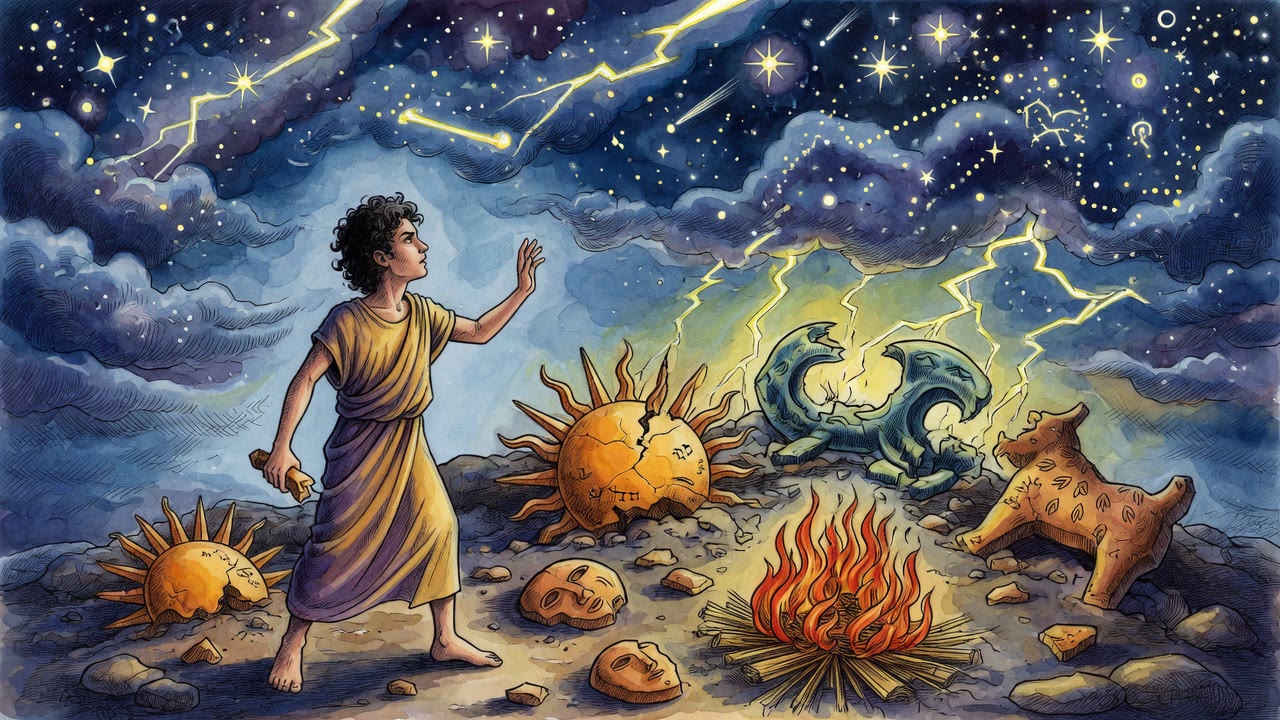
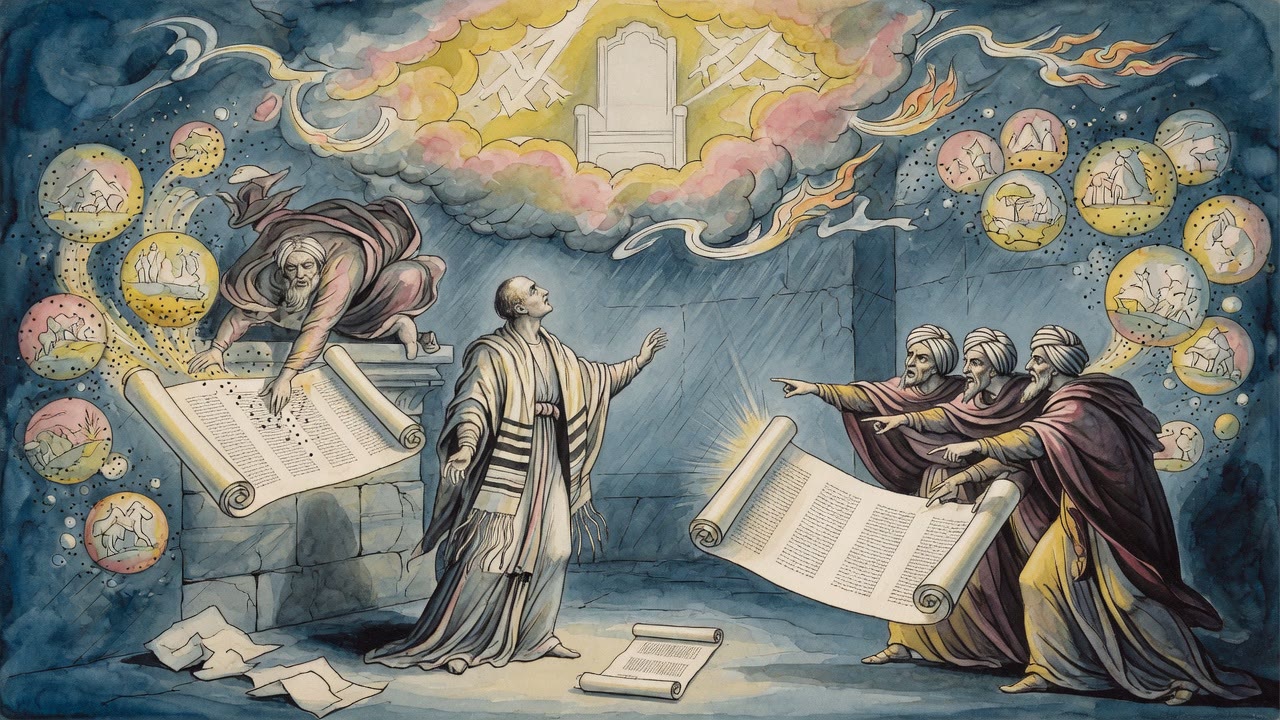
The heretics did not come with swords. They came with a verse and a smile that already thought it had won. R. Simlai, a third-century sage of the land of Israel, stood in the study house with dust on his sandals and the room listening. "How many deities created the world?" they asked, as if the count were already settled and he only needed to confess it.
R. Simlai Answered the Heretics Who Read Elohim as Many Gods Click for full size

He did not step back. A fly walked the rim of a cup and no one brushed it. The trap was already open on the table in the shape of two plurals. R. Simlai set his palm on the open scroll and waited for them to name their proof.

Holy Gods on Joshua's Tongue

They pointed to Joshua 24:19. In literal Hebrew the line can sound like "For He is holy gods." Elohim is plural. The adjective kedoshim, holy, is plural too. Two plurals in a row. Proof, they claimed, of multiple divine powers sitting behind Israel's God-talk.

R. Simlai's answer was immediate. "Read the rest of the verse. It does not say 'they.' It says 'He.'" He tapped the singular subject with one finger. The actor under the plural clothing remains one. Grammar can wear many sides. The One who stands inside it does not multiply.

A heretic opened his mouth to press the plurals again. R. Simlai kept going before the second trap could close. He would not let a count of deities hide inside an adjective. Students leaned in. The fly left the cup. The room held its breath around a pronoun.

Holiness in Every Mode at Once

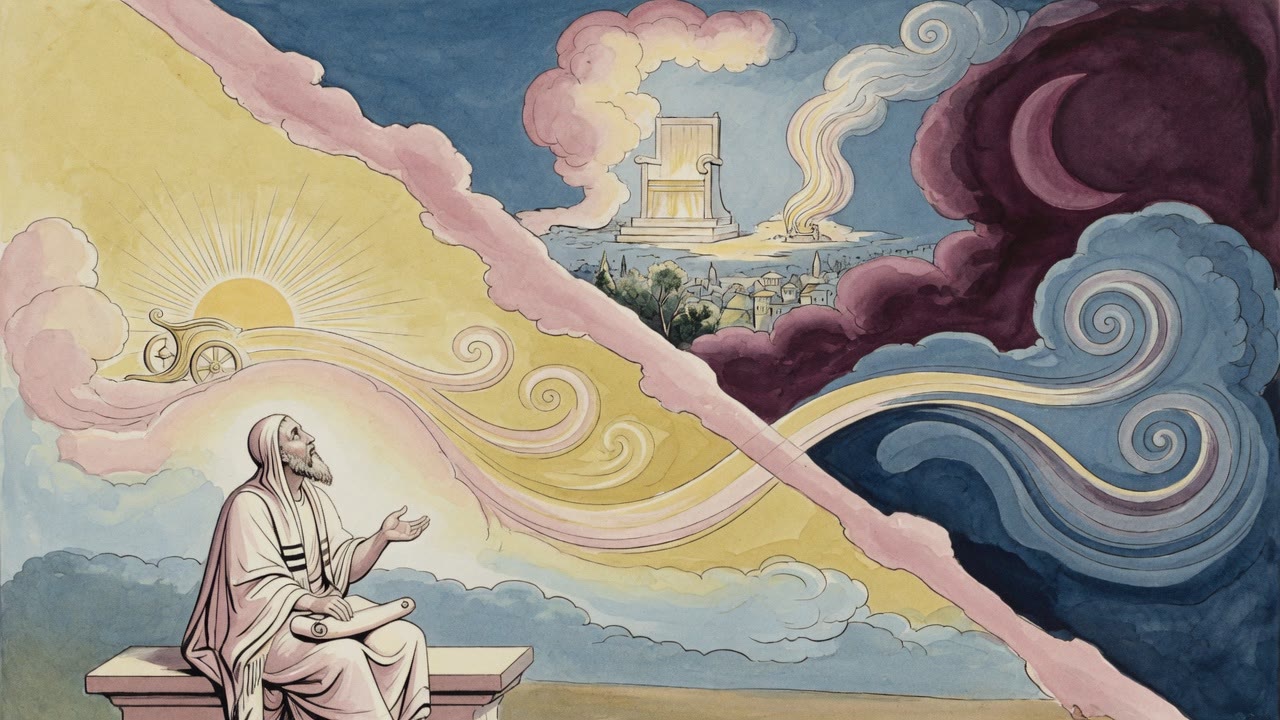
He turned the plural from a problem into a map of sanctity. Why does Joshua call the Holy One "holy" in the plural form? Because God is holy in every category of holiness at once, not because many gods share a committee.

R. Aha bar Hanina unfolded the list while R. Simlai stood and the heretics shifted their weight. God's way is in holiness (Psalms 77:14). God's processions are in holiness (Psalms 68:25). God is seen in holiness (Psalms 63:3). God speaks in holiness (Psalms 60:8). God's arm is uncovered in holiness (Isaiah 52:10). God is beautiful and glorious in holiness (Exodus 15:11). Six modes. Six verses. One God operating in every register of sanctity simultaneously. The plural form is qualitative, not numerical.

One of the challengers wiped sweat from his temple. The heat in the room did not ease. Genesis still waited on their tongues like a second knife.

The Singular Verb at the Beginning

"But Genesis says Bereshit bara Elohim," they said. "In the beginning God, plural, created."

R. Simlai pulled the scroll toward the first line and countered without raising his voice. "The verb bara is singular. It does not say bar'u. One subject, one action." A plural noun governed by a singular verb points to a single actor. Hebrew itself closes the case they tried to open with vocabulary alone (Genesis 1:1).

Silence took the room for a breath. The trap that had looked like two plurals had met a singular verb and a singular "He," and the count of deities stayed at one. R. Simlai did not smile. He had not come to win a game. He had come to keep creation from being divided among rivals. The heretics left with their verse still on their lips and their victory gone from their faces.

Akiva and the Tiny Word Et (את) No One Translates

In another hall, another century's pressure, R. Ishmael and R. Akiva faced the first verse from a different angle. English skips two words that Hebrew will not drop. Et (את) appears twice: God created et the heavens and et the earth. R. Ishmael read them as grammar, direct object markers, ordinary tools of a sentence. No hidden freight. He said so with a flat palm on the table.

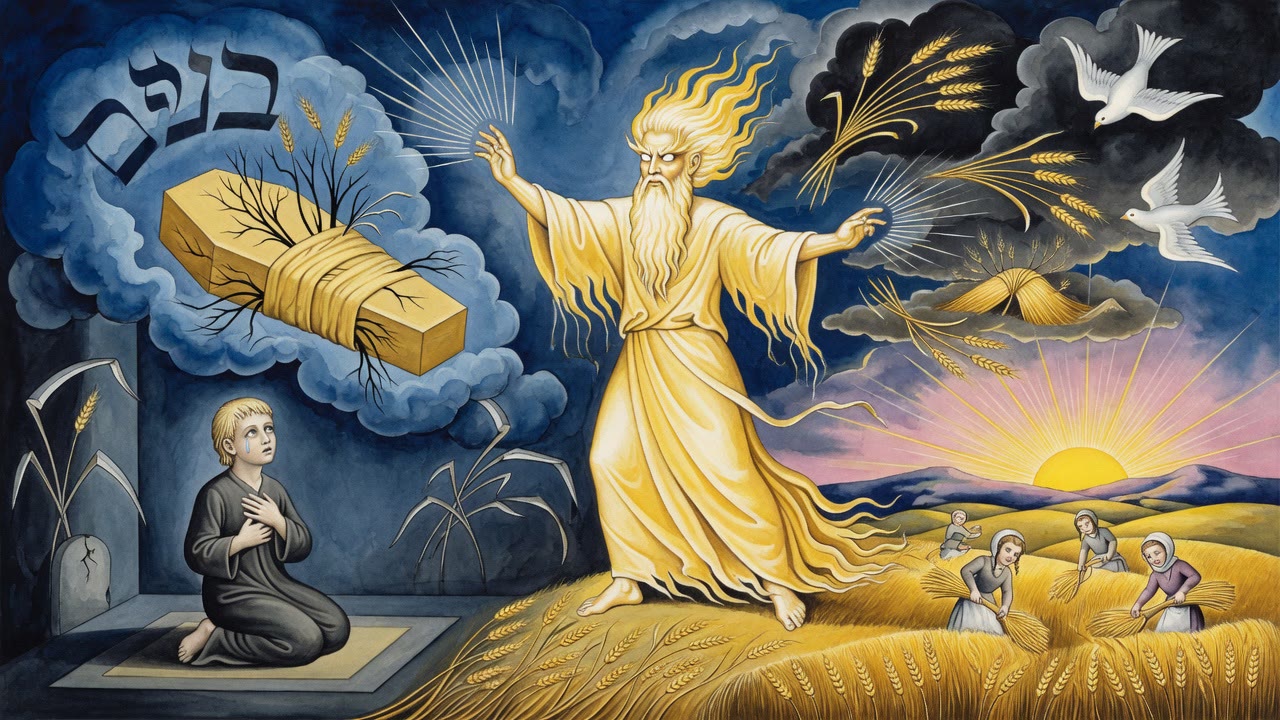
R. Akiva refused empty ink. He stood, cited Deuteronomy 32:47, and drove the verse home: it is no empty thing for you. If the Torah contains nothing empty, then et (את), the particle that marks a direct object, cannot be filler. Particles that seem small mark inclusions. Et the heavens means the heavens plus everything that belongs to them. Et the earth means the earth plus everything that belongs to it. Sun, stars, trees, animals, humans. All direct objects of a single divine verb.

Without the double et, a careless reader might have heard heaven and earth as co-creators named beside God. With the double et, they become owned creations under one actor. R. Akiva's fight was not pedantry. It was the same monotheism R. Simlai defended in the face of heretics, only fought at the scale of two letters that translators drop.

R. Ishmael still preferred the plain tool. R. Akiva still loaded every particle. Between them the first verse stayed one verb, one God, and a world that enters as object, not partner. Outside both halls the heretics' smile had less to stand on. Inside both halls men sweat over letters because letters can unmake a people if they are allowed to count gods.

R. Simlai left the study house with the plurals still on the page and the singular "He" still ruling the sentence. R. Akiva left his debate with et still invisible in every foreign tongue and still heavy in Hebrew. Creation remained one act. The world remained one belonging.


← All myths
From the tradition

Sources

2 sources

The texts behind this telling. Some cards carry a translation of the source; others are our own retelling of it, and each card says which. Every card links out to the original.

Midrash Tanchuma Buber, Bereshit 7:1Midrash Tanchuma Buber, Bereshit

Retold in our words. Read the original at the link below.Midrash Tanhuma, S. Buber Recension, trans. John T. Townsend (1989) · CC-BY

Heretics once cornered R. Simlai, a third-century sage of the land of Israel, and tried to trap him on a grammatical point. Midrash Tanchuma Buber, Bereshit 7:1 records the exchange. "How many deities created the world?" they asked.

The proof text they thought they had

The heretics pointed to (Joshua 24:19), which reads, in literal Hebrew: "For He is holy gods." The word Elohim is plural, and here the adjective kedoshim (holy) is plural too. Two plurals in a row. Proof, they claimed, of multiple divine powers.

R. Simlai's response was immediate. "Read the rest of the verse. It does not say 'they.' It says 'He.'" The subject of the sentence is singular even when the nouns describing Him are plural.

The holiness in all its modes

R. Simlai did not stop at grammar. He turned the plural from a problem into a theology. Why, he asked, does Joshua call the Holy One "holy" in the plural form? Because God is holy in every category of holiness at once.

R. Aha bar Hanina then unfolded the list. God's way is in holiness (Psalms 77:14, in the holy Temple). God's processions are in holiness (Psalms 68:25). God is seen in holiness (Psalms 63:3). God speaks in holiness (Psalms 60:8). God's arm is uncovered in holiness (Isaiah 52:10). God is beautiful and glorious in holiness (Exodus 15:11).

Six different modes. Six different verses. One God, who operates in every register of sanctity simultaneously. The plural form is not numerical, it is qualitative.

The (Genesis 1:1) challenge

The heretics tried one more angle. "But (Genesis 1:1) says Bereshit bara Elohim, in the beginning God (plural) created."

R. Simlai countered: "The verb bara is singular. It does not say bar'u. One subject, one action. The plural noun agrees with the singular verb only because the subject itself is singular." Hebrew grammar resolves the dispute. A plural word governed by a singular verb points to a single actor.

Why this argument mattered

R. Simlai's battles with heretics (minim) are preserved across the midrashic literature, Jerusalem Talmud Berakhot 9:1 has a parallel, as does Genesis Rabbah 8:9. He was defending a foundational Jewish claim: the unity of God. Every time a sectarian group pointed to a plural noun to suggest plurality in the Godhead, R. Simlai answered with the verb. The action is always singular. Therefore the Actor is always singular.

The takeaway: Jewish monotheism is not naive. It reads the plural forms in Hebrew scripture with care, and finds in them not evidence of many gods but evidence of one God whose holiness operates in many registers at once.

Full source
Midrash Tanchuma Buber, Bereshit 8:1Midrash Tanchuma Buber, Bereshit

Retold in our words. Read the original at the link below.Midrash Tanhuma, S. Buber Recension, trans. John T. Townsend (1989) · CC-BY

The first verse of the Torah contains two words that English translations almost always skip. The Hebrew et (את) appears twice in (Genesis 1:1), "in the beginning God created et the heavens and et the earth." Midrash Tanchuma Buber, Bereshit 8:1 records a legendary debate between two giants of early rabbinic Judaism over what those particles mean.

The two schools

R. Ishmael, the second-century sage, read the Torah plainly. Hebrew grammar uses et as a direct object marker, and Hebrew uses gam (also) and akh (but) as ordinary connective words. No hidden meanings. Just grammar.

His colleague R. Akiva disagreed sharply. For Akiva, every word in the Torah carried meaning, because the Torah was not ordinary speech. Particles that seemed grammatical served as signals, akh and raq marked exclusions, while et and gam marked inclusions. Each tiny word pointed to something beyond its literal function.

The Genesis test case

R. Ishmael challenged R. Akiva on (Genesis 1:1). "The verse does not say 'in the beginning God created heaven and earth.' It says et the heaven and et the earth. The et is just a grammatical clarification, it tells you what the direct object is."

R. Akiva pushed back. He cited (Deuteronomy 32:47): "For it is no empty thing for you", meaning the Torah itself. If the Torah contains nothing empty, then et cannot be merely grammatical filler. Every word must carry weight.

Then he made his positive argument. If the Torah had simply said "heaven and earth," readers might have concluded that heaven and earth were co-creators alongside God, two deities named in parallel. But the double et changes the picture. Et the heavens, meaning the heavens plus everything that belongs to them. Et the earth, meaning the earth plus everything that belongs to it. Sun, stars, trees, animals, humans. All included. All direct objects of a single divine verb.

Why this protects monotheism

R. Akiva's reading is theological as well as grammatical. Without the et, the Hebrew phrase could be parsed as a list of co-creators. With the et, it becomes unambiguous: God created, and everything else, heavens, earth, and all they contain, was created. One Actor, many objects.

The Greek translator Aquila, a second-century convert who studied under R. Akiva, followed this same principle in his Greek rendering of (Genesis 1:1). Where other translations dropped the et, Aquila rendered it with a Greek preposition meaning "together with." The principle survived into the language of the Gentiles.

The larger method

This debate between Ishmael and Akiva is one of the foundational methodological arguments in rabbinic exegesis. Or do you read it as a document in which every letter is loaded, every particle intentional?

Jewish tradition ultimately preserved both approaches. But it was Akiva's method that dominated the midrashic imagination.

The takeaway: in the Torah, no word is wasted. Two Hebrew letters, aleph and tav, the first and last letters of the alphabet, hide a whole theology of creation. The et ensures that God stands alone as Creator, and everything else is gathered under His verb.

Full source