Parshat Vayetzei5 min read

Rachel Demanded Children at the Edge of Death

Leah had four sons. Rachel had none. She told Jacob to give her children or she would die, and his anger flared at being asked to do God's work.

Curated by Arthur · Told by Maggid ·
Table of Contents
  1. Four Sons Across the Tent Rope
  2. The Handmaid and the Name of Judgment
  3. Affliction Upon Affliction
  4. The Donkey That Told Leah First
  5. What the Edge of Death Bought
  6. Rivalry That Named the Map of Israel
Rachel Demanded Children at the Edge of Death Click for full size

Four Sons Across the Tent Rope

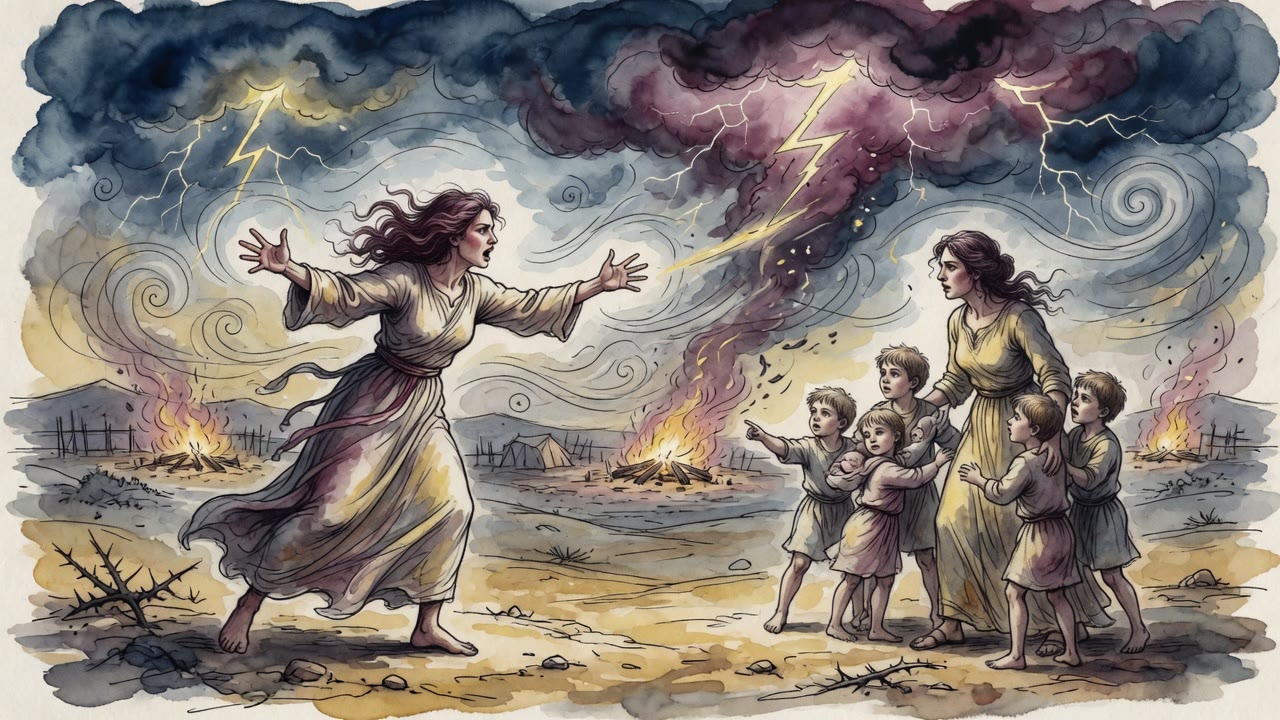
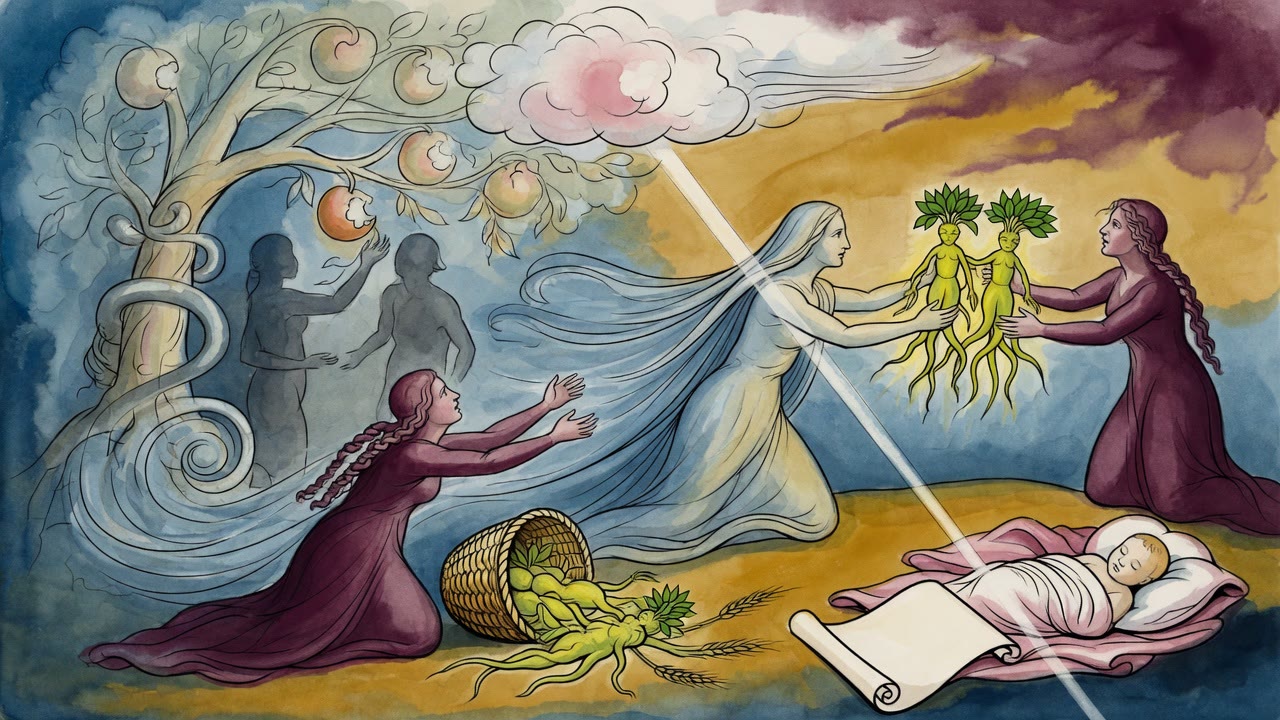
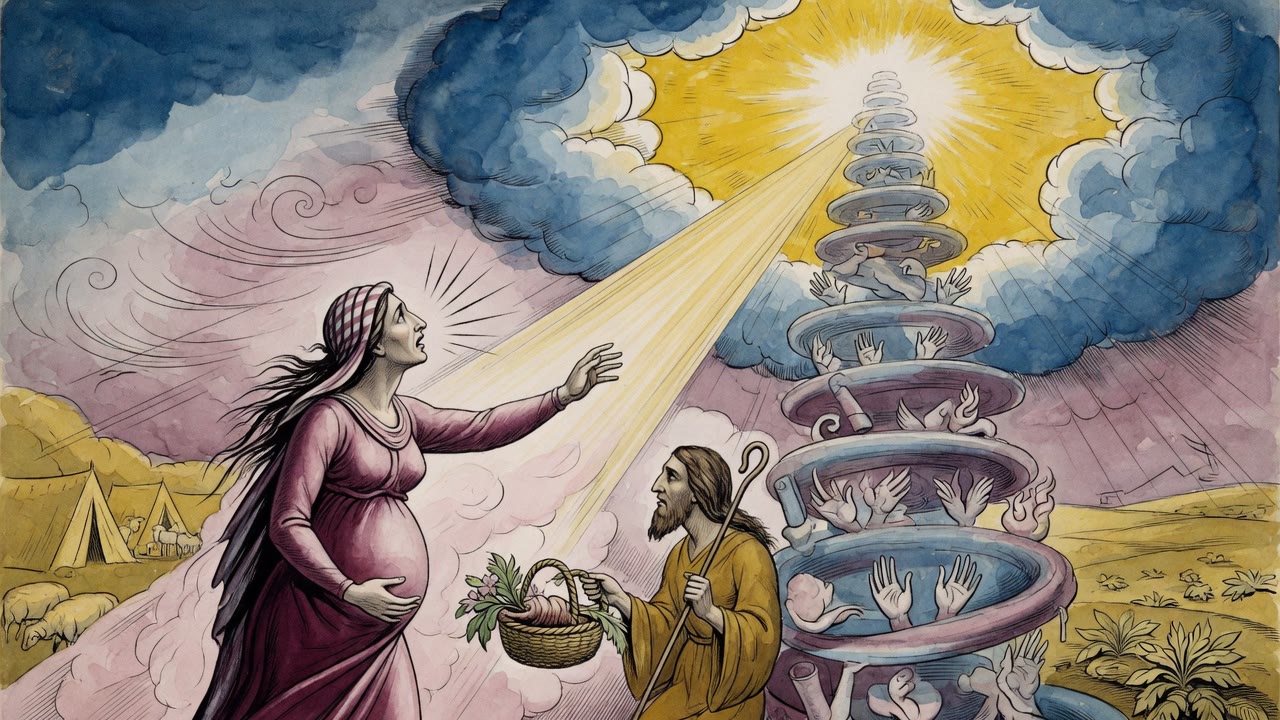
Leah had four sons. Rachel had none. Envy was not a petty heat over jewelry. It was the daily sound of other children's feet while her own arms stayed empty. She turned on Jacob with a sentence that put death on the table between them. Give me children, or else I die.

Jacob's anger flared, because a man cannot open a womb by will alone, and because the demand made him stand in for Heaven. Rachel did not soften the words. She meant the threshold. A life without a child felt to her like a life already walking out of the world.

The Handmaid and the Name of Judgment

She gave him Bilhah. When the boy came, Rachel named him Dan, from judgment. God has judged me and heard my prayer. The Aramaic heard farther than the cradle. So it is to be that He shall judge by the hand of Shimshon bar Manovach, who shall be of his seed. Samson, not yet born to Manoah, already rode inside the name like a future verdict. Rachel's first borrowed son carried a judge who would tear lions and Philistine gates ages later.

She had demanded life. Heaven answered with a name that would one day demand justice from enemies.

Affliction Upon Affliction

The second son through Bilhah received the name Naphtali. With affliction afflicted was I before the Lord in prayer. The intensive doubling is not poetry for its own sake. It is sweat. Nights of bargaining. Days of watching Leah nurse. Rachel's prayer had been soaked until the words themselves hurt. Redemption, in this house, did not arrive clean. It arrived through affliction stacked on affliction until a name could hold the weight.

Still Leah bore more. Still Rachel's own body stayed shut. The camp learned the sound of two kinds of motherhood: one loud with sons, one loud with prayer.

The Donkey That Told Leah First

On a day of mandrakes and bargains, Leah knew Jacob had returned from the fields before she saw his face. She heard the voice of the braying of the ass. His donkey. Years of listening had taught her the rhythm of his arrivals. She went out and claimed the night that love and politics had assigned her. Rachel, still counting empty months, watched another arrangement close around a man who was husband to both and fully present to neither.

The bray was a small sound. In a house of rival sisters it became a trumpet of who would be held and who would wait.

What the Edge of Death Bought

Rachel's cry did not stay a single tantrum. It reordered the family map. Dan. Naphtali. Later, after more years and more bargains, Joseph and Benjamin would come from her own body, and death would finally take her on the road as she had once feared it would take her in childlessness. The first demand, though, was the raw one: children or the threshold.

Jacob lived between a wife who named sons as victories and a wife who named sons as judgments and afflictions. The covenant advanced through both grammars. Rachel stood at the edge and refused to call emptiness peace.

Rivalry That Named the Map of Israel

The names born in that season did not stay private. Dan would become a tribe that judged and wandered and, in Samson's day, tore at Philistine power with a strength that looked like Heaven's joke on strong men. Naphtali would be associated with swiftness and with words released under pressure. Leah's sons already carried other futures: priesthood, kingship, commerce, study. Rachel's borrowed sons carried judgment and affliction because that was the weather of her prayer life when she named them.

Jacob moved between tents like a man sentenced to translate two languages of love. Leah spoke in the grammar of attachment and reward. Rachel spoke in the grammar of crisis. Give me children or I die was not rhetoric to her. It was a medical and spiritual diagnosis of a life she refused to call complete. Heaven delayed her own pregnancy long enough that the demand became a whole chapter of Israel's family tree, not a single outburst.

When the donkey brayed and Leah claimed the night, the household heard how precisely each sister tracked Jacob's body through the camp. Love had become logistics. Still the cry at the threshold remained the loudest human line of the season. Rachel would not decorate barrenness with patience she did not feel. She threw her need at her husband and, through him, at God, and the names that followed still taste of court and of suffering.

In the nights after Dan and Naphtali, Rachel still woke to the sound of Leah's household and measured her own silence against it. She had moved the line from despair to partial answer, yet partial answer is a hard bed for a woman who asked for life or death. The edge had not vanished. It had only been pushed back far enough for two names to stand on this side of it, waiting for the sons that would one day come from her own body and cost her more than envy ever had.


← All myths
From the tradition

Sources

4 sources

The texts behind this telling. Some cards carry a translation of the source; others are our own retelling of it, and each card says which. Every card links out to the original.

Targum Pseudo-Jonathan on Genesis 30:1Targum Pseudo-Jonathan on Genesis

Retold in our words. Read the original at the link below.The Targum of Jonathan ben Uzziel, trans. J. W. Etheridge, London, 1862 · Public Domain

Leah had four sons. Rachel had none. The Targum Pseudo-Jonathan on (Genesis 30:1) preserves the raw edge of her suffering.

Rachel was envious of her sister. The Aramaic does not hide the word. Envy is the right word for what Rachel felt, not petty jealousy over new clothes, but the consuming ache of a childless woman watching her sister's tent fill with boys. Leah's four sons were not abstract. They were running in and out of the house. Rachel saw them every day.

So she said to Jacob, Pray before the Lord that He give me children. Notice, she is not asking Jacob to give her children. She is asking him to pray. Rachel knows that fertility comes from Heaven, not from a husband. She is asking the patriarch to intercede.

Then the threshold: if not, my life I shall reckon as the dead. In the Aramaic this is a statement of identity, not a threat. Rachel is saying that a life without children is, to her, already a kind of death. She is not suicidal. She is heartbroken.

The Talmud (Nedarim 64b) will later say that four types of people are considered as if dead: the poor, the leper, the blind, and the childless. Rachel knows this taxonomy in her bones. Her words are the first statement of that principle in Jewish history.

Jacob will respond angrily. But Rachel's cry will be heard in heaven, and her two sons, Joseph and Benjamin, will eventually come. The pain of (Genesis 30:1) is the soil out of which the viceroy of Egypt will grow.

The takeaway: the loudest prayers of the Hebrew Bible are often the angriest. Rachel pleaded in envy, and Heaven answered.

Full source
Targum Pseudo-Jonathan on Genesis 30:6Targum Pseudo-Jonathan on Genesis

Retold in our words. Read the original at the link below.The Targum of Jonathan ben Uzziel, trans. J. W. Etheridge, London, 1862 · Public Domain

Bilhah, Rachel's handmaid, bears Jacob a son whom Rachel names Dan, from the Hebrew din, "judgment" (Genesis 30:6). Rachel says, God has judged me and heard my prayer.

The Targum Pseudo-Jonathan makes the name into a prophecy. So it is to be that He shall judge by the hand of Shimshon bar Manovach, who shall be of his seed; and hath He not delivered into his hand the people of the Philistaee?

Rachel sees Samson. She sees the judge who will rise from the tribe of Dan centuries later (Judges 13:2). She sees his long hair, his strength, his single-handed war against the Philistines. She sees the pillars of Dagon's temple falling on his shoulders.

The matriarch who just received her first son through a surrogate is already seeing the shape of her line's greatest warrior. The Aramaic din becomes not only God's judgment of her infertility but God's judgment of the enemies of Israel. Both meanings live in one name.

This is how the Targum Pseudo-Jonathan works across the genealogy of Israel. Every tribe's name contains a prophecy of that tribe's later moment of national significance. Judah will produce David. Levi will produce Moses and Aaron. Dan will produce Samson. The mothers were not guessing. They were seeing.

Samson himself is the tragic hero of the book of Judges. He is flawed, passionate, violent, devoted. He dies bringing down an enemy temple. From Rachel's perspective at the moment of naming, she sees only the deliverance of Israel through his hand, the final din, the judgment that vindicates the covenant against its oppressors.

The takeaway: when a Jewish mother names a child, she often speaks more than she knows. Rachel named Dan and saw a warrior who would not be born for four hundred years.

Full source
Targum Pseudo-Jonathan on Genesis 30:8Targum Pseudo-Jonathan on Genesis

Retold in our words. Read the original at the link below.The Targum of Jonathan ben Uzziel, trans. J. W. Etheridge, London, 1862 · Public Domain

The second son born through Bilhah is named Naphtali, and the Targum Pseudo-Jonathan hears in the name a principle of Jewish spiritual life.

Rachel says: With affliction afflicted was I before the Lord in prayer. The Aramaic uses an intensive doubling, affliction upon affliction. Her prayer has been soaked in suffering. Then she adds: He hath received my request that I might have a son as my sister, and hath given me two.

Two sons through her handmaid. Not yet through her own body, but two children she can count as hers. Her wrestling, the Hebrew naphtulei, has yielded a reward.

Then the prophecy. Even so are my children to be redeemed from the hand of their enemies when they shall afflict themselves in prayer before the Lord.

Rachel is naming the pattern of Jewish redemption. Affliction in prayer, then deliverance. Inui tefillah, pouring oneself out in front of Heaven, emptying oneself until there is nothing left but the request, is the mechanism by which her children will one day be rescued in every future generation of exile.

The Targum is pointing forward to the prayer of Moses in Egypt, the prayer of Hannah at Shiloh (1 Samuel 1:10), the prayer of Mordechai and Esther in Shushan, the prayer of the exiles in Babylon. Every time the children of Israel are in the hand of their enemies, the answer comes through the same pattern Rachel identifies at her son's naming. Affliction. Prayer. Deliverance.

Naphtali, in other words, is not merely the name of a tribe. It is the name of a theology.

The takeaway: Jewish redemption has always traveled through the narrow gate of sincere, afflicted prayer. Rachel named the gate when she named her son.

Full source
Targum Pseudo-Jonathan on Genesis 30:16Targum Pseudo-Jonathan on Genesis

Retold in our words. Read the original at the link below.The Targum of Jonathan ben Uzziel, trans. J. W. Etheridge, London, 1862 · Public Domain

A small Targumic detail in (Genesis 30:16) captures how Leah knew her husband had returned from the fields.

She heard the voice of the braying of the ass. Jacob's donkey. Leah recognized the sound before she saw the man. She had spent years learning the rhythm of her husband's arrivals, and now she could identify his approach by the bray of his animal alone.

The Targum gives us this small domestic reality because it matters to the story. Leah is not idly standing at the door. She is listening, has been listening, for years, for exactly this moment. The night of the mandrakes has been promised to her. She does not want to miss her turn.

So she goes out to meet him and speaks a line the Torah preserves in all its bluntness. Thou wilt enter with me, because hiring I have hired thee with my son's mandrakes from Rachel my sister.

Leah is claiming her night. She has purchased it, in the currency of a handful of mandrake roots, from her sister. There is no romance here, no subtlety. Only a woman whose husband has walked past her tent too many nights, now calling out her contract rights.

The Midrash (Niddah 31a) says that because Leah went out to meet Jacob with such raw desire for a child of her own, she was rewarded with Issachar, a son whose tribe would become the foremost scholars of Torah in Israel. Her desire was not shameful. It was holy.

The donkey's bray, the trade of mandrakes, the blunt proposition at the tent door, every detail preserved by the Targum builds toward a single point: the tribe of Torah study was born because Leah refused to let another night pass without her husband.

The takeaway: sometimes the ears of love hear what the eyes cannot. Leah heard the donkey, and the tribe of Issachar was born.

Full source