5 min read

Raguel Weeps Then Names Seven Dead Husbands

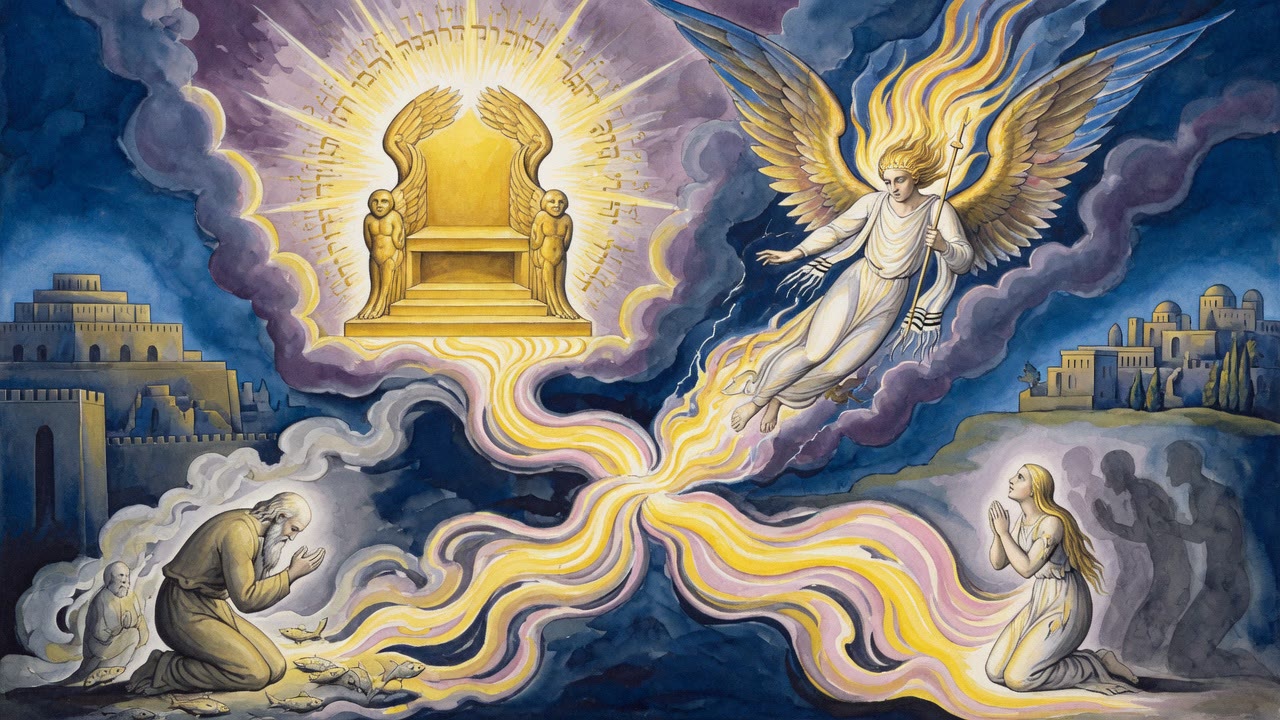
Tobiyyah reaches Ecbatana with Raphael hidden beside him. Raguel weeps for joy, then warns that seven grooms died before they could touch Sarah.

Curated by Arthur · Told by Maggid ·
Table of Contents
  1. The Sprint Across the Courtyard
  2. The Request Before the Second Course
  3. A House Full of Unburied Names
  4. Eat, Drink, and the Matter Will Not Leave
  5. What Kind of Courage Walks In
Raguel Weeps Then Names Seven Dead Husbands Click for full size

The Sprint Across the Courtyard

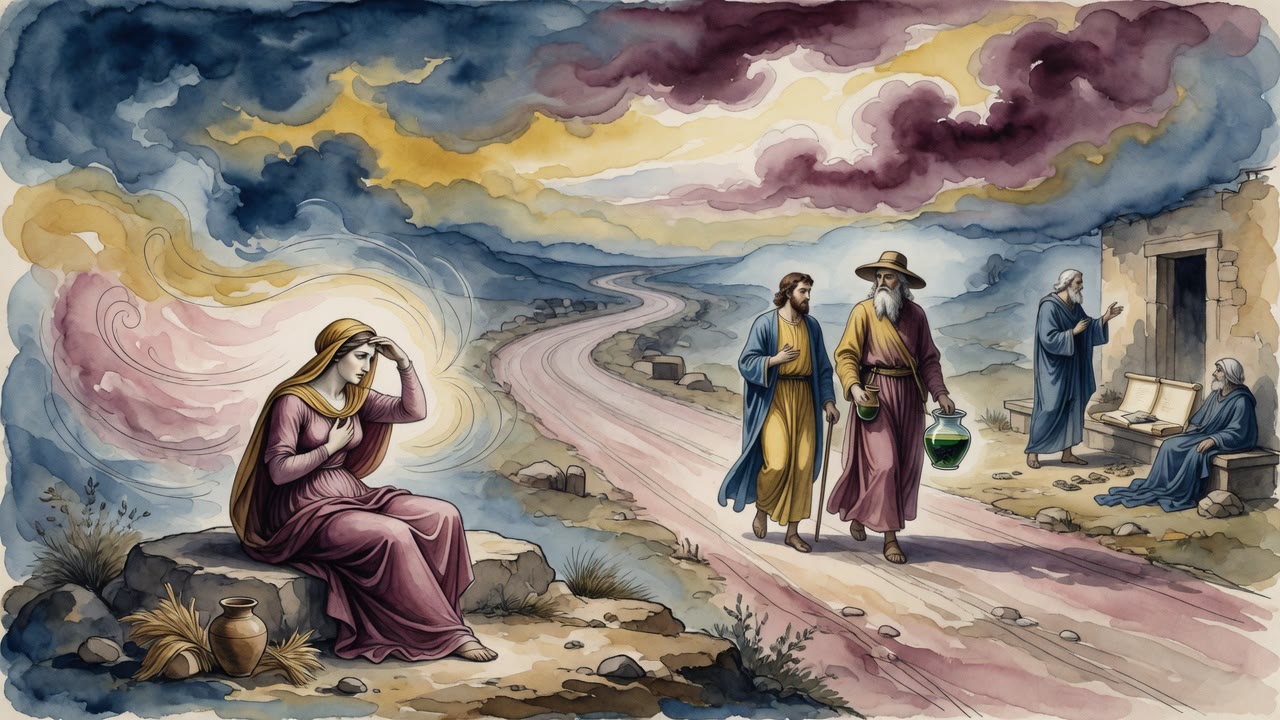
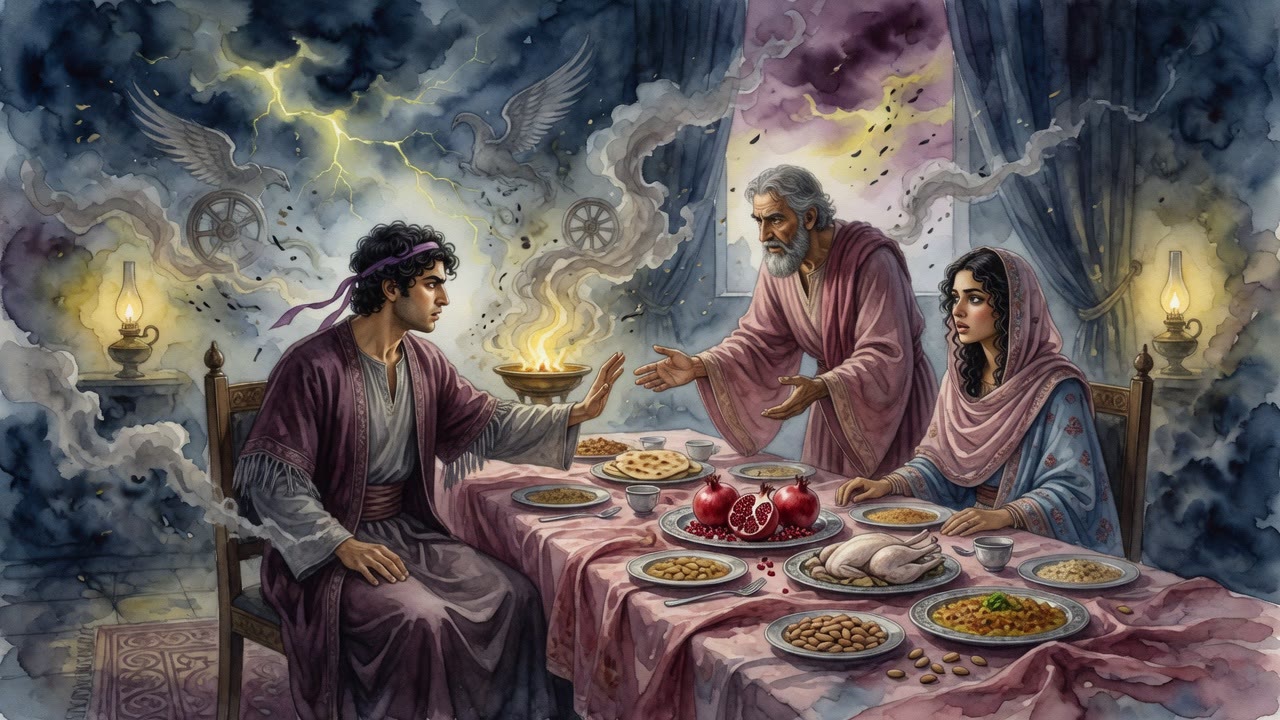
Raguel saw the young man's face and ran. Not a dignified walk. A sprint. He caught Tobiyyah in both arms and wept into his shoulder as if a lost river had found its bed. "Blessed art thou, my son, of the Lord, for thou art the son of a righteous and upright man."

Ednah came. Sarah came. More tears. A ram went to sacrifice. Meat hit the fire. Cups filled. The house of Ecbatana put on joy like a garment that still smelled of old smoke underneath. Tobiyyah's companion stood quiet, a man called Azariah to their eyes, Raphael to heaven's ledger.

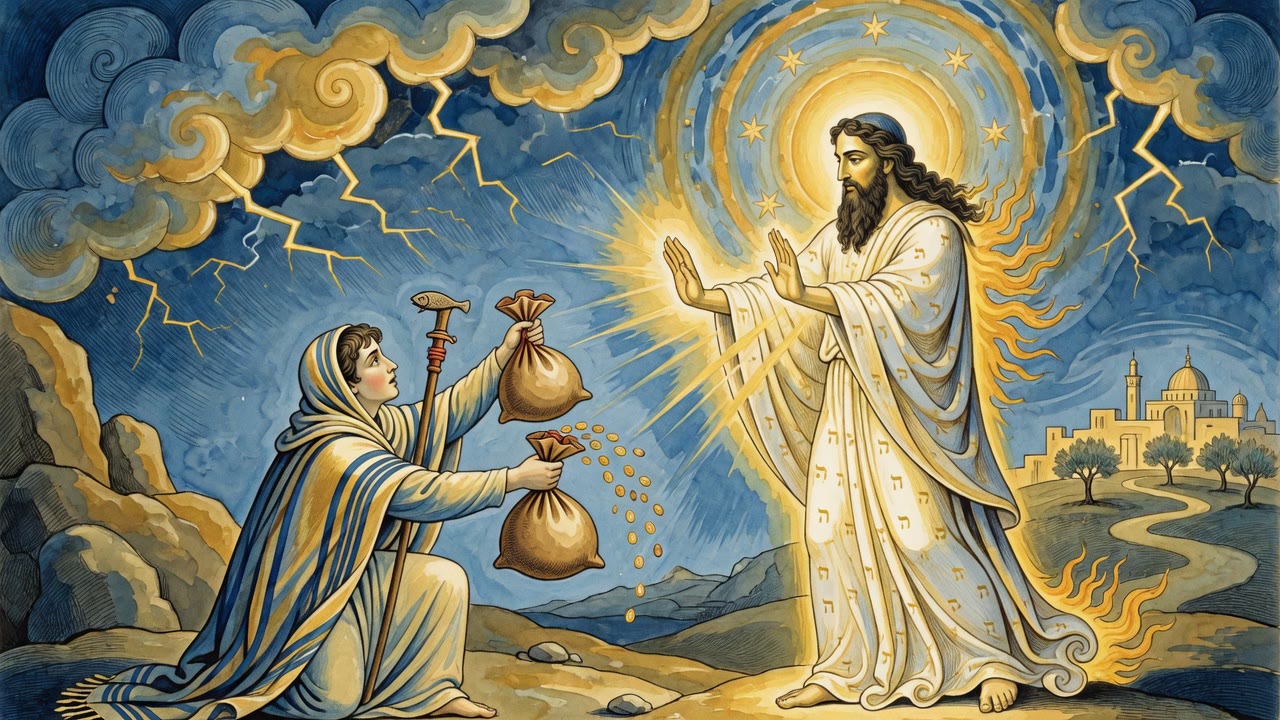
Tobit was blind far away in Nineveh. Money waited in a trust that had outlasted empires' moods. The son had walked hard roads to collect it. Tonight the road ended in a relative's embrace and a feast that tried too hard.

The Request Before the Second Course

Tobiyyah did not wait for dessert diplomacy. He told his companion to speak of Sarah, of marriage, of the right that kinship and law could claim. Raguel's face changed the way a sky changes when hail is decided.

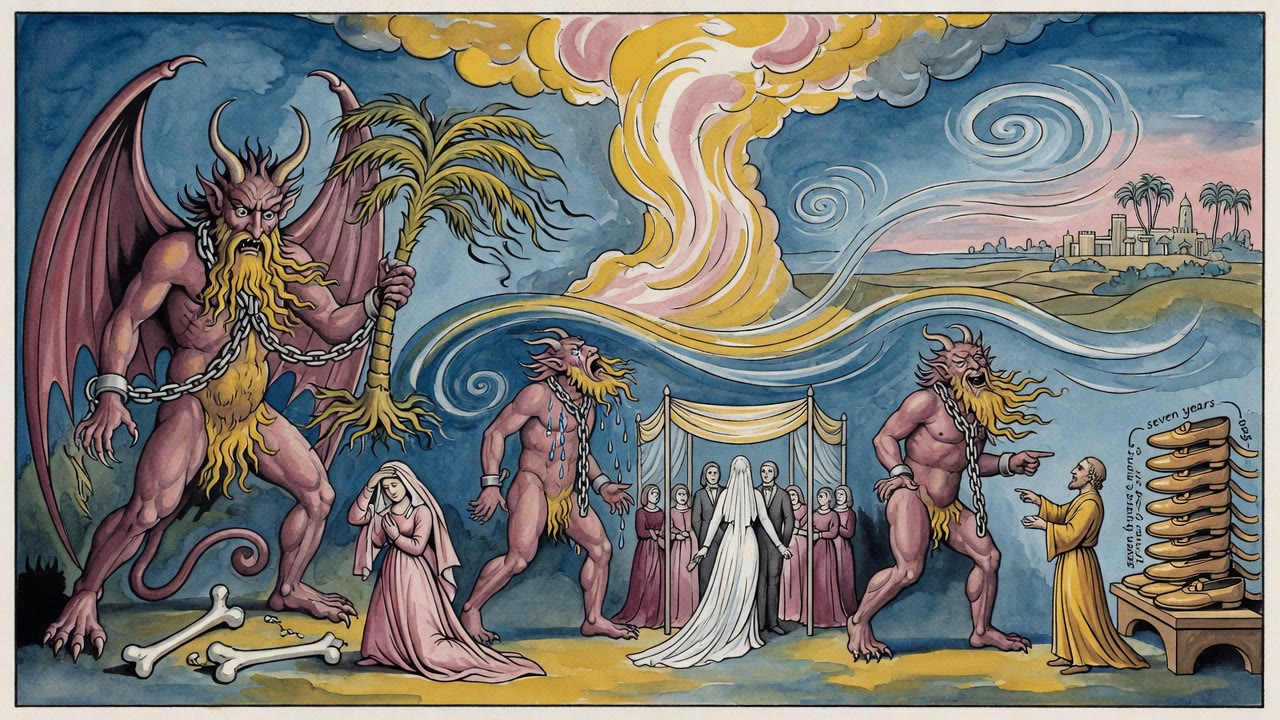
"I know it is better that I give her to thee than to another," he said. Truth followed like a blade from a sheath. "I have already given her to seven husbands, who all died before they came in unto her."

Seven. Not a storyteller's flourish. Seven grooms who never finished a wedding night. The temperature in the room dropped while the meat still steamed. Raguel offered the coward's mercy: eat, drink, leave the matter alone. Pretend the request never opened the grave under the table.

A House Full of Unburied Names

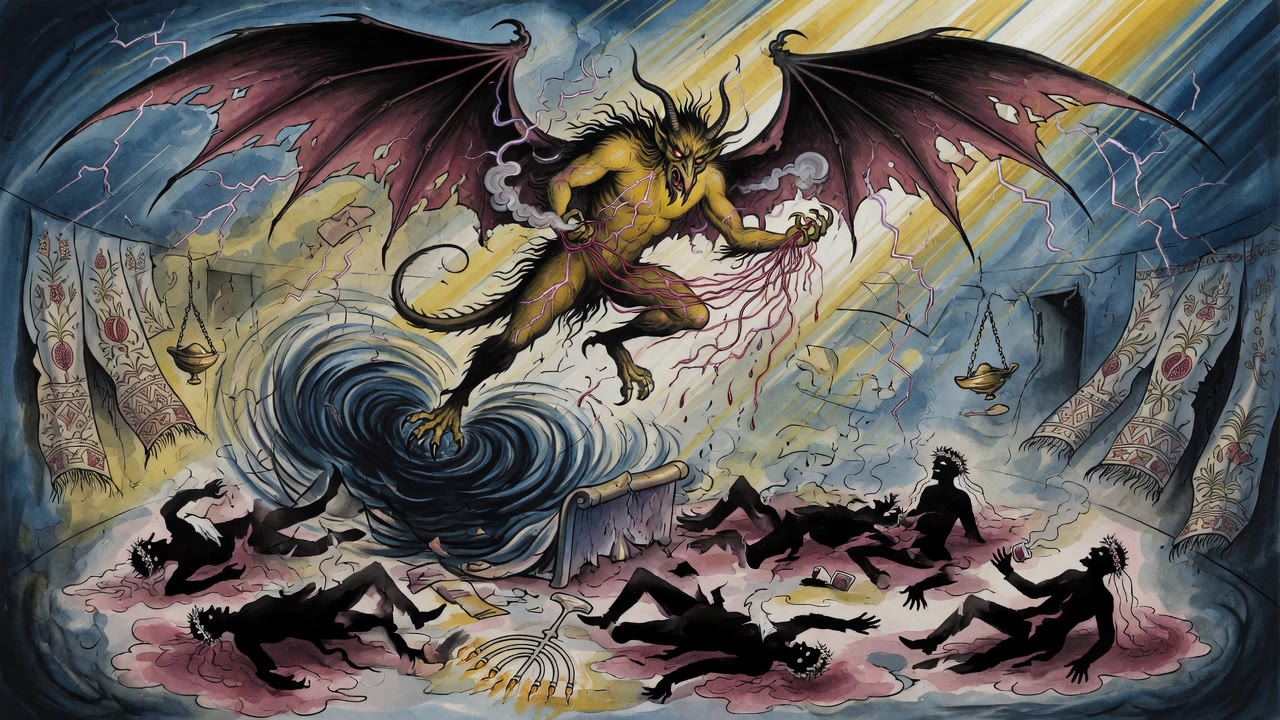
Sarah had lived under those names like a roof that leaks blood. Each dead husband was a sentence she did not write and still had to hear. The demon of the old tale is not on stage in this hour of tears, but the body count is. Joy and curse share the same plates.

A hard Second Temple wisdom voice warns the living not to set the heart forever on the dead: dismiss the endless clinging, remember the end, know that yesterday's sentence is today's shared fate. Obsessive mourning profits the dead nothing and wounds the mourner. When the dead rest, let remembrance rest enough for the living to stand up again.

Raguel's house has not learned that balance. It swings from weeping welcome to freeze of dread. Sarah sits inside both weathers. Tobiyyah hears the seven and does not fold the request back into his pocket.

Eat, Drink, and the Matter Will Not Leave

"Eat and drink, and leave the matter alone," Raguel repeats, as if food could muzzle destiny. Tobiyyah's jaw sets. A man who has walked with an angel (unknowing, still) does not treat a bride like a rumor to drop for politeness.

The feast continues with a limp. Jokes die mid-air. Ednah watches her daughter the way a mother watches a cliff. Raphael's human face gives nothing away. He already knows the fish's organs waiting in a bag for smoke that will drive a killer out of a bedroom. Tonight is only the naming of the wound.

Outside, Ecbatana's night goes on being a city. Inside, seven absences pull chairs close to the living.

Tobiyyah looked at Sarah and did not see a curse first. He saw a person trapped inside other men's endings. That sight is its own kind of bravery. Raguel saw only the math of graves. Ednah saw her daughter's shoulders fold and straighten, fold and straighten, a body trained by dread.

What Kind of Courage Walks In

Tobiyyah will marry. The road ahead holds a chamber, a prayer, a stench of burning innards that holiness uses like a weapon, and a dawn where Raguel digs a grave in private fear and finds no corpse to fill it. For this hour it is enough that a father weeps twice: once for a kinsman's son, once for the ledger of dead sons-in-law he must confess.

Sarah's hand lies still on the table. Tobiyyah's hand does not retreat. Hard comfort about letting the dead rest is not spoken in the room, yet the room needs it. Endless rehearsal of the seven names would freeze Tobiyyah at the door. Memory must make space for a living vow or the house becomes a museum of failure.

Raguel pours wine with a shaking wrist. "Blessed art thou," he said at the door. Now he must learn whether blessing can outlive seven endings. The ram's smoke thins. The request stays.

Outside a dog barked at nothing and everyone flinched as if the sound were an eighth omen. Tobiyyah set his cup down without drinking. Some toasts should wait for a morning that has not been canceled by dread wearing a father's face.

Sarah deserves more than a guided tour of funerals. She deserves a night that ends with morning. Tobiyyah holds that sentence without saying it aloud. Raphael watches the oil lamps and counts hours until the fish-smoke can do its work.


← All myths
From the tradition

Sources

2 sources

The texts behind this telling. Some cards carry a translation of the source; others are our own retelling of it, and each card says which. Every card links out to the original.

Book of Tobit 7:4Book of Tobit

Retold in our words. Read the original at the link below.Sefaria-hosted English translation · CC-BY

Remember Tobiyyah (sometimes called Tobias), our hero? He's on this epic journey to retrieve some money for his blind father, Tobit. And he's got the angel Raphael disguised as a human companion. They’ve finally arrived at the home of Reuel, a relative living in a distant land.

The scene: Reuel practically sprints to greet Tobiyyah, embraces him with tears, and proclaims, "Blessed art thou, my son, of the Lord, for thou art the son of a righteous and upright man!" Big hugs all around, Reuel's wife Ednah and daughter Sarah join in the weeping. A celebratory ram is sacrificed, a feast is prepared, and everyone's eating and drinking with joyful hearts. It’s a picture of perfect hospitality.

Beneath the surface of this warm reception, there's a HUGE elephant in the room.

Tobiyyah, bless his heart, doesn't waste any time. Turning to Raphael, he instructs him to speak to Reuel about a rather delicate matter: asking for his daughter Sarah's hand in marriage.

Now, picture Reuel's face as he hears this request. I mean, can you imagine? He says, "I know, my son, that it is better that I give her to thee than that I give her to another husband, but I will tell thee the truth." Uh oh. Here it comes...

"My son, know that I have already given her to seven husbands, who all died before they came in unto her."

Seven. That's not a typo. Seven grooms have perished before consummating their marriages to Sarah. It's the kind of dark secret that hangs heavy in the air, a curse, a tragedy. You can almost feel the temperature drop in the room.

And Reuel's solution? “But now eat and drink, and leave the matter alone." Basically, let’s just pretend this whole thing didn’t happen, okay?

Talk about awkward! Tobiyyah has walked right into a minefield. What does a guy do when he finds out the woman he wants to marry is, shall we say, unlucky in love? Does he run for the hills? Does he trust in divine intervention? Does he order another plate of that delicious feast and hope it all blows over?

We'll have to wait and see what happens next, but one thing's for sure: this is one dinner party no one will soon forget. How much do we really know about the people we invite into our lives? And what secrets might be lurking just beneath the surface of even the warmest welcomes?

Full source
Ben Sira 38:24Ben Sira

Retold in our words. Read the original at the link below.The Wisdom of Ben Sira, Cambridge University Press (1899) · CC-BY

The Book of Ben Sira, a work of wisdom literature from the Second Temple period, offers some surprisingly direct advice about remembering the dead. It’s not what you might expect. It almost sounds…harsh.

"Set not the heart upon him any more," Ben Sira urges. "Dismiss his remembrance, and remember the end." It feels almost counter-intuitive. Shouldn't we cherish the memories of those we've lost?

Look closer. The text continues, "Remember his sentence, for it is thy sentence; His yesterday, and thine to day." He’s not suggesting we forget the person entirely. Instead, Ben Sira seems to be saying that dwelling excessively on the past can trap us. Their fate is now their fate, and you have to live your life. Facing the reality of mortality, both theirs and our own, is key to moving forward.

There's a practical reason, too. "Remember him not, for there is no hope for him," Ben Sira says. "What shalt thou profit him? And thou shalt hurt thyself." This isn't about being callous; it’s about recognizing the limits of our ability to help. Obsessive mourning can be self-destructive, preventing us from engaging with the world and living fully.

"When the dead is at rest, let his remembrance rest; And be comforted when his soul departeth." This line offers a sense of closure. Once the period of mourning is over, we should allow their memory to find peace. This isn’t about forgetting, but about finding a healthy balance between remembrance and moving on. It's about accepting the natural cycle of life and death and finding comfort in the belief that their soul has found its place.

Then, in a seemingly unrelated turn, Ben Sira shifts gears. "The wisdom of the scribe increaseth wisdom; And he that hath little business shall become wise." What’s this about?

It’s actually quite connected. After dealing with loss, we need to find ways to re-engage with life. Ben Sira suggests that immersing ourselves in study, in the pursuit of wisdom, can be a path towards healing and renewed purpose. It's about finding meaning in the present and future, rather than being consumed by the past.

But what about those who don't have the luxury of endless study? Ben Sira asks, "How shall he get wisdom that holdeth the plough, And glorieth in the stimulant spear?" In other words, how can the working person, the farmer or the soldier, find wisdom?

This question acknowledges that not everyone has the time or resources for formal learning. The answer, implied but not explicitly stated, lies in the experiences of everyday life. Wisdom can be found in hard work, in observing the natural world, and in interacting with others. Even in the midst of labor, there is opportunity for reflection and growth.

So, what does Ben Sira ultimately teach us? It's not about forgetting those we’ve lost, but about honoring their memory in a way that allows us to live fully. It's about finding a balance between remembrance and moving forward, and about seeking wisdom in all aspects of life, whether through study or through the daily grind. It’s a tough lesson, but one that can ultimately lead to healing and a renewed appreciation for the preciousness of life.

Full source