Parshat Bereshit5 min read

The River That Made Eden Larger Than Paradise

Two sages measured Eden with verses and field units, while the mystics heard a hidden river carrying wisdom into the garden.

Curated by Arthur · Told by Maggid ·
Table of Contents
  1. The Garden Became a Border
  2. One Small Word Moved the Fence
  3. The River Settled the Measure
  4. Rabbi Hanin Added the Hidden Scale
  5. Wisdom Became a River
  6. The Garden Drank What It Could Hold

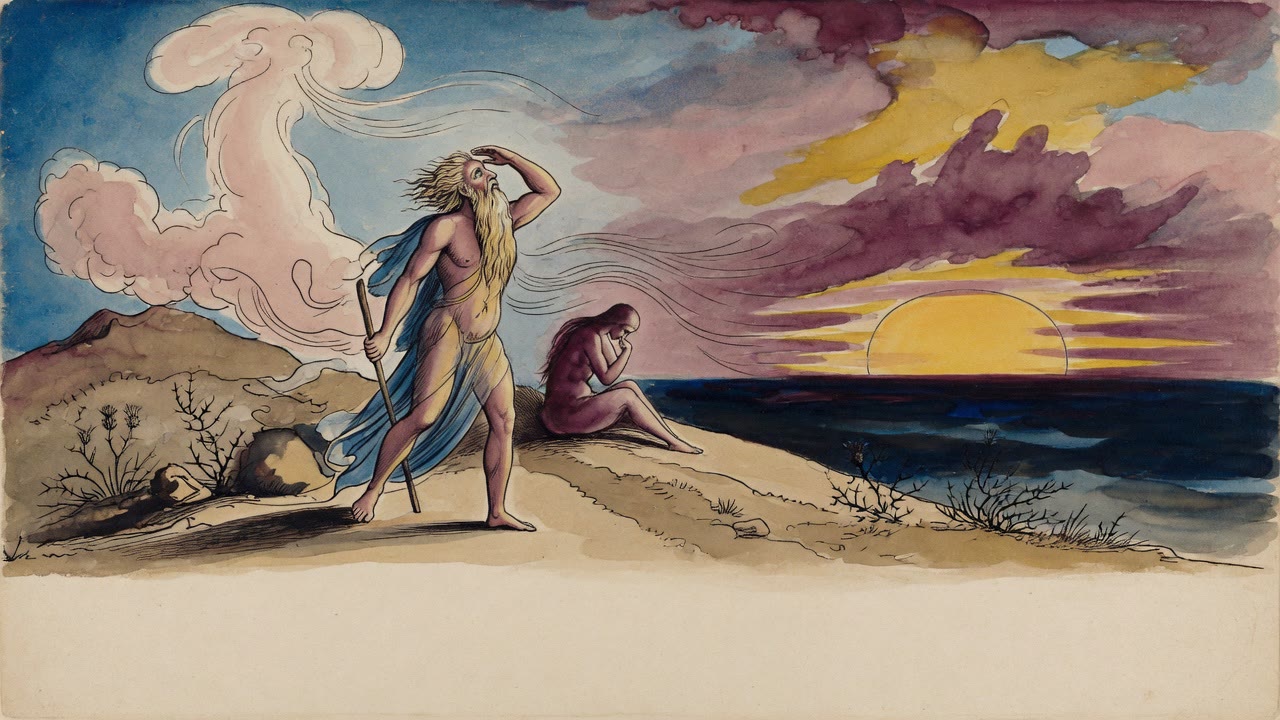
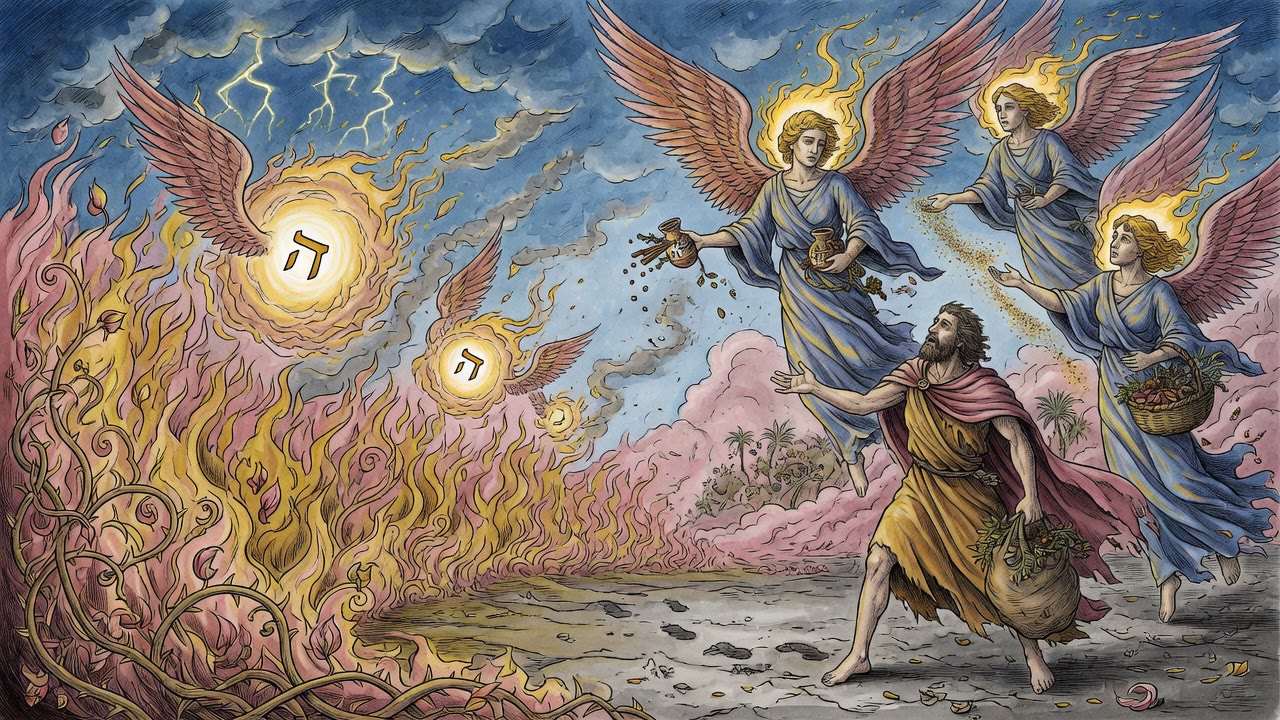
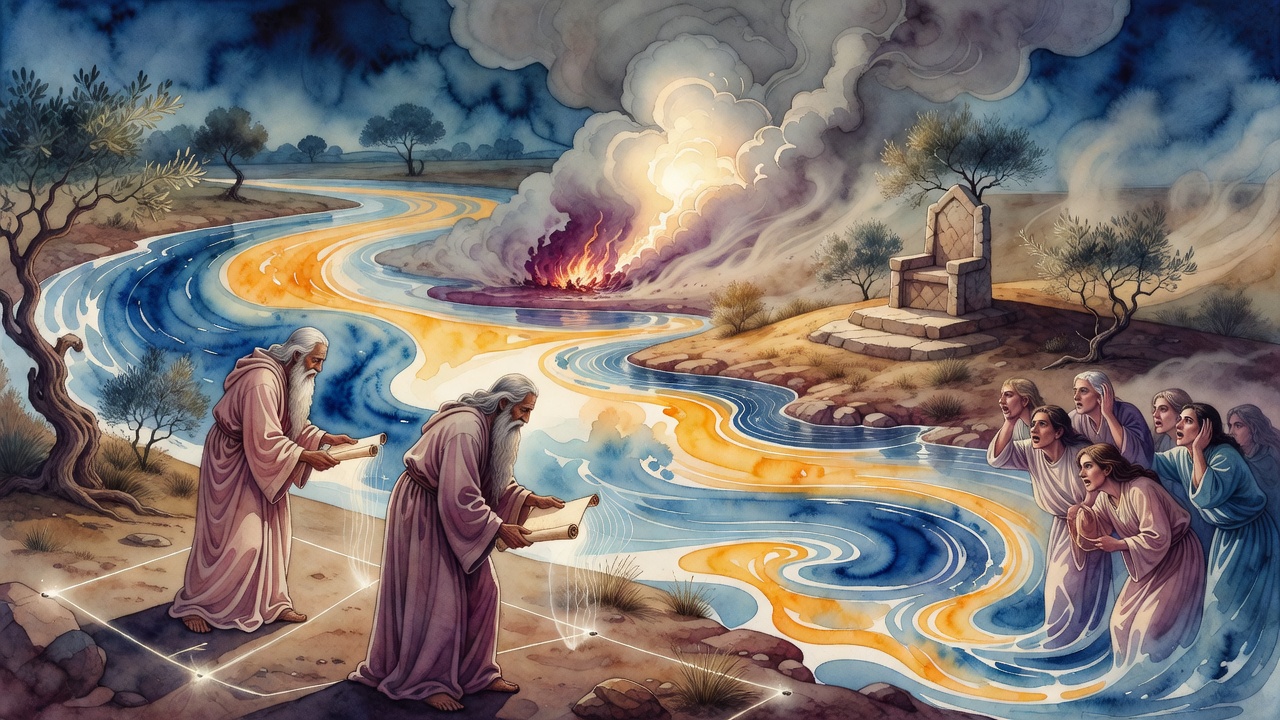
The river left Eden before the sages finished measuring the ground. It moved first, clear and impossible, from hidden abundance into the planted place where trees could drink. The argument came after the water.
The Garden Became a Border

Rabbi Yehuda held the verses like survey stakes. If the trees of Eden stood in God's Garden, and if a figure could be placed in Eden of God's Garden, then the Garden was the greater enclosure. Eden was the inner district, precious but smaller, contained by the place that God had planted.

The claim had force because the Garden felt like a world of its own. It held trees, command, delight, danger, exile. It had gates that could close. It had a path that could be guarded. A boundary that strong seemed capable of holding Eden inside it.

One Small Word Moved the Fence

Rabbi Yosei did not start with the grandeur of the Garden. He started with one small word: in. God planted the Garden in Eden. The preposition became a spade, and with it he dug up the fence Rabbi Yehuda had set. If the Garden was planted in Eden, then Eden had to be the wider ground.

The study hall did not need marble columns to feel the pressure of that word. A single word could overturn two proofs. A planted garden needs soil around it, rain above it, channels beneath it, and a world that can feed its roots. Eden became not the courtyard within Paradise, but the deep country from which Paradise lived.

The River Settled the Measure

Then the river crossed the argument and made the map speak. It went out from Eden to water the Garden. Water does not flow from the cup into the spring. It does not leave the small vessel to fill the source. It descends from abundance toward need.

Rabbi Yosei heard the motion and knew what it meant. Eden was the great wet field. The Garden was the thirsty plot. A larger measure could irrigate a smaller one, as a broad field could give drink to a fraction of its size. The old measures made the image earthy: a beit kor above, a tarkav below, the smaller piece only one-sixtieth of the larger. Paradise was not diminished by being smaller. It became alive because something greater poured into it.

Rabbi Hanin Added the Hidden Scale

Rabbi Hanin sharpened the matter, and Rabbi Yosei's proof widened. The debate was no longer only a contest of verses. It became a way to see how holiness travels. The Garden was visible enough for trees and commandments. Eden stood beyond it, not less real, but less easily held by speech.

The river mattered because it crossed that distance. It carried what the planted place could not produce by itself. Without the river, the Garden would have been an enclosure with roots in dry ground. With the river, every tree stood in dependence. Even Paradise had to receive.

Wisdom Became a River

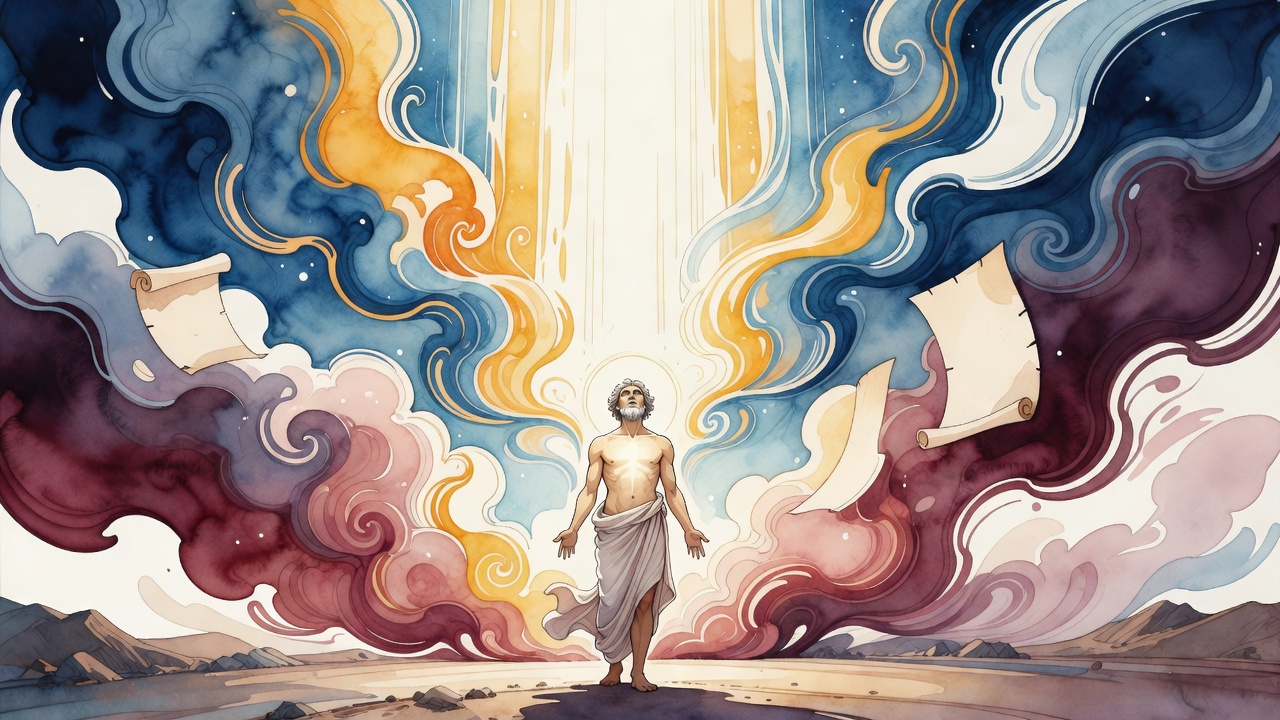
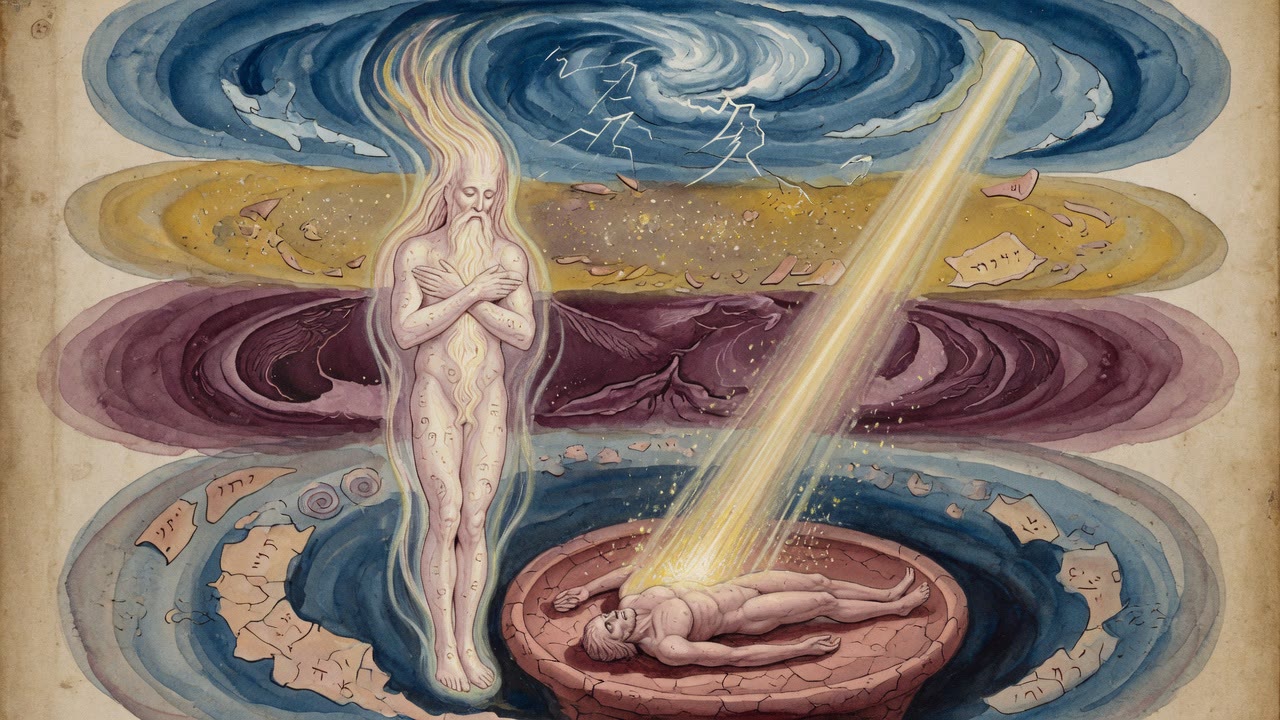
When the mystics listened behind the river, Eden rose beyond geography. It became the hidden source of Chochmah, wisdom, drawn from a place concealed above even ordinary concealment. From that hidden Eden, intelligence did not remain sealed. It pressed outward. It carved paths. It became a river.

The river was Binah, understanding, flowing from wisdom into shape. Chochmah flashed like a seed of light. Binah widened it into a channel that could be received, named, and borne by worlds below. Malchut, kingdom, rose into that current and gave the lower world a way to touch what was above it. The Garden now looked like every created place that survives only because a hidden source keeps sending life through a narrowing stream.

The Garden Drank What It Could Hold

So Eden was larger than the Garden, and still smaller than the wisdom behind it. The sages measured with verses and field units. The mystics listened for flow behind the measures. Both imagined a planted world unable to sustain itself from its own soil.

The river kept moving. It ran from concealment into form, from source into vessel, from the ungrasped into leaves, fruit, command, and exile. The Garden could not own Eden. It could only drink.


← All myths
From the tradition

Sources

3 sources

The texts this telling draws on, in full. Open a card to read inline, or expand it for a wider, quieter read.

Bereshit Rabbah 15:2Bereshit Rabbah

The rabbis of old certainly pondered this question.

In Bereshit Rabbah, that incredible collection of rabbinic interpretations on the Book of Genesis, we find Rabbi Yehuda and Rabbi Yosei locked in a friendly debate about just this. It all revolves around one simple question: which was bigger, the Garden, or Eden itself?

Rabbi Yehuda, he's on Team Garden. He argues that the Garden was actually larger than Eden. How does he figure this? Well, he points to the Book of Ezekiel. In one verse (Ezekiel 31:9), it says “All the trees of Eden that were in God’s garden envied it.” And another verse (Ezekiel 28:13) states, “You were in Eden, of God’s garden.” See his point? The phrasing suggests that Eden is inside the Garden, a smaller area contained within a larger one.

Rabbi Yosei sees it differently. He believes Eden was the larger entity. His proof text? (Genesis 2:8): "The Lord God planted a garden in Eden.” That little word "in" is key. It implies the garden is located within Eden.

And he doesn't stop there. (Genesis 2:10) tells us "A river emerges from Eden to water the garden." Rabbi Yosei takes this to mean that even the runoff from a small part of Eden could irrigate the entire garden! He illustrates it with measurements: from the runoff of a beit kor (a unit of land measurement), a tarkav (one-sixtieth of a beit kor) could be watered. So, Eden must have been huge!

Rabbi Yehuda counters that the river was like a spring situated right in the middle of the garden, efficiently watering everything. It's a good point, but...Rabbi Yehuda needed two verses to make his argument, while Rabbi Yosei only needed one.

But wait! The story doesn't end there. Rabbi Hanin of Tzippori steps in, and according to Bereshit Rabbah, he says, “The Holy One blessed be He illuminated the eyes of Rabbi Yosei and he found another verse that was decisive in addition to the first.” What was this game-changing verse? (Isaiah 51:3): “He will render its wilderness like Eden and its desert like the garden of the Lord.” The verse compares Eden to the wilderness of the Land of Israel, and the Garden to its desert. The wilderness is far larger than the desert, implying that Eden is larger than the Garden.

So, in the end, it seems Rabbi Yosei's view might have gained the upper hand. But what does this all mean? Why should we care about the square footage of paradise? Perhaps it's not about the literal size. Maybe the Rabbis were trying to teach us something about perspective. About how we perceive the world, about how we understand the relationship between the contained and the boundless. Maybe, just maybe, Eden, in all its vastness, is still within our reach.

Full source
Idra Zuta 1:48Idra Zuta

Idra Zuta turns to The Flowing River of Eden and Wisdom.

The passage introduces us to the idea of Eden. Not just the Garden of Eden we might picture from Genesis, but a higher, more abstract Eden connected to the very source of divine wisdom. This Eden, we are told, is linked to Chochmah, one of the ten Sefirot (the divine emanations), or divine emanations, in Kabbalistic thought. Chochmah represents wisdom, and here it's specifically the "Chochmah of the thirty-two paths." Think of these paths as conduits through which divine understanding flows.

Where does this Chochmah originate? From an even more concealed place, the "most concealed highest Eden," described as the "concealed brain." This "concealed brain" is associated with Atika, a term often referring to the Ancient One, the most hidden aspect of the Divine.

Here's where it gets interesting. This Eden, this Chochmah, is considered a "beginning" for shining on lower beings, on us. The text emphasizes that in Atika, the "concealed brain," there's neither beginning nor end. It simply is. Beginning and end, rather, belong to Chochmah, both the supernal (higher) and lower manifestations of it.

Why this distinction? Because the "concealed brain" doesn't shine directly on us. Instead, its illumination passes through Mazala (often understood as divine influence or good fortune) and into the "brain of the thirty-two paths", that lower Chochmah we discussed earlier. This lower brain does have a beginning because it contains Chochmah of the left column, which in Kabbalah represents limitation and judgment. And it has an end: Malchut, the final Sefirah (a divine emanation), representing the Kingdom, the realm of manifestation where this Chochmah can be revealed.

The Idra Zuta then makes a fascinating linguistic point. Because Atika has neither beginning nor end, it's not addressed as "you" (second person) but as "he" (third person). It's too distant, too beyond our grasp for direct address. But the place that does contain a beginning, that Chochmah of the thirty-two paths, is called "you" and "father," as in the verse from (Isaiah 63:16), "You… are our father." This suggests a closer, more personal relationship with the divine wisdom that manifests in a way we can comprehend and connect with.

So, what does this all mean? Perhaps it's a reminder that true wisdom isn't just about accumulating knowledge. It's about accessing a flow of understanding that originates from a source beyond our comprehension, a source that then manifests in ways that do have a beginning and an end, a way that we can relate to and learn from. It’s a journey from the hidden "He" to the accessible "You," a journey of unfolding revelation. A journey, ultimately, of becoming more human.

Full source
Idra Zuta 1:45Idra Zuta

In Kabbalah, the mystical tradition of Judaism, that source is a complex and beautiful flow, originating from the very highest realms. to a piece of the Idra Zuta and explore this flow of wisdom.

The Idra Zuta, a section of the Zohar, unveils the hidden dynamics within the divine structure, particularly how the attributes of Chochmah (Wisdom) and Binah (Understanding), along with Da’at (Knowledge) which unifies them, descend and influence the lower realms. Think of it like a cosmic plumbing system, but instead of water, it's divine intelligence

Specifically, The text explains that this Chochmah is "engraved" and produces a "river." This river, it turns out, represents Binah.

Why a river? Well, according to this passage, Binah is extruded from Chochmah because of an "ascent of Malchut to Binah." Malchut (Kingdom) is the lowest of the sefirot, the ten emanations through which God manifests in the world. When Malchut ascends to Binah, it creates a kind of pressure that causes Binah to separate from Chochmah, like a river flowing from its source.

And what does this river do? It "waters the garden," which is Malchut itself. Without this flow from Chochmah, the text implies, Malchut would be devoid of the intellectual capacity, the “brains,” so to speak, necessary to fulfill its role. This ascent of Malchut to Binah, we're told, is connected to the "right column," often associated with mercy and expansion.

This river then enters the "head of Zeir Anpin." Zeir Anpin, often translated as "Small Face," is a central figure in Kabbalistic cosmology, representing the active, expressive aspect of God in the world. The river of Chochmah becomes "one brain" within Zeir Anpin, specifically the brain of Chochmah on the right side of its head. From there, it flows throughout the entire body of Zeir Anpin, nourishing all the "plants", a metaphor for the various aspects and influences within the divine structure.

This process, the Idra Zuta tells us, echoes the biblical verse from (Genesis 2:10): "And a river went out of Eden to water the garden." It’s a powerful image! Eden, the source, giving rise to a river that sustains all of creation.

So, what does it all mean? This passage illuminates the intricate processes by which divine wisdom flows from the highest realms down to the lowest, nourishing and sustaining all of existence. It all hinges on the dynamic interplay between the sefirot, particularly the ascent of Malchut and the subsequent extrusion of Binah from Chochmah. It reminds us that even the most abstract concepts in Kabbalah are ultimately connected to the practicalities of creation and sustenance. the next time you're feeling parched for knowledge – the source is always flowing.

Full source