5 min read

Sap Rose on Tu BiShvat and the Devourer Fled

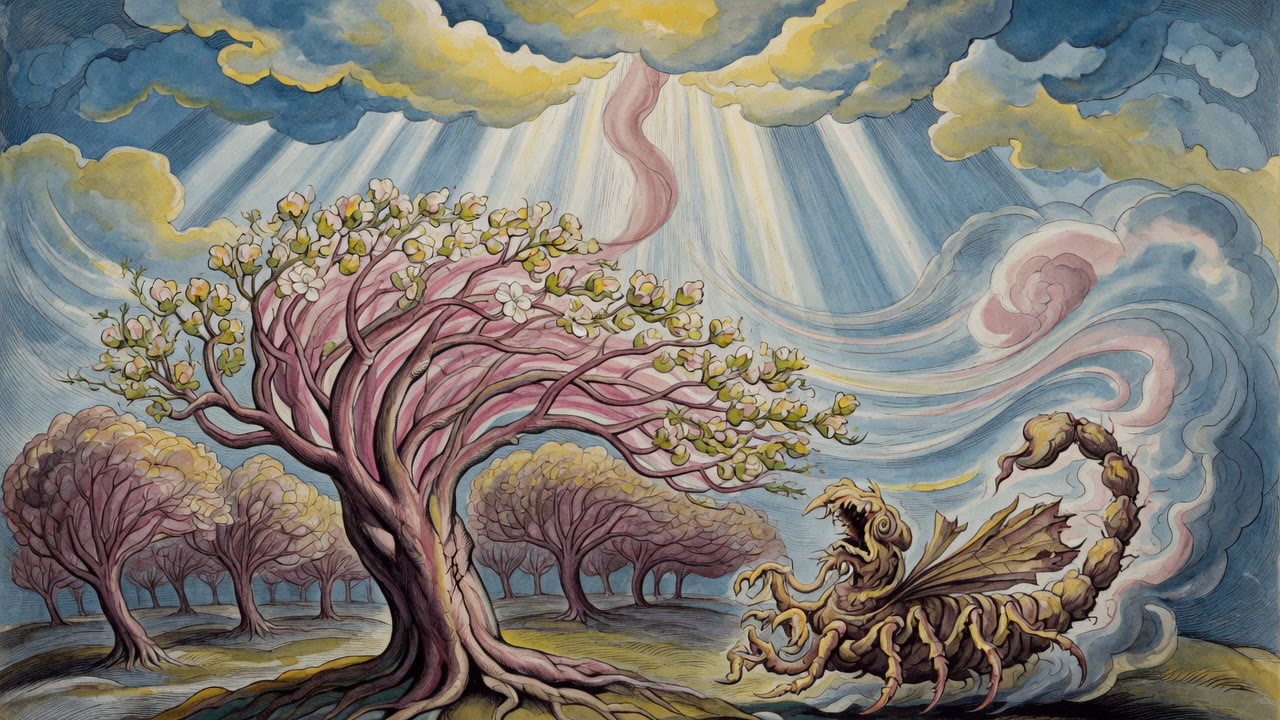
On the fifteenth of Shevat the sap pushed upward, the orchard held its breath, and a prayer named Malachi drove the devourer from the fruit.

Curated by Arthur · Told by Maggid ·
Table of Contents
  1. The Orchard Opens Its Hands
  2. The Work of Hands on the White Cloth
  3. Malachi's Promise Against the Mouth That Eats
  4. Repair That Climbs Both Ways

Sap pressed against the winter bark on the fifteenth of Shevat, cold wood suddenly warm from the inside. The orchard did not wait for spring. It woke early, as if a New Year for Trees had already been stamped into the calendar of the ground.
Sap Rose on Tu BiShvat and the Devourer Fled Click for full size

The Orchard Opens Its Hands

A man walked the rows with wet boots and a knife he did not use. He only touched the trunks, counting the places where the shefa, the living flow, had begun to climb. Most of the year's rain had already fallen. The soil held what it could. The trees, which had looked dead a month ago, now argued with their own silence.

He stopped under a fig whose crown still looked bare. "You are late," he told it, and the fig answered by bleeding a little sweet dark at a cut no larger than a fingernail. That was enough. The day was real.

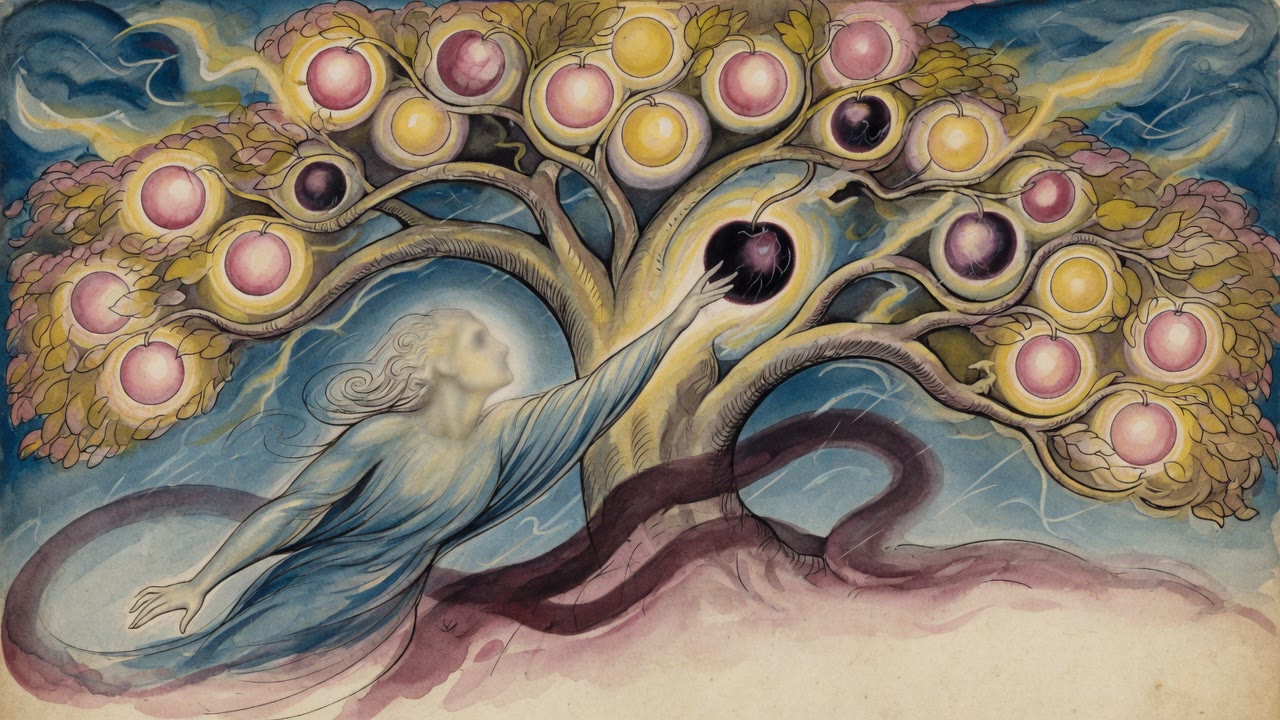
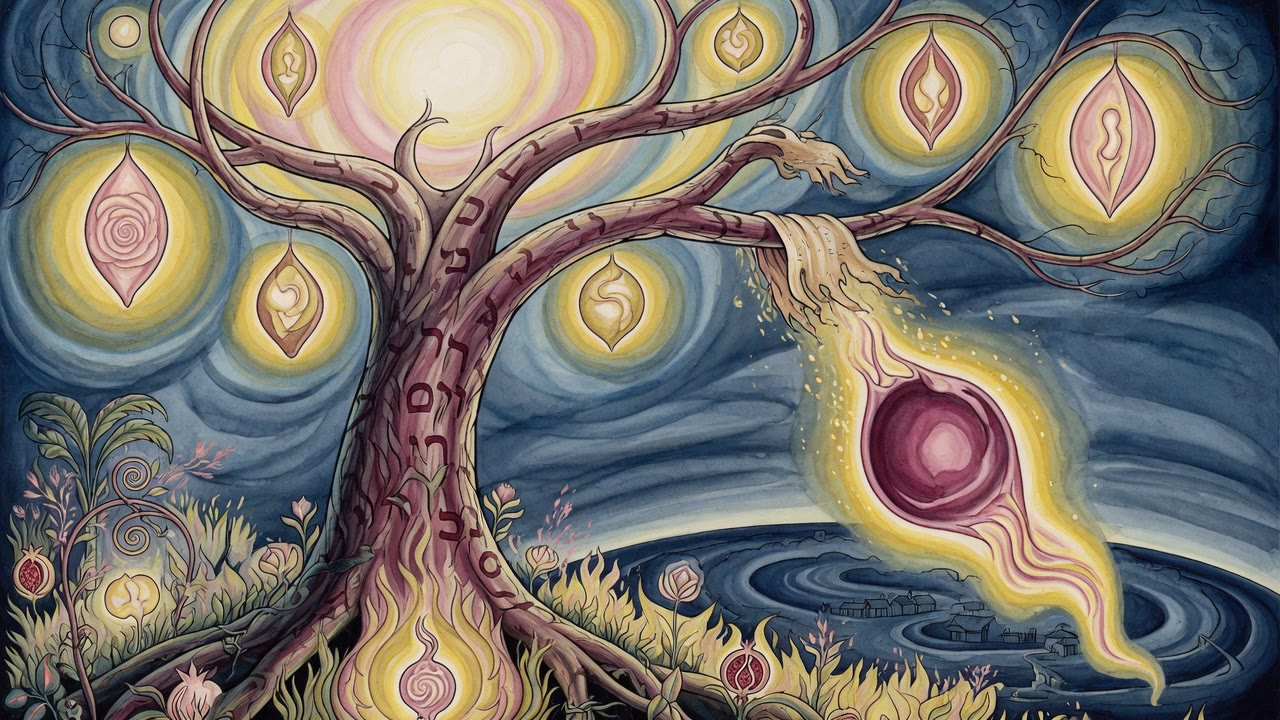
Tu BiShvat is not only a farmer's mark. The ones who keep the night of fruit say a higher tree wakes with these. The supernal tree does not root in Israeli dirt. It leans out of the upper worlds, and every earthly branch is a thinner version of that leaning. When the sap rises here, something answers there.

The Work of Hands on the White Cloth

Indoors, a white cloth took the weight of bowls. Figs. Dates. Olives. A hard winter apple that still smelled of storage. Wine waited in two colors, pale and deep. The man washed his hands as if he were about to write, not eat.

He spoke first from Psalm 90, the line that begs for hands to matter: may the favor of the Lord be upon us, and establish the work of our hands. He said it twice, the way the verse itself doubles the plea. Establish. Establish again. Do not let effort dry into dust.

Then he did not rush the fruit. Each piece was a small court case. Blessing, then pause, then the bite that seals the blessing into the body. The table was not a picnic. It was a tikkun, a repair aimed at the root from which fruit takes its character.

Malachi's Promise Against the Mouth That Eats

When the plates had been touched once around, his voice changed. He asked for more than sweetness. He asked for banishing.

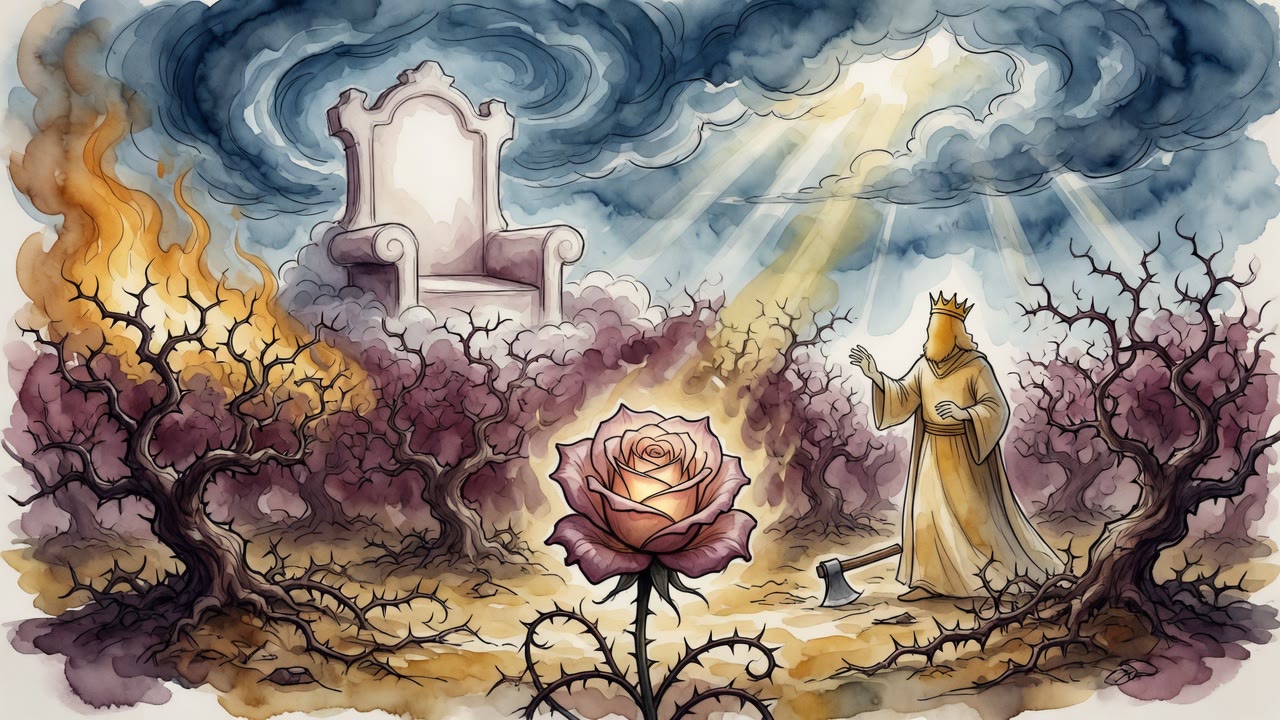
"And fulfill for us the word You promised through Malachi, Your seer," he said, and the room tightened. The prophet's line is not soft. God of hosts will rebuke the devourer, so that it will not destroy the fruit of the earth, and the vine in the field will not miscarry (Malachi 3:11).

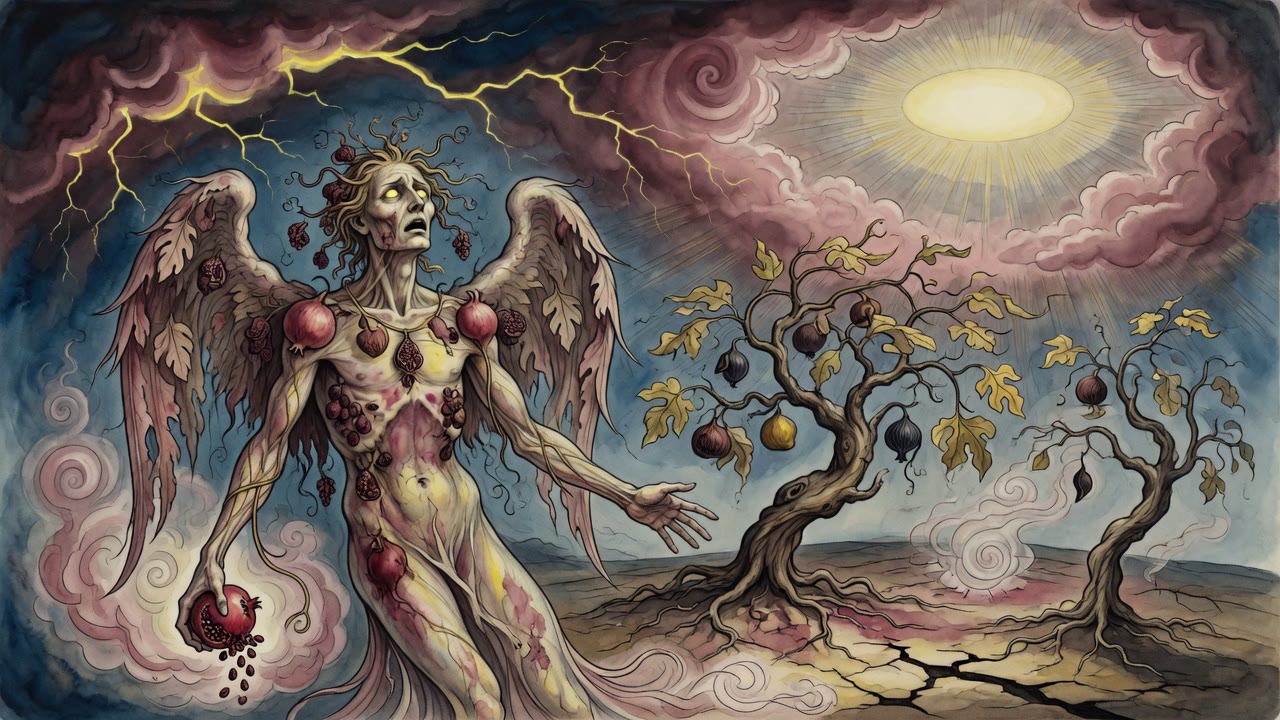
The devourer is not only a worm in a fig. It is whatever thins a harvest after labor has already been paid. Locust. Rot. Empty market. The quiet failure of a year. On this night the orchard is treated as a person under threat, and the Name that commands armies is asked to clear the field.

He did not shout. He named the threat and put it outside the cloth.

Repair That Climbs Both Ways

The tikkun of Tu BiShvat does not end when the last seed is spit into a dish. The teaching is stranger than gratitude. Blessings aimed at fruit's divine root can change the fruit's inner shape, and the one who blesses is changed with it. Beauty of contemplation is not decoration. It is a tool that works on both hands of the exchange.

He lifted a date that had split itself along a seam and saw, for a second, not sugar but a channel. Below, the root. Above, the crown. Between them, the human mouth as a gate that can open or clog the flow. If the gate opens cleanly, the supernal tree is not embarrassed by the earthly one. If the gate clogs, the devourer finds the seam first.

Outside, wind moved the bare branches without breaking them. The sap kept rising in the dark, indifferent to whether anyone watched. He packed the bowls carefully, as if the leftover skins still belonged to a court session that had only recessed.

On the road home the ground felt less like mud and more like a ledger. Somewhere a vine was being measured for miscarriage or fullness. Somewhere a worm reconsidered a soft place it had chosen. The man wiped date sugar from his thumb and said the psalm's last half again under his breath, only the work of the hands, only the request that it not be wasted.

Rain from earlier weeks still lived in the ditches. Frogs spoke once and went under mud. The man stepped over a root that had lifted a stone the size of a fist, patient violence of wood against mineral. He thanked the root without theology, only with a nod, then saved the theology for the cloth indoors.

Children's voices carried from a path. One wanted summer now. One wanted candy. Neither wanted a New Year for trees. He smiled at their honesty. The orchard does not campaign for fans. It rises because rising is what sap does when the calendar of water says rise.


← All myths

From the tradition

Sources

4 sources

The texts behind this telling. Some cards carry a translation of the source; others are our own retelling of it, and each card says which. Every card links out to the original.

Peri Etz Hadar 1:18Peri Etz Hadar

Retold in our words. Read the original at the link below.Pri Etz Hadar, Aharon N. Varady transcription and Miles Krassen translation · CC-BY

There’s a special day in the Jewish calendar that invites us to do just that: Tu Bishvat, the 15th of the month of Shevat. It’s often called the New Year for Trees. But why this particular day? What makes it so special?

Well, the simple answer is that Tu Bishvat marks a turning point in the agricultural cycle in Israel. By this time, most of the year’s rain has already fallen. The shefa, the vital sap, begins to rise in the trees. It’s a time of renewal, when the promise of fruit starts to become real. The trees awaken, and so too, perhaps, should we.

There’s a deeper, more mystical meaning at play here. Tu Bishvat isn’t just about the physical trees around us. It’s also about the supernal tree, a concept explored in Peri Etz Hadar, a Kabbalistic text. This "supernal tree" isn’t rooted in our earthly soil. Instead, it represents the higher worlds, the divine realms from which all blessings flow.

Think of it this way: just as the sap rises in the trees of our world, so too does divine abundance, or shefa, flow from these upper realms. It’s the New Year's Day, so to speak, for tithing the fruit of trees. This shefa descends, nourishing not only the physical trees and their fruit, but also the spiritual forces that govern them.

So, as we celebrate Tu Bishvat, let’s not only enjoy the fruits of the trees. Let's also take a moment to appreciate the intricate web of connections that link us to the divine, to the shefa that sustains all of life, above and below. Can we align ourselves with the renewal of this season?

Full source
Peri Etz Hadar 3:8Peri Etz Hadar

Retold in our words. Read the original at the link below.Pri Etz Hadar, Aharon N. Varady transcription and Miles Krassen translation · CC-BY

It's one that the ancient prayers, particularly those connected to seeking blessing and abundance, address head-on. we ask for blessing, but we also ask for protection from that which diminishes blessing.

In the prayer Peri Etz Hadar (the Fruit of the Goodly Tree), there's this powerful line, a direct plea to the Divine. It echoes the words of the prophet Malachi: "And fulfill for us the word which you promised us through Malachi, Your seer, 'And I will banish the devourer from among you and he will not destroy the fruit of your earth and the vine of your field will not miscarry,' says YHVH Tsevaot." (Malachi 3:11).

YHVH Tsevaot. That's a powerful name, often translated as "Lord of Hosts." It speaks of a divine power that commands armies, a force capable of vanquishing any threat. And here, that threat is personified as "the devourer" – anything that would steal away our potential harvest, whether literal or metaphorical.

The prayer continues, shifting from a plea to a request for divine observation and intervention: "Look down from your sacred dwelling place in heaven and bless us this year with bounty and blessing. God looking down, bestowing favor.

The prayer then calls upon other verses from the Tanakh (Hebrew Bible), weaving a tradition of blessing. "You will make him a source of blessings forever, you will cause him to rejoice in the joy of Your countenance" (Psalm 21:7). It's a vision of unending blessing, a joy so profound it stems directly from the Divine Presence.

And finally, a promise of earthly abundance: "And the earth will bestow its harvest and the tree of the field will yield its fruit" (Leviticus 26:4).

What's so striking about this sequence is the interplay between divine promise and human action. We ask for the "devourer" to be banished, we seek God's gaze and blessing. and then we're reminded that the earth will respond. The potential is there. The abundance is waiting. But it requires both divine grace and our own efforts.

What forces are stealing our joy, our creativity, our potential? And what can we do, in partnership with the Divine, to banish them and cultivate a harvest of blessing? What seeds can you plant today?

Full source
Peri Etz Hadar 1:20Peri Etz Hadar

Retold in our words. Read the original at the link below.Pri Etz Hadar, Aharon N. Varady transcription and Miles Krassen translation · CC-BY

"And establish for us, the work of our hands. It speaks to the idea that we can, through our actions, influence not only our own lives but also the world around us. The source turns to a particularly fascinating example of this: a tikkun – a repair or rectification – connected to the holiday of Tu B’Shvat, the "New Year for Trees."

This particular tikkun, found in the text Peri Etz Hadar (which literally means "Fruit of the Goodly Tree"), focuses on the mystical power of blessings and contemplation directed towards the fruit's divine roots. The idea is that by performing this tikkun on Tu B'Shvat (the New Year for Trees), we can actually affect the very structure and character of the fruit itself, on a spiritual level.

The text suggests that the person performing the tikkun can also be profoundly affected. How? Through the beauty of this act, he can correct something that was "distorted," something that was "crooked [and] cannot be made straight," me’uvat lo yukhal litkon

The Peri Etz Hadar subtly hints that this tikkun can address a very specific and sensitive issue: damage to the "covenant," potentially caused by "inchastity." Now, while the text doesn't explicitly name the issue, some scholars, like Yehuda Liebes, suggest it might be referring to shikvat zera le-vatalah, the "wasting of seed," which is a rabbinic term for male sexual incontinence, and possibly even masturbation. The Zohar, that foundational text of Jewish mysticism, views ejaculation outside of "normal" intercourse as a particularly serious sin. If this is what Peri Etz Hadar alludes to, it would be considered an earlier form of tikkun for this issue than the more widely known Tikkun ha-Kelali of Rabbi Nachman of Breslov.

So, how does performing a tikkun for a fruit tree possibly relate to something so personal? The text goes on to explain that by doing this tikkun for the fruit tree, the individual can heal "his wound" – literally, his flawing of the Tzaddik (a righteous person) who makes fruit.

Now, Tzaddik here isn't just a righteous person. In Kabbalah, it refers to the ninth sefirah (a divine emanation), Yesod, which represents the divine phallus and is associated with potency and generation. Sexual irregularities, what's called the "flaw of the covenant," are believed to negatively impact this sefirah. Since the Tu B'Shvat tikkun directly affects this sefirah and deals with supernal potency, it can, therefore, correct damage caused by aberrant sexuality.

What's fascinating here is the implied magical connection between human sexuality and the fecundity of nature. The text suggests that male irregularities in this area can actually damage the divine quality responsible for the quality of the year's fruit! There's also the added benefit of the penitential period, mentioned elsewhere in the text in connection to shovavim. So a tikkun for the flaw of the covenant is being performed.

Our actions, even the most personal ones, have repercussions that extend far beyond ourselves. This Tu B'Shvat tikkun, as described in Peri Etz Hadar, offers a powerful and profound way to understand and address these connections, reminding us that we can all participate in the ongoing work of repair, both within ourselves and within the world. And isn't that a beautiful and hopeful thought?

Full source
Peri Etz Hadar 4:1Peri Etz Hadar

Retold in our words. Read the original at the link below.Pri Etz Hadar, Aharon N. Varady transcription and Miles Krassen translation · CC-BY

There's a beautiful prayer, a verse from (Psalm 90:17), that speaks directly to that feeling: "May the favor of the Lord, our God, be upon us, establish the work of our hands for us, yes, establish the work of our hands."

A yearning for our efforts to bear fruit, literally and figuratively. But what if I told you that there's a way to actively engage with that prayer, to embody it through a ritual involving… fruit?

That's what Now, when we And this particular tikkun, focused on fruit, is a way to tap into that creative, generative energy.

So, how does it work? Well, according to the Peri Etz Hadar, after offering that heartfelt prayer – "May the favor of the Lord, our God, be upon us..." – your words, your intentions, can actually prosper through a specific ritual seder (order) involving fruit. This isn't just about eating a snack; it's about a conscious, focused engagement with the potential for growth and abundance.

What kind of fruit are we talking about? The Peri Etz Hadar doesn't specify, leaving it open to interpretation and personal connection. Maybe it’s a fruit that’s particularly meaningful to you, or one that represents a goal you’re trying to achieve. Perhaps a pomegranate, bursting with seeds, symbolizing abundance. Or a sweet apple, representing knowledge and wisdom.

The power here lies in the intention you bring to the act. It's about recognizing that the simple act of eating fruit can be elevated to a sacred practice, a way to connect with the divine flow of creation and to actively participate in bringing your own aspirations to fruition.

Think of it this way: you're not just consuming a piece of fruit; you're internalizing the potential for growth, the promise of sweetness, the very essence of creation.

Now, the Peri Etz Hadar goes on to detail the specific seder, the order of actions to follow. We'll explore that more in depth later. But for now, the key takeaway is this: we have the power to partner with the divine in the process of creation. Through intention, prayer, and even the simple act of enjoying a piece of fruit, we can cultivate the conditions for our efforts to truly flourish. We can actively invite the favor of the Lord to be upon us, establishing the work of our hands. It's an invitation to move from feeling stuck and unproductive to being active participants in the blossoming of our own lives.

Full source