Parshat Bereshit6 min read

Thirty Fruits Against Adam's Bite and One Bad Swallow

Thirty fruits waited on a midwinter table to pry loose the sparks Adam left in the orchards, and the youngest man swallowed the medlar in silence.

Curated by Arthur · Told by Maggid ·
Table of Contents
  1. The Table Set Against the First Bite
  2. What Adam Left in Every Orchard
  3. The Medlar He Swallowed Without Thinking
  4. The Quince, the Hackberry, and the Name of Seventy-Two
  5. The Walnut Cracked Open at the Thirtieth Blessing
  6. The Stones He Buried in Frozen Ground
Thirty Fruits Against Adam's Bite and One Bad Swallow Click for full size

The Table Set Against the First Bite

Wind came under the door and pushed the lamp flames sideways. Thirty fruits lay on the table in three ranks of ten. Nearest the window, the ones a mouth swallows whole, grape and fig and pomegranate. Behind them the ones that hide a stone, olive and date and cherry. Farthest, in a bowl, walnut and almond and pistachio, shut inside shells nobody eats.

The teacher pressed both palms flat on the wood. "One bite emptied the orchard," he said. "Thirty will start the argument the other way."

The youngest man there had walked four hours through winter mud, and his stomach was loud. He stopped at a fruit he could not name. Brown. Wrinkled. Soft at the crown, the size of a plum that had given up.

"Uzerad," the teacher said without turning his head. "Medlar. It has to rot a little before it turns sweet. Do not skip it."

What Adam Left in Every Orchard

They poured the first cup and the teacher lifted a fig so the lamp shone through its skin.

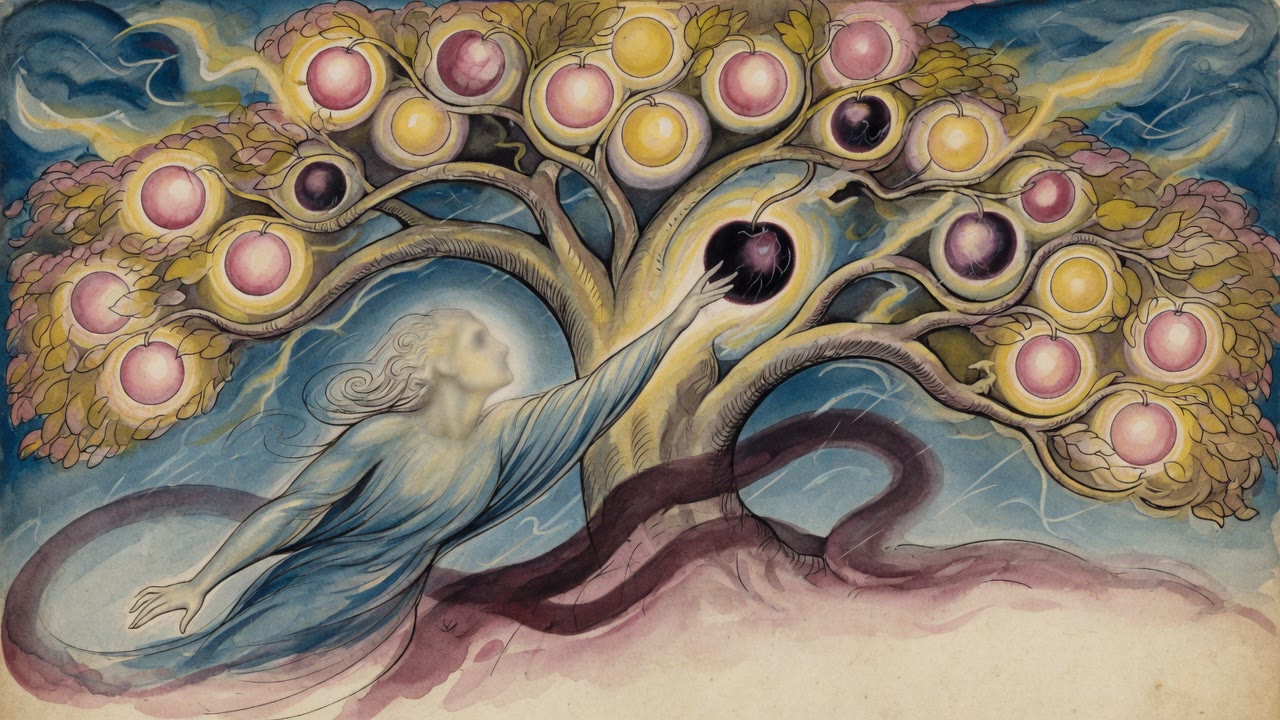
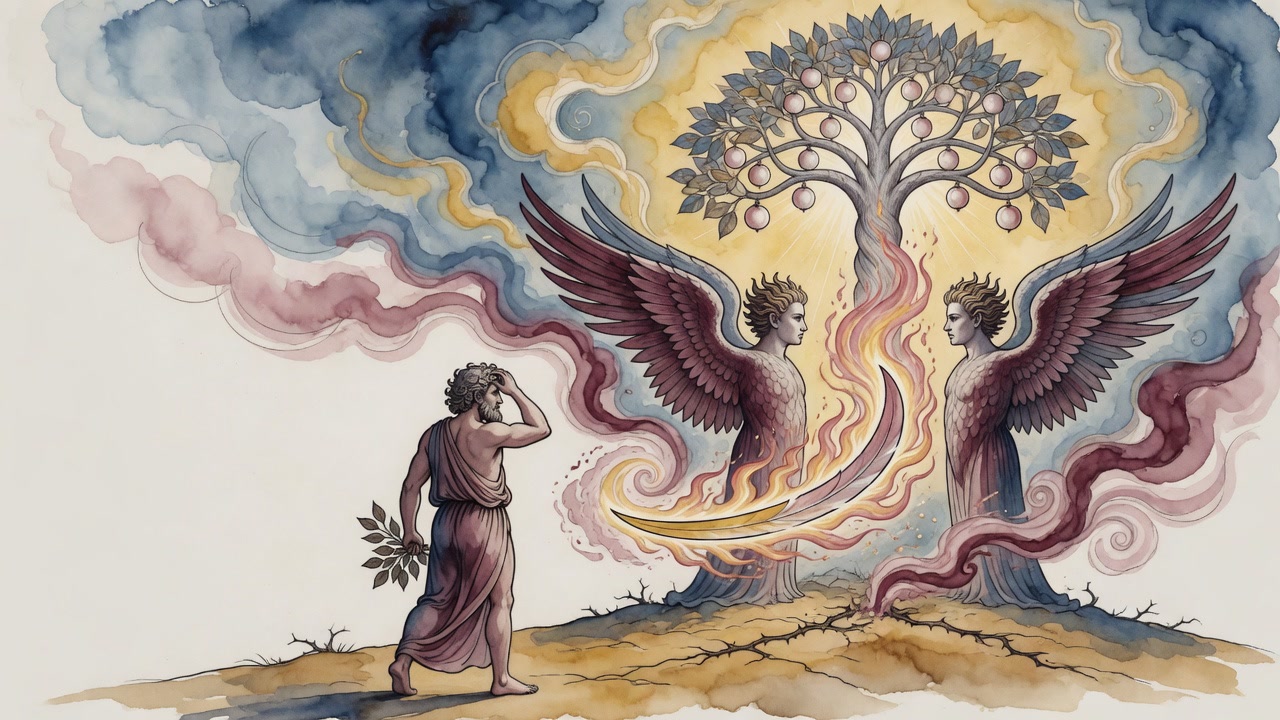
"Adam ate in a hurry and said nothing over it," he said. "The sweetness went into him. The spark stayed behind in the fruit. Every orchard on this earth has been carrying what he dropped."

An angel had been set over every growing thing, he told them, and behind each angel a rung of the sefirot (divine emanations), so no fig ripened without something above it leaning down to watch. A blessing said with the mind on the right Name went into the fruit like a blade into a crack. The spark came loose. It climbed.

"And a blessing mumbled at the ceiling?" the man beside him asked.

"Then you have eaten fruit," the teacher said. "The angel over it stands there with empty hands and waits out another winter."

The Medlar He Swallowed Without Thinking

They began at the near rank and went slowly. Grape, and the room answered amen into the steam off the cups. Fig. Pomegranate, broken so the seeds spilled red across the board.

The youngest was starving by the time the bowl reached the medlar. He took it in the middle of somebody else's sentence, bit down, tasted the sweetness of a fruit that ripens by rotting, and swallowed. Two brown stones ended up in his palm. His mouth was still working when he understood what he had done.

The teacher stopped talking. Nobody reached for the wine.

"Say it over the next medlar," the teacher said.

"There is one medlar."

The teacher looked at the gap in the rank. "There is one," he agreed, and said nothing more about it.

He put the stones in his coat and kept his fist closed around them the rest of the night. Above the roof a thin thing stood with nothing to carry up.

The Quince, the Hackberry, and the Name of Seventy-Two

The teacher recited the medlar's order anyway, the way a man reads a will after the money is spent. Before that fruit a mouth holds the second teaching of the sixth chapter of Berakhot and the first of Demai, the tractate for doubtfully tithed produce, and fastens on the letters HYVH.

Then he took a quince, too hard to eat raw, cooked in honey that afternoon. For the quince, the third teaching of that chapter, the third of Ma'aserot, and the letters AHVH.

Hackberries came next, small and gritty. The teacher held one between two fingers.

"Seventy-two," he said. "The Name that came out of the sea when the pillar moved behind Israel and the water stood up on both sides. Hold that over this berry."

The young man held it. The berry was the size of nothing.

Jujubes after that, dry as old dates, with the sixth teaching and the letters YAHDVNHY. Twelve fruits. Nineteen. Twenty-four. The wine had gone from white to rose. Outside, a dog gave up barking.

The Walnut Cracked Open at the Thirtieth Blessing

Last came the shells. The teacher set a walnut on its seam and struck it once with the flat of a knife handle.

It fell open in four parts.

"I went down to my walnut garden," he said. "That garden went out from Eden, and it is the Shekhinah (the Divine Presence), the Presence at the bottom of the rungs, in Malkhut. The nut inside it is the chariot Ezekiel saw, standing under her, wheeled and eyed and burning. Four rivers went out of Eden. Count the quarters."

They counted. The room smelled of honey and cracked shell and wet wool.

"The shell is bitter and nobody eats it," the teacher said. "It is still holding the fruit."

The thirtieth fruit went to the young man. The teacher pressed a walnut into his hand, closed the fingers over it, and would not let go until the blessing had been said whole and slow with the mind on the Name. His voice came out wrong at the start. He said it again, and the second time it held.

Nobody clapped. The teacher reached for the almonds.

The Stones He Buried in Frozen Ground

Before dawn he walked out to the orchard, where the almonds were pushing white against black branches on the fifteenth of Shevat, the day the sap turns and the year of the trees starts over.

He dug with the knife handle because the ground was too hard for fingers, put both stones in, pushed the dirt back, and held the letters HYVH in his mind the whole time, which is not a blessing over eating, and he knew it. The spark he had swallowed without a word was still down there, waiting on a tree that would take years and a mouth that would not be his.

He wiped his thumb on his coat. The stain stayed brown. Behind him the lamps burned over thirty empty places on a table, and above the orchard a thin thing that had waited since Adam settled in to wait longer.


← All myths
From the tradition

Sources

3 sources

The texts behind this telling. Some cards carry a translation of the source; others are our own retelling of it, and each card says which. Every card links out to the original.

Peri Etz Hadar 2:1Peri Etz Hadar

Retold in our words. Read the original at the link below.Pri Etz Hadar, Aharon N. Varady transcription and Miles Krassen translation · CC-BY

My teacher, a man steeped in the wisdom of generations, used to say something profound about that connection. He believed that every time we eat fruit, we have a chance to do a tikkun – a repair.

A repair of what, you ask? Well, let's go back to the very beginning... to Adam and the fruit from the Tree of Knowledge. That first bite, that act of disobedience, reverberates through all of history. It’s the source of so much of what we struggle with as humans. But what if we could, in a small way, start to heal that primal wound?

That's the idea behind this tikkun. It's about intending, with every bite of fruit we take, to correct the sin of Adam. It might seem like a small thing, but the Kabbalists, the mystics of Judaism, teach us that even the smallest act, done with the right intention, can have enormous cosmic consequences.

You might be thinking, "Shouldn't we be doing this all the time?" And the answer is, yes, absolutely! We should always be mindful of our actions and their potential impact. But as the saying goes, a mitzvah, a good deed, is best when observed at its proper time. And what is the proper time for focusing on the fruit of the tree?

Well, the text I'm looking at, called Peri Etz Hadar, reminds us that there's a specific day especially auspicious for this practice. It's a day that marks the beginning, the start of the season for the fruit of the tree. It's a time when the energy of growth and renewal is particularly potent. It's a chance to really focus our intention and make that connection between our own actions and the grand sweep of history.

Remember Adam. Remember the potential for tikkun. And remember that even in something as simple as eating a piece of fruit, you have the power to participate in the healing of the world.

Isn't that a beautiful thought?

Full source
Peri Etz Hadar 4:17Peri Etz Hadar

Retold in our words. Read the original at the link below.Pri Etz Hadar, Aharon N. Varady transcription and Miles Krassen translation · CC-BY

The ancient mystics certainly did. They saw the natural world, including the orchard, as a living tapestry woven with divine threads. Let's peel back a layer of that wisdom, focusing on a few lesser-known fruits and the meditations associated with them.

First, the medlar. This fruit, called uzerad in Hebrew – essentially a type of crabapple – might not be gracing your supermarket shelves, but it held significance. The text Peri Etz Hadar ("Fruit of the Goodly Tree") directs us to reflect on the second mishnah (a teaching or law) of the sixth chapter of Berakhot (Blessings) and the first mishnah of the first chapter of Demai (produce about which there is doubt whether tithes have been properly separated). And the kavvanah, the focused intention to bring to mind during this meditation? HYVH. These letters, like so much in Kabbalah, represent something far deeper than their simple appearance.

Next, the quince. Ah, the quince – a fragrant fruit that’s often cooked rather than eaten raw. For this one, we turn to the third mishnah of the sixth chapter of Berakhot, and the third mishnah of the first chapter of Ma’aserot (Tithing). Think about the blessings we recite, the acts of giving we perform. The suggested kavvanah here is AHVH. What does this combination of letters spark within you?

Then there's the hackberry. They're small, sweet, and a little… unexpected. For the hackberry, the text instructs us to reflect on the fourth and fifth mishnayot of the sixth chapter of Berakhot. The kavvanah for this fruit is linked to the "name of 72." This is a reference to the 72 Names of God, powerful combinations of Hebrew letters derived from (Exodus 14:19-21), each believed to hold a unique spiritual energy. Meditating on this name while eating a hackberry… well, that's a potent combination.

Finally, we have the jujube – also sometimes called a Chinese date. For this little fruit, we reflect on the sixth mishnah of the sixth chapter of Berakhot. The kavvanah is YAHDVNHY. Another powerful string of letters to contemplate as you savor its sweetness.

So, what do we make of all this? It's more than just a quirky list of fruits and meditations. It’s a reminder that the everyday world is brimming with opportunities for connection, for kavvanah. It invites us to slow down, to be present, and to recognize the hidden depths within the seemingly ordinary. Maybe next time you bite into a piece of fruit, you'll remember these ancient teachings and find a little spark of the divine within.

Full source
Peri Etz Hadar 1:9Peri Etz Hadar

Retold in our words. Read the original at the link below.Pri Etz Hadar, Aharon N. Varady transcription and Miles Krassen translation · CC-BY

Jewish mystical tradition, particularly the Kabbalah, suggests exactly that. It proposes that while God, the blessed Creator, reigns over the earth and assigns angels to oversee all things, the true significance lies in the connection of everything to the supernal attributes – the sefirot (the divine emanations).

What are the sefirot? Think of them as divine emanations, ten aspects of God that act as a bridge between the infinite and our finite world. They are the blueprint of creation, and, according to Kabbalistic thought, everything in existence reflects these attributes.

The Zohar, that foundational text of Kabbalah, puts it beautifully. It asks, “Why is it written, ‘I went down to my walnut garden’?” (Song of Songs 6:11). The answer? “This is the garden that went forth from Eden, and it is the Shekhinah (the Divine Presence).”

Okay, The Shekhinah is often understood as the divine presence, the immanent aspect of God that dwells within creation. In Kabbalah, it’s often associated with the tenth sefirah (a divine emanation), Malkhut (Sovereignty), representing the culmination of all the other attributes.

And the walnut? The Zohar continues, explaining that the "walnut" refers to the Merkavah, the Holy Chariot described in Ezekiel’s vision. This chariot, a complex and awe-inspiring image, is located beneath the tenth sefirah and represents the structure through which divine energy flows into the world. The Zohar sees the four rivers flowing from the Garden of Eden as being mirrored by the sections of a walnut.

So, what does this all mean for that little herb garden? Well, the Zohar implies that even herbs can be distinguished by the pre-eminence of their divine roots above. Each plant, in its own way, reflects and is connected to these higher realms. It's not just about the physical properties we see, but about the spiritual essence it embodies.

Everything is interconnected, woven together by a divine tapestry that stretches all the way back to Eden. Maybe next time you're weeding, you'll pause and consider the deeper roots, the divine connections that bind all of creation together.

Full source