5 min read

Saul Raises Samuel From the Ground at En-dor

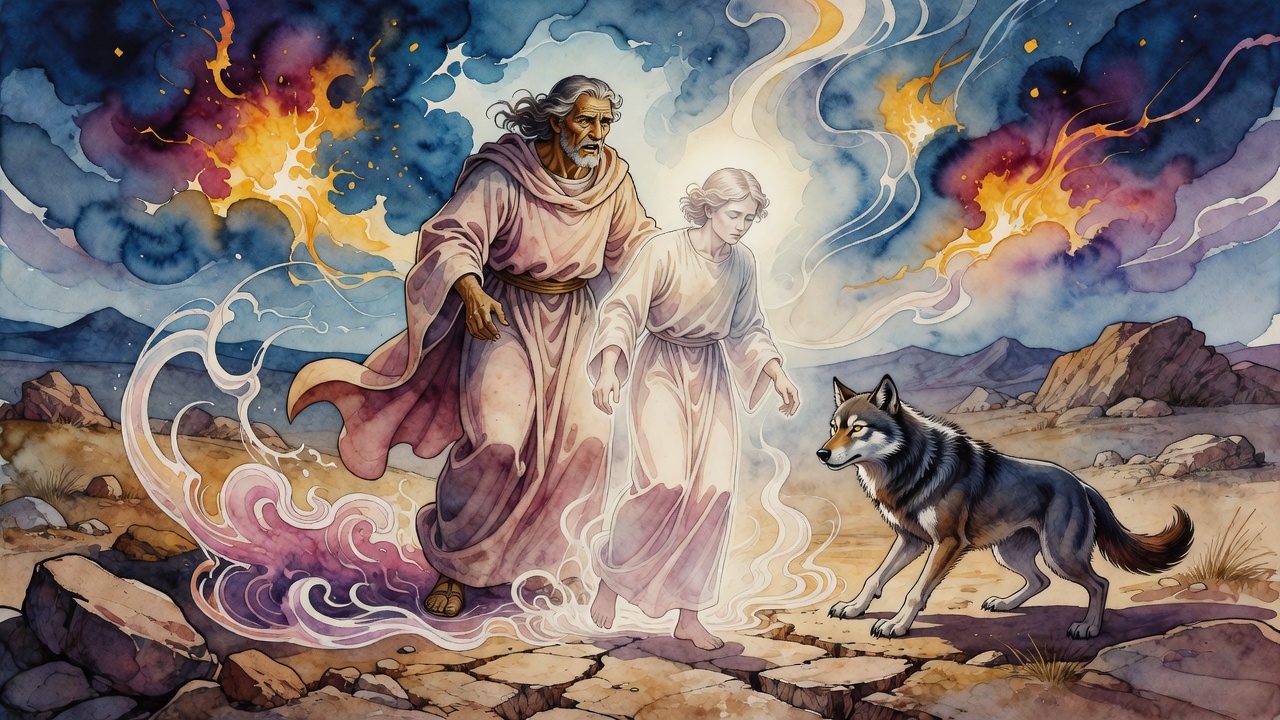
King Saul bans ghosts, then hunts one by night at En-dor. Samuel rises in his childhood robe and tells the wolf of Benjamin that morning has ended.

Curated by Arthur · Told by Maggid ·
Table of Contents
  1. The King Who Banned What He Needed
  2. Truth From the World of Truth
  3. Morning Wolf, Evening Spoil
  4. The Robe and the Road to Gilboa
  5. From Ban to Breach in One Reign
Saul Raises Samuel From the Ground at En-dor Click for full size

The King Who Banned What He Needed

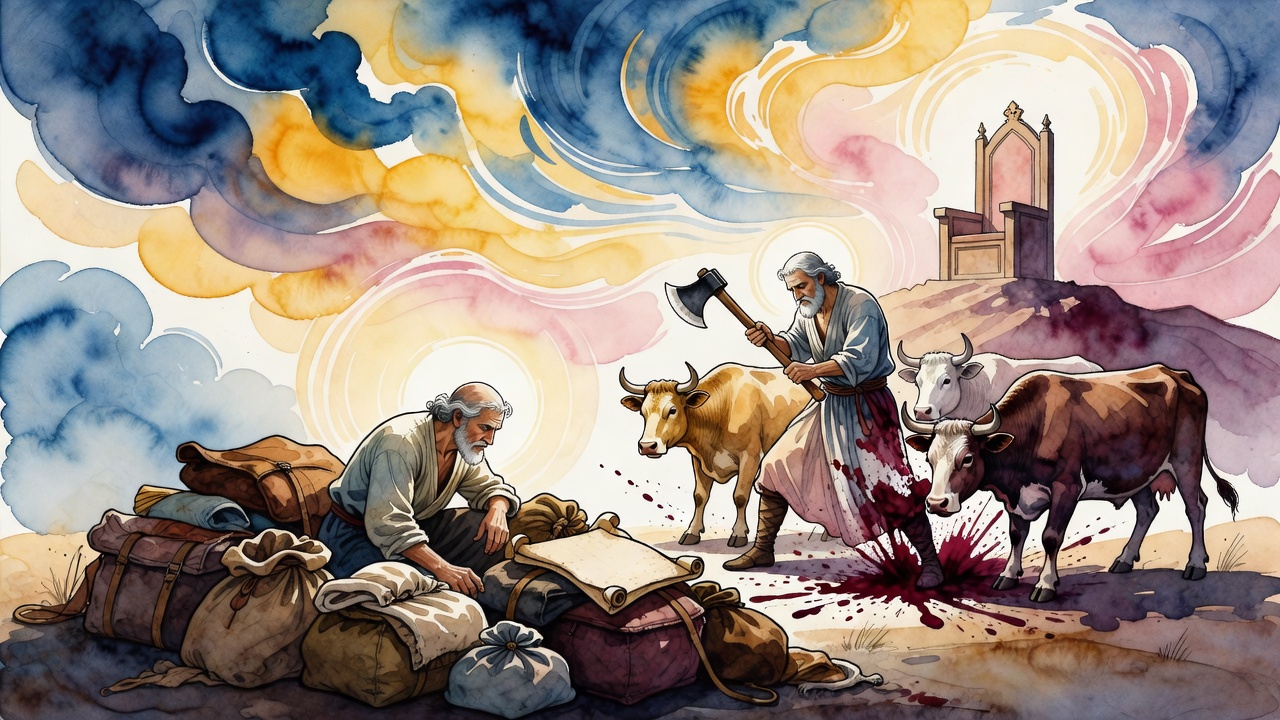
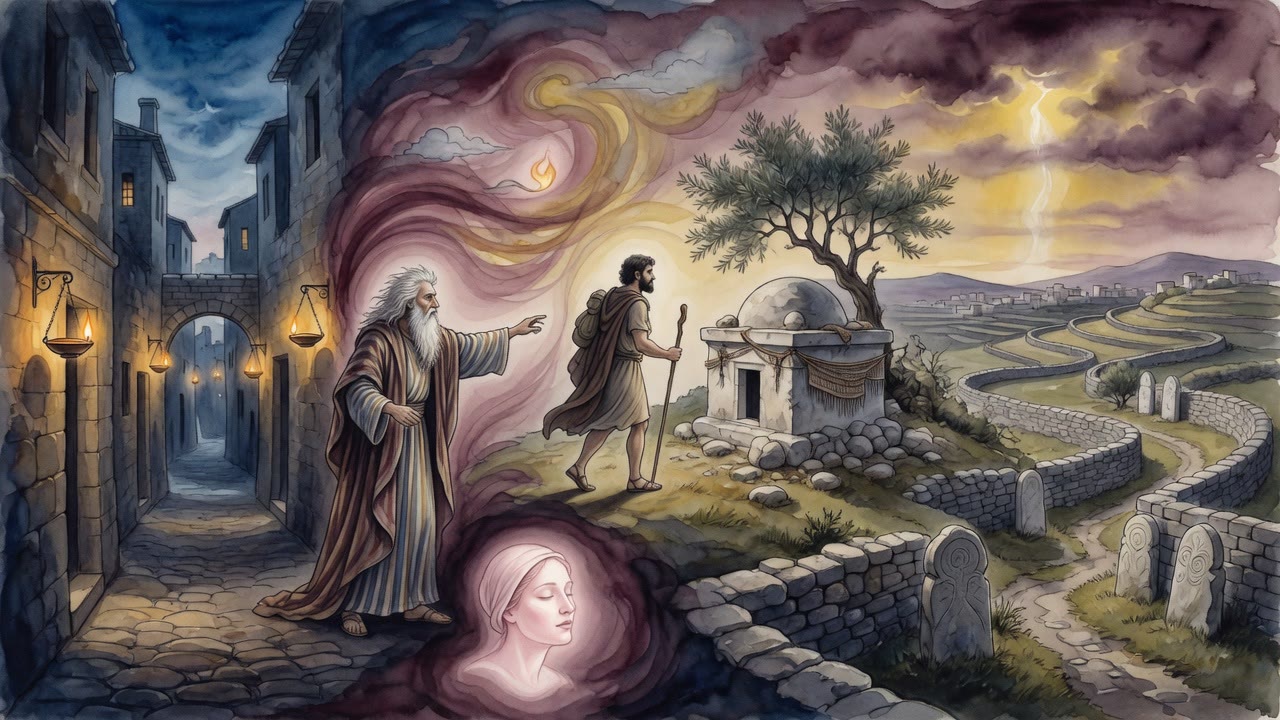
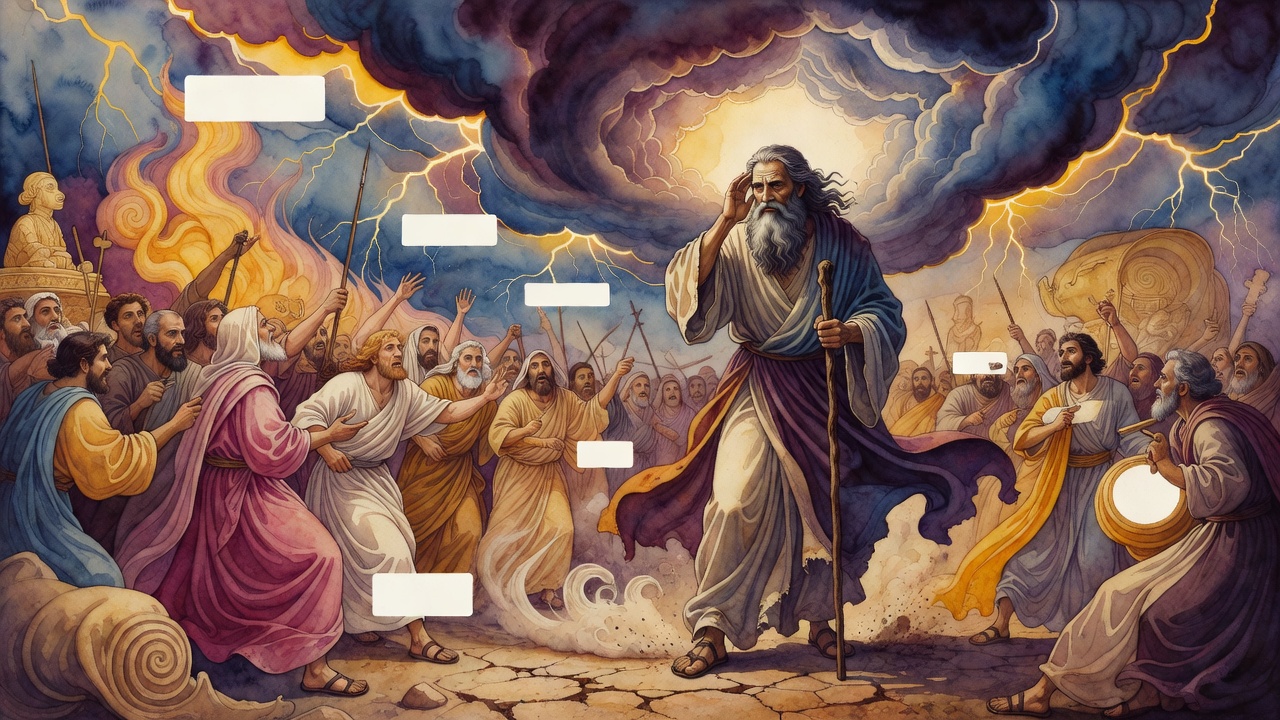
Saul had swept the necromancers from the land. Then he stood empty of answers and said, "Seek me a mistress of a ghost" (1 Samuel 28:7). Resh Lakish mocks the shape of it. Saul is the king who orders every rooster killed, then asks why none crow at dawn. He disguises himself, for the kingship has already slipped from him, and goes by night to the woman of En-dor with two men beside him, Abner and Amasai, because the Torah forbids a lone road.

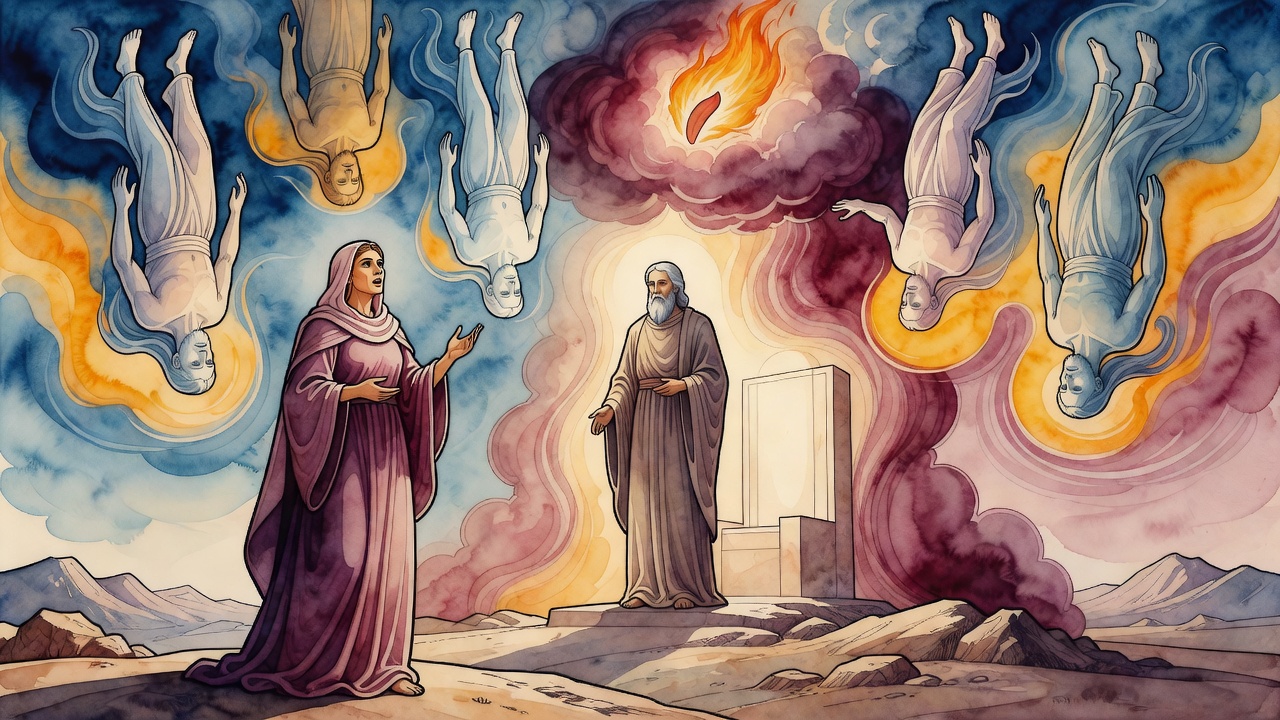
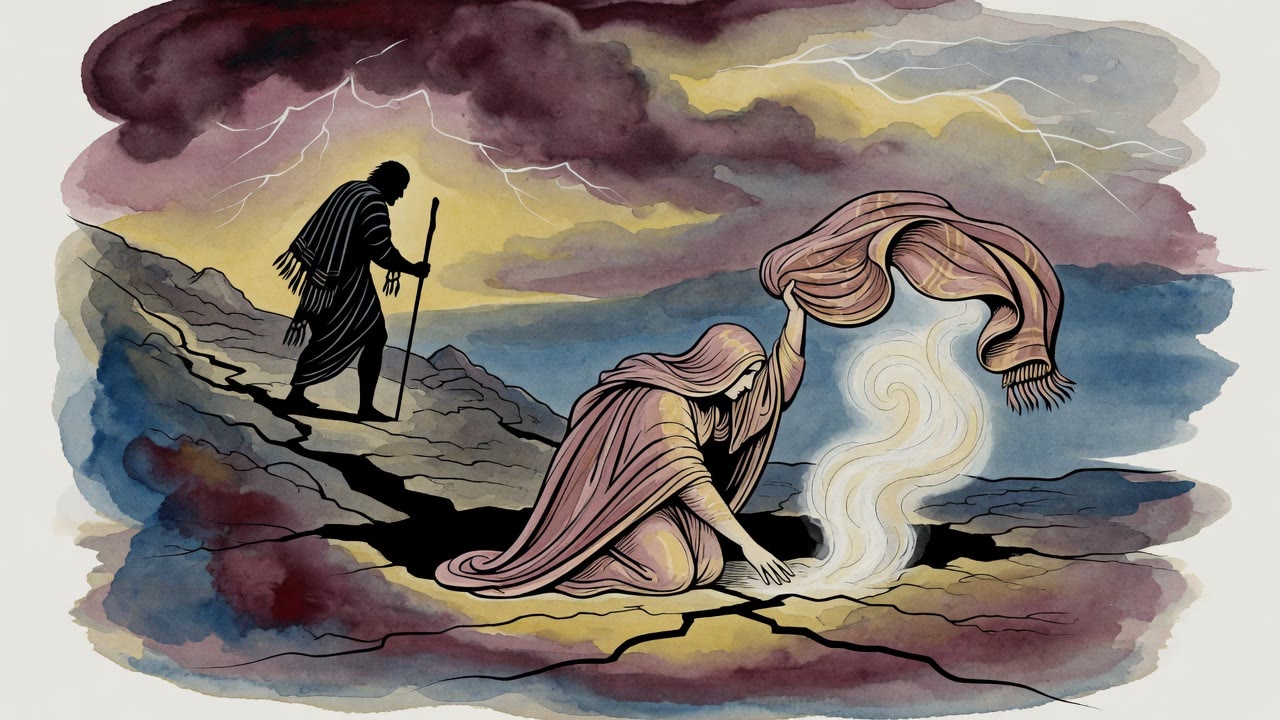
"Bring up Samuel for me." She does what she does, and shrieks. A ghost rises feet-first for a commoner but face-up for a king, and so she knows the hooded man is Saul. Two ascend: Moses and Samuel. The old prophet comes wrapped in the little robe his mother once made him, the garment of grave and resurrection both.

Truth From the World of Truth

Samuel rebukes him. Why disturb your Creator by making me an idol? In life I feared you and spoke carefully. Now, in the world of truth, hear only truth. Tomorrow you and your sons are with me, in my portion of heaven. Saul falls his full length on the ground. Then he rises and marches knowingly toward death with his sons. The angels marvel: see this creature who rejoices in the justice that strikes him.

The law of ghosts sits beside the charge to the priests for a reason. The Holy One foresaw the king who would slaughter the priests of Nob and then steal in the dark to consult a ghost. Crime and consultation share one life. The ban and the breach share one mouth.

Morning Wolf, Evening Spoil

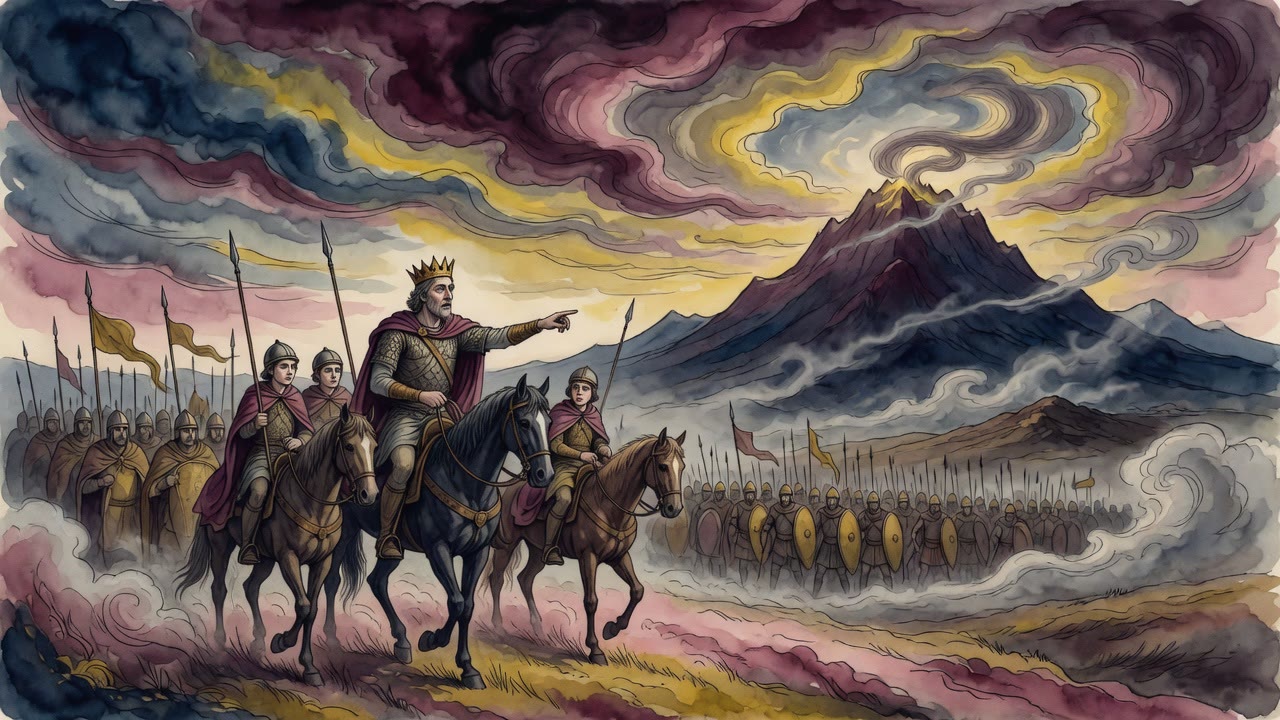
Long before En-dor, dying Jacob had looked at Benjamin and said, "Benjamin is a ravenous wolf; in the morning he devours the prey, and at evening he divides the spoil" (Genesis 49:27). The sages hear a whole reign in that line. In the morning of his rule, Saul of Benjamin seized the kingship and did valiantly. He struck enemy after enemy and smote Amalek. The wolf tore at Israel's foes and prevailed.

At evening he divides the spoil. Read evening as the end of his days. The same king who rose so high fell upon the heights of Gilboa, and Saul died, and his three sons with him. Morning triumph. Evening division. The blessing spoken over a child in Egypt held the arc of a life that would end asking a forbidden woman for a dead prophet's voice.

The Robe and the Road to Gilboa

Samuel's childhood robe rises from the ground as if time had folded. Saul sees the past he once obeyed and the future he cannot bargain away. He eats the woman's food because his strength is gone. He walks out into a night that already belongs to tomorrow's battle. The wolf of Benjamin has finished the morning's devouring. The spoil of evening is his own body and the bodies of his sons.

He had banned the dark arts as a king still able to clean a land. He returns to them as a king who has run out of every permitted light. Between those two Sauls stands the whole tragedy Jacob folded into one animal image: a wolf who wins at dawn and loses everything when the light fails.

From Ban to Breach in One Reign

Saul's tragedy is not only the seance. It is the sequence. He cleanses the land of ghosts as policy, then needs a ghost as last resort. He silences the priests at Nob, then needs a dead prophet's word because living prophecy has gone quiet for him. The wolf who devoured in the morning of kingship spends the evening dividing what remains of his own house.

Samuel's robe is almost unbearable. A mother's sewing rises from the earth to confront a king who once tore a different garment in a different quarrel. Saul eats because his knees have no strength. He walks toward Gilboa because courage and doom have become the same road. Jacob's blessing did not curse Benjamin. It described a life that can win early and still end on a mountain with three sons and a hard truth spoken by a voice that should have stayed buried until the end of days.

Face-up the prophet rises, and the woman knows a king is in her house. Feet that once chased Philistines now fail on a cottage floor. Tomorrow is already spoken. Saul's last freedom is how he receives a justice he can no longer outrun. He falls full length, then stands, then marches. The morning of the wolf is finished. The evening has begun to count the spoil.


← All myths
From the tradition

Sources

2 sources

The texts behind this telling. Some cards carry a translation of the source; others are our own retelling of it, and each card says which. Every card links out to the original.

Midrash Tanchuma Buber, Emor 4:1Midrash Tanchuma Buber, Emor

Translation of the source text.Midrash Tanchuma (Buber), Public Domain, on Sefaria · CC-BY-SA

"And a man or a woman in whom there is a ghost or a familiar spirit" (Leviticus 20:27). What is written after it? "Speak to the priests" (Leviticus 21:1). What is the connection of this matter to that one? Rather, the Holy One, blessed be He, foresaw that Saul was destined to reign over Israel, and to kill the priests, and to inquire of a ghost and familiar spirits, as it is said, "And Saul said to his servants: Seek out for me a woman who is a mistress of a ghost" (I Samuel 28:7).

Resh Lakish said: To what is Saul comparable? To a king who entered a province and said: Let all the roosters in this province be slaughtered tonight. He sought to depart on his way; he said: Is there no rooster here to crow? They said to him: Did you not yourself command to slaughter them? So too here, Saul "had removed the ghosts and the familiar spirits" (ibid. 28:3), and yet he said: "Seek out for me a woman who is a mistress of a ghost."

"And Saul disguised himself" (ibid. 28:8). What is "disguised himself" (vayyithapes)? That he was made free (hofshi) of the kingship. "And he went, he and two men with him" (ibid.). Who were they? Abner and Amasai. The Torah taught proper conduct, that a person should not go out on the way alone; and so did Abraham our father do: "And he took his two lads with him and Isaac his son" (Genesis 22:3); and so, "And he went, he and his two lads with him" (I Samuel 28:8). "And they came to the woman by night" (ibid.). And was it night? Rather, at that hour it was for them dark as night.

"And he said: Divine for me, please, by a ghost" (ibid.). "And the woman said to him: Behold, you know what Saul has done, that he has cut off the ghosts and the familiar spirit" (ibid. 28:9). Immediately, "And Saul swore to her by the Lord, saying: As the Lord lives, no punishment shall befall you in this matter" (ibid. 28:10). Resh Lakish said: To what is Saul comparable? To a woman who was set beside her lover, and swore by the life of her husband.

"And the woman said: Whom (mi) shall I bring up for you?" (ibid. 28:11), from those who say "Who (mi) is like You" (Exodus 15:11), or from those who say "Who (mi) is the Lord" (Exodus 5:2). He said to her: "Bring up Samuel for me" (I Samuel 28:11). She did what she did and brought him up. "And the woman saw Samuel and cried out with a loud voice, and the woman said to Saul: Why have you deceived me, for you are Saul?" (ibid. 28:12). From where did she know? Our Rabbis said: It does not come up for a king as it comes up for a commoner: for a king its face is upward and its feet downward, like the way of all people; but for a commoner its feet are upward and its face downward.

"And the king said to her: Do not fear; for what did you see? And the woman said to Saul: I saw a god coming up from the earth" (ibid. 28:13). "Coming up", two; and who were they? Moses and Samuel. When Saul heard this, he was afraid, for he had called one and two arose. "And he said to her: What is his form? And she said: An old man is coming up, and he is wrapped in a robe" (ibid. 28:14, 12). Three things they said concerning one who brings up the ghost: the one who brings it up sees it but does not hear its voice; the one who inquires of it hears its voice but does not see it; those who stand there neither see it nor hear its voice. "An old man is coming up, and he is wrapped in a robe," and elsewhere it says, "And his mother would make him a little robe" (I Samuel 2:19). It was taught: In it he grew up, in it he was buried, in it he came up. It was taught in the name of Rabbi Nathan: A garment that goes down with a person to burial, in it he is destined to come up at the resurrection of the dead, as it is said, "It is changed like clay under a seal, and they stand forth as in a garment" (Job 38:14).

"And Saul knew that it was Samuel, and he bowed his face to the ground and prostrated himself. And Samuel said to Saul: Why have you disturbed me, to bring me up?" (I Samuel 28:14-15). You had no one to disturb your Creator with except me, in that you made me into an idol. Did we not learn thus: Just as one exacts punishment from the worshipper, so one exacts punishment from the worshipped? And some say: "Why have you disturbed me", that he said to him: I was disturbed, lest it be the Day of Judgment, and I was afraid. And here is a matter of a fortiori reasoning: if Samuel, the master of all the prophets, was afraid of the Day of Judgment, the rest of humankind all the more so.

"And Saul said: I am greatly distressed... and He answers me no more, neither by the prophets nor by dreams" (ibid. 28:15). Why did he not say to him, "by the Urim and Thummim"? Rabbi Isaac said: "The heart knows its own bitterness" (Proverbs 14:10), because he had killed Nob, the city of the priests. "And the Lord has done to you as He spoke through me, and the Lord has torn the kingship from your hand and given it to your fellow, to David" (I Samuel 28:17). He said to him: When you were with us, you said to me, "and He has given it to your fellow who is better than you" (I Samuel 15:28), and now you say "to your fellow, to David." He said to him: When I was with you I was in the world of falsehood, and I would tell you words of falsehood, for I was afraid of you, lest you kill me; but I now, in the world of truth, you shall hear from me only words of truth. And not for nothing did He do this thing to you, "because you did not hearken to the voice of the Lord and did not carry out His fierce wrath against Amalek" (ibid. 28:18). "And the Lord will give also Israel with you into the hand of the Philistines, and tomorrow you and your sons are with me" (ibid. 28:19), "with me," within my partition.

When he heard this, "And Saul hastened and fell his full height to the ground, and he was greatly afraid of the words of Samuel" (ibid. 28:20). Abner and Amasa said to him: What did Samuel say to you? He said to them: He said to me: Tomorrow you go down to battle and are victorious, and your sons are appointed officers. Resh Lakish said: At that hour the Holy One, blessed be He, called the ministering angels. He said to them: Come and see a creature that I created in My world. As is the way of the world, a person goes to a feast house and does not bring his sons with him, because of the evil eye; but this one, who goes down to war and knows that he will be killed, takes his sons with him, and rejoices over the measure of justice that strikes him.

Rabbi Joshua of Sikhnin said in the name of Rabbi Levi: This teaches that the Holy One, blessed be He, showed Moses each generation and its expositors, each generation and its judges, each generation and its kings; and He showed him Saul and his sons falling by the sword. He said before Him: Master of the World, the first king who arises over Your children shall be pierced by the sword? He said to him: Moses, to Me you say it? Say it to the priests whom he killed, for they accuse him. Our Rabbis taught: For five sins that righteous man was killed, as it is said, "And Saul died for his trespass that he trespassed against the Lord" (I Chronicles 10:13).

Full source
Midrash Tanchuma Buber, Vayechi 15:2Midrash Tanchuma Buber, Vayechi

Translation of the source text.Midrash Tanchuma (Buber), Public Domain, on Sefaria · CC-BY-SA

Another interpretation: "BENJAMIN IS A RAVENOUS WOLF," and so forth. It speaks about Saul. "IN THE MORNING HE DEVOURS THE PREY", and Saul seized the kingship over Israel, [and so forth,] "and he did valiantly and smote Amalek" (1 Samuel 14:47-48). "AND AT EVENING HE DIVIDES THE SPOIL", "and Saul died, and his three sons" (1 Samuel 31:6).

Full source