Serach Saw the Jordan Stand Like a Glass Window
Rabbi Yochanan taught the water as lattice. A woman at the back of the hall stood and said she had walked through it, and it was glass.
Table of Contents
Rabbi Yochanan lifted his hands as if spray still lived on them. How did the water become a wall for Israel? He answered the way a teacher answers a room that needs a picture. Like lattice-work, he said. A screen. Openings for light. Water held upright yet not opaque, a structure you could almost see through while you walked between its ribs.
 Click for full size
I Was There
A voice from the back of the hall cut the teaching clean. Serach bat Asher stood.
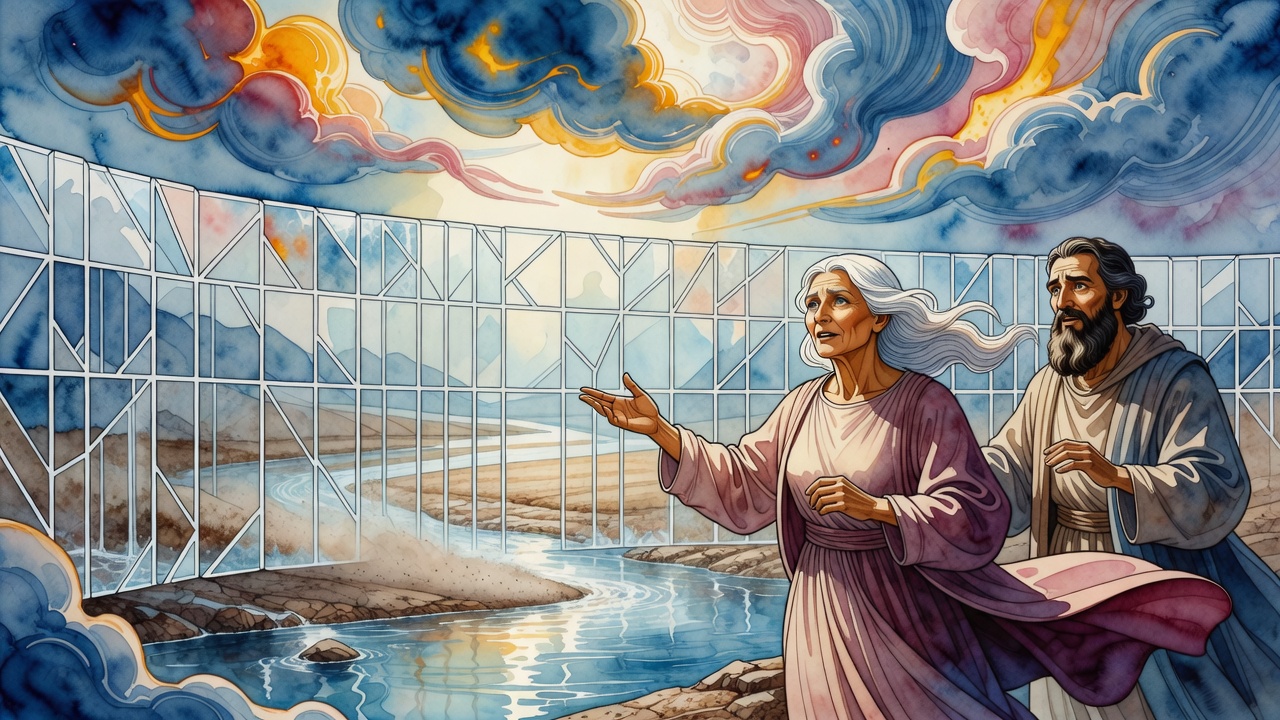
"I was there," she said. "It was not lattice. It was like a glass window."
Men who had never crossed a river in their lives looked at a woman who had outlived generations. Serach had left Egypt with Jacob's household and still sat among the living when sages argued over the shape of a miracle. A student near the front dropped his stylus. No one laughed.
Her correction was not rudeness. It was testimony. Lattice is woven. Glass is a single face of light. She had walked with the spray on her skin and preferred the clearer image. Rabbi Yochanan tilted his head as if listening for the river again.
Dry Enough to Walk
Anyone can invent a wall of water. Few can say they saw the panes. She did not deny the miracle. She refined it. Lattice suggests gaps, craft, a fence built of many parts. Glass suggests a surface that holds and reveals at once, a barrier you could see the far bank through while your feet stayed dry.
Rabbi Yochanan did not silence her. Authority in that room split two ways: the sage who builds a metaphor, and the survivor who refuses the wrong metaphor. Without the teacher, the event becomes only weather. Without the witness, the teacher risks polishing the past until it no longer cuts.
After the session, someone asked her whether the bottom of the riverbed was mud or stone. She smiled the way the very old smile when the young want inventory instead of awe. "Dry enough to walk," she said. "That is the part that mattered to my feet." Three students went back to their notes with less pride and more hunger.
She Turned Their Hearts
A student stayed behind. The waters no longer stood. The Temple stones lay cold. He wanted to know which way to face when he prayed in a courtyard that was not Jerusalem.
Outside the Land, turn the heart toward the Land of Israel. Inside the Land, toward Jerusalem. In Jerusalem, toward the Temple. In the Temple, toward the Holy of Holies. Song of Songs calls the neck a tower of David, talpiyot (תלפיות), the hill toward which all turns are directed.
Serach's glass wall and that map are kin. The people who walked between water had to look forward. The people who pray in exile still aim their chests at a single point on the earth. The student closed his eyes in the doorway and turned slightly, not because a compass lived in his bones, but because a woman who had crossed between panes had taught him that miracles and daily speech both need a facing.
Without facing, even a miracle becomes fog.
Rain Hit the Courtyard
Clouds broke over the hall while they were still talking. The first drops hit the packed dirt of the courtyard hard. Students ran outside bareheaded. Children shouted. A bull that had gone out lowing in the morning came back with a different gait, eating from a mound that had been dust an hour before.
Rabbi Yitzchak said a day of rain is as great as the resurrection of the dead, for the Lord returns captivity like streams in the Negev. Dry wadis fill. Brown land greens. Those who sow in tears reap with joy. Jacob walked and cried on the road to Haran, and he raised his voice and wept, and he came back bearing sheaves.
Serach stood in the wet and did not need a lecture hall to name the joy. The Jordan that stood like glass and the Negev that runs with sudden streams teach one grammar. Water answers a people on the move and a people coming home. Farmers who never saw the Exodus still know the night when the first drops hit hard ground.
What She Left in the Hall
When the session ended, students repeated both images. Lattice. Glass. Some preferred the teacher's craft. Some preferred the old woman's pane. The better ones kept both in their mouths, the way you keep two witnesses for a single fact. The miracle had happened. The shape of the water still argued in human speech.
Serach sat quiet after her one sentence. She had not come to own the room. She had come to keep the river honest. Years later, when some of those students faced their own closed seas of trouble, they remembered a woman who would not let a wall of water become a vague idea.
She made them see a window, hard and bright, and the path between. That image outlived the session, the teacher, and the hall.
← All myths