5 min read

Seven Days Beside the Mother Before the Altar

A firstborn calf nurses seven days before consecration. Separation, tithe, and Abraham's tenth of all teach how firstness is handed over.

Curated by Arthur · Told by Maggid ·
Table of Contents
  1. Gentleness Written into Dedication
  2. What Set Apart Means Under the Rod
  3. Abraham's Tenth of All
  4. Under the Rod and at the Table of Spoils
  5. Milk, then Fire

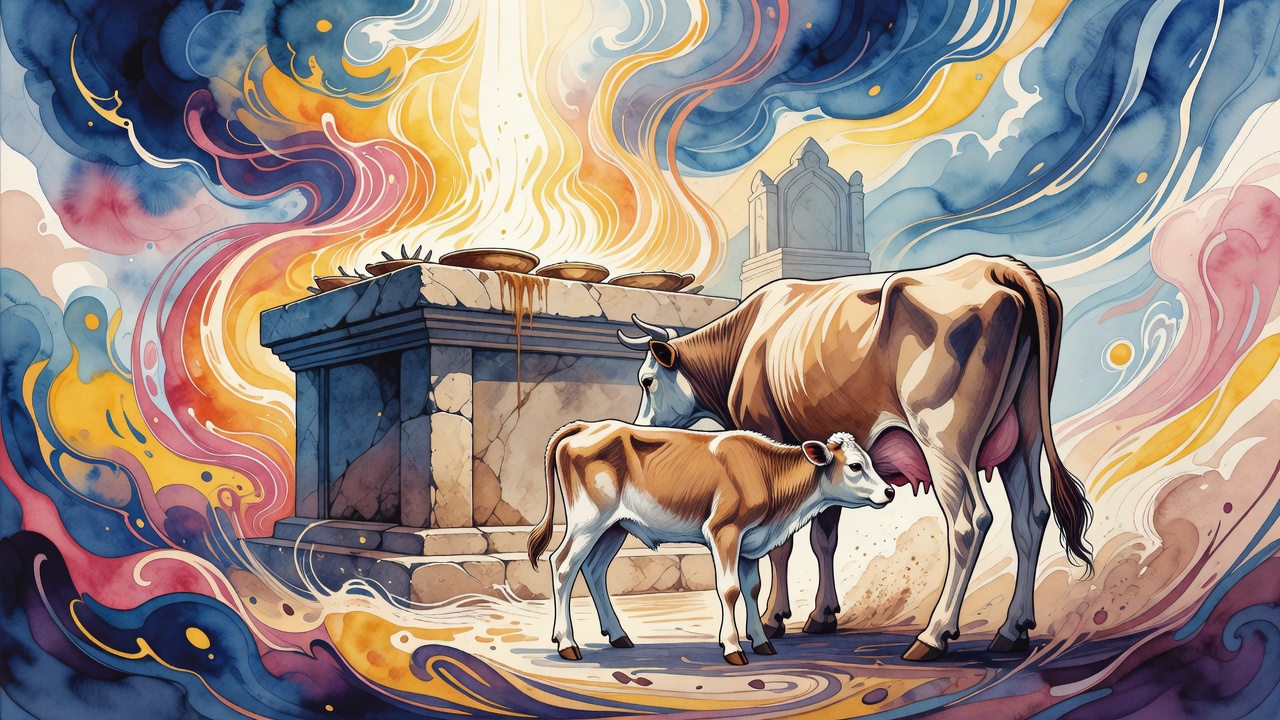
A calf folded its legs in the straw and found the udder. The farmer already knew the law on this one. Firstborn male. Destined for the altar. Still the Aramaic translators and the sages refused to rip it from the mother on the first night. Seven days it would nurse. Then consecration. Life first. Holiness second.

Seven Days Beside the Mother Before the Altar Click for full size

Gentleness Written into Dedication

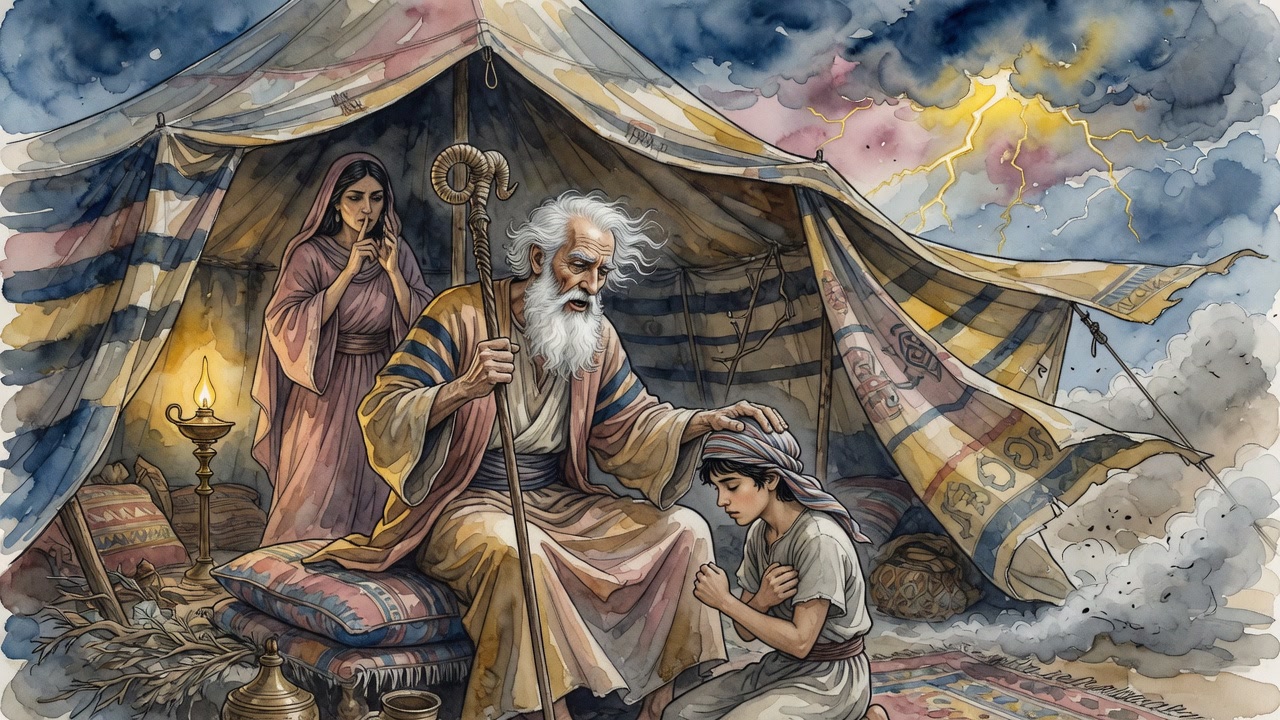
Targum Pseudo-Jonathan on Exodus hears the interval with unexpected softness. Seven days it shall be suckled by its mother, then on the eighth day you may give it to Me. The altar does not cancel the first week of milk. Even an animal marked from birth for God is allowed a small ordinary childhood. The rod of counting waits. The knife waits. The mother does not wait alone.

Anyone who has heard a calf bawl when separated too early knows why the Torah bothers with this. Holiness that tramples the first bond trains a cruel priesthood. Holiness that waits a week trains a people that can give without becoming stone.

What Set Apart Means Under the Rod

"And you shall set apart every firstborn to the Lord." Set apart means lift a thing out of the ordinary and hand it over. From here the sages worked the close cases of firstborn animals and flock tithe, the beasts that pass under the rod. Could an orphaned animal whose mother died before tithing still enter the pen? Verbal links decide. Holiness takes hold while the mother still lives. A firstling counts only as the true first issue of its mother's womb. A miscarriage before it cancels the status. The next born is not a firstborn by wishful counting.

Ownership matters. The law speaks of the firstborn that will be yours, which lifts out a fetus partly owned by a gentile. Rabbi Yose the Galilean imagined twin males born head to head in the same instant, both then owed to the priest. The sages waved realism at him. No birth is ever that exact. One goes to the priest. One stays. Nature does not stage perfect ties for the sake of a clever derash (homiletic reading).

Abraham's Tenth of All

When Scripture says the Lord had blessed Abraham in all things, the sages press the word all. The blessing was promised early, among the divided animals of the Covenant of the Pieces, though Isaac waited more than fifty years. At forty-eight, they say, Abraham recognized his Maker and turned from his father's idols. Recognition and the first rumor of a son share a season.

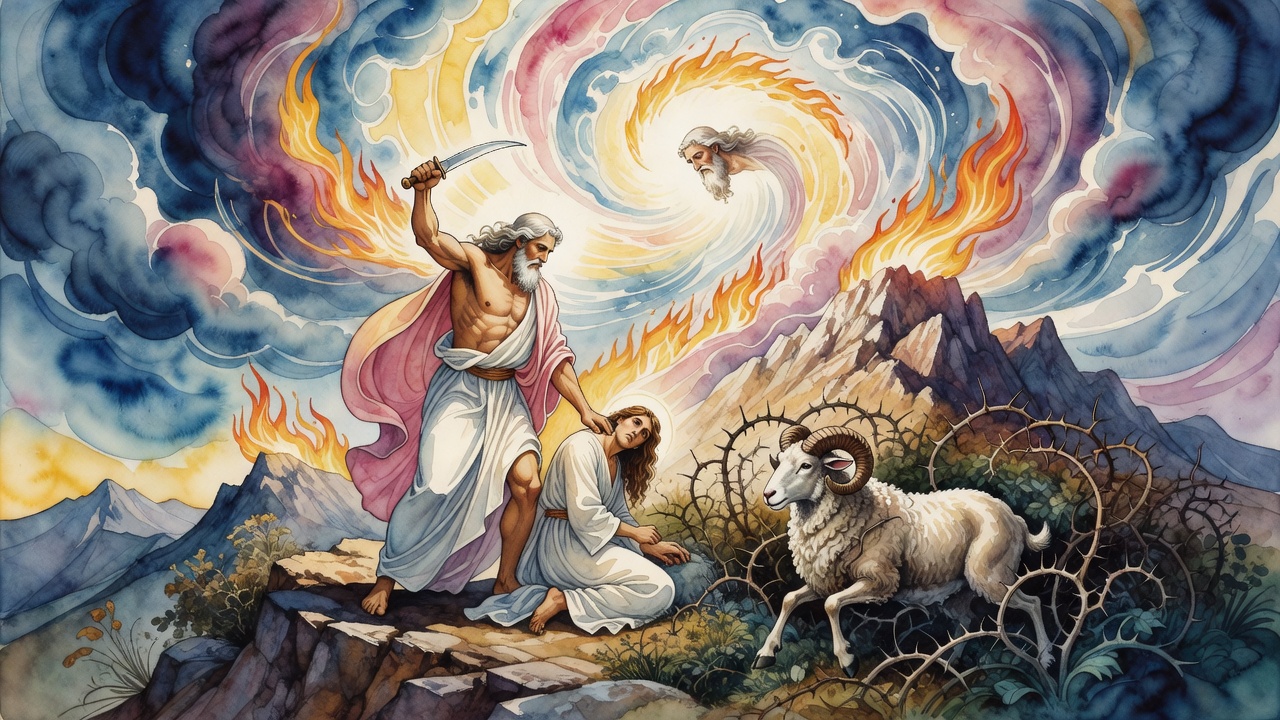
The deepest reading hangs on the tithe. After rescuing Lot, Abraham gave Melchizedek a tenth of everything (Genesis 14:20). He gave a tithe of all, and therefore he was blessed in all. Generosity when he could have kept the spoils became the measure of what returned to him. Firstness again. Not the first calf this time, but the first claim of gratitude on wealth that might have stayed clenched.

Under the Rod and at the Table of Spoils

A flock passes. The rod lifts. Every tenth is holy. A firstborn waits seven days at the udder, then becomes a gift. A patriarch on a battlefield counts spoils and peels off a tenth for a priest of God Most High. The pattern rhymes. What comes first, what comes as a tenth, what comes as a rescued fortune: all of it can be lifted up without erasing the life that produced it.

The orphaned animal problem, the twin problem, the gentile ownership problem: these are the seams where people try to game firstness. The sages sew the seams shut with words that keep mother, womb, and true first issue in view. Holiness is picky about origins because origins are where gratitude begins.

On the third day the farmer's daughter named the calf against her father's warning. On the fifth she cried into its neck. On the eighth she stood back while the law took what the law was owed. Her father put a hand on her shoulder and said the week was the Torah's gift to both of them, a permission to love what must be given. Abraham's open hand after battle was the same muscle in another century. Firstness hurts more when it has been allowed to live.

Milk, then Fire

On the eighth morning the calf no longer belongs only to the stall. The week of milk has done its work. The farmer who kept the law has practiced a small mercy that will matter when larger mercies are asked. Abraham's open hand after battle and the firstborn's week at the udder teach the same muscle. Give what is first. Do not give it in a way that forgets how it lived.

The altar receives a creature that was allowed to be a nursling. The blessing "in all" returns to a man who tithed all. Between them stands a people learning how to set things apart without becoming strangers to life.


← All myths

From the tradition

Sources

3 sources

The texts behind this telling. Some cards carry a translation of the source; others are our own retelling of it, and each card says which. Every card links out to the original.

Targum Pseudo-Jonathan on Exodus 22:29Targum Pseudo-Jonathan on Exodus

Retold in our words. Read the original at the link below.The Targum of Jonathan ben Uzziel, trans. J. W. Etheridge, London, 1862 · Public Domain

A calf is born. A lamb is born. The farmer knows this one is destined for the altar, a firstborn male, dedicated to God from its first breath. What happens in the interval between birth and offering?

Targum Pseudo-Jonathan on Exodus (Exodus 22:29) answers with unexpected gentleness: seven days it shall be suckled by its mother, and on the eighth day thou shalt separate it before Me. Seven full days at the mother's side. Only on the eighth is it taken.

Why the Torah Waits

One practical reason: a calf or lamb that has not nursed for a full week is not yet viable for offering. The Torah refuses sickly sacrifices, and it refuses sacrifices that have not had the chance to become whole animals.

There is also a tenderness here. Even the animal destined for the altar receives a full week of mothering. The same number seven that governs Shabbat, that governs the cycles of purity, that governs the festivals, it also governs this. Even a firstling owes its first week to its mother's warmth.

The Same Eighth Day as the Covenant

The eighth day is also the day of circumcision (Genesis 17:12). A Jewish son enters the covenant on the eighth day. A firstling animal is separated to God on the eighth day. The number is not coincidence, it is the Torah's marker for the passage from raw birth into consecration.

The Takeaway

Even in the economy of sacrifice, the Torah makes room for the mother. Before anything is given to God, life is given its first chance to be nursed.

Full source
Yalkut Shimoni on Torah 223:1Yalkut Shimoni on Torah

Translation of the source text.Torat Emet (Yalkut Shimoni) · CC-BY-NC

"And you shall set apart" (Exodus 13:12), "setting apart" means nothing but separation, and so it says, "And you shall pass on his inheritance to his daughter" (Numbers 27:8). Shimon ben Azzai says: "And you shall set apart every one that opens the womb", what does this teach? Because it says, "All that pass under the rod" (Leviticus 27:32), I might understand that even the orphaned animal is included; and there is reason to argue so: if a blemished animal, which is unfit upon the altar, nonetheless enters the pen to be tithed, an orphaned animal, which is fit upon the altar, surely should enter the pen to be tithed. But a purchased animal, which is fit upon the altar yet does not enter the pen to be tithed, refutes this for the orphaned one. [The argument is balanced:] you cannot draw the orphan in by reasoning alone. It says "passing" here and "passing" elsewhere: just as the "passing" stated here means sanctity takes hold only during its mother's lifetime, so the "passing" stated elsewhere means sanctity takes hold only during its mother's lifetime. If here only males, perhaps elsewhere only males? Scripture teaches, "All that pass under the rod" (Leviticus 27:32), both males and females are included.

"And every firstling that comes of a beast" (Exodus 13:12), a firstling "sent forth" by its mother. [If the firstborn miscarried,] it is exempt from the law of the firstborn, and the one that comes after it is not a firstborn. "Which you shall have" (Exodus 13:12), to exclude one who sells the fetus of his animal to a gentile [the partial gentile share exempts it]. I might think to exclude one who sells his fetus to a gentile yet to include one who buys the fetus of a gentile's animal; Scripture teaches, "Whatever is born among your herd and your flock, the males" (Deuteronomy 15:19), to exclude one who buys the fetus of a gentile's animal.

"The males shall be the LORD's" (Exodus 13:12). From here Rabbi Yose the Galilean used to say: a ewe that had not given birth before and bore two males, and the two heads emerged as one, both belong to the priest, as it says, "The males shall be the LORD's." But the sages say: it is impossible to be so exact; rather, one is his and one is the priest's.

Full source
Yalkut Shimoni on Torah 106:1Yalkut Shimoni on Torah

Translation of the source text.Torat Emet (Yalkut Shimoni) · CC-BY-NC

"And the LORD had blessed Abraham in all things" (Genesis 24:1). Already while he was between the pieces [at the Covenant of the Pieces], He brought him the good tidings that He would give him a son after fifty-two years. At the age of forty-eight he recognized his Creator, and at that very moment He announced the tidings to him. "In all things" - by the merit of the tithe, as it is said, "and he gave him a tithe of all" (Genesis 14:20).

Full source