5 min read

Seven Ranks of the Righteous Rise in Eden

A guide who would not give his name asked the soul what it had loved most. It answered with one week: a coin given quietly, a page learned while tired.

Curated by Arthur · Told by Maggid ·
Table of Contents
  1. Stars, Not a Single Lamp
  2. Seven Classes, Seven Nearnesses
  3. What Learning Buys a Lineage
  4. Days Multiplied Beyond One Life
  5. Which Court Keeps You
Seven Ranks of the Righteous Rise in Eden Click for full size

Stars, Not a Single Lamp

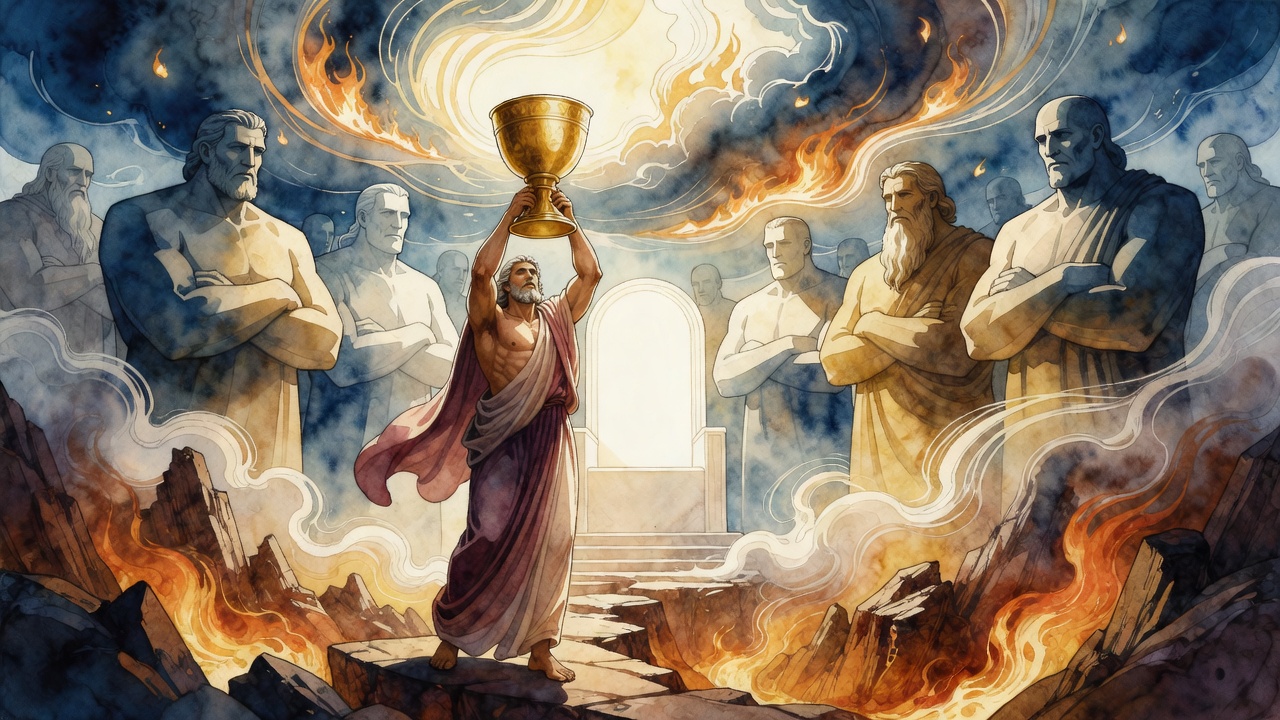
The soul rose and found that paradise was not one flat meadow. Light stacked itself in ranks. Below, the world still called it Gan Eden as if the name were simple. Above, the first court already differed from the second the way one star differs from another in a crowded sky. "You are this day as the stars of the heavens in multitude," the verse had said, and the sages heard not only number but kinds of brilliance.

The soul felt its own light measured against neighbors and did not yet know which court would keep it.

Seven Classes, Seven Nearnesses

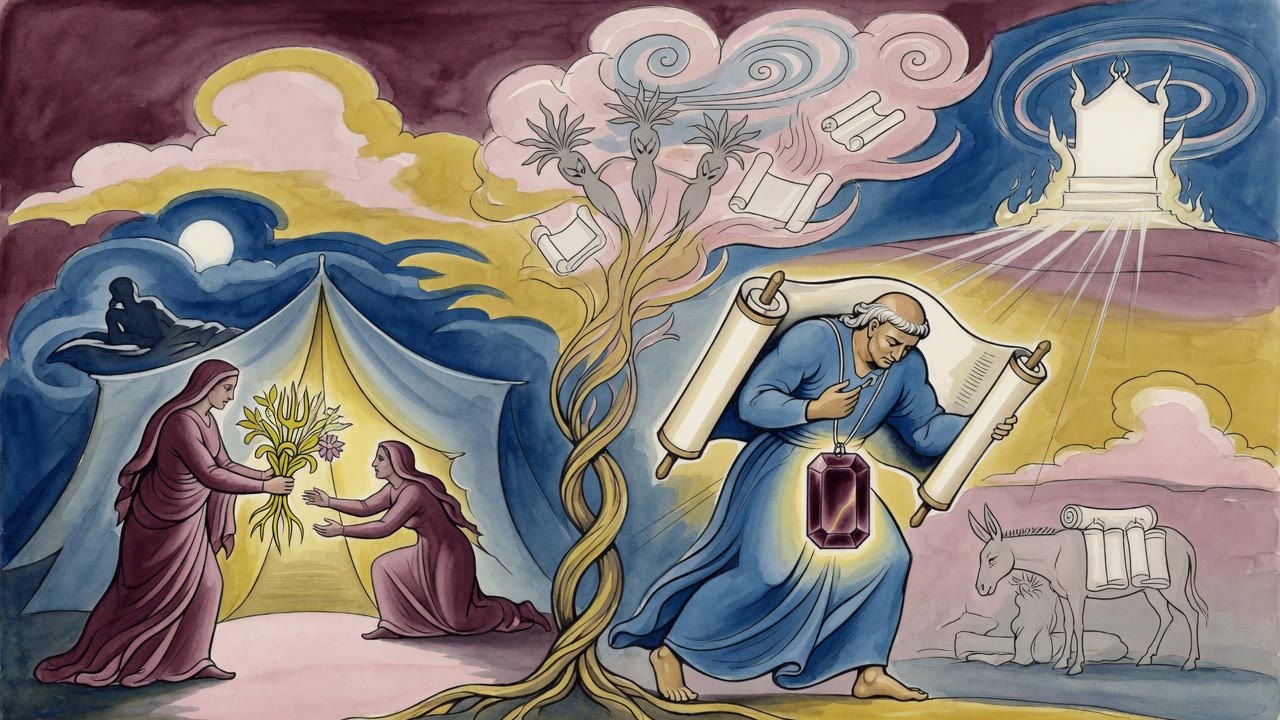
First came those who give praise and dwell in the Presence, mouths still shaped for song. Second, the chosen drawn near to courts. Third, dwellers in the House as if residence itself were reward. Fourth asked who may dwell in the Tent, a more intimate canvas. Fifth climbed the holy mountain in the old psalm's question. Sixth pressed higher still on that ascent. Seventh entered the rank where nearness stops needing metaphors of furniture and starts becoming fire that does not consume the worthy.

Each step changed the air. The soul that had known only one flavor of joy learned that joy has altitudes.

What Learning Buys a Lineage

On the climb a memory returned from the academy: if you merit Torah, you merit it for yourself and for descendants until the end of generations. Slight commandments want the same love as weighty ones. Whoever is not in the class of learning is not fully in the class of doing, because action without understanding is a half-built bridge.

Rabbi Akiva had argued that "what is good and what is just" means good in heaven's eyes and just in human eyes. Rabbi Yishmael pressed the reverse order in other places, but the soul carried Akiva's double demand upward: a life that satisfies the court above and the street below. That double had weight here. Some lights shone with private piety alone and found a lower court. Some shone with public justice alone and found the same. The higher ranks wanted both.

Days Multiplied Beyond One Life

Another teaching unspooled like a map of time. "So that your days will be multiplied" points to this world. "The days of your children" opens into the days of the Messiah. "To your forefathers to give to them" hints at resurrection, the dead called back into the gift. "As the days of the heavens upon the earth" names the World to Come, a span that outruns ordinary counting.

The soul saw that Eden's ranks were not the whole story. Messiah, rising of the dead, and the world that is all heaven-on-earth waited as further rooms in a house larger than any single garden. Still the garden mattered. It was the first sorting of lights after the body fell away.

Which Court Keeps You

A guide who would not give a name asked what the soul had loved most. Praise without justice? Justice without study? Study without the small acts? The soul answered with a week from its life: a coin given quietly, a page learned while tired, a hard word not spoken. The guide pointed to a middle court that still climbed. Not the highest. Not the lowest. Room to rise further when the messianic days rearrange the furniture of reward.

Below, someone living still opened a book at dawn, unaware that the page was already buying light for a court not yet seen. The soul watched that small diligence the way a person watches a lamp across a valley, and for the first time understood why the tradition refused to make paradise a single color.

In a lower court someone who had loved only public honor tried to climb on reputation and found the air too thin. In a higher court a woman who had washed the dead and taught children their letters sat as if furniture itself made room for quiet service. The soul learning the ranks began to rewrite its old scores. Applause was not a sefirah (a divine emanation) here. Thoroughness was. The slight commandment glowed the same color as the weighty when both had been kept with a whole heart.

A messenger mentioned messianic days the way a host mentions a wing of the house still under construction: real, not yet the room where you sleep. Resurrection would reunite bodies with lights that had already been sorted. The World to Come would outrun the garden's seven courts without erasing them, the way a sea outruns a harbor and still needs harbors.

The soul asked whether it could send a signal downward. The guide said every page opened at dawn is already a signal. Then the soul was silent, not from fear, from the first true understanding that its living descendants were still laying stones in courts they could not see, and that this was not a burden but a kindness stretched across generations.


← All myths
From the tradition

Sources

3 sources

The texts behind this telling. Some cards carry a translation of the source; others are our own retelling of it, and each card says which. Every card links out to the original.

Sifrei Devarim 10:1Sifrei Devarim

Retold in our words. Read the original at the link below.Sifrei by Rabbi Shraga Silverstein · CC-BY

The Jewish tradition offers a tradition of possibilities, and one fascinating glimpse into the afterlife comes from Sifrei Devarim (a collection of early Jewish legal interpretations on the Book of Deuteronomy).

It paints a picture of Gan Eden, the Garden of Eden, not as a single, homogenous paradise, but as a place with varying levels of spiritual reward. And it all begins with the verse from Deuteronomy (1:10): "And you are this day as the stars of the heavens in multitude." It's from this seemingly simple phrase that the sages derive the idea of multiple tiers in the afterlife. "as the stars of the heavens in multitude." Countless, varied, each with its own brilliance. It’s not just about quantity, but about quality, about different levels of light.

So, what are these levels? Sifrei Devarim describes seven distinct classes of the righteous in Gan Eden, each one higher than the last. We can get a sense of these levels through verses from Psalms, each hinting at a different kind of closeness to the Divine.

The first class? They are those who "give praise to Your name; the upright [who] will dwell in Your presence" (Psalm 140:14). These are the ones who directly offer praise, finding themselves in the very presence of the Divine.

Then there's the second class: "Praises to him You choose and draw near to dwell in Your courts" (Psalm 65:5). These are the chosen ones, drawn near to dwell in God's courts, a step closer to the inner sanctum.

The third class are "Praised are the dwellers in Your house" (Psalm 84:5). They are the permanent residents, the ones who have made God's house their home.

Moving on, the fourth class asks the question, "Who shall dwell in Your tent?" (Psalm 15:1). The tent suggests a more intimate, protected space.

And the fifth class takes us even higher: "Who shall dwell on Your holy mountain?" (Psalm 15:1). The holy mountain represents spiritual ascent, a higher plane of existence.

The sixth class then poses, "Who shall ascend the mountain of the L-rd?" (Psalm 24:3). Ascending suggests effort, striving towards something greater.

Finally, the seventh, and highest, class: "Who shall stand in the place of His sanctity?" (Psalm 24:3). These are the ones who have reached the ultimate level of closeness, standing in the very place of God's holiness.

Sifrei Devarim doesn't give us all the answers, but it offers a powerful reminder that our actions in this world have consequences in the next. It suggests that our journey of spiritual growth doesn't end with our physical life, but continues, perhaps even expands, in the world to come.

Perhaps it's an invitation to strive for greater righteousness, to deepen our connection with the Divine, and to live a life worthy of ascending to the highest levels of Gan Eden. Or maybe, it's simply a comforting thought, a reminder that our efforts to live a good life are not in vain, and that a reward awaits us, in one form or another, in the world beyond.

Full source
Sifrei Devarim 47:1Sifrei Devarim

Retold in our words. Read the original at the link below.Sifrei by Rabbi Shraga Silverstein · CC-BY

Heaven, the Messiah, resurrection... But how does it all fit together?

Well, the source turns to Sifrei Devarim, a collection of legal interpretations on the Book of Deuteronomy. Specifically, It sounds straightforward, but listen to how the Sages break it down.

"So that your days will be multiplied": this refers to this world, the one we're living in right now. Makes sense. Live a good life, follow the commandments, and hopefully, you'll have a long and prosperous time here.

It doesn’t stop there. "And the days of your children": this speaks of something more, something different. This refers to "the days of the Messiah." The Messianic Era – a time of peace, justice, and universal knowledge of God. A future golden age.

And it goes even deeper. "...to your forefathers to give to them": this isn't just about future generations, but about the past as well. This passage hints at the resurrection of the dead. A time when those who came before us, our ancestors, will be given their due, their reward, their chance to participate in the perfected world.

But the biggest, most breathtaking promise? "As the days of the heavens upon the earth": this, my friends, speaks of olam ha-ba, the World to Come. A reality so profound, so beyond our current comprehension, that it's likened to the very heavens.

So, what are we left with? A layered vision of eternity. We're not just talking about one afterlife, but rather a series of interconnected stages: a long life in this world, followed by the Messianic Era, the Resurrection, and ultimately, the World to Come. Each building upon the last, each a step closer to ultimate fulfillment.

It’s a powerful reminder that our actions today have ripple effects that extend far beyond our own lives, influencing not only our present but also shaping the future – and even impacting the very fabric of eternity. What kind of legacy are we building, not just for our children, but for all of eternity? What "world" are we building here and now?

Full source
Sifrei Devarim 79:5Sifrei Devarim

Retold in our words. Read the original at the link below.Sifrei by Rabbi Shraga Silverstein · CC-BY

The ancient text Sifrei Devarim suggests that the answer is a resounding yes, especially when it comes to the transformative power of Torah learning.

One interpretation within Sifrei Devarim states that if you've been fortunate enough to explore the wisdom of the Torah, you're not just benefiting yourself. You are securing blessings for all your future descendants. It frames Torah study not just as personal enrichment, but as an act of intergenerational love and responsibility.

The text then takes a turn towards the practical. "Take heed and hearken," it urges. And then makes a rather pointed statement: "Whoever is not in the class of learning is not in the class of doing." What does that even mean? It's not saying that ignorance is bliss, but rather that genuine action, informed action, stems from understanding. It suggests that to truly do, to effect real change, we must first engage in learning. To hearken is not just to hear, but to listen, to understand, and then to act.

This is where it gets really interesting. We're told that even a "slight" commandment should be as beloved as a "weighty" one. readers often prioritize the big, splashy acts of righteousness, the ones that get noticed. But Sifrei Devarim reminds us that the seemingly small things, the everyday acts of kindness and observance, are just as crucial. They all contribute to the fabric of a life lived in accordance with Torah.

And the reward? The text reiterates: "If one merits learning, he merits it for himself and for his descendants until the end of all the generations." It’s a powerful promise, a vision of a legacy of wisdom and blessing stretching far into the future.

But what constitutes truly doing "what is good and what is just"? Here, we encounter a fascinating difference of opinion between two great sages: Rabbi Akiva and Rabbi Yishmael.

Rabbi Akiva argues that it means doing "what is good in the eyes of Heaven and what is just in the eyes of man." In other words, actions that are both divinely sanctioned and morally upright by human standards.

Rabbi Yishmael flips the order, suggesting it means doing "what is just in the eyes of Heaven and what is good in the eyes of man," citing (Proverbs 3:4): "And you will find grace and good regard in the eyes of G-d and man."

What's the difference? Perhaps Rabbi Yishmael is emphasizing that our actions should first and foremost be aligned with God’s will, and that then they will naturally lead to good regard in the eyes of others. Perhaps he is emphasizing the importance of internal integrity first. It subtly shifts the focus from seeking external validation to pursuing inner righteousness.

Both perspectives highlight the importance of living a life that is pleasing both to God and to our fellow human beings. It is a path that is both spiritually fulfilling and socially beneficial, a path that, according to Sifrei Devarim, can bless not only ourselves but generations to come. So, what small step can we take today to contribute to that legacy?

Full source