5 min read

David Waited to Sing Until Four Giants Fell

David went out with his men one more time and his strength gave out in the middle of the fighting. Afterward they made him swear never to come again.

Curated by Arthur · Told by Maggid ·
Table of Contents
  1. The King's Strength Gave Out
  2. You Will Not Go Out With Us Again
  3. Three More Out of Gath
  4. Leaves on the Green Tree
  5. The Song He Had Been Holding
David Waited to Sing Until Four Giants Fell Click for full size

The King's Strength Gave Out

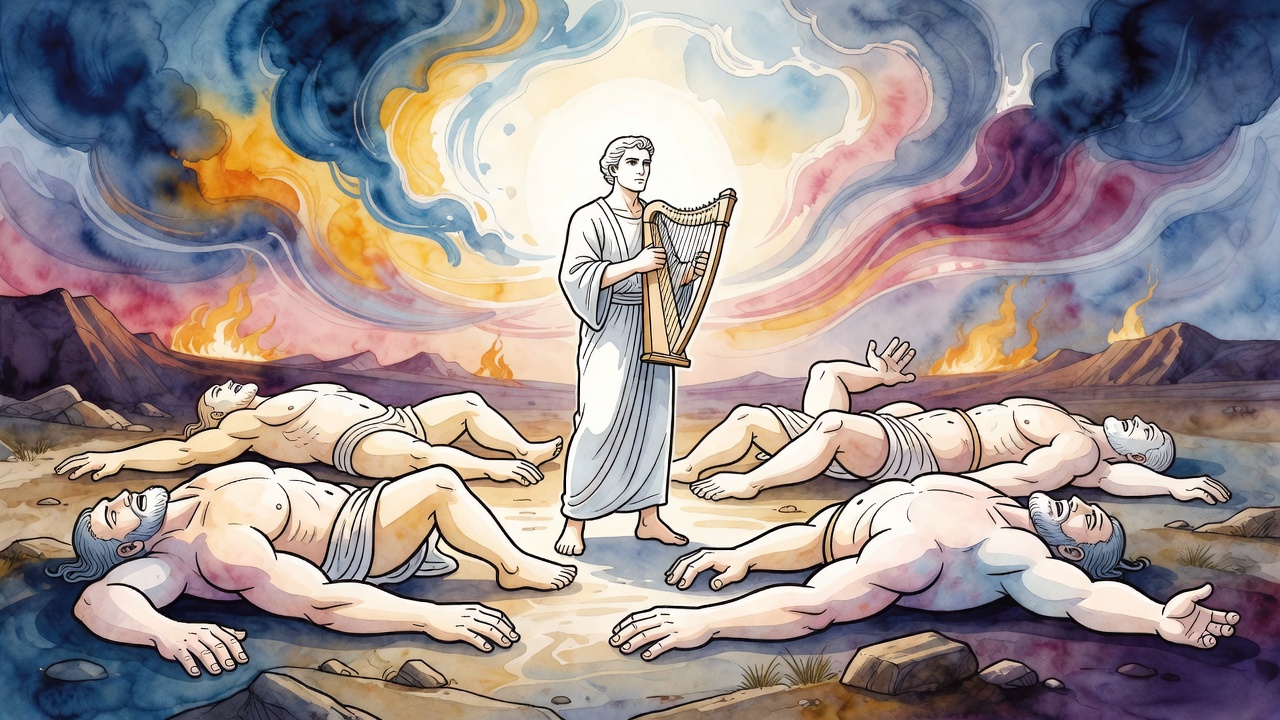
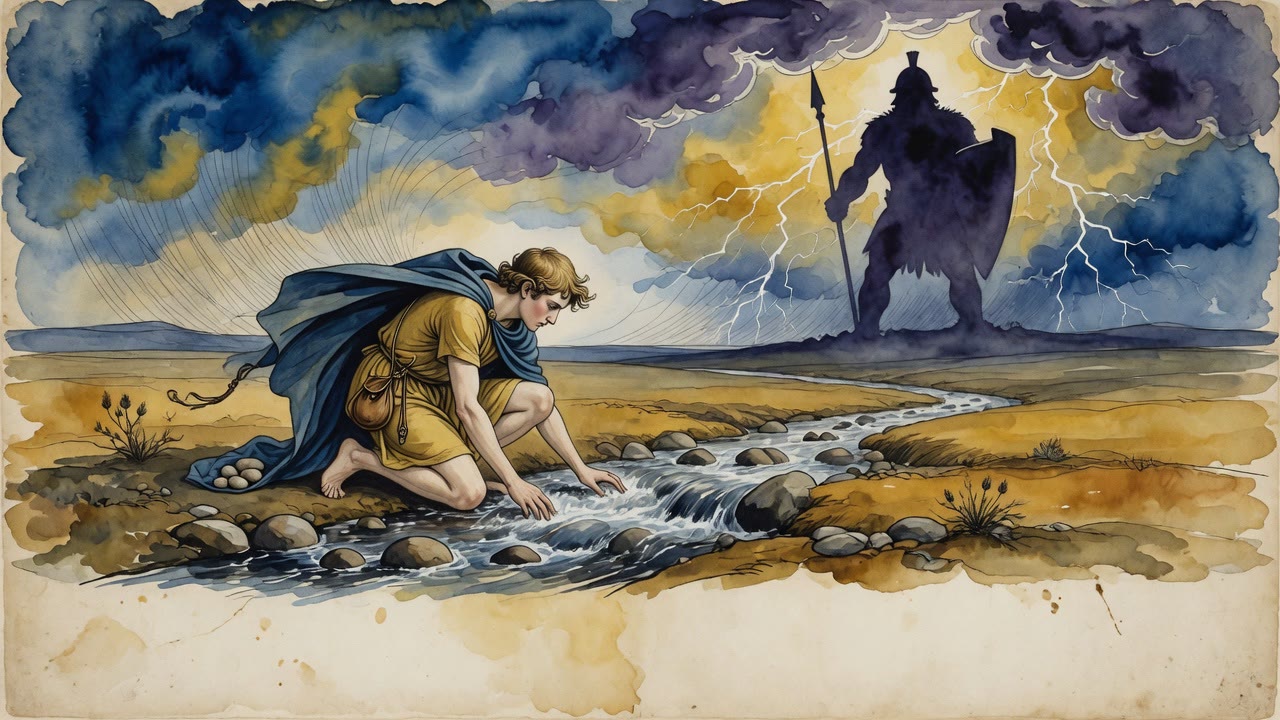
The Philistines came up again and David went down with his servants to meet them, the way he had gone down since he was a boy with a sling, and somewhere in the middle of that day his body quit on him.

Ishbi-benob saw it happen. He was one of the sons of the giant, and the head of his spear weighed three hundred shekels of bronze, and he had a new sword strapped on him that had never been used. He came for the king with the whole afternoon in front of him and no reason to hurry.

Abishai the son of Zeruiah got there first. He put himself between the giant and the king and killed the Philistine on the spot, and then he stood there breathing hard while the men came running up the field toward a king sitting in the dirt.

You Will Not Go Out With Us Again

They made him swear it before they let him up.

"You shall not go out with us to battle any more. You will not put out the lamp of Israel."

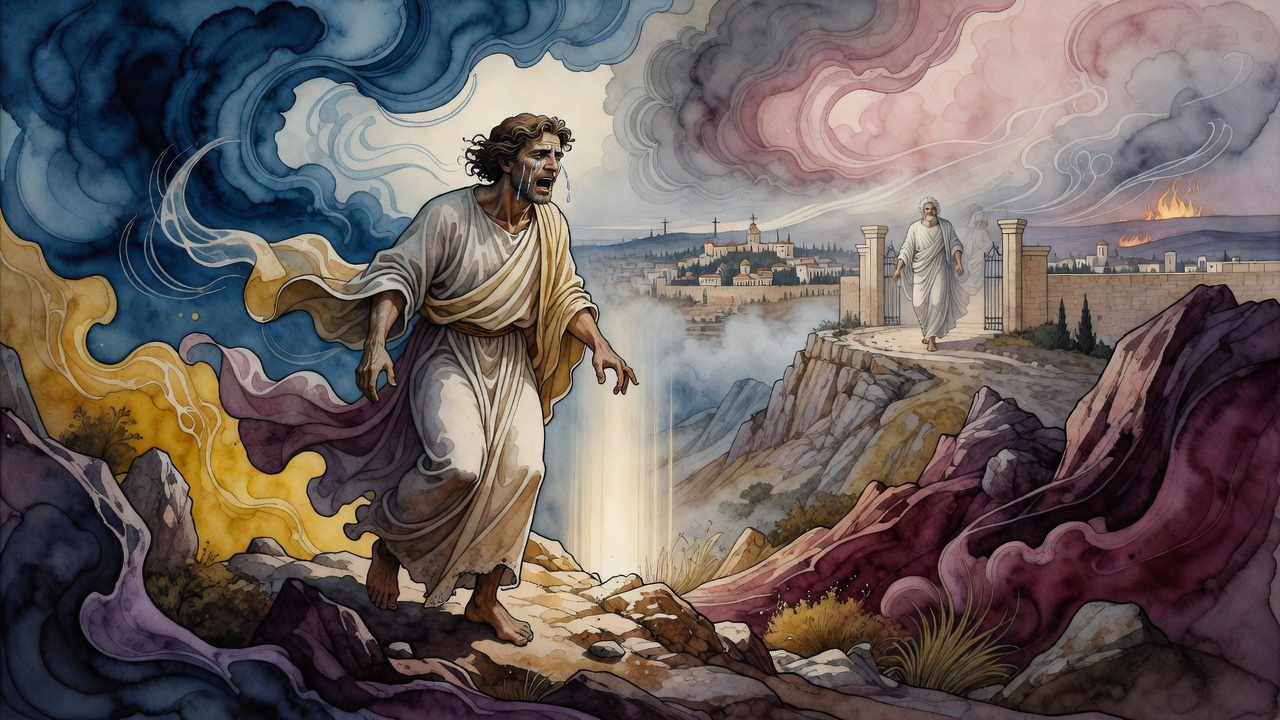
It was said with love and it landed like a sentence. He was the man who had walked out to the champion in the valley with five stones and no armor, and now his own soldiers were telling him where he was allowed to stand. He went back to the camp and sat among the tents while other men went out in the morning.

Somebody expected a psalm out of it. There was always somebody expecting a psalm. He did not give them one.

"Not yet," he said. "I do not sing until I have been shamed, and until four of them have fallen into my hand, and until I have the better of the master of fingers."

Three More Out of Gath

The war came back at Gob. Sibbechai the Hushathite killed Saph, another of the giant's sons, and the count stood at two.

At Gob again, Elhanan of Bethlehem killed the Gittite whose spear shaft was like the beam of a weaver's loom. Three.

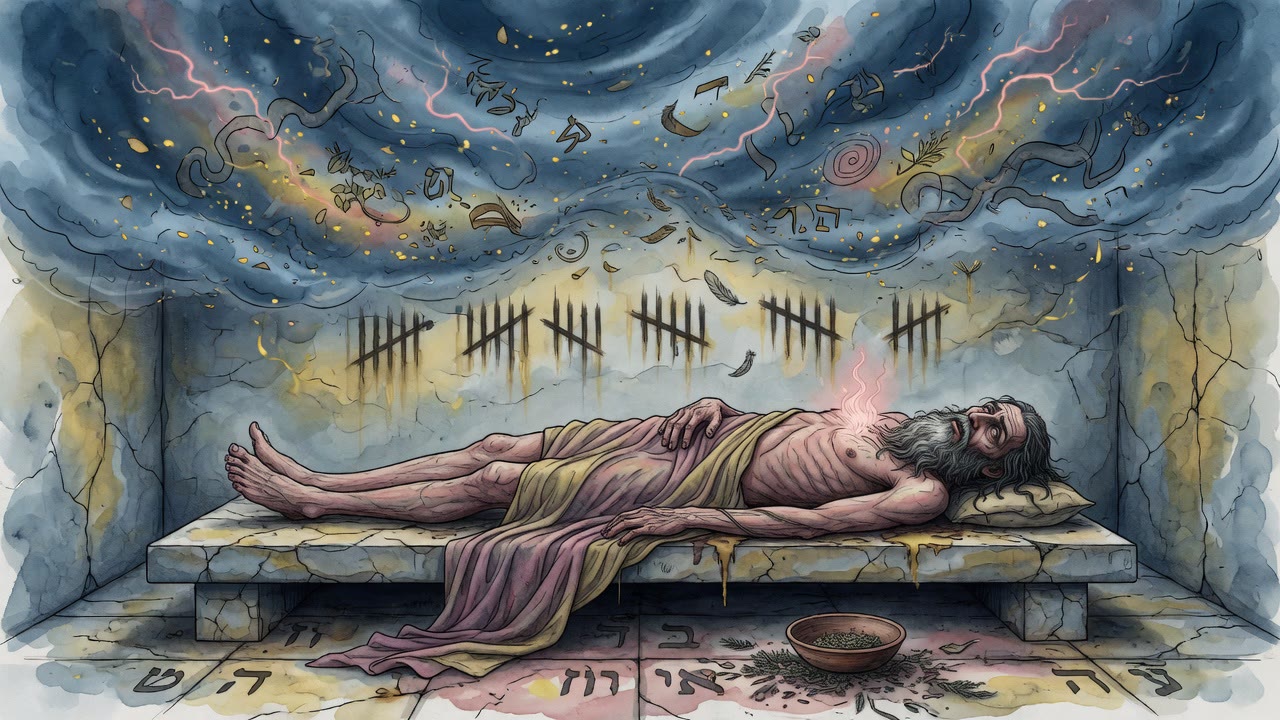
Then a fourth came out at Gath, and this one was built wrong. Six fingers on each hand. Six toes on each foot. Twenty-four in all, and men counted them, because a thing like that gets counted. He walked out in front of the lines and taunted Israel the way his family had always taunted Israel, and Jonathan the son of Shimei, David's own nephew, went out and killed him and left the fingers curling in the dust.

Four. Four giants out of one house in Gath, and every one of them dead by David's hand or by the hands of the men who served him.

Leaves on the Green Tree

David heard about the last three from other men's mouths.

That is what the oath had bought him, a chair and a report. His nephew took the six-fingered one. Abishai's brothers and their sons carried the swords now, boys he remembered as children in Zeruiah's house, and they came back at evening with the details and he listened and asked good questions and did not go out.

Leaves grow on a green tree. One of them dries and comes off and another opens in the same place, and the tree does not stop being green. That is how it goes with generations of flesh and blood. One perishes, another ripens, and the man who notices it first is usually the one drying at the edge of the branch.

The Song He Had Been Holding

He had waited years for this. When the fourth was buried, David opened his mouth.

He spoke the whole song on the day the Lord delivered him out of the hand of all his enemies and out of the hand of Saul, and it is a long one. The Lord is my rock and my fortress. The earth shook and trembled. He bowed the heavens and came down. He sent from above and took me, He drew me out of many waters.

Every line of it had been sitting in him through the years when the count was at zero, and through the afternoon in the dirt with Abishai standing over him, and through the mornings when the army left without him. He had refused to spend it on a skirmish. A song is not a receipt for a good day. It is what is left after the shame and the fourth body.

And the rule he made for himself he laid on his people too. Israel does not sing either. Not until they have been shamed, not until four have fallen into their hand, not until they have the better of the master of fingers. Four kingdoms are still standing. The nations are still to be gathered against Jerusalem. Somewhere on the other side of all that, a new song is written and nobody has heard the first line of it yet.


← All myths
From the tradition

Sources

2 sources

The texts behind this telling. Some cards carry a translation of the source; others are our own retelling of it, and each card says which. Every card links out to the original.

Midrash Tehillim 18:4Midrash Tehillim

Retold in our words. Read the original at the link below.Rabbi Mike Feuer, Jerusalem Anthology · CC-BY

It seems the answer, according to ancient wisdom, lies not in triumph alone, but in the crucible of adversity.

The Midrash Tehillim, a collection of homiletic interpretations on the Book of Psalms, asks a profound question: "What is the meaning of the verse 'I will sing to the Lord, for he is highly exalted'?" (Exodus 15:1). Rabbi Yudan offers a powerful insight, connecting it to (Psalms 71:7), "I have become a sign to many; you are my strong refuge."

In Rabbi Yudan, David himself understood this connection intimately. David declared that he "did not sing a song until I was disgraced and until four fell into my hand and until I had dominion over Baal of the fingers." What does all of that mean?

David's disgrace came in the form of revealing the secrets of the Philistines (1 Samuel 17), an act that, while ultimately victorious, brought initial shame upon Israel. The four who "fell into his hand" refers to the descendants of Baal of the fingers (2 (Samuel 21:20), 22), a giant from Gath who had six fingers on each hand and six toes on each foot. A formidable foe,.

The Midrash (rabbinic interpretive commentary) draws a parallel between David's experience and the future redemption. Just as David's song arose from hardship, so too will Israel's ultimate song of praise be born from a period of intense struggle. "So too, Israel does not sing a song until they are disgraced and until four fall into their hands and Baal of the fingers.": we often turn to song in moments of profound emotion, whether it's joy, sorrow, or, yes, even after overcoming great challenges.

The text continues, drawing a parallel to the coming of the Messiah. It suggests that even the Messiah will face a period of disgrace, echoing the sentiment expressed in (Psalms 69:10): "Because zeal for your house consumes me, and the insults of those who insult you fall on me." Only after the fall of "four wicked empires," as prophesied in (Zechariah 14:2) ("I will gather all the nations to Jerusalem"), will the time be ripe for a new song. "At that time, one should say a new song to the Lord," the Midrash states, referencing (Psalms 98:1): "Sing to the Lord a new song, for he has done marvelous things."

So, what does this all mean for us today? Perhaps it's a reminder that even in our own moments of struggle, of disgrace, of feeling overwhelmed, there is potential for song. Perhaps it's in those very moments that we are being prepared to sing a new song, a song of resilience, of hope, and of unwavering faith in the face of adversity. It suggests that the most beautiful melodies often arise from the deepest valleys.

Full source
Ben Sira 14:23Ben Sira

Retold in our words. Read the original at the link below.The Wisdom of Ben Sira, Cambridge University Press (1899) · CC-BY

"As leaves grow upon a green tree," he writes, "Whereof one withereth, and another springeth up; So of the generations of flesh and blood, One perisheth, and another ripeneth." (Ben Sira 14). This constant cycle of renewal and decay. A reminder of our own mortality, perhaps, but also of the enduring power of life itself.

Ben Sira doesn't stop there. He doesn’t just observe this cycle, he digs deeper. "All his works shall surely rot," he continues, "And his handywork shall draw after him." Harsh. It's a stark reminder that even the things we build, the things we create, are ultimately subject to the same forces of time and decay.

So, what does endure? What can we hold onto in this fleeting existence? Ben Sira suggests an answer: wisdom.

"Happy is the man that shall meditate in wisdom; And shall have respect to understanding."

But what does it mean to "meditate in wisdom"? It’s not just about accumulating knowledge, is it? It's about something deeper, something more profound.

Ben Sira elaborates: "That setteth his heart upon her ways; And considereth her paths." It’s about actively engaging with wisdom, pursuing it, letting it guide your actions and shape your understanding of the world.

He paints a vivid picture of this pursuit: "Going forth after her in search of her; And spying all her entries. That prieth through her window; And will hearken at her doors." Imagine someone literally seeking out wisdom, peeking around corners, listening intently, trying to catch a glimpse of its secrets. It's a powerful metaphor for the dedication and effort required to truly understand. idea of "hearkening at her doors." Wisdom isn't something that just falls into your lap. You have to actively seek it out. You have to be willing to listen, to learn, to question, to explore the depths of understanding.

But why? Why is wisdom so important? Perhaps it’s because wisdom provides a framework, a compass, to navigate this ever-changing world. Perhaps it’s because true understanding allows us to connect with something larger than ourselves, something that transcends the fleeting nature of our individual lives.

Ben Sira offers a potent, lasting message: acknowledge the transient nature of existence, yes, but strive for the enduring power of wisdom. Seek it out, embrace it, and let it illuminate your path. Because in the end, it’s not the things we build, but the wisdom we cultivate, that truly defines us.

Full source