5 min read

David Weeps and Sings While Fleeing Absalom

On the Mount of Olives David climbs barefoot, tears on his face, a psalm in his mouth. Absalom takes the city, and measure for measure walks with the king.

Curated by Arthur · Told by Maggid ·
Table of Contents
  1. Barefoot Up the Mount
  2. Why Weep and Sing Together
  3. The Cup He Would Not Leave Dirty
  4. Three Weights on the Soul
  5. Bread in Mahanaim
David Weeps and Sings While Fleeing Absalom Click for full size

Barefoot Up the Mount

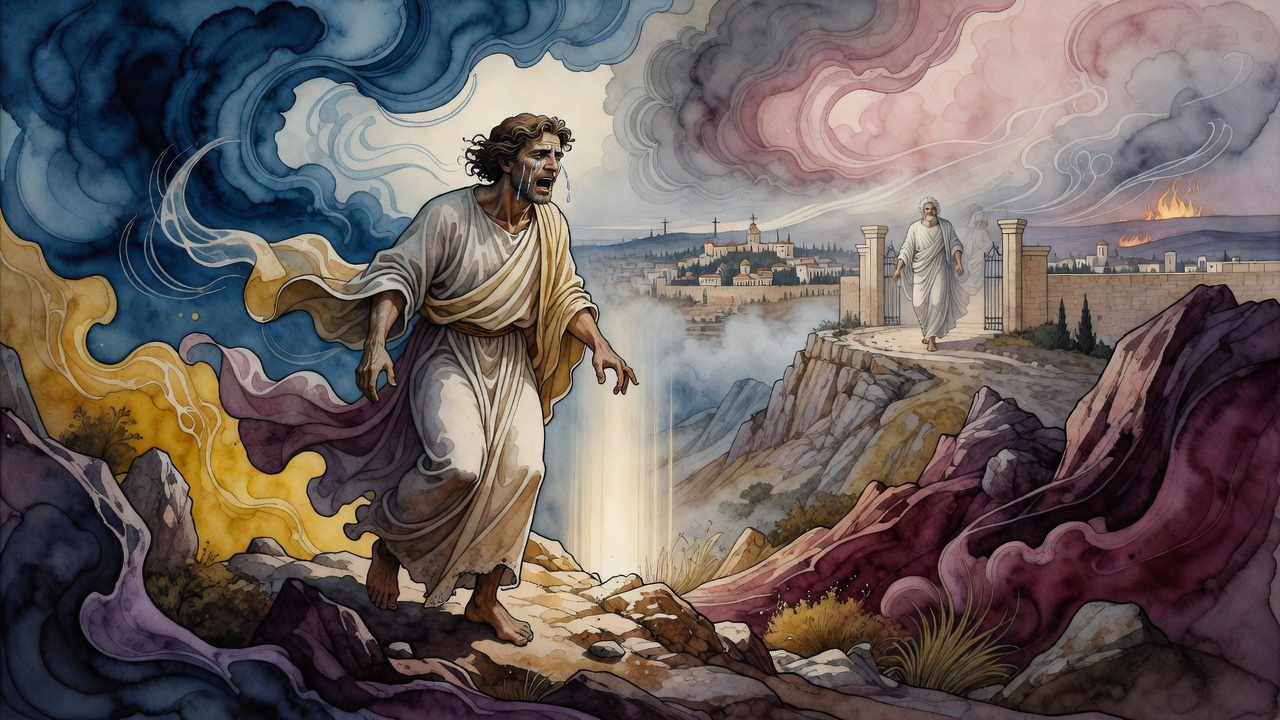
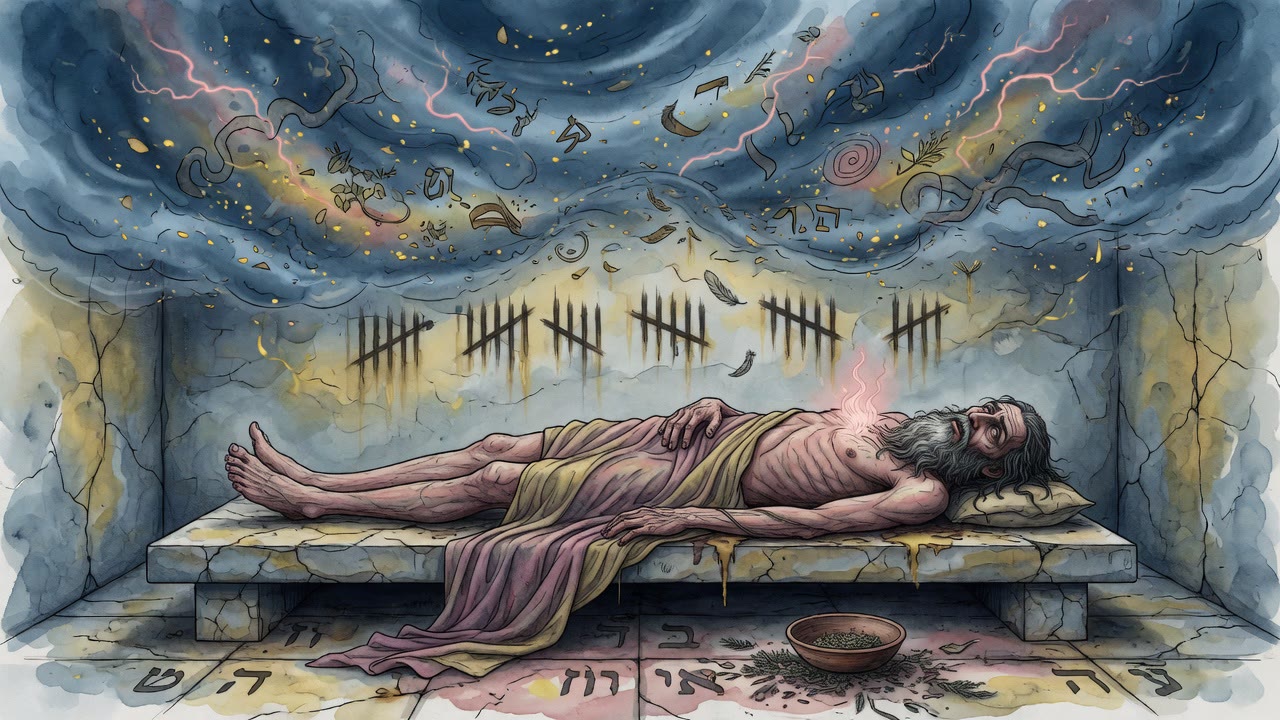
David climbed the Mount of Olives barefoot and weeping, and the strange part is that he was also singing. Behind him Absalom held Jerusalem. Ahead of him the road ran toward the wilderness and the fords. Dust stuck to the tears on his face. The ark had turned back into the city at his own command. The king who once danced before the ark now walked like a man already half exiled from his own name.

When did he say Psalm 3? The sages place it here, on the ascent, with foes multiplied and a son among them. "O Lord, how many are my foes!" If someone else had taken the kingdom, the distress would have been great. Now his own son had taken it, and the number of enemies became personal in a way no Philistine army ever managed. The harp was not in his hand. The psalm still found his mouth.

Why Weep and Sing Together

Rabbi Abba bar Kahana offers a parable. A king grows angry with his son and banishes him. He sends the son's teacher after him. The teacher finds the son weeping and singing at once. If you weep, why sing? If you sing, why weep? The son answers, I weep because I provoked my father. I sing because my punishment is not death. And not only that. He is sending me to duchies and provinces, places of authority even in exile.

David felt that doubled math. He had provoked Heaven. He was not dead. The road itself became a strange mercy. Rabbi Yudan hears him lining up with his ancestors. Jacob fled to Aram. Moses fled from Pharaoh. And I too am fleeing like them. In distress he remembered old judgments and comforted himself with them (Psalm 119:52). Flight became a membership in a holy pattern, not only a political collapse.

The Cup He Would Not Leave Dirty

When David said, "Arise, and let us flee," some heard strategy. Leave the city so we are not judged as a city led astray, dragging the innocent into collective guilt. Others heard confession. He took the cup to rinse it, and he would not move from there until he had rinsed it. God was cleansing his iniquities on the road, and the song rose because the washing had begun.

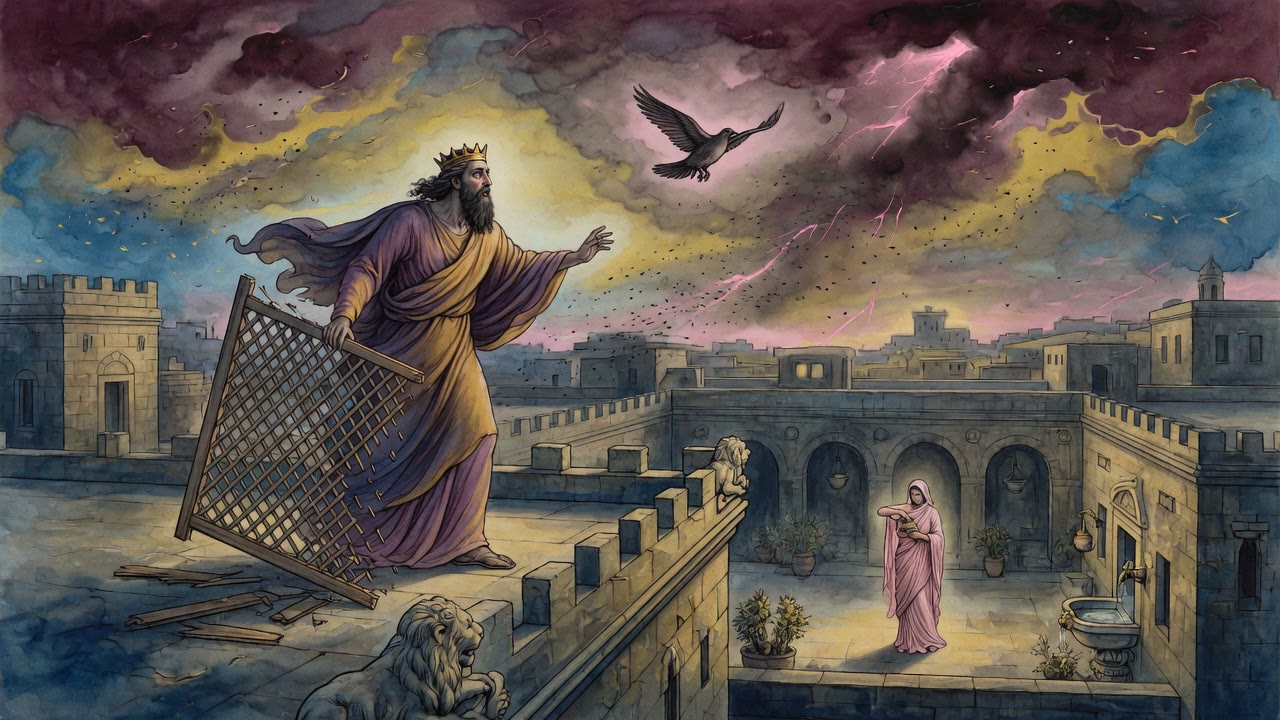
The affair with Bathsheba still walked before him. Measure for measure had been spoken. You committed one adultery? Sixteen will be committed against you. You murdered one person? Sixteen murders will answer. Shimei would later curse him on the road with an acronym of insults, and the platter of Bathsheba would walk before David in the midrash's hard image, a reminder that private sin becomes public weather. Nathan had said the Lord had taken away his sin, that he would not die. Living with the taken-away sin still meant climbing a mountain in tears while a son hunted the crown.

Three Weights on the Soul

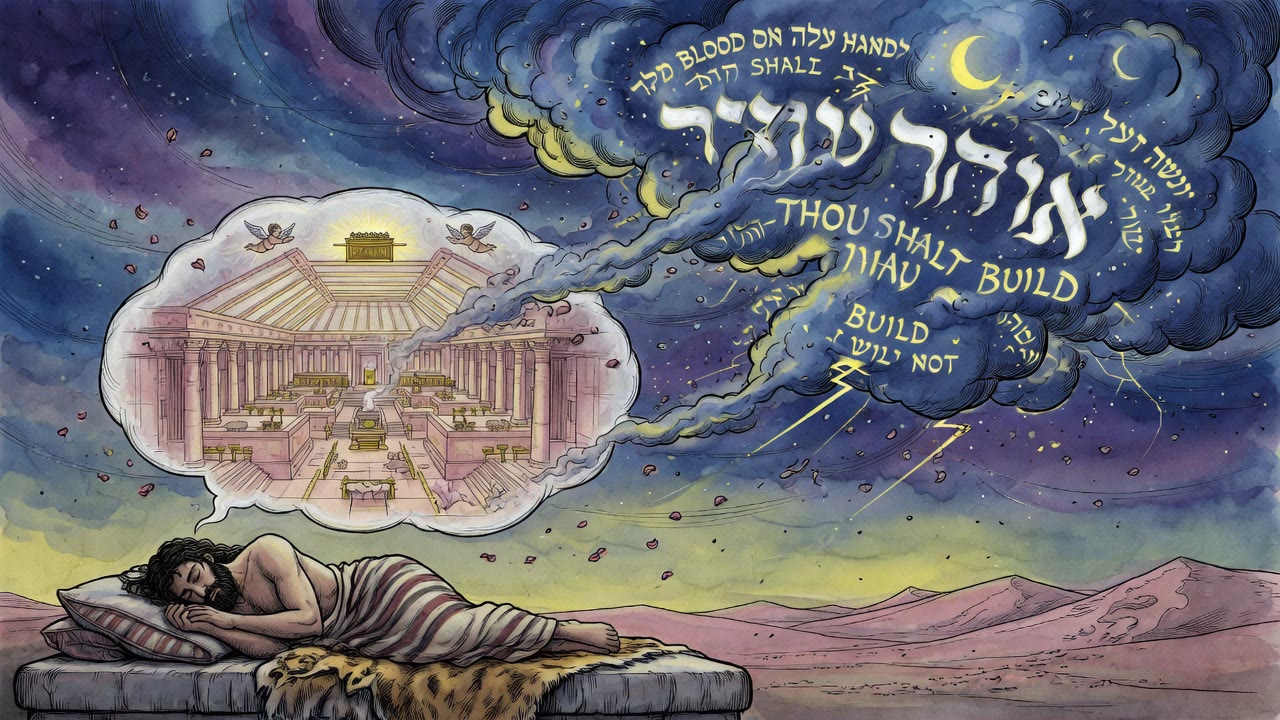
Other nights David carried three anxieties the midrash names without softening. The future destruction of the Temple, until God showed him the place. "This is the house of the Lord God." The shame of Bathsheba, until the word came that he would not die for it. The question of succession, until Solomon was promised, Jedidiah, beloved of the Lord, born through the very house of the sin, the son through whom healing of the line would run.

Confession is the hinge. Blessed is the one whose transgression is forgiven, whose sin is covered, who has no deceit in his spirit. Some sages say do not drag last year's already-thanked sins back to the mouth like a dog to its vomit. Others say keep the sin before you always as memory, not as performance. Either way, the man on the Mount of Olives is not bargaining with flattery. He is rinsing the cup while he walks.

Bread in Mahanaim

On the far side, loyalty still found him. Hushai the Archite stayed behind to break counsel. Cherethites and Pelethites held. In Mahanaim, Shobi, Machir, and Barzillai brought beds, basins, and earthen vessels, mattresses and wine and bread for the hungry court in flight. When David saw their kindness he sang again, tasting the proverb that when a man's ways please the Lord, even his enemies can be at peace with him.

The city behind him still rang with Absalom's name. The mountain still held the memory of bare feet. Weeping and singing had shared one throat, and neither canceled the other. A king can lose a capital and keep a psalm. A father can flee a son and still call the flight a washing. The foes were many. The song did not wait for the foe count to drop to zero.


← All myths
From the tradition

Sources

3 sources

The texts behind this telling. Some cards carry a translation of the source; others are our own retelling of it, and each card says which. Every card links out to the original.

Midrash Tehillim 3:3Midrash Tehillim

Retold in our words. Read the original at the link below.Rabbi Mike Feuer, Jerusalem Anthology · CC-BY

King David knew that feeling well.

Midrash Tehillim, a collection of rabbinic interpretations on the Book of Psalms, dives deep into the context and meaning behind David's songs. And it asks a compelling question about the very first verse of Psalm 3: When did David actually say this psalm?

The Midrash (rabbinic interpretive commentary) tells us it was when David was going up the Mount of Olives, fleeing his son Absalom's rebellion, and he was weeping. But then, if he was weeping, why was he singing? And if he was singing, why was he weeping?

Rabbi Abba bar Kahana offers a parable to explain this paradox. The king sends the son's pedagogue (teacher) after him, who finds the son in this conflicted state – weeping and singing. The teacher asks, "If you're weeping, why are you singing? And if you're singing, why are you weeping?" The son replies, "I'm weeping because I provoked my father. But I'm singing because my punishment isn't death! And not only that, but he’s sending me to duchies and provinces – places of importance and authority!"

Rabbi Yudan adds another layer. He says David felt like his ancestors. “Jacob our father fled,” as it says in Hosea (12:13), "And Jacob fled to the field of Aram." "Moses fled," as we read in Exodus (2:15), "And Moses fled from Pharaoh." “And I, too, am fleeing like them!” In his distress, David finds comfort in remembering God's enduring justice. He recalls (Psalm 119:52): "I have remembered Your judgments of old, O Lord, and have comforted myself."

The Midrash offers another interpretation, focusing on David's actions. When David said, "Arise, and let us flee," (2 (Samuel 15:1)4), Rav and Rabbi Yudan offer different reasons for his decision. Rav suggests it was "So that we would not be judged as a city led astray," avoiding collective punishment. Rabbi Yudan, however, says that “He took the cup to rinse it, and he would not move from there until he had rinsed it.” In other words, David recognized that God was cleansing his iniquities, and this realization prompted his song, "A Psalm of David."

But the story doesn't stop there. The Midrash continues, exploring the events surrounding David's flight and the loyalty (and disloyalty) of those around him. We learn about the Cherethites and the Pelethites – David's elite guards. Rabbi Ivo explains that "Cherethites" refers to those who made covenants, and "Pelethites" refers to those who were wondrous in the court of law. The Rabbis say that their wisdom was unmatched.

And then there's Hushai the Archite, who plays a crucial role in David's eventual return to power. The Midrash offers different opinions on why he was called "the Archite." One says he was one of David's courtiers. Another says that through him, David's kingdom was established. Still another says he was named after his city. When David saw that his kingdom was secure, he began to sing.

Later, in Mahanaim, David receives provisions and support from loyal subjects like Shobi, Machir, and Barzillai. The generosity moves David deeply. Rav explains the details of these gifts: "Beds" refers to mattresses and sheets; "Basins" refers to casks of wine; "Earthen vessels" refers to those coming from Rachmah. When David sees their kindness, he realizes that even his enemies can be at peace with him when his ways please the Lord, echoing (Proverbs 16:7). And he sings.

However, the Midrash doesn’t shy away from David’s flaws and the consequences of his actions. Referencing (2 Samuel 12:6), Rabbi Judah son of Hanina emphasizes the concept of measure for measure. The Holy One, Blessed be He, says to David, "You committed one adultery? Sixteen adulteries will be committed against you. You murdered one person? Sixteen murders will be committed against you." This stark reminder of the repercussions of sin adds a somber note to the narrative.

The Midrash also highlights the personal pain David endured because of his son's rebellion. Rabbi Joshua portrays David lamenting: "If someone else had taken my kingdom, it would have been a great distress for me… Now my son has taken my kingdom – 'O Lord, how many are my foes!'" This personal betrayal cuts deeper than any external threat.

The story of Shimei, who cursed David, is also explored. The Midrash explains that Shimei's curse was an acronym for "adulterer, Moabite, wicked, oppressor, abomination," highlighting the severity of his transgression. Rabbi Abba bar Kahana adds that "The platter of Bathsheba walked before David," a constant reminder of his past sin.

Finally, the Midrash concludes with a reflection on the nature of divine mercy and forgiveness. Rabbi Samuel bar Nachmani recounts a discussion with Rabbi Yochanan about the verse, "To the Lord our God are the mercies and the forgivenesses, for we have rebelled against Him" (Daniel 9:9). Rabbi Yochanan explains that God's mercy is most evident when we rebel against Him, yet He still provides for us.

Perhaps it's the recognition that life is rarely simple. We can experience joy and sorrow simultaneously, and it's in those moments of tension that we often find the deepest meaning. David's story reminds us that even in our darkest hours, we can find comfort in faith, in the memory of God's enduring presence, and in the hope for a brighter future. And maybe, just maybe, we can even find a reason to sing.

Full source
Midrash Tehillim 4:2Midrash Tehillim

Retold in our words. Read the original at the link below.Rabbi Mike Feuer, Jerusalem Anthology · CC-BY

The familiar picture has him as this divinely favored ruler, harp in hand, composing the Psalms. But even kings, especially those after God’s own heart, have their burdens. Midrash Tehillim, a collection of rabbinic interpretations on the Book of Psalms, gives us a glimpse into some of David's deepest anxieties, all tied to the phrase "Bikrei Anani" found at the start of Psalm 18.

The Midrash (rabbinic interpretive commentary) tells us there were three major things weighing heavily on David’s soul.

First, he was tormented by the thought of the future destruction of the Beit Hamikdash, the Holy Temple in Jerusalem. As (Psalm 132:1) says, "Remember, O Lord, for David all his hardships." But God, in His infinite mercy, offered David solace. He revealed to him the very spot where the Temple would eventually stand. As we read in (1 Chronicles 22:1), "Then David said, 'This is the house of the Lord God.'" A small comfort, perhaps, knowing that even destruction couldn’t erase the sacred place.

Then there was the matter of Bathsheba.

This is a story we all know, that dark chapter in David's life. He committed adultery with Bathsheba and arranged for her husband, Uriah, to be killed in battle. It was a profound moral failing, a stain on his reign. The people whispered, questioning whether David deserved to live. The weight of that sin, the public shame, must have been crushing. But God, in his compassion, reassured David, as told in (2 (Samuel 12:1)3), "The Lord has taken away your sin. You will not die." Forgiveness, it seems, was possible, even for a sin of that magnitude.

And finally, David worried about succession. Who would follow him on the throne? Would his kingdom endure? This is a universal concern for any leader, but for David, it carried the added weight of divine expectation. God comforted him with the promise that his son Solomon would inherit the kingdom. (1 (Chronicles 22:9-1)0) states, "Behold, a son will be born to you…and his name shall be Solomon…I will establish his kingdom forever.”

But the Midrash adds a fascinating layer to this. When David inquired, "Who will be born to me?" God replied with a cryptic answer: "Through whom will you be healed of your sins? Through the son of the woman with whom you sinned." Solomon, the fruit of that transgression, would be the one to solidify David’s legacy.

This revelation came through the prophet Nathan. As (2 (Samuel 12:2)5) tells us, "And he sent word through Nathan the prophet, and he named him Jedidiah," which means "beloved of the Lord."

So, what do we take away from this glimpse into David’s anxieties? It’s evidence of the enduring power of forgiveness and the possibility of redemption, even from the darkest of deeds. And perhaps most powerfully, it highlights the idea that even our mistakes can, in unexpected ways, contribute to something meaningful and lasting.

Full source
Midrash Tehillim 32:2Midrash Tehillim

Retold in our words. Read the original at the link below.Rabbi Mike Feuer, Jerusalem Anthology · CC-BY

The midrash (rabbinic interpretation) on Psalm 32 opens with a powerful idea: "Blessed is the man who does not think the Lord counts his sins." In other words, blessed is the person who trusts in God's capacity for forgiveness. But how does that forgiveness actually work?

Rabbi Yosei bar Yehuda believed that complete repentance unlocks divine mercy. He argued that if we truly turn away from our wrongdoings, God, blessed be He, will forgive us. Sounds straightforward. But other rabbis had different nuances to add to this concept.

Rabbi Eliezer ben Yaakov raised a fascinating point about gratitude. He suggested that sins we've already expressed gratitude for in one year shouldn't be brought up again the following year. It's like going back to something already dealt with, a sentiment he powerfully illustrates with a quote from (Proverbs 26:11): "Like a dog that returns to its vomit." Strong imagery. But what did he make of (Psalm 51:5), “My sin is always before me”? He suggested that we should keep our past sins in mind, but not necessarily voice them aloud repeatedly. It's about remembrance, not dwelling.

The Sages had another opinion. They felt one should acknowledge sins in subsequent years, to fulfill that very verse from Psalms: "My sin is always before me." How do we reconcile these seemingly contradictory views?

Rabbi Pinchas, quoting Rabbi Abba bar Papa, offered another layer: "Since you have no disgrace of this year's sins, do not speak falsehood. Do not boast about not having any sins this year." Humility, it seems, is key. It's not about pretending to be perfect, but about acknowledging our imperfections and striving to do better.

Rabbi Huna bar Abba added a poignant image, saying, "I wrote about myself as if I had forgotten," referencing (Micah 7:18): "Who is a God like you, who pardons sin and forgives the transgression of the remnant of his inheritance?" He describes sins as debts that God chooses to forgive. He then evokes the tenderness of a mother's love, quoting (Isaiah 49:15): "Can a woman forget her nursing child?" Just as a mother's love endures, so too does God's forgiveness.

All these different perspectives circle back to Psalm 32, which proclaims, "Blessed is he whose transgressions are forgiven, whose sins are covered." The psalm emphasizes that this person has no deceit in their spirit and doesn't pray with deceit. God's loving-kindness surrounds them.

Rabbi Yudan, citing Rabbi Berachiah, offered a message of inclusion: "Let not the righteous say, 'We have been excluded from the ranks of the upright.'" Even the righteous experience the need for rejoicing, as (Psalm 33:1) reminds us: "Rejoice in the Lord, O you righteous ones."

Rabbi Yehuda bar Simon connected our actions to our very being. He noted that we have 248 limbs and that there are 248 positive commandments in the Torah. He taught that fulfilling even one of these commandments is like fulfilling one of the limbs in your body, citing (Psalm 34:21): "He keeps all his bones; not one of them is broken."

Finally, Rabbi Eliezer ben Yaakov, quoting Rabbi Pinchas ben Yair, brought us back to the heart of the matter: God's unconditional forgiveness. Citing (Isaiah 43:25), he stated, "The Holy One, blessed be He, said, 'I, even I, am He who blots out your transgressions for My own sake; and I will not remember your sins.'"

So, what do we take away from all of this? Perhaps it's that forgiveness is a complex, many-sided process. It involves repentance, gratitude, humility, remembrance, and, ultimately, trust in God's boundless capacity for mercy. The rabbis don't offer a simple, pat answer, but rather a tradition of perspectives that invite us to reflect on our own relationship with sin, forgiveness, and the Divine. And maybe, just maybe, that’s the point. It’s not about having all the answers, but about wrestling with the questions, striving to be better, and trusting in the unwavering love that surrounds us.

Full source