4 min read

Seventy-Two Sages Rewrote the Torah for Ptolemy in Secret

Ptolemy put seventy-two Jewish scholars in separate rooms and demanded a Greek Torah. Each made the same thirteen changes without consulting the others.

Curated by Arthur · Told by Maggid ·
Table of Contents
  1. The King's Demand
  2. What Each Sage Changed
  3. What the Letter of Aristeas Remembered
  4. Why the Sages Changed What They Changed

The King's Demand

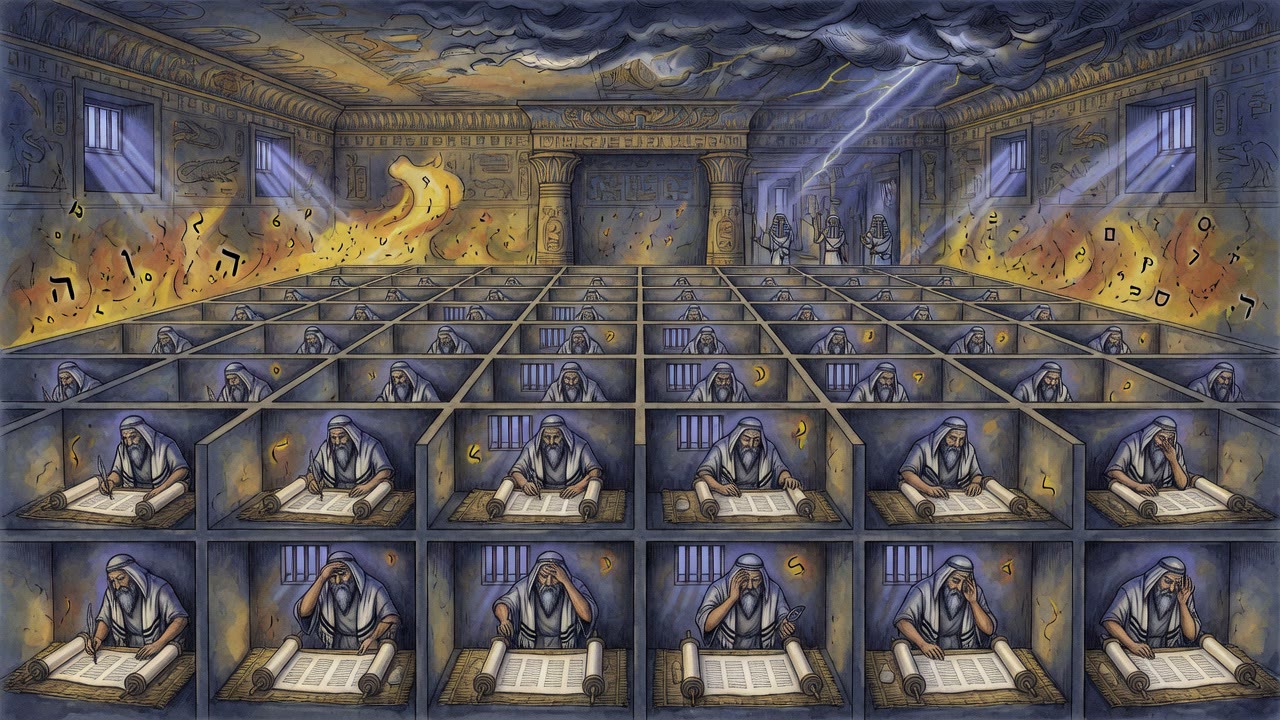
Ptolemy of Egypt wanted the Torah in Greek. He was not asking as a curious reader. He assembled seventy-two Jewish elders, separated them from each other, placed each one in a private room, and gave each the same instruction: translate the Torah of Moses your teacher into Greek.

The arrangement was designed to expose inconsistency. If the sages disagreed with each other, if one wrote one thing and another wrote differently, Ptolemy would have his proof that the text was not from heaven at all, just the work of human scribes who could not keep their story straight. He expected contradictions. He expected the isolation to crack the project open.

What Each Sage Changed

The Holy One placed counsel in the heart of each sage, and they all wrote as one.

Where the Torah opened "In the beginning God created," they wrote "God created in the beginning," closing the grammatical door Ptolemy might have used to claim the text said something like "In the beginning, god was created." Where the Torah said "Let us make a man in our image," language that could suggest multiple divine beings, they wrote "I will make a man in image and form." Where it described God resting on the seventh day, they adjusted the phrasing so it could not be read to suggest that God was finished and had moved on.

Thirteen changes. Each sage, working alone in a sealed room, made exactly the same thirteen adjustments. When the papers were collected and compared, the translations were identical. Not similar. Identical. Every change they had each made independently matched every change the others had made. Ptolemy had his translation. He also had his proof, though it was not the proof he had expected.

What the Letter of Aristeas Remembered

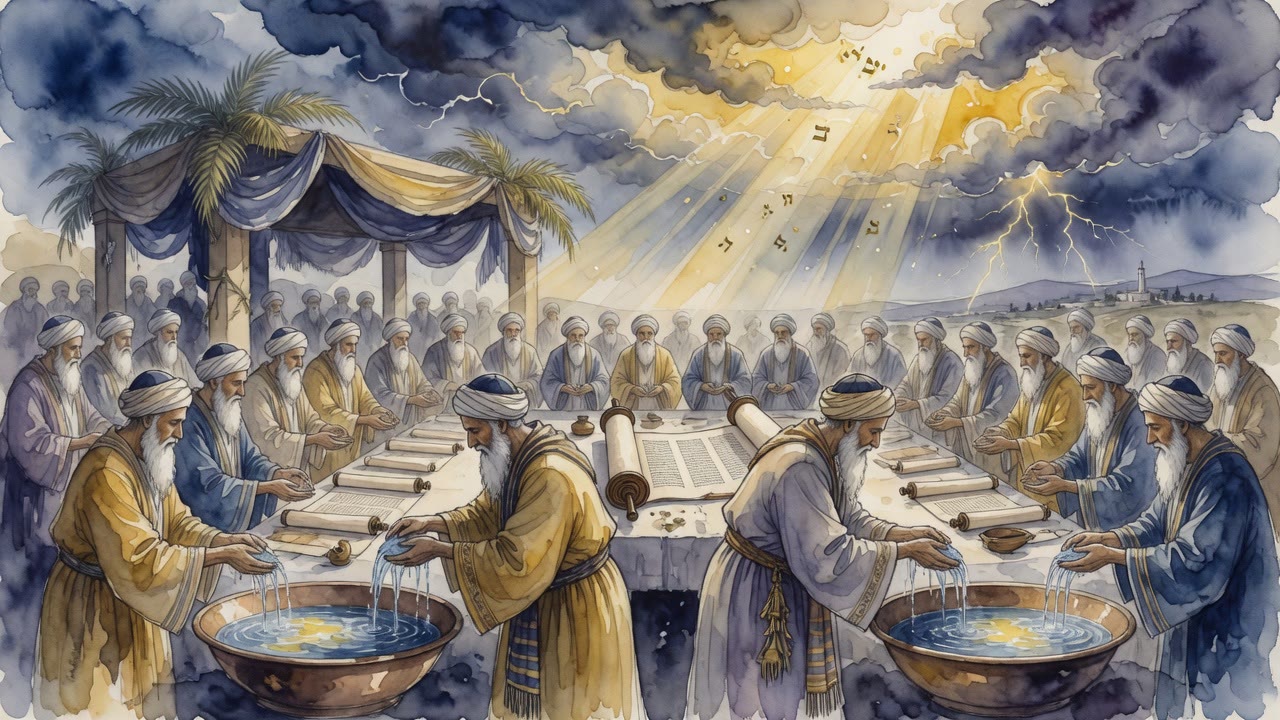
The other account of this event comes from an entirely different angle. The Letter of Aristeas, written in Greek and framed as a dispatch from a court official named Aristeas to his brother, describes the translation project from the perspective of Ptolemy's own circle. It opens with the emancipation of Jewish captives Ptolemy's father had transported from Judea, more than a hundred thousand people taken in the conquest of Coele-Syria and Phoenicia, reduced to slavery in Egypt.

The letter frames the translation as an act of royal generosity and cultural interest, a patron king supporting the preservation of a foreign people's sacred literature. But it also documents the arrangement of scholars brought from Jerusalem, the scholarly environment Ptolemy created, the great library in which the work was done. The external record confirms the isolation, confirms the seventy-two, confirms the Greek product. It does not mention that the seventy-two translations were identical without collaboration, because that part of the story required a different kind of attention to notice.

Why the Sages Changed What They Changed

The changes the sages made were not distortions. They were defensive translations, protective adaptations designed to prevent misreading in a hostile intellectual environment. A Greek-speaking philosopher reading that God "rested" might conclude God was exhausted. A grammatically ambitious reader might find a polytheism in "let us make a man." Every change closed an interpretive door that an opponent might have pushed through.

The sages were not betraying the Torah. They were protecting it in a language and a court where it had no protection. And the miracle of their unanimity was not just a demonstration of divine guidance. It was proof that the Torah they carried in their heads was a single coherent text, not an assemblage of competing traditions that would disaggregate under pressure. Seventy-two men, isolated, made the same judgments about what needed protection. That is not coincidence. That is transmission.


← All myths
From the tradition

Sources

5 sources

The texts this telling draws on, in full. Open a card to read inline, or expand it for a wider, quieter read.

Mekhilta Tractate Pischa 14:17Mekhilta DeRabbi Yishmael

"And the habitation of the children of Israel in Egypt and in other lands was four hundred and thirty years." This is one of the verses that they (the seventy-two elders changed) in transcribing (the Torah) for King Ptolemy, viz. (Megillah 9a): Once King Ptolemy assembled seventy-two elders and placed each in a separate house (without telling them why he was doing so), and he said to each of them: "Transcribe for me [into Greek] the Torah of Moses your teacher." The Holy One Blessed be He placed goodly counsel in the heart of each, and they all wrote as one (Genesis 1:1): "G–d created in the beginning" [so that Ptolemy could not structure the words as: "In the beginning, god was created."] [They wrote] (Ibid. 1:26): "I will make a man in image and form" [and not, literally: "Let us make a man, etc.", so that he would not be able to argue for a plurality of gods]. [They wrote] (Ibid. 2:2): "And He finished on the sixth day, and He rested on the seventh day" [and not, literally: "And G–d finished His work on the seventh day," so that he could not argue that G–d worked on the seventh day]. [They wrote] (Ibid. 5:2): "Male and female He created him" [and not, literally: "Male and female He created them" (which Ptolemy could use as an argument for the creation of two separate bodies)]. [They wrote] (Ibid. 11:7): "Let Me go down and confound their tongue" [and not, literally: "Let us go down", so that he would not find support for his polytheistic views]. [They wrote] (Ibid. 18:12): "And Sarah laughed bikrovehah" ["among her neighbors", and not, literally: "bekirbah" ("within her"), so that Ptolemy would not question why Sarah should be punished for laughing, and not Abraham, if they both laughed inwardly]. [They wrote] (Ibid. 49:7): "For in their wrath they killed an ox" [instead of: "a man" (so as not to give Ptolemy a pretext to call Jews murderers)], "and in their willfulness they razed a manger" [instead of: "an ox"]. [They wrote] (Exodus 4:20): "And Moses took his wife and his sons and he rode them on the bearer of men" [instead of "on the ass" (so that he not say that Moses lacked a horse or a camel)]. [They wrote] (Ibid. 12:40): "And the sojourning of the Jews, their dwelling in Egypt and in other lands was four hundred years." [(and not just: "their dwelling in Egypt," as per the verse, which would be open to dispute by Ptolemy's reckoning)]. [They wrote] (Ibid. 24:5): "And he sent the dignitaries of the children of Israel" [lest "youths" be taken demeaningly]; (Ibid. 11): "And to the dignitaries of the children of Israel, He did not stretch forth His hand." [They wrote] (Numbers 16:15): "Not one desirable object of theirs" [(instead of, literally: "Not one ass of theirs")] have I taken" [thus preventing Ptolemy from contending that it was only an ass that Moses had not taken]. [They wrote] (Deuteronomy 4:19): ["all the host of heaven …] which the L–rd your G–d bequeathed for illumination to all the peoples under the heavens" [and not, as in the verse: "which the L–rd your G–d bequeathed to all the peoples under the heavens," thus preventing him from construing this verse as a license for idolatry]. [They wrote] (Ibid. 17:3): "and he go and serve other gods … which I did not command to serve" [instead of, as per the verse: "which I did not command", lest he misconstrue it as: "which I did not command to exist" (and which "forced themselves" into creation against My will)]. And instead of (Leviticus 11:6): "And the arneveth (hare) […it is unclean to you"], they wrote: "the slender-legged"; for Ptolemy's wife was called "Arneveth", and Ptolemy would [otherwise] say: "The Jews have poked fun at me and put my wife's name in the Torah!" (Megillah 9a)

Full source
Letter of Aristeas 1:12Letter of Aristeas

Thinking that the time had come to press the demand, which I had often laid before Sosibius of Tarentum and Andreas, the chief of the bodyguard, for the emancipation of the Jews who had been transported from Judea by the king's father - for when by a combination of good fortune and courage he had brought his attack on the whole district of Coele-Syria and Phoenicia to a successful issue, in the process of terrorizing the country into subjection, he transported some of his foes and others he reduced to captivity. The number of those whom he transported from the country of the Jews to Egypt amounted to no less than a hundred thousand.

Full source
Yalkut Shimoni on Torah 3:2Yalkut Shimoni on Torah

It happened with King Ptolemy that he gathered seventy-two elders and placed them in seventy-two separate houses, and did not reveal to them why he had brought them in. He went in to each and every one and said to him, "Write for me the Torah of Moses your teacher." The Holy One, blessed be He, put [wisdom] into the heart of each one, and their understanding agreed as one, and they wrote for him: "God created in the beginning" [reversing the order so none would say "In the beginning" was a separate divine power]; "I shall make man in image and likeness" [singular, not "Let us make"]; "And He finished on the sixth day and rested on the seventh day"; "male and female He created him"; "Come, let Me go down and there confound their language"; "And Sarah laughed among her relatives"; "for in their anger they slew an ox and in their wanton will they uprooted a stall"; "And Moses took his wife and his sons and mounted them upon a carrier of human beings"; "And the dwelling of the children of Israel who dwelt in Egypt and in other lands was four hundred and thirty years"; "And he sent the youths of the children of Israel"; "And against the youths of the children of Israel He did not stretch out His hand"; "Not one precious thing of theirs have I taken"; "which the LORD your God apportioned to give light to all the peoples"; "and he went and served other gods which I did not command to be served." And they wrote for him "the short-legged one" and did not write for him "the hare" [arnevet], because the name of [Ptolemy's] wife was Arnevet, so that he should not say, "The Jews have mocked me and put my wife's name in the Torah."

Full source
Yalkut Shimoni on Torah 12:5Yalkut Shimoni on Torah

"And God said, Let us make man" (Genesis 1:26), this is one of the things that they altered for King Ptolemy. (The rest of the passage is written above in Remez 3.)

Full source
Midrash Tanchuma, Shemot 22Midrash Tanchuma

And Moses took his wife and his sons, and set them upon an ass (Exod. 4:20). This is one of the ten verses our rabbis altered when they translated the Torah into Greek for King Ptolemy. The ten changes are: “God created in the beginning” (Gen. 1:1); “I shall make man in My image and My likeness” (ibid., v. 26); “And He finished on the sixth day, and rested on the seventh day (ibid. 2:2); “Male and female He created him” (ibid. 5:2); “Come, let Me descend and confound their tongue” (ibid. 11:7); “And Sarah laughed among her relatives” (ibid. 18:12); “For in their anger they slew an ox, and in their wrath they digged up a stall” (ibid. 49:6); “And Moses took his wife and his sons, and made them ride on a carrier of men” (Exod. 4:20); “Now the time that the children of Israel dwelt in Egypt, and in the land of Goshen and in Canaan was four hundred and thirty years” (ibid. 12:40); “And he sent the elect of the children of Israel” (ibid. 24:5); “And against the elect of the children of Israel he put not forth his hand (ibid., v. 11); “Since the Lord thy God hath arranged to give light to all the peoples under the entire heavens” (Deut. 4:19); “Which I had not commanded the people to serve” (Deut. 17:3); they wrote about “the slender-footed,” but they did not write the word ‘arnevet (“the hare”) (Lev. 11:5) because the name of Ptolemy’s wife was ‘Arnevet, and he might say: “The Jews are ridiculing me by writing my wife’s name in the Torah.”

Full source