Parshat Bereshit5 min read

When Shabbat Stopped the Bodies of the Shedim

God created souls for the shedim, but Shabbat arrived before their bodies; Adam's spirit waited earlier still, pure and unhoused.

Curated by Arthur · Told by Maggid ·
Table of Contents
  1. Adam's Spirit Before Adam's Dust
  2. Souls Made Pure, Not Already Guilty
  3. When Sleep Kills the Senses
  4. Throw Down the Object Before the Sun Sets

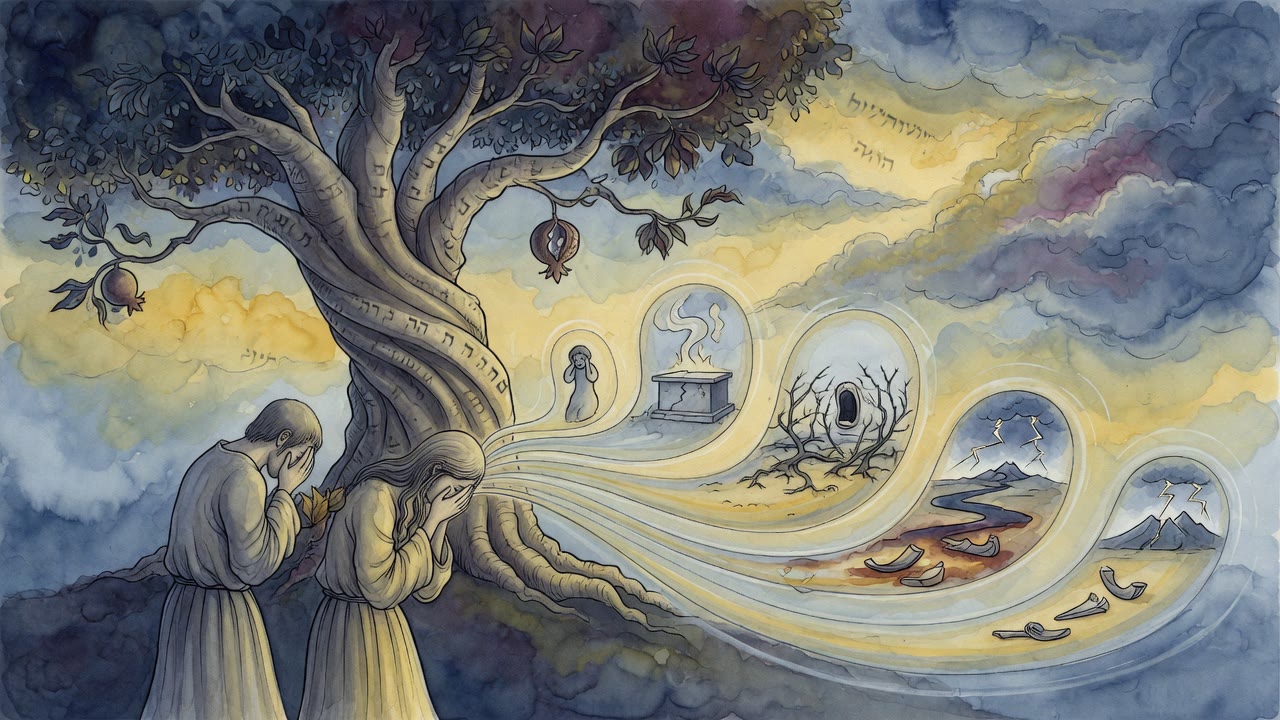
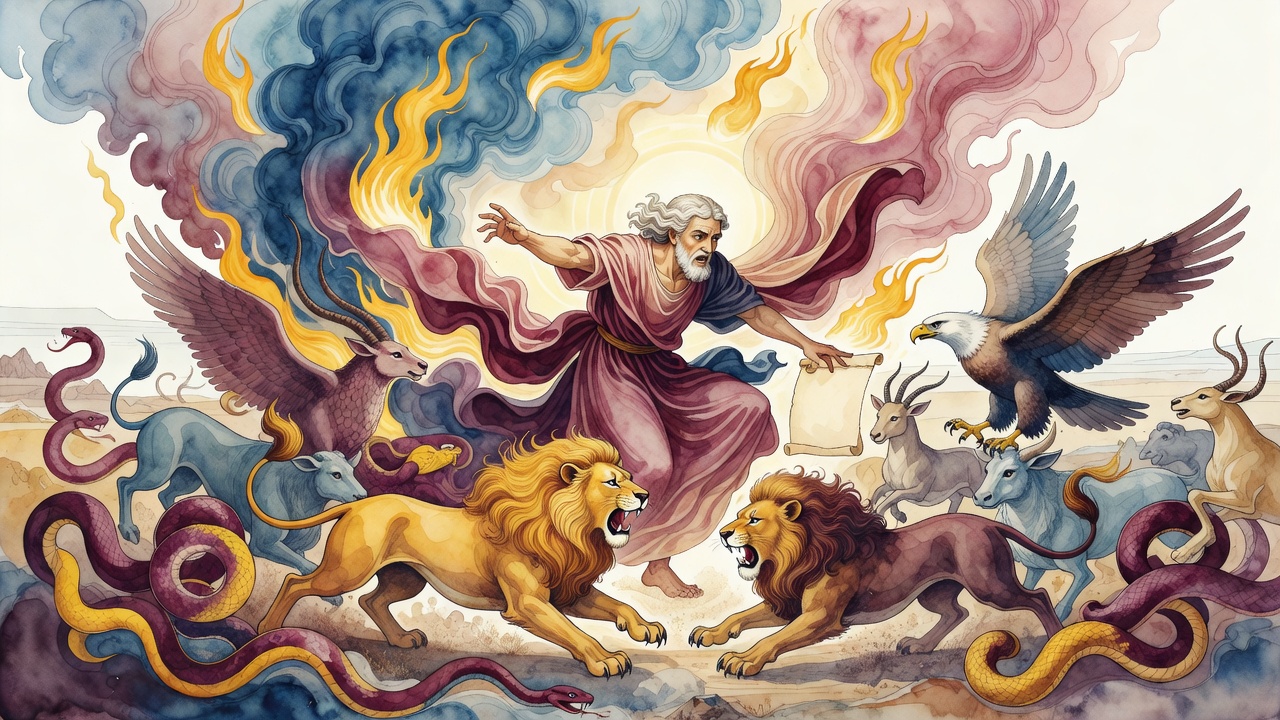
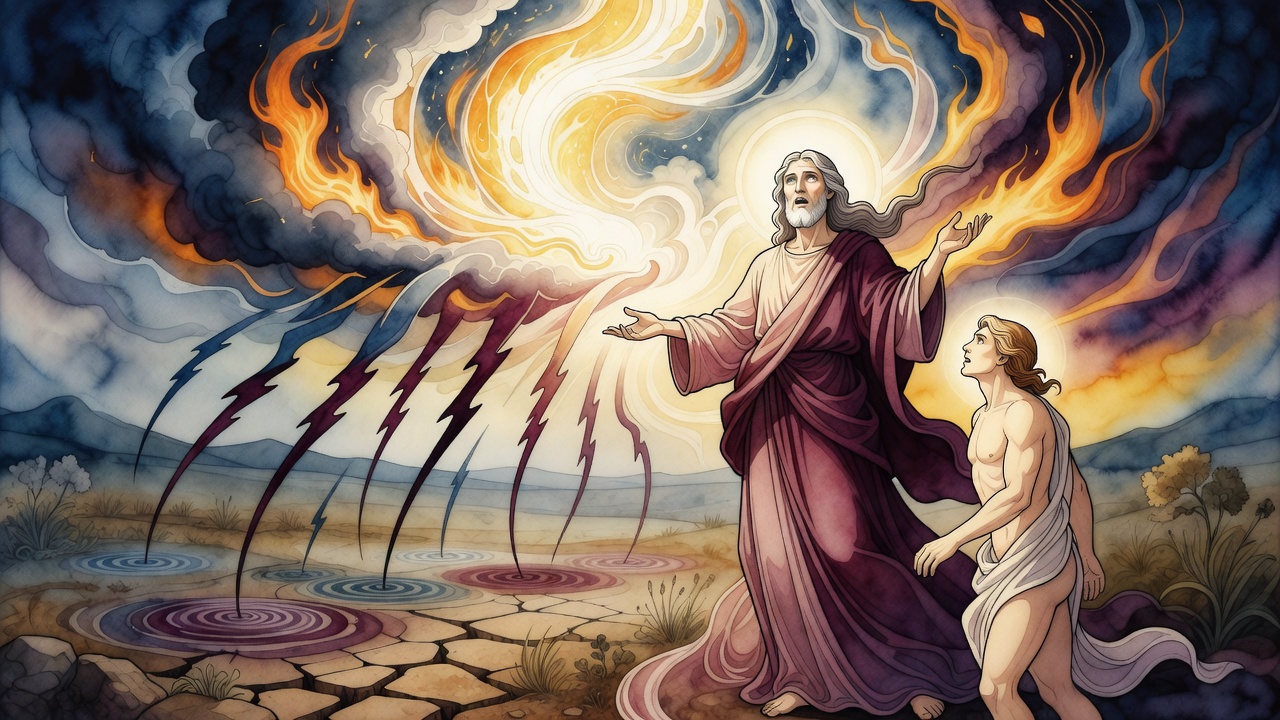
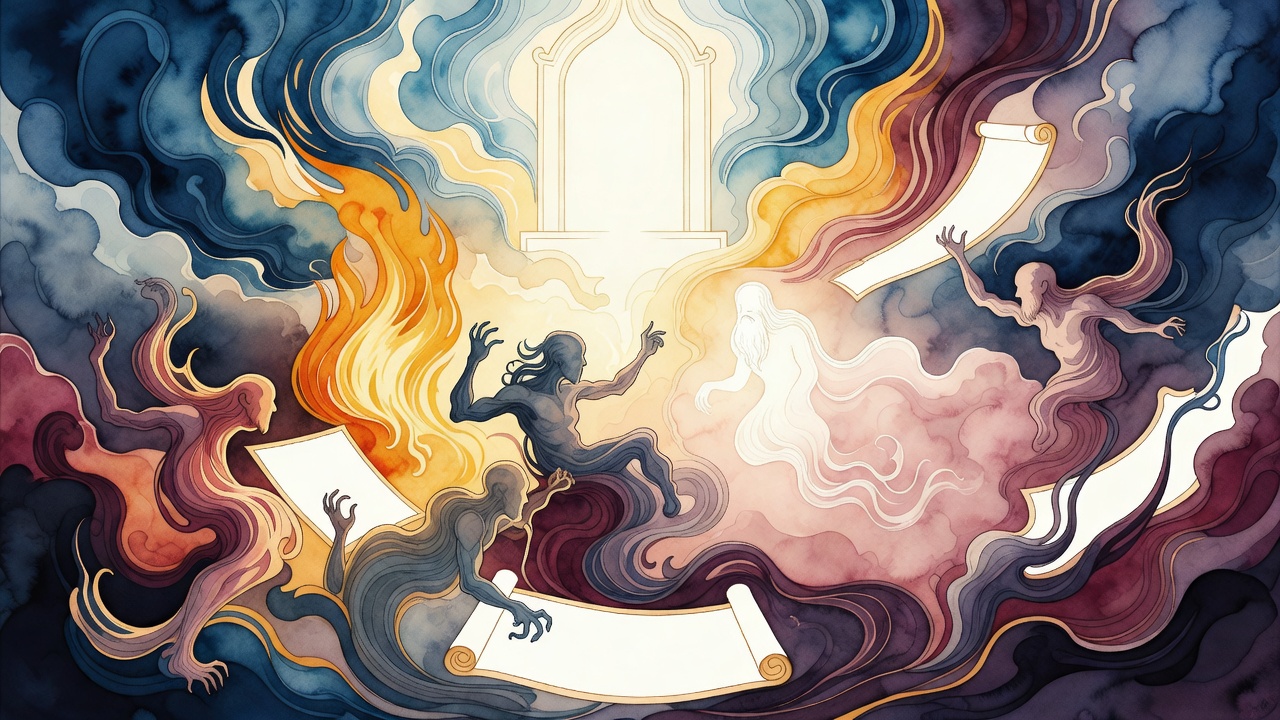
On the sixth day the earth was ordered to bring forth living spirits by their kinds, and four categories of life stood in the command. When the making was counted afterward, only three kinds of body appeared. The fourth spirit had nowhere to sit. Rabbi Hama bar Hoshaya named the missing ones: shedim, demons. The Holy One created their souls, but when the hour came to clothe them in flesh, Shabbat arrived and was sanctified. There was no more time. They remained voices and hungers without hands. Twilight of that first Friday felt to them like a door closing on skin they never received.
When Shabbat Stopped the Bodies of the Shedim Click for full size

Adam's Spirit Before Adam's Dust

Rabbi Elazar heard "the spirit of living beings" in that same creation speech as the life-spirit of Adam himself, spoken before clay was shaped. The soul waited while the body was still a plan. Priority ran soul-first, body-second, and the shedim learned the cost of a second that never came.

So the world began with a pure soul prepared for a human and with unfinished spirits who would never get skin. Both facts sit in one midrashic room. One is dignity. One is a warning about the clock. Adam would stand upright. The shedim would press against the windows of reality without knuckles to knock with.

Later storytellers who felt a cold presence in an empty house were, in this frame, brushing against a creation deadline, not inventing a rival god.

Souls Made Pure, Not Already Guilty

Later teachers refused the idea that a soul sins before it enters a body. Morning prayer still says, "My God, the soul which You placed in me is pure." Ruah, nefesh, and neshamah (the higher soul) name layers of breath and self, but the rabbis will not load a newborn with a pre-world crime. The body is a vessel; the soul arrives clean.

Apocryphal lines speak of souls prepared before the foundation of the world. Talmudic voice answers: formed in the six days, present at Sinai, assigned to embryos under angel watch. Preexistence, yes. Premade guilt, no. A child opens eyes already argued for by that prayer.

The shedim complicate the picture without canceling it. Their souls exist. Their incompleteness was forced by holiness of time, not a stain carried from before birth into a human cradle.

When Sleep Kills the Senses

Philo of Alexandria watched a sleeper and said the senses die each night while the soul wakes into its own work. The body lies like a dropped tool. Dream and intellect keep moving. That nightly unclothing is a soft echo of the shedim's harder fate: spirit active, body absent or quiet.

A parent standing over a child's bed feels the riddle without naming Philo. Breath continues. Eyes do not answer. Something travels that the hand cannot hold. Creation week left a sharper version of that riddle walking the edges of the world without feet.

Philo's sleeper will wake to bread and argument. The shedim do not get that morning. Their waking has no eyelids.

Throw Down the Object Before the Sun Sets

Bereshit Rabbah turns the unfinished demons into law of conduct. If you hold a precious object as Shabbat arrives, cast it away rather than desecrate the day by carrying. Even the Creator, who spoke worlds into being, stopped for Shabbat rather than finish the shedim's bodies. The midrash does not pity the demons into a loophole. It uses their lack as a fence for human hands.

At the edge of a Friday, a merchant feels the weight of a last coin-pouch and the weight of the sky changing color. He sets the pouch down. Somewhere the shedim remain unbodied. Somewhere Adam's first spirit still teaches that the person is more than dust. The day takes precedence over completion.

Candles are lit. The world that could have been finished is left unfinished on purpose. Completeness is not the highest good. Sanctified time is. The missing bodies of the shedim are the price tag still hanging on that choice, rattling whenever the wind hits an empty corner.

On the eve of that first Shabbat the unfinished spirits pressed against the boundary of time like moths against glass. They had names for hunger and none for fingers.

A later father teaching his son the laws of carrying points to the sky turning colors and says, "Even unfinished work is put down." The boy looks for demons and sees only twilight. Sanctity interrupts completion. Completion is not king.

Adam rose from dust with a soul that had been waiting in speech. The shedim circled a world that had chosen rest over their skin. Both movements belong to one Creator who can pause a project mid-stroke because the day itself has become holy.


← All myths
From the tradition

Sources

3 sources

The texts behind this telling. Some cards carry a translation of the source; others are our own retelling of it, and each card says which. Every card links out to the original.

Bereshit Rabbah 7:5Bereshit Rabbah

Retold in our words. Read the original at the link below.The Sefaria Midrash Rabbah, 2022 · CC-BY

Creation is often remembered as a grand, sweeping act, but Jewish tradition also explores the nitty-gritty details, the almost-missed deadlines, and the "oops, we'll get to that later" moments. to Bereshit Rabbah, a classic Midrashic (rabbinic interpretive commentary) text, specifically section 7, which wrestles with the verse in (Genesis 1:24): "God said: Let the earth produce the spirit of living beings by their species, animals, and crawling creatures, and beasts of the earth by their species, and it was so."

Rabbi Elazar offers a fascinating interpretation. He suggests that "the spirit of living beings" mentioned here actually refers to the very life spirit of Adam, the first human! So, according to this view, Adam's soul was created before his physical body even existed. What does it say about the primacy of the soul, the essence of being, over the physical form?

The next verse (Genesis 1:25) then tells us, "God made the beasts of the earth by their species, and the animals by their species, and every creature that crawls upon the ground by its species, and God saw that it was good."

Here’s where things get interesting. Rabbi Hoshaya Rabba points out a discrepancy. In the initial command ("Let the earth produce…"), we have four categories of spirits mentioned. But in the actual creation ("God made…"), only three are listed. Where did that fourth spirit go?

Rabbi Ḥama bar Hoshaya really digs into this. He notes the four spirits in the verse: "(1) living beings by their species, (2) animals, and (3) crawling creatures, and (4) beasts of the earth by their species." But then only three are actually created. What’s up with that?

Rabbi offers a startling explanation: that missing spirit refers to shedim (demons), demons! The Holy One, blessed be He, created their souls, but when it came time to create their bodies, Shabbat – the Sabbath – arrived and became sanctified. There simply wasn't time. So, they remained disembodied spirits.

Think about the implications! The Zohar, that foundational text of Kabbalah, also touches upon the creation of spirits and their relationship to the divine. This idea of incomplete creation, of beings existing in a liminal space between spirit and form, is a powerful one.

And here’s the kicker: This story, according to Bereshit Rabbah, is a lesson in proper conduct. Imagine, says the text, you have a precious object on the eve of Shabbat, right before dusk. What do you do? The answer is, you cast it away rather than desecrate Shabbat by carrying it. Because even God, who spoke and brought the world into being, paused creation for Shabbat.

The text emphasizes that if even the Creator of the Universe prioritized Shabbat over completing the creation of the demons' bodies, how much more so should we prioritize the sanctity of Shabbat in our own lives! We learn something profound about priorities.

This little Midrash offers a glimpse into the rabbinic mind, their meticulous reading of scripture, their willingness to confront inconsistencies, and their ability to find profound meaning in seemingly minor details. As we find in Midrash Rabbah, the Sages were not afraid to ask difficult questions of the text. It reminds us that even in the act of creation, there's room for imperfection, for things left undone, and for the ever-present call of Shabbat. And that maybe, just maybe, those unfinished things hold a unique kind of wisdom.

Full source
Jewish Encyclopedia, "Soul" (1906)Jewish Encyclopedia (1901-1906)

Retold in our words. Read the original at the link below.The Jewish Encyclopedia, 1901-1906 · Public Domain

The concept of soul in Jewish tradition derives from Genesis, where God endows humans with "spirit or breath" (ruah). Initially, this spirit was "inseparably connected, if not wholly identified, with the life-blood." Contact with Persian and Greek philosophy introduced the idea of a disembodied soul with individual identity, appearing in later biblical texts like Proverbs and Ecclesiastes.

Three Hebrew terms describe the soul: "ruah" (spirit in primitive state), "nefesh (the vital soul)" (spirit associated with body), and "neshamah (the higher soul)" (spirit active in the body). The Apocrypha explicitly states that "All souls are prepared before the foundation of the world," establishing the doctrine of preexistence. Different souls possess varying qualities, and the body serves as a temporary vessel for the soul during earthly life.

Philo Judaeus, the Alexandrian Jewish philosopher, synthesized Biblical interpretation with Platonic psychology. He identified the three Hebrew soul-terms with Plato's tripartite soul: rational (seated in the head), spiritual (in the chest), and desiring (in the abdomen).

The rational mind (nous) represents divine essence, "a fragment of the Divinity" that is preexistent and immortal. This mind transcends bodily limitations, operating through independent spiritual powers rather than directly. Sensory perception requires mediation between mind and senses through pleasure (symbolized biblically by the serpent).

Talmudic scholars rejected the notion that souls sin before incarnation, instead teaching perfect bodily purity. The daily morning prayer affirms: "My God, the soul which Thou didst place in me is pure." This represented protest against Platonic doctrines of preincarnate transgression.

The Rabbis maintained consistent body-soul dualism while rejecting Platonic preexistence. According to Talmudic teaching, all souls were "formed during the six days of Creation," existing in paradise and present at Sinai. Souls enter embryos through divine appointment, supervised by angels. The soul's entry occurs either at conception or after embryonic formation, a point of rabbinic debate.

The Talmud compares body and soul to a city and its inhabitants. Souls ascend during sleep, receiving dream communications. Some advanced rabbis explained dreams psychologically rather than supernaturally.

The distinction between "spirit" (ruah) and "soul" (nefesh) appears consistently in rabbinical literature. Friday Sabbath observance involved receiving an additional individual soul, which returned at the Sabbath's conclusion.

The Rabbis established parallels between soul and God: as the world fills with divine presence, the body fills with soul; as God sees without being seen, so the soul perceives invisibly. The "yezer Tob" (good inclination) and "yezer ha-ra'" (evil propensity) represent moral forces, with the soul bearing responsibility for ethical conduct.

Saadia Gaon systematically addressed soul philosophy in his "Emunot we-De'ot." He argued the soul was "created by God at the same time as the body," with substance resembling celestial spheres but finer in quality. Three latent powers activate through bodily union: intelligence, passion, and appetite, belonging to one indivisible soul seated in the heart.

Saadia opposed Plato's preexistence doctrine, arguing that bodily union advantaged the soul, enabling paradise access through obedience. Fire requires fuel; similarly, the soul needs the body's instrumentality for spiritual achievement.

Neoplatonic influence pervaded tenth and eleventh-century Jewish thought. Bahya ibn Pakuda proposed three distinct souls: vegetative (matter-derived), animal (matter-derived), and rational (emanating from active intellect). The rational soul's ray penetrates the embryo, supervising vegetative and animal development.

Ibn Gabirol and Joseph ibn Zaddik similarly asserted three distinct souls. Their respective attributes were: vegetative (chastity), animal (energy), and rational (wisdom), collectively producing justice.

Jewish Peripatetics, particularly Maimonides, adopted Aristotelian psychology: the soul as unified entity with five faculties, nutritive, sensitive, imaginative, appetitive, and rational. Each faculty comprehends inferior ones potentially. The intellect operates theoretically (discerning truth/falsehood) or practically (judging good/evil, exciting will).

Maimonides held that the soul, constituting bodily form, remains indissolubly united with it. Upon death, all faculties cease, except the "acquired intellect" (knowledge obtained through study), which constitutes real substance and survives independently.

Levi ben Gershon followed Maimonidean psychology but differentiated human knowledge into three classes: sensory perception of individuals, abstraction producing generalities, and reflection concerning God and angels. He contended that generic forms exist independently "ante rem" in the universal intellect, and mathematical theories constitute real substances contributing to acquired intellect.

Crescas attacked the acquired intellect principle philosophically and theologically. He questioned how something created during lifetime achieves immortality, and if only acquired intellect survives bodily death, what entity experiences reward or punishment? If the soul ceases existing, what enjoys paradise? Crescas proposed that the soul, though constituting bodily form, represents spiritual substance wherein thinking exists potentially, preserving soul continuity through death.

Zoharic psychology demonstrates Neoplatonic influence within mystical frameworks. The soul originates in Supreme Intelligence, the "universal soul" containing forms distinguishing all living existences. All souls were "formed" and "prepared to be given" to future humans, observed by God in their destined forms.

The soul comprises three elements: rational (neshamah), moral (ruah), and vital (nefesh), emanations from Sefirot (the divine emanations), each possessing ten potencies subdivided into trinities. The rational element connects humans to the intellectual world through the Crown Sefirah (a divine emanation); the moral element connects to the moral world through Beauty; the vital element connects to the material world through Foundation.

Two additional soul-elements exist: one inherent in the body without mingling, serving as intermediary; another uniting body and soul. At conception, the Zohar teaches, "the Holy One sends on earth an image engraved with the Divine Seal," presiding over human formation, growing with the person, and departing at death.

Male and female souls emanate from masculine and feminine Sefirot respectively, paired before earthly descent but separated upon incarnation. The Zohar compares soul elements to a burning lamp's flame: the dim light (vital element) springs from burning material below; the white light (moral element) struggles upward while remaining connected; the invisible flame-top (rational element) actually disengages and rises independently.

Human souls descend into bodies because of their finite nature, uniting with flesh to contemplate creation, achieve self-consciousness, and eventually return to God, the "inexhaustible fountain of light and life."

Full source
The Midrash of Philo 21:2The Midrash of Philo

Retold in our words. Read the original at the link below.The Works of Philo Judaeus, trans. C. D. Yonge, London, H. G. Bohn, 1854-1890 · Public Domain

Philosophers have scratched their heads, trying to undo the mystery of slumber. But you know, sometimes the answers are closer than we think.

Our own tradition, through the wisdom of figures like Philo of Alexandria, offers a fascinating perspective. Philo, a Jewish philosopher living in Roman Egypt, delved deep into the intersection of Greek thought and Jewish scripture. And he had something to say about sleep.

In Midrash of Philo, sleep isn't just about being tired. It's a kind of trance. But not the wild, unpredictable kind that borders on madness. No, this is a much more orderly retreat. It's a dissolution, a gentle fading of our senses and our conscious thought. When we drift off, our senses – sight, sound, touch – they all start to quiet down. They withdraw from the world around us. And then, our intellect, the part of us that processes information and makes decisions, it withdraws too. It stops actively engaging with the senses.

Philo explains that during sleep, the intellect isn't strengthening the nerves or directing movement. It's not sending signals to our muscles. It's as if the connection to the outside world is temporarily severed. We become less aware of external stimuli, less responsive to the things we can normally see, hear, and feel.

So, what does this all mean? Is sleep just a biological necessity? Perhaps. But through Philo's lens, it’s also a moment of profound detachment, a temporary separation from the sensory world that usually dominates our waking lives. We possess a deeper, quieter self that can exist, even thrive, in the absence of external stimulation.

Maybe, just maybe, that's why sleep feels so restorative. It's not just about physical rest; it's about giving our minds and souls a chance to breathe, to disconnect, and to reconnect with something deeper within ourselves.

Full source