Parshat Bo6 min read

Shishak Came for a Widow's Settlement and Took the Throne

Shishak never broke the walls. He came to Jerusalem with scribes and a claim on paper. His widowed daughter was owed her marriage money from Solomon.

Curated by Arthur · Told by Maggid ·
Table of Contents
  1. The Father-in-Law at the Gate
  2. Egyptian Gold Goes Home
  3. The Seat Sennacherib Could Not Carry Home
  4. The Lion That Made Necho Limp
  5. Nebuchadnezzar Stands Beside What He Owns
  6. The Copy That Would Not Come Right
Shishak Came for a Widow's Settlement and Took the Throne Click for full size

The Father-in-Law at the Gate

The Egyptian came to Jerusalem to collect a debt from a dead man.

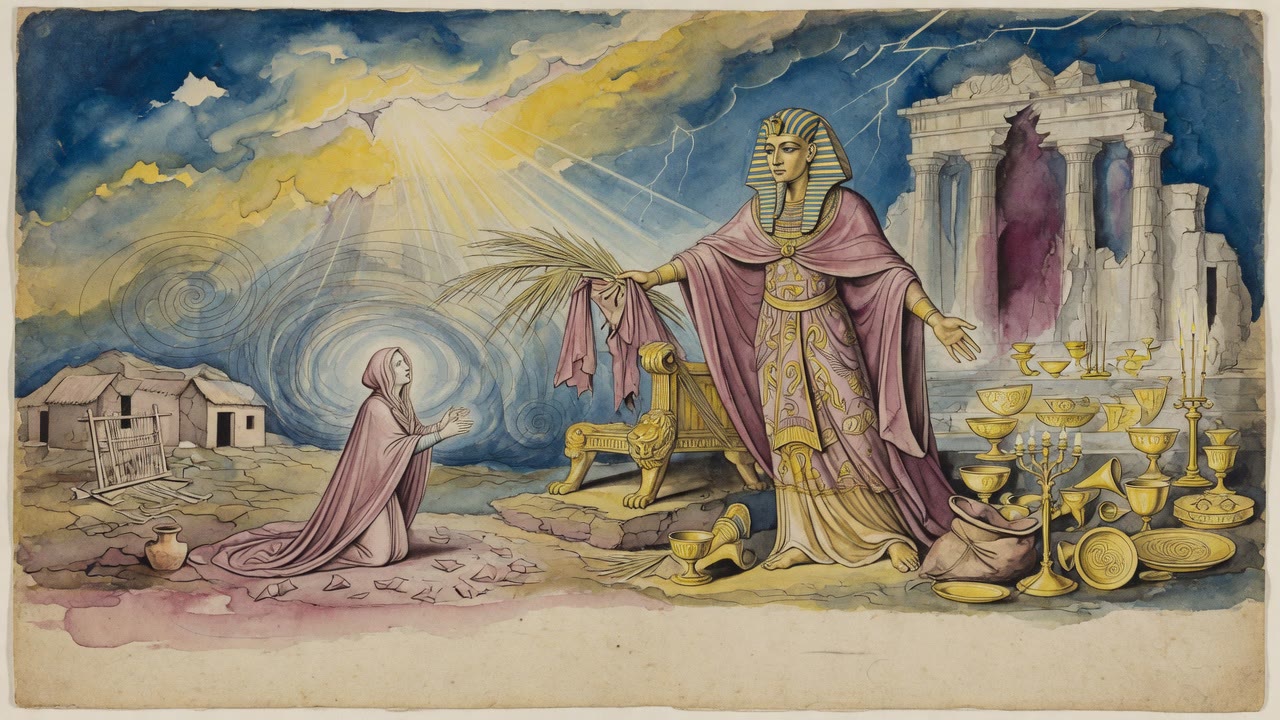
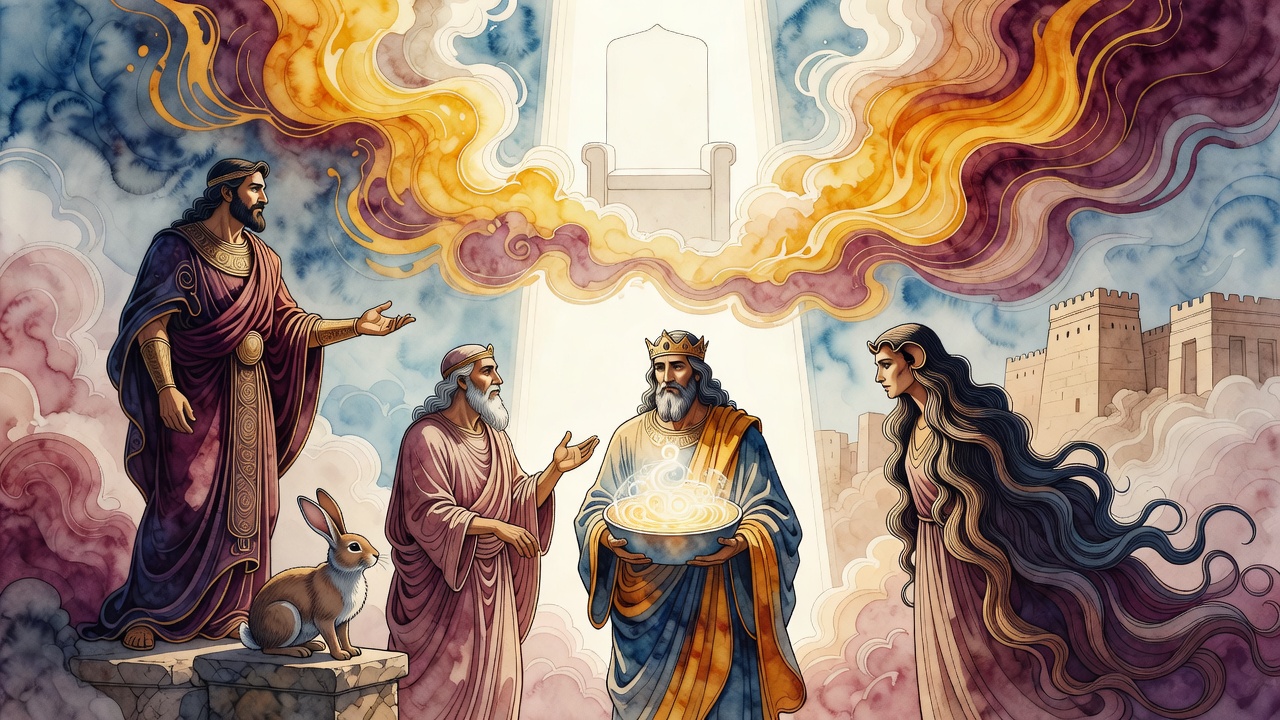
Shishak did not need to break the walls. He arrived in the fifth year of Rehoboam with scribes, pack animals, and a claim written out in advance, and the claim was a family matter. His daughter had been given in marriage to Solomon. Solomon was in the ground now, and a widow is owed her ketubah (כתובה), the settlement written into the contract on the day of the wedding and payable out of her husband's estate.

Rehoboam held the estate. He also held a kingdom that had cracked down the middle when ten tribes walked away from him, and he had no army worth marching out of the gate.

"My daughter is owed what her husband promised her," Shishak said. "Open the storehouses."

They opened them. Out came the gold shields Solomon had hammered for his guard, and the vessels of the house of God, and the plate of the king's own table. The men of Egypt walked past all of it and went on into the judgment hall, because Shishak had come for one particular piece of furniture.

Egyptian Gold Goes Home

The throne stood at the top of its steps with the golden lions ranked along them, the machine Solomon had built to make a foreign king feel small while he climbed toward the man he had come to petition. Getting it down took a crew, rollers, and most of a day. Shishak stood in the hall while the lions came off the steps one at a time and went into the straw.

Then the rest was loaded. Among the treasure rolling out of the storehouses that afternoon was silver and gold that had crossed the border once before, going the other way, carried in the arms of slaves on the night Israel walked out of Egypt. It had sat in Jerusalem through the wilderness, the judges, the wars of David, and the building of the Temple. Now it went back down the same road under Egyptian guard.

The money of Egypt returned to Egypt. Shishak had come for a widow's settlement and left with everything Israel had ever taken out of his country.

The Seat Sennacherib Could Not Carry Home

Egypt kept it a long time and then lost it the way Jerusalem had lost it. Sennacherib of Assyria came down on the Nile, broke what he found there, and had the throne loaded among his spoil to bring home to Nineveh.

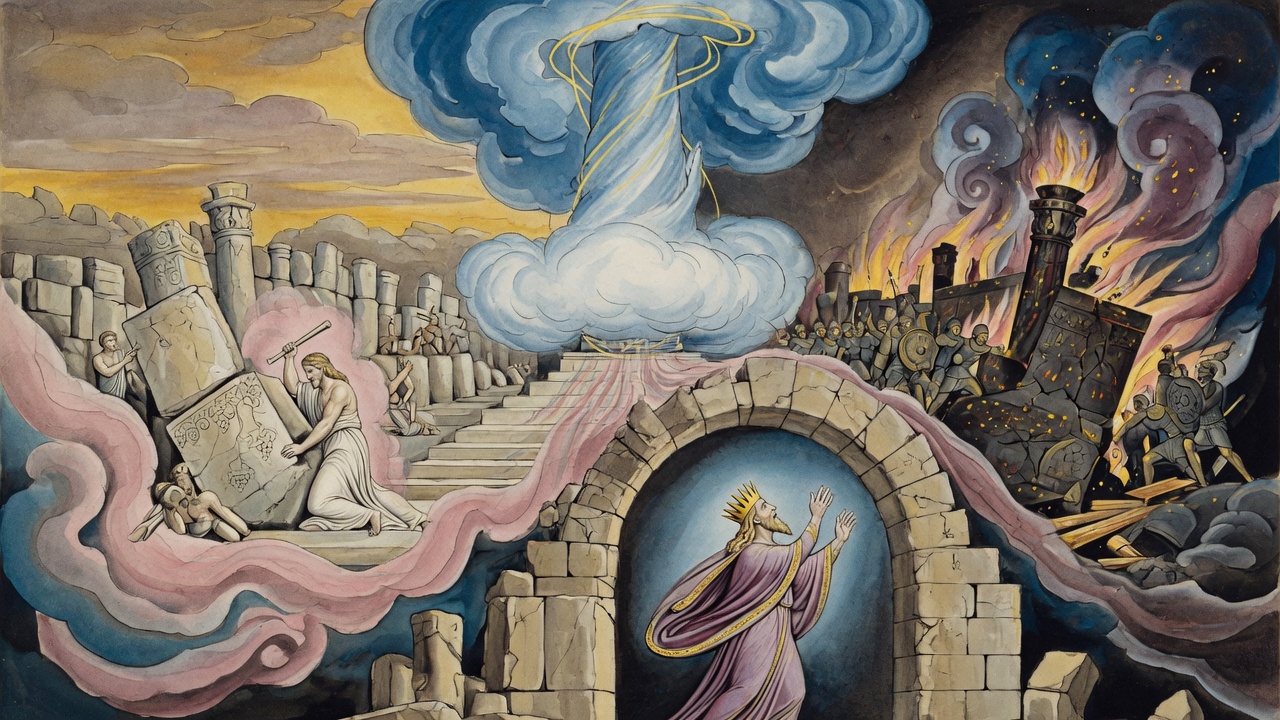
He never brought it home. He turned aside to Jerusalem first and camped, and his messengers stood under the wall making speeches about which gods had saved which cities and which had not. Inside, Hezekiah spread the Assyrian letter open in the Temple and prayed over the parchment. In the morning the camp outside was full of dead men. What was left of the army went back the way it had come, and the throne did not go with it. Sennacherib handed it over and rode north without it.

So the chair came back into Jerusalem, and for a while it stood again in the city that had built it.

The Lion That Made Necho Limp

It did not stay. In the days of Jehoash, Necho of Egypt hauled it back to the Nile, and there Necho made the mistake Shishak had been careful enough, or lucky enough, to avoid. He decided to sit on it.

The court assembled to watch. Necho set his foot on the first step, then the second, and whatever was under the gold woke up. One of the lions swung around and took him in the side. The sound in that hall was a Pharaoh going down on the stairs of a chair.

He lived. He never walked straight again. Egypt called him Necho the hobbler, behind his back at first and then to his face, and the name outlasted whatever he had wanted the throne to say about him.

Nebuchadnezzar Stands Beside What He Owns

Nebuchadnezzar took Egypt, and the throne came to Babylon with the rest of the plunder. He had heard about Necho. He climbed anyway.

The lion caught him with the same blow in the same place. He got himself up off the steps of the throne of Solomon and he did not go up them again, not that season, not ever. For the rest of his reign the most famous seat in the world stood in his hall with nobody in it, and the king of Babylon gave his judgments standing beside a chair he owned and could not use.

The Copy That Would Not Come Right

After Babylon fell, Darius had it carried to Elam. He had heard the stories too, and he left it alone. Ahasuerus inherited it and left it alone as well, and then, being the kind of king who liked a thing to be his, he sent for craftsmen and ordered a second one built. Same steps. Same lions. Same gold, and as much of it as they wanted.

They worked a long time. What they produced was a chair with animals on it. The weight was wrong somewhere, or the hinges, or whatever Solomon's builders had known had gone into the ground with them. Nothing on the copy moved.

From Elam the throne passed to the kings of Media, and from the Medes to the Greeks, and from the Greeks to Rome. There the record of it stops. Nobody wrote down what became of a golden chair with a lion in it that had broken two kings on its steps and refused every man alive who was not Solomon.


← All myths
From the tradition

Sources

2 sources

The texts behind this telling. Some cards carry a translation of the source; others are our own retelling of it, and each card says which. Every card links out to the original.

Legends of the Jews 6:14Legends of the Jews

Retold in our words. Read the original at the link below.The Legends of the Jews by Louis Ginzberg (1909) · Public Domain

We left off with the tribe of Dan backing down from their planned invasion of Judah. Good news for Judah. But, as often happens, one problem solved just paves the way for another. This time, it came in the form of Shishak, the ruler of Egypt.

Shishak had a connection to the Israelite monarchy: he was actually Solomon's father-in-law. And he arrived in Jerusalem with a demand: his daughter's jointure, her marriage settlement. Apparently, he felt it was time to collect. But what he took was far more than just a simple settlement. According to Legends of the Jews, Shishak made off with Solomon's throne itself, and something even more significant: the treasure the Israelites had taken from the Egyptians during the Exodus!

For a second. All that wealth, acquired after generations of slavery, now flowing right back to where it came from. As Ginzberg puts it in Legends of the Jews, "So the Egyptian money returned to its source." You can almost hear the echoes of history, can't you? A cosmic balancing act, perhaps?

The drama doesn't end there. Remember Jeroboam, the king of the breakaway northern kingdom of Israel? He hadn't entirely given up on his plans to invade Judah. Though he didn't act while Rehoboam (Solomon's son) was king, he eventually launched his campaign after Abijah took the throne in Jerusalem.

And Abijah was victorious! A great victory, but a short-lived one. Because soon after, Abijah died, and his death, the Legends suggest, was brought on by his own wickedness. in his war against Jeroboam, Abijah acted with extreme cruelty. He ordered the mutilation of enemy corpses, preventing proper identification and burial.

Think about the implications of that. According to Legends of the Jews, this savagery was "all the more execrable as it prevented many widows from entering into a second marriage." Mutilated bodies meant uncertainty. Were their husbands dead? Were they alive? These women were left in a terrifying limbo, unable to move on with their lives.

The consequences of Abijah’s actions, it seems, caught up with him. And it leaves us with a question: Do our deeds, especially those driven by cruelty and disregard for human dignity, ultimately determine our fate? This story, woven from ancient texts and retold through generations, certainly suggests that they do.

Full source
Legends of the Jews 5:110Legends of the Jews

Retold in our words. Read the original at the link below.The Legends of the Jews by Louis Ginzberg (1909) · Public Domain

The stories we find in Legends of the Jews, that incredible compilation by Rabbi Louis Ginzberg, paint a wild picture of this throne's journey. It wasn't exactly smooth sailing for anyone who dared to sit upon it.

In tales, the throne didn't stay in Israel for very long after Solomon's reign. During the time of Rehoboam, Solomon's son, it was carted off to Egypt by Shishak, Solomon's father-in-law. Shishak claimed the throne as payment for debts he felt the Jewish kingdom owed his widowed daughter. (Ginzberg based this on (1 (Kings 14:25-2)6) and (2 (Chronicles 12:2)-9).)

Egypt wasn't the throne's final destination. Sennacherib, the Assyrian king, conquered Egypt and snatched the throne for himself. However, his victory was short-lived. As the story goes, on his way back home, his army was famously defeated before the gates of Jerusalem (as described in Isaiah 37), and he had to hand the throne over to Hezekiah, the righteous king of Judah.

So, the throne returned to Palestine, but only for a while. The narrative continues: in the days of Jehoash, Pharaoh Necho of Egypt hauled it back to the land of the Nile.

Here's where the story gets really interesting.

Pharaoh Necho, it seems, wasn't familiar with the throne's...quirks. According to the legends, it wasn't just a pretty chair. It had mechanisms, perhaps even magical defenses. The first time Necho tried to sit on it, one of the lion figures that adorned the throne injured him in the side. Ouch! He was left with a permanent limp, earning him the nickname "Necho the hobbler."

Next up: Nebuchadnezzar of Babylonia. He seized the throne during his conquest of Egypt. But his experience mirrored Necho's. The lion near the throne gave him such a wallop that he never dared to sit on it again!

From Nebuchadnezzar, the throne passed to Darius, who brought it to Elam. But knowing the history of injury and woe, Darius wisely decided to keep his posterior far away from it. Ahasuerus (the king of the Purim story, also known as Xerxes I) followed suit. He even tried to have his own artisans create a replica, but they couldn't match the original's craftsmanship – or, perhaps, its inherent dangers.

The legends don't stop there. According to Ginzberg, the throne then journeyed from the Median rulers to the Greek monarchs, and finally, all the way to Rome! What became of it then? The texts are silent.

What are we to make of this whirlwind tour of a legendary artifact? Is it just a fanciful tale? Perhaps. But it speaks to something deeper: the allure and the peril of power. Each ruler who sought to possess Solomon's Throne faced a test, a challenge to their own authority and wisdom. The throne, in a way, judged them as much as they sought to control it. And the story reminds us that true power isn't about possessing symbols, but about the wisdom and character to wield influence justly.

Full source