Solomon Rode to His Coronation on a Borrowed Ass
The stables held nothing on the day they poured the oil. Years later a woman stood in his court and wept as if the tears were proof.
Table of Contents
 Click for full size
The Oil and the Empty Stall
Solomon stood in the yard with oil still wet in his hair, and the stable boy had nothing to bring him.
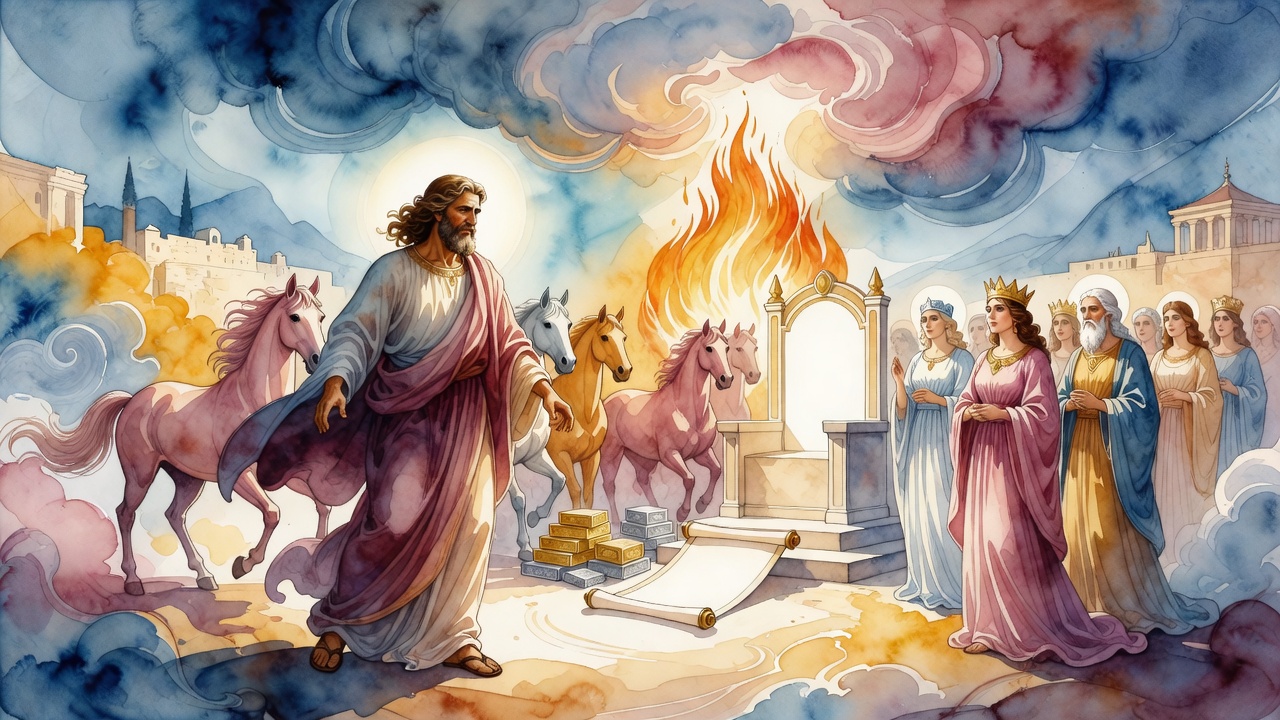
Not one horse. The stall smelled of old straw and no animal. A king who could not ride could not be seen, and a king who could not be seen was only a rumor in a room. They went next door and borrowed an ass. Solomon put his palm on the coarse neck, swung a leg over, and rode. The hooves clicked on the stone of Jerusalem. People lined the way and shouted for him. His feet hung low. The animal's backbone rose into him with every step. He kept his face still.
The Torah had already named the limit: a king shall not multiply horses to himself (Deuteronomy 17:16). On the morning of his coronation Solomon began inside that limit without trying. He had zero horses. The law had not yet been tested. The borrowed ass had.
Horses by the Score
Years turned. Traders learned the road to his house. Teams arrived, then drivers, then chariots with iron bits that caught the sun. The man who had borrowed a mount now counted power in stalls. Bills of sale stacked in the same rooms that held the scroll of Deuteronomy.
God had already given him a hearing heart (1 Kings 3:12). The stables could not hold that gift and could not replace it. Between the first ride and the full courtyards, another kind of inventory grew faster than the horses: the reputation that he could see through a face.
The Woman Who Wept on Cue
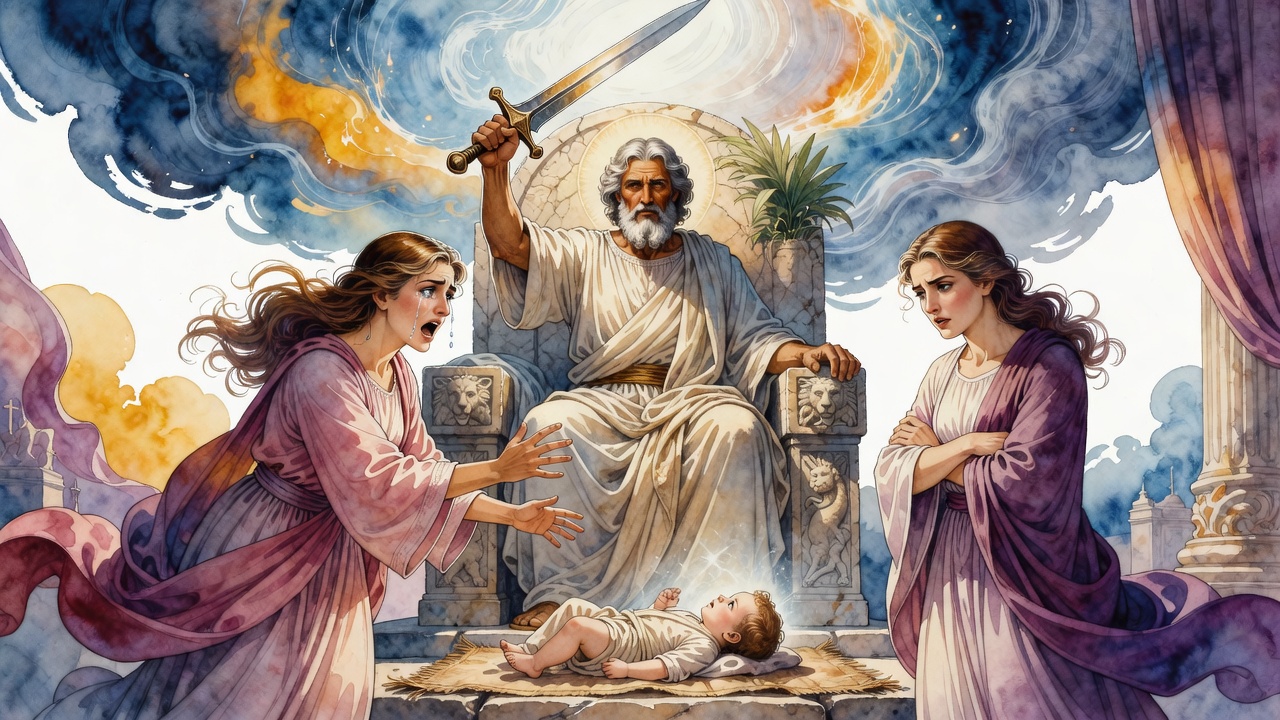
A woman came into court dressed as injury itself. Modest voice. Careful tears. A story cut to fit a judge's pity and aimed at someone who was not there to speak. She wanted the court to punish an innocent on her behalf.
Solomon listened. He did not lean forward. He asked questions that sounded almost idle. What time. What door. What word she claimed to have heard. She answered each one as if the tears were still doing the work. The answers did not agree with each other. Each reply tightened the net she had woven for another person until it closed on her own wrist.
The performance fell in open court. She was not the wronged party. She was the engineer of the wrong. He named what she had done so the intended victim could step out of the path of her tears.
"Do not judge by appearance," he said. The most dangerous people are not those who look dangerous. They are those who look harmless while they aim.
Three Gifts in One Court
When God named Bezalel, He filled him with wisdom, understanding, and knowledge. Proverbs assigns that same trio to the founding of earth and heaven and the splitting of the deep. Hiram, artisan of Solomon's house, carried the three as well. The prophets said the future Temple would rise when that spirit rested again on the redeemer.
Solomon's questions belonged to that line. Not carpentry. Still building: a court where truth could stand without costume. The woman had brought a finished face. He took it apart with the same tools Bezalel used on gold and acacia. Skill was never only technique. It was a share of the tools by which reality itself was framed, and a hearing heart was one of them.
He Could Not Buy the Next Question
Foreign queens came. Foreign altars. The palace grew crowded with people who thought gold was the proof of a king. The first ride still cut clean. A king can forget the animal that carried him to the oil. The borrowed ass does not forget the weight.
On the day he had no mount of his own, he already had the beginning of the hearing that would unmask a performance. Courtiers later measured him by horses. They missed the continuity. The woman who wept on cue learned it for free. A king can multiply horses until the law frets. He cannot buy the next question.
← All myths