5 min read

Solomon Raised the Sword Over a Living Child

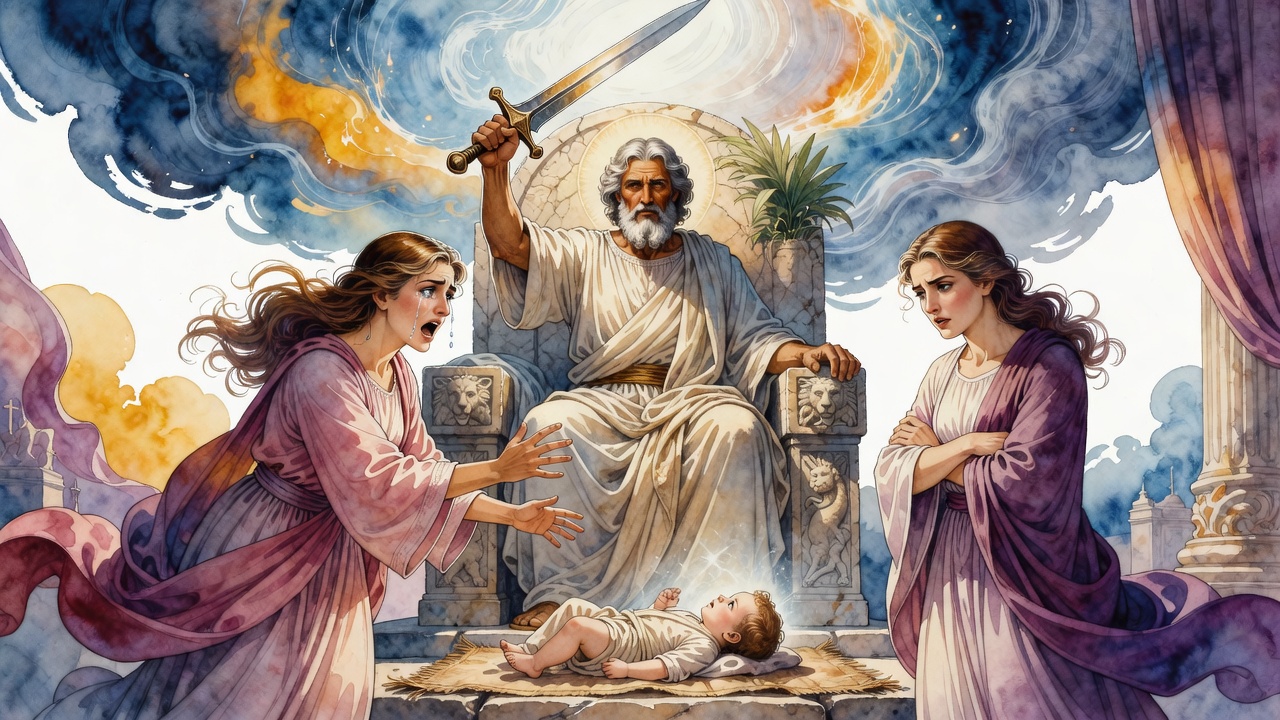
Two women claim one living infant before Solomon's throne. He calls for a sword to split the child, and the true mothers cry stops the blade.

Curated by Arthur · Told by Maggid ·
Table of Contents
  1. Two Mouths, One Breath
  2. Who Stood at the Bar
  3. Wine of Torah, Folly of Thrones
  4. After the Blade Comes Down Empty
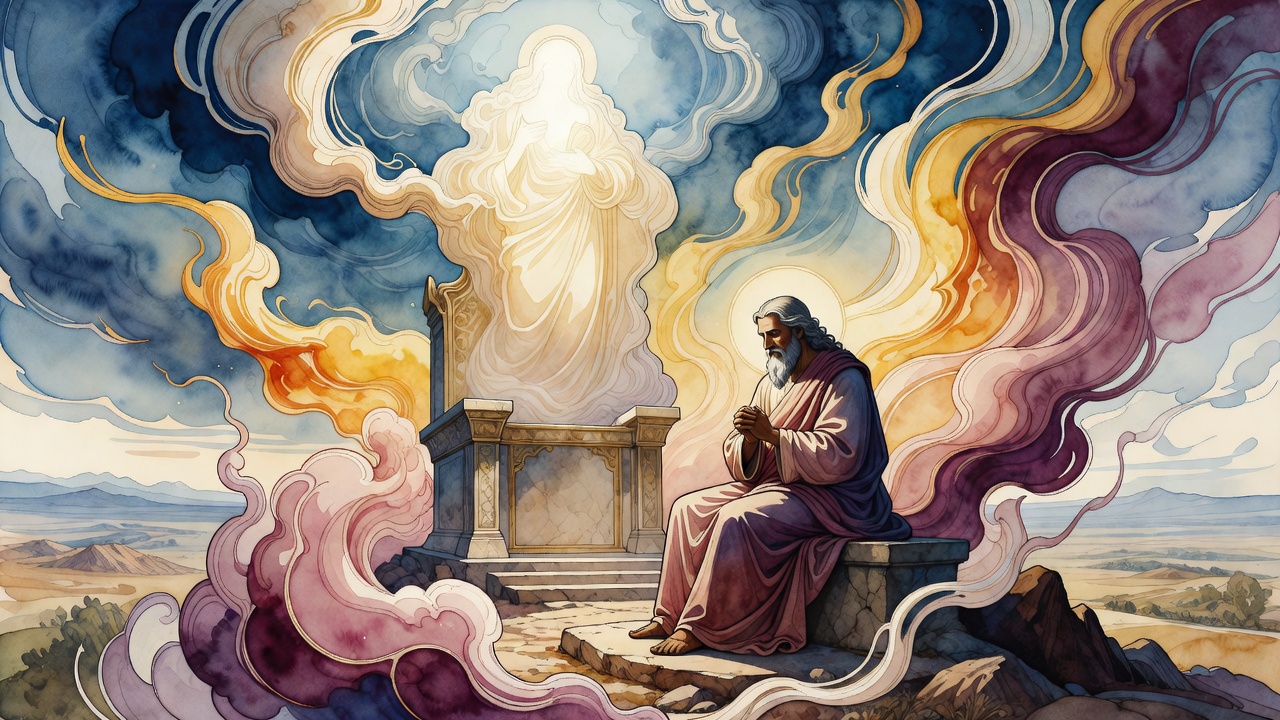
Solomon Raised the Sword Over a Living Child Click for full size

Two Mouths, One Breath

Two women stood before Solomon with one living child between them and one dead child already cold under a cloth. Each said, "The living is mine." The throne room narrowed to their voices. Guards shifted. Courtiers leaned in. Solomon repeated both claims aloud so the court would hear the symmetry of the lie and the truth braided together, then called for a sword.

Divide the boy. Give half to each.

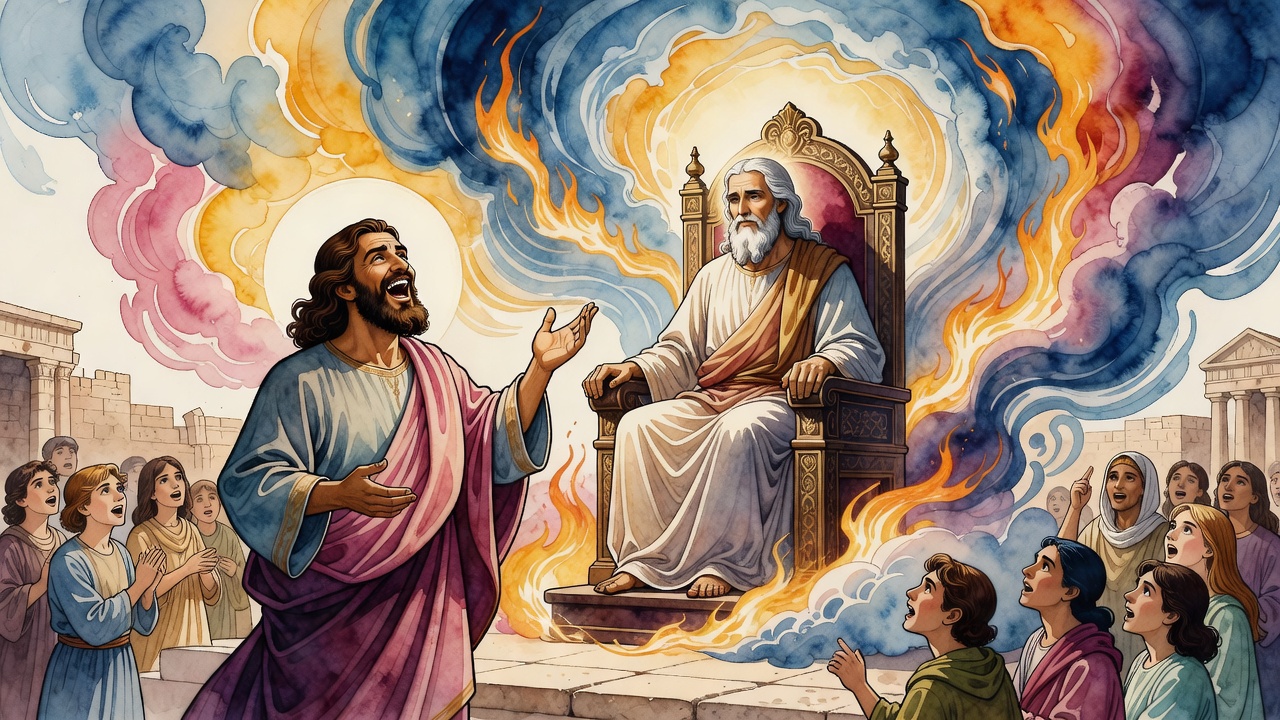
One woman agreed, voice flat as a market price. The other broke as if the blade had already entered her. "Give her the living child and do not kill him." Mercy named the mother faster than any witness list. The sword stayed high a heartbeat longer, light on the edge, then lowered into law. The living child went to the woman who could not bear the split.

Who Stood at the Bar

The midrash will not let the women stay simple. Some say spirits testing the king. Some say widows waiting on levirate marriage, so the case decided more than a cradle and reached into property, name, and the dead husband's house. Rabbi Simon calls them prostitutes and notes Solomon judged without every formal step. Procedure still ghosts the scene: judge seated, parties standing, claims restated so neither side can say it was misheard.

Rabbi Yehuda later said that if he had been there he would have wrapped soft wool around Solomon's neck. A false judgment earns strangulation. The sword was a gamble with a living stake. If the real mother had hardened, the king would have stood inside a catastrophe of his own making, a dead child and a ruined name. Wisdom here is not calm. It is risk under a crown, breath held until a heart speaks louder than a claim.

Solomon watched faces, not ledgers. The court learned that a king can look cruel for one measured moment and still be hunting life.

Wine of Torah, Folly of Thrones

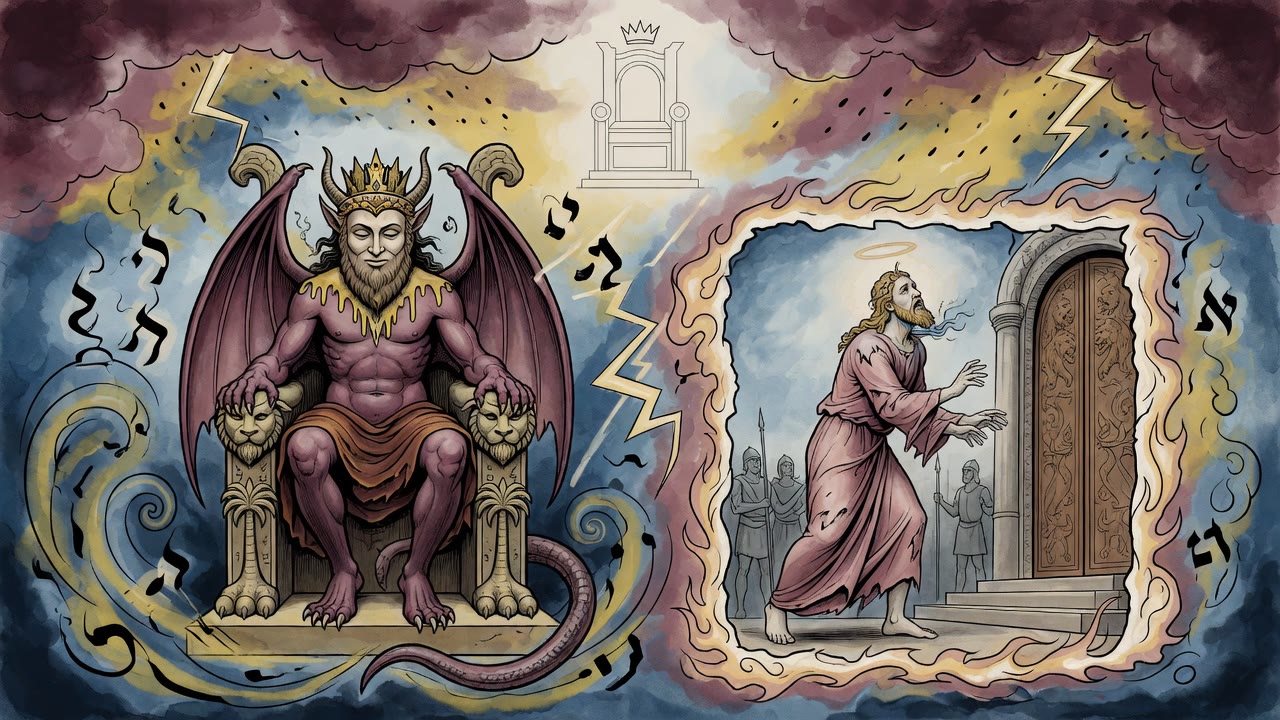
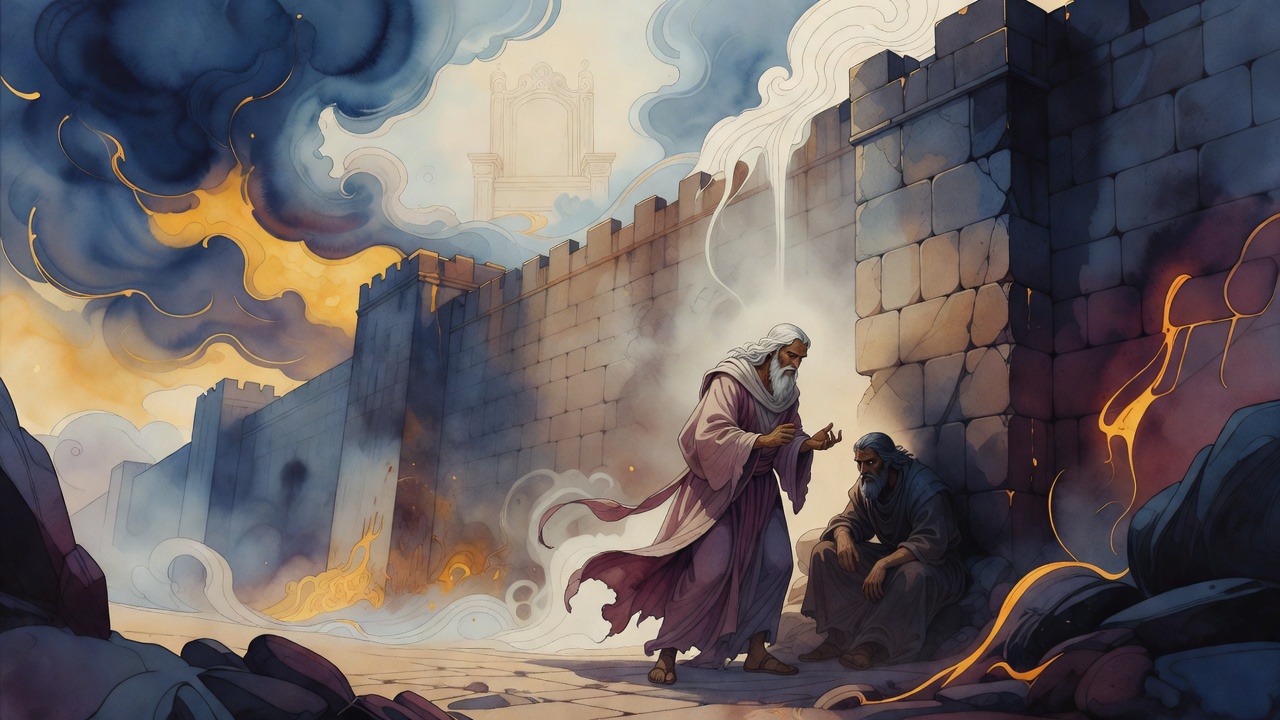
Elsewhere Solomon searches his heart to tempt his flesh with wine and finds the midrash renaming that wine as Torah's intoxication, wisdom conducting the heart even when the verse says folly. The child under the sword is the same man testing limits: how far can a ruler push a scene before truth cracks open? He does not withhold joy from his eyes in Kohelet's voice. He also learns, after the throne is stripped in other legends, what a plate and a belt feel like when palaces are gone and a king begs like any traveler.

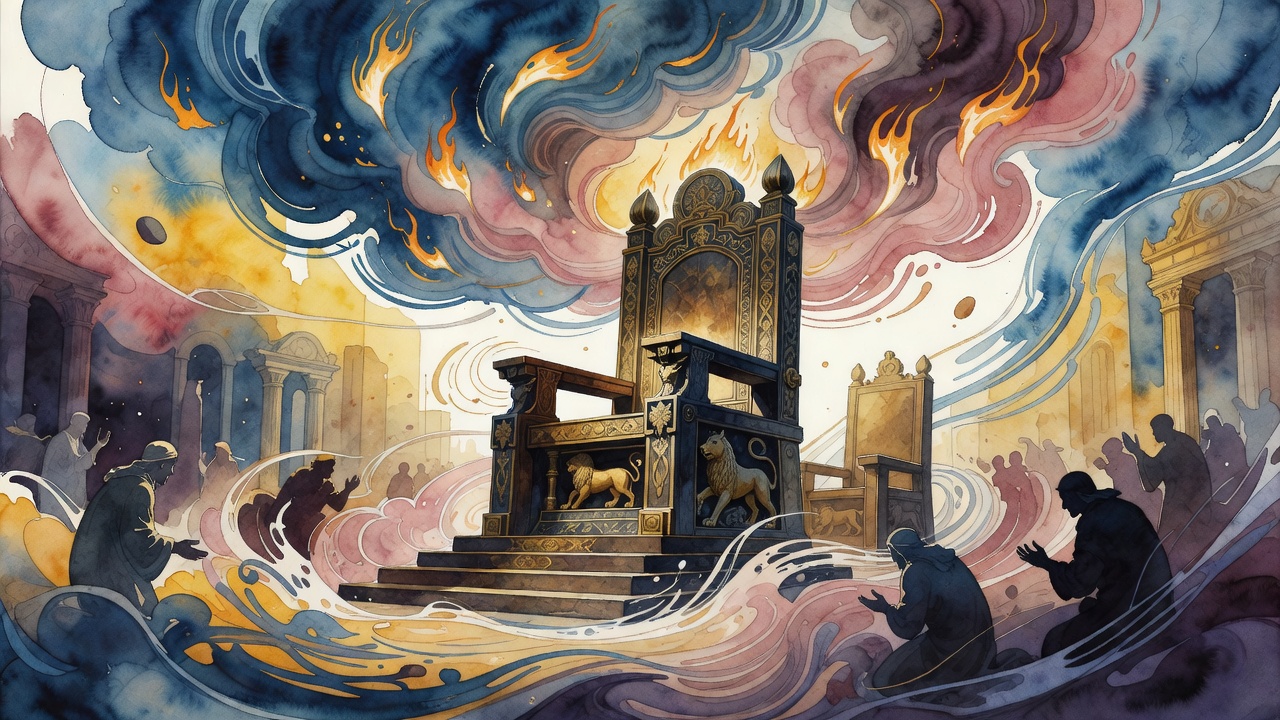
Happy the land whose king is free and whose princes dine in strength, not drunkenness. The sword scene is sobriety wearing steel. No feast. No song. Only a baby and a blade and a cry that reorders the room. The ivory throne elsewhere in the books is heavy and carved. This hour needs no ivory. It needs a man willing to look like a butcher until love identifies itself.

When the blade comes down empty, the room exhales. Someone laughs once from nerves and stops. The child hiccups. History starts repeating the story before the women leave the floor.

After the Blade Comes Down Empty

The living child goes to the woman who could not bear the split. The other leaves with whatever story she still needs, face closed. Solomon's name travels as the king who saw a heart by threatening a body. Later ages will argue whether the move was pure or nearly fatal. The midrash keeps both the brilliance and the wool around the neck, as if to say: do not copy this without the wisdom that knew when to stop.

Outside, Jerusalem keeps building. Vineyards wait in other verses. Houses rise over twenty years. Inside this hour, the only architecture that matters is a mother's outstretched hands and a king's willingness to look monstrous for one measured breath so a child can keep breathing.

Night comes. The sword returns to its place. Somewhere a woman feeds a living son and does not sleep easily, because she has seen how close law can come to the edge of a throat and still call itself justice.

Servants who carried the sword out that day told the story for years, each time lifting an empty hand to show how high the blade had hung. They remembered the mother's cry more than the king's words. Solomon could stack silver like stones in other seasons. This season he stacked a single breath of risk on a single living child and waited for love to confess itself in public.

The land that rejoices in a free king rejoiced that night in a quieter way: a boy lived, a court learned to watch faces, and a ruler proved he could threaten death only long enough to serve life.


← All myths
From the tradition

Sources

3 sources

The texts behind this telling. Some cards carry a translation of the source; others are our own retelling of it, and each card says which. Every card links out to the original.

Kohelet Rabbah 10:16Kohelet Rabbah

Retold in our words. Read the original at the link below.The Sefaria Midrash Rabbah, 2022 · CC-BY

Kohelet Rabbah, a collection of rabbinic interpretations on the Book of Ecclesiastes, grapples with this very question, using the famous story of King Solomon and the two mothers to illustrate its point.

Happy are you, land, that your king is a free man, and your princes dine at the proper time, in valor and not in drunkenness.” This sets the stage for a deeper dive into what constitutes good and bad leadership, using Solomon's iconic judgment as a case study.

Remember the story? Two women, both claiming to be the mother of the same baby, come before King Solomon. One baby has died, and each woman insists the living child is hers. It’s a gut-wrenching situation, and Solomon, in his wisdom (or perhaps initially, apparent lack thereof), famously calls for a sword to divide the baby in two.

Who were these women? The text offers several interpretations. Rabbi Meir suggests they were spirits! The Rabbis offer a more grounded explanation: they were women awaiting yibbum, levirate marriage. This is where, according to Jewish law, if a man dies without children, his brother is obligated to marry his widow. According to Midrash (rabbinic interpretive commentary) HaMevo’ar, the outcome of Solomon’s case would determine which woman was subject to this law. Then Rabbi Simon, in a more blunt assessment, says they were actual prostitutes, and Solomon rendered his verdict without the usual legal formalities.

The text dissects the courtroom drama. We get a play-by-play, almost like a director's cut of the biblical narrative. "The one woman said: Please, my lord…it was on the third day after I gave birth…the son of this woman died" (I (Kings 3:17)–19). Rabbi Pinḥas and Rabbi Yirmeya, citing Rabbi Ḥiyya bar Abba and Rabbi Beivai (or Rabbi Pedat, depending on who you ask!), outline the proper judicial procedure: judge sits, parties stand, mediator decides (though some dispute the mention of a mediator), plaintiff complains, defendant responds, and then the judge decides.

Rabbi Simon adds a crucial detail: a good judge reiterates the claims of both parties. He draws this from the verse: "[The king said:] This one says: This is my son that lives [and your son is the dead], and that one says: [No, your son is the dead and my son is the living]" (I (Kings 3:2)3). It’s about ensuring everyone is heard and understood.

But what about the sword? Rabbi Yehuda, quoting Rabbi Ilai, offers a fascinating, if slightly alarming, insight: Had he been there, he would have wrapped soft wool around Solomon's neck! Why? Because a judge who issues a false judgment is executed by strangulation. The idea is that when Solomon called for the sword, he was testing the women. Had the true mother not been overcome by mercy, Solomon’s judgment would have led to an unjust outcome.

It's at this moment, the text argues, that the "Woe is you, land, whose king is a lad" applies. It's a moment of potential disaster averted only by the true mother's compassion. But then, Solomon’s wisdom truly emerges. He realizes the significance of human anatomy, noting that God created us with pairs of eyes, ears, hands, and feet in anticipation of this very judgment! As the text notes, the Holy One blessed be He created man proportionally so it would be possible to cut the child lengthwise into two equal parts. And instead, he declares, “Give her the living child, and do not kill him" (I (Kings 3:2)7).

And here, we transition to "Happy are you, land, that your king is a free man." This is the moment Solomon proves his worth. The Kohelet Rabbah interprets "dines at the proper time" as referring to the World to Come, and "not in drunkenness" as "in his strength and not in his weakness."

The text culminates with a powerful image: "The Divine Spirit was shouting and saying: She is certainly his mother." Rabbi Shmuel bar Naḥmani identifies three instances where the attribute of justice itself cried out: in the court of Shem, the court of Samuel, and here, in the court of Solomon. In each case, a divine voice affirms the truth.

Finally, the text offers another interpretation: "Woe is you, land, whose king is a lad" refers to the kings of Israel, while "Happy are you, land, that your king is a free man" refers to the kings of Judah. The kings of Israel, being wicked, consumed all their goodness in this world, while the righteous kings of Judah saved their reward for the World to Come.

So, what do we take away from all this? The story of Solomon isn’t just a clever trick. It's a lesson in leadership, compassion, and the importance of divine guidance. It’s a reminder that true wisdom isn't just about intellect, but about understanding the human heart and acting with justice and mercy. And maybe, just maybe, it suggests that sometimes, the best leaders are the ones who know when to listen to a higher power.

Full source
Kohelet Rabbah 10:1Kohelet Rabbah

Retold in our words. Read the original at the link below.The Sefaria Midrash Rabbah, 2022 · CC-BY

The book of Ecclesiastes, or Kohelet as it's known in Hebrew, wrestles with these very questions. And Kohelet Rabbah, a rabbinic commentary on Ecclesiastes, dives even deeper. one particularly fascinating verse, (Ecclesiastes 2:10): "Everything that my eyes sought I did not keep from them; I did not withhold my heart from any joy, as my heart was joyful from all my toil, and this was my portion from all my toil."

So, what’s going on here? Kohelet Rabbah breaks it down. “Everything that my eyes sought…I did not withhold my heart from any joy” – the commentary suggests, could be talking about the fleeting joy of wealth. It's that initial rush, the thrill of acquisition. But is that true, lasting happiness?

Then comes the next part of the verse: “As my heart was joyful from all my toil, and this was my portion from all my toil.” Now, The Rabbis in Kohelet Rabbah offer different interpretations. One suggests this refers to a simple plate, another to a belt. Wait, a plate and a belt? What's that all about?

Well, this connects to a story we find earlier in Kohelet Rabbah (section 2:3) about a time when King Solomon, the supposed author of Ecclesiastes, was banished from his throne. Stripped of his riches, he was reduced to a wandering beggar. All he had was a plate to collect food and a belt to keep his robes together as he traveled. The joy, then, wasn't in grand palaces or overflowing coffers, but in the simple sustenance and practicality represented by these humble items. Profound. But the commentary doesn't stop there. It offers another perspective: "Everything that my eyes sought," could also be referring to… women. "I did not withhold my heart from any joy" – meaning the joy derived from relationships. But again, the Rabbis probe deeper. "As my heart was joyful from all my toil…" What "toil" are they talking about in the context of relationships?

Here, too, we find two interpretations. One suggests it's the separation of ḥalla, the portion of dough traditionally given to the kohen (priest). The other suggests it's the separation of libations, the wine poured out as an offering. Both mitzvot, these sacred acts, involve a great deal of preparation and effort. You can't have the wine without tending the vineyard. So, what does it all mean? What is the peshat (plain meaning) here? Maybe it's that true joy isn't about endlessly chasing after fleeting desires, whether they be wealth or pleasure. Instead, it's about finding contentment and meaning in the simpler things, in the act of creation and dedication, and in appreciating the fruits of our labor – both literal and metaphorical. Perhaps true happiness is found not in the having, but in the doing. And maybe, just maybe, the wandering king with his plate and belt had a deeper understanding of joy than he ever did on his throne.

Full source
Kohelet Rabbah 3:1Kohelet Rabbah

Retold in our words. Read the original at the link below.The Sefaria Midrash Rabbah, 2022 · CC-BY

The Book of Ecclesiastes, or Kohelet as it's known in Hebrew, wrestles with this tension beautifully. And the Rabbis in Kohelet Rabbah, a classic midrashic (rabbinic interpretive commentary) commentary on Ecclesiastes, dive even deeper.

"

Seems straightforward enough. Solomon, the traditionally attributed author, is contemplating pleasure, maybe even a little excess, while still trying to maintain some semblance of wisdom. But the Rabbis saw something far more profound.

“I searched in my heart to tempt [my flesh] with wine,” it says. Kohelet Rabbah interprets this to mean Solomon searched his heart "to tempt my flesh with the wine of Torah." Hold on a minute. The wine of Torah? What's that?

Think of it this way: Torah, the sacred teachings, can be intoxicating. It can fill you with joy, passion, and a thirst for more knowledge. It’s not just dry legal text, but a source of profound spiritual experience. Solomon, in this interpretation, wasn't seeking the temporary buzz of physical wine, but the enduring intoxication of divine wisdom.

And what about "my heart, conducting itself with wisdom"? According to the Rabbis here, this refers to "the wisdom of Torah" itself. So, his heart wasn't just being wise; it was being guided by the very wisdom it sought.

Now comes the really interesting part: "To grasp folly [sikhlut]." Sikhlut generally means foolishness, but Rabbi Yudan raises a fascinating question. He asks Rabbi Aḥa, "What is this that is written: 'To grasp folly [sikhlut]'?" Rabbi Aḥa responds with a surprising twist: "To grasp with wisdom [sukhlenuta]."

Wait… what? He's interpreting sikhlut, folly, to actually mean sukhlenuta, wisdom! It seems completely backwards.

The commentary is suggesting that even in what appears foolish, there can be a deeper wisdom to be found. Perhaps it’s about understanding the limits of human understanding, or recognizing that sometimes, the path to wisdom requires exploring seemingly foolish avenues. Maybe it’s about seeing the world from a different, unexpected angle.

That even in our moments of perceived foolishness, wisdom might be lurking, waiting to be discovered. That the very act of seeking, even if it leads us down unexpected paths, can ultimately bring us closer to understanding. Perhaps the answer lies not in choosing one over the other, but in finding the wisdom within the apparent folly.

Full source