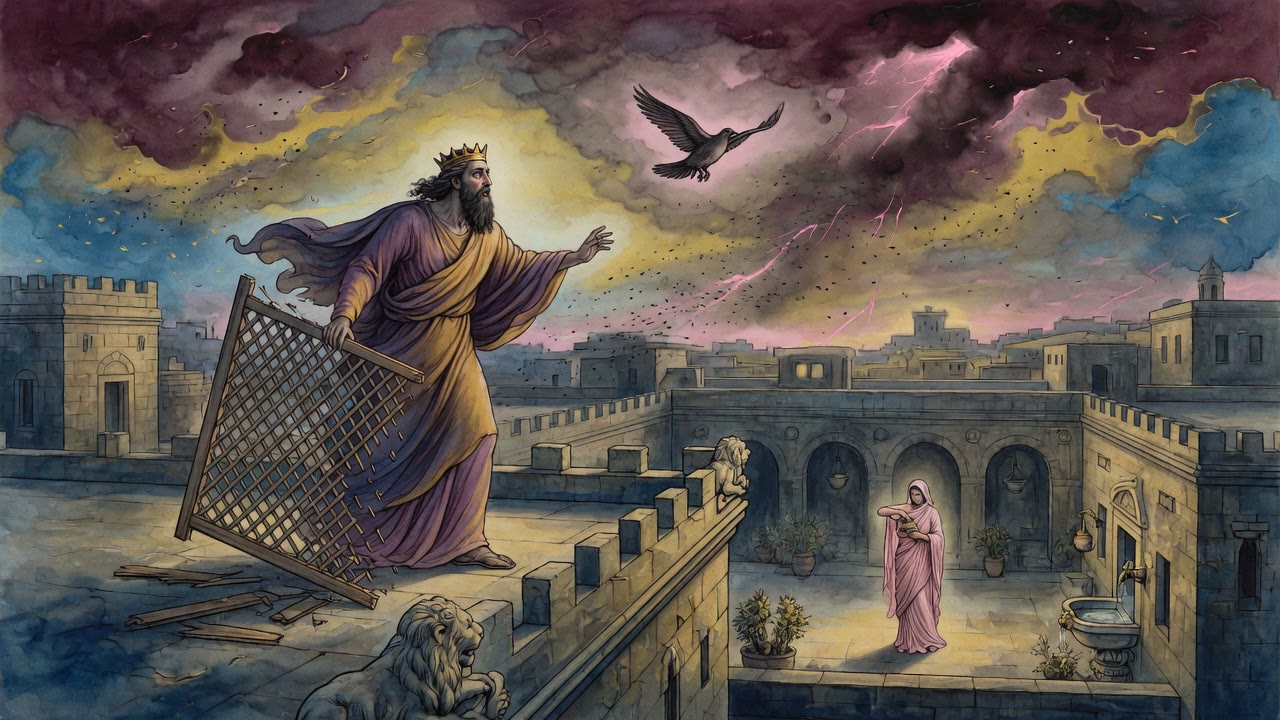
Solomon's Silver Goblet and the Two Hidden Lovers
Solomon hands a builder a silver goblet that fuses his wife's mouth to her lover's, and a robber on the road exposes a second wife's heart.
Table of Contents
The builder had laid every stone of the palace with his own hands, and Solomon told him the worst thing a king can tell a craftsman who has just finished his masterwork.
 Click for full size
"Your wife is unfaithful."
The man would not hear it. He had raised cedar beams to the height of Solomon's ambition. He had fitted the gates and dressed the inner walls, and he was not about to let the king poison the one room he could not build, the one inside his own house. He shook his head. He thanked the king for the wage and waited to be sent home.
Solomon did not argue. Argument is for men who can be persuaded, and this one had already decided. So the king let him go, and as a parting gift he pressed into the builder's hands a silver goblet of fine workmanship, a thing so beautiful it asked to be used.
The Cup Set Out on the Shelf
The builder carried it home and set it on a shelf where the light could find it. That same day, while he was gone, the wife's lover came to visit.
The man's eye went straight to the silver. He turned it in his hands and praised the workmanship, and the wife, vain and warm with the pleasure of a king's gift in her house, suggested they drink from it together. Why not. The husband was away. The cup was lovely. Two mouths rose to the rim at once.
Their lips fused to the metal.
They could not let go. They pulled, and the silver would not release them, and they could not pull the goblet from each other, two faces locked an inch apart over a cup that had become a trap. Solomon had inscribed a working into the metal, a test of faithfulness that bound any two mouths that drank from it in treachery. The king had not needed to prove a thing. He had only needed to wait for the cup to be raised in betrayal, and it had been raised within a day.
The Husband Came Home
The builder walked in and found his wife and a stranger frozen face to face, their mouths sealed to the silver he had carried home as a gift. There was nothing left to disbelieve. He marched them both, still joined, still struggling, to the palace.
Solomon looked at the two of them stuck to the cup and pronounced the remedy as a cold thing. "The spell can only be broken if their heads are pierced with red-hot iron."
The builder panicked. Whatever his wife had done, and the cup said plainly what she had done, he did not want her killed. He begged. He pleaded for the mercy he had refused to believe she needed protecting from. And the king relented.
Solomon sent for the sword of his father David, the blade with the Ineffable Name engraved along its edge, the Shem ha-Meforash. He poured water over the iron until the water carried the charge of the Name. Then he sprinkled it across the two faces locked at the cup. The seal broke. Their mouths came free of the silver.
In another telling, no sword came at all. Two scholars carried a Torah scroll between the lovers, and the weight of scripture itself pried the adhesion loose. Either way, the working that the king had inscribed yielded to a stronger thing. A spell made by Solomon still bowed to the Name and to the Torah.
A Second Road, a Second Wife
The king had other proofs of what a cup could only catch one couple at a time. He kept a story for the verse that troubled him, the one he himself had written, that among a thousand women he had not found one who was faithful.
A young man rode from Tiberias toward Betar and met a young woman on the road who fell in love with him the instant she saw him. They married within days. A year passed, and she asked him to bring her home to her parents, and they set out together.
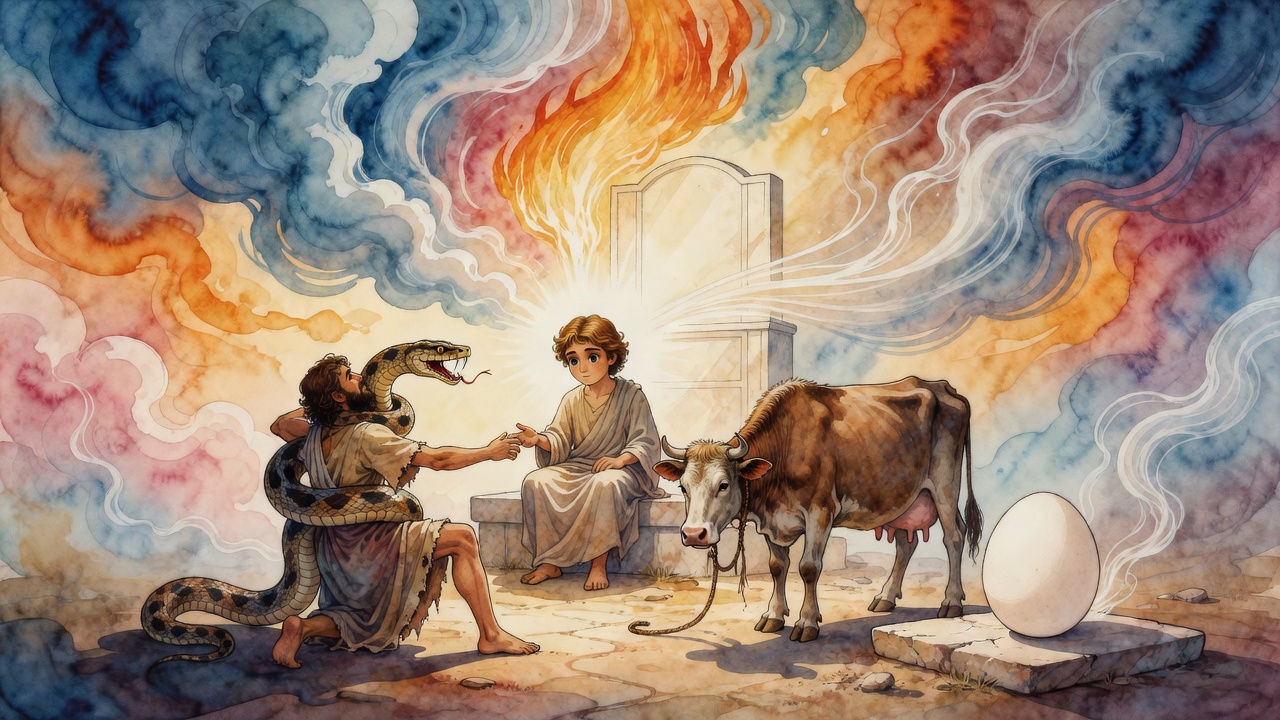
A robber stopped them. He was tall and dangerous, and the wife took one look at him and fell in love a second time, in the open, in front of the husband she had wanted only a year before. The robber tied the husband to a tree. From opposite sides of the clearing, husband and wife watched each other while she and the robber disappeared into the bushes.
The Snake That Settled It
Afterward the robber slept, worn out, beside a jug of wine he had carried off from his last raid. A snake came to the jug, thirsty, and drank, and before it slid away it spilled its venom into the wine.
The robber woke and drank and died convulsing at the woman's feet.
Now she was alone with the man she had betrayed, still bound to his tree. She walked over to him. "If you promise not to kill me, I will untie you." He promised. She freed him, and they went on together to her father's house as though the clearing had never happened.
There, in front of her father, the husband told the whole story to the end. The father listened. Then he drew his blade and killed his own daughter.
The King's Verdict on the Human Heart
Solomon set the matter beside another from the same collection, the builder who would not kill his wife when the king commanded it, paired against this woman who was willing to kill her husband when the king tested her. One man clung to a wife the cup had already condemned. One woman traded her husband for a robber on the road. The king laid both cases down like evidence and sealed his harsh proverb over them: among a thousand, not one.
The sages kept his pessimism but would not let it stand unanswered. In the study halls they argued that the line held only for certain generations, that the king had judged the women who chose the robber and the cup, not every woman who ever lived. Solomon had inscribed a goblet that could catch what no witness could prove. The rabbis inscribed a limit on the king's despair, and like the Torah pressed between the lovers, their reading pried his verdict loose.
← All myths