5 min read

The Soul Finds the Seventh Millennium Sealed and Studies What It Can

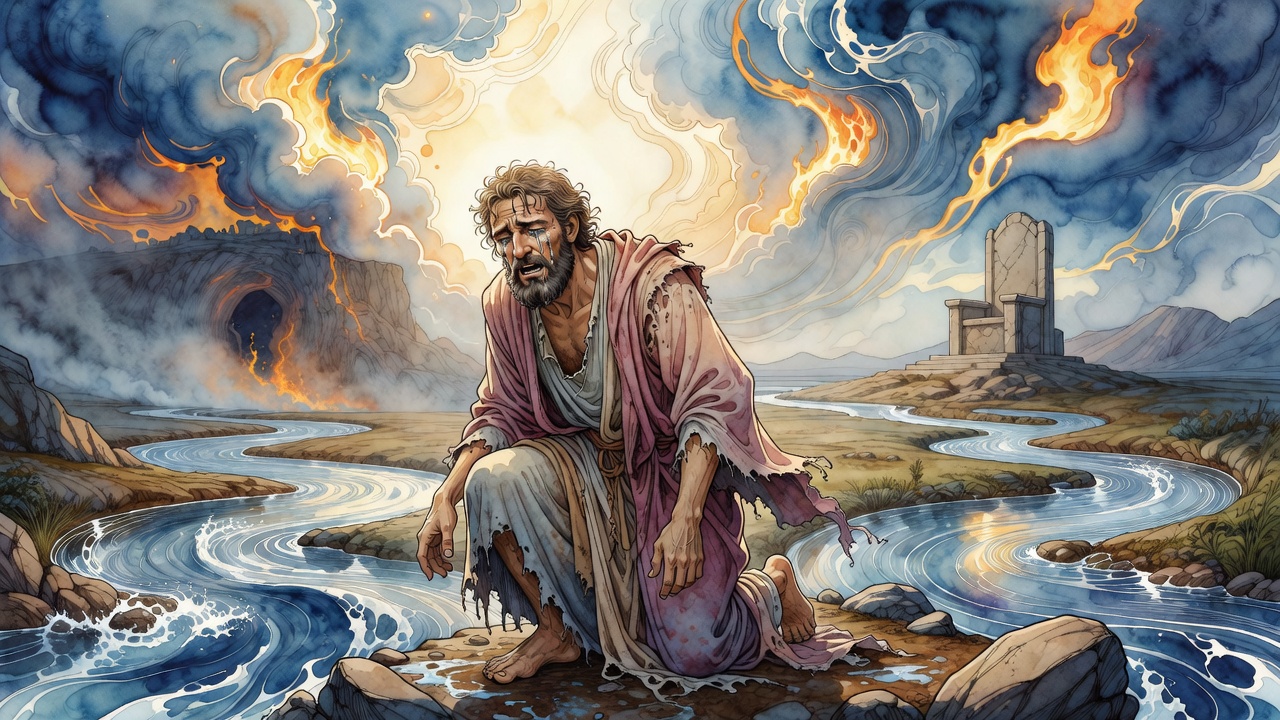
The Soul reaches a sealed door marked for the seventh thousand years. Knowledge stops. Desire does not. What can be grasped is named, and the rest stays shut.

Curated by Arthur · Told by Maggid ·
Table of Contents
  1. A Door With No Handle
  2. What May Be Grasped
  3. Why Deficiency Was Allowed
  4. The Knock That Does Not Force
  5. Turning Back With the Fire Still Ahead
The Soul Finds the Seventh Millennium Sealed and Studies What It Can Click for full size

A Door With No Handle

The Soul walked the corridor of permitted knowledge until the floorboards ended in clean air. Ahead stood a door without a handle, warm as if a furnace worked on the far side through stone too thick to show a seam. No hinge glittered. No nameplate offered a polite lie. Only a pressure in the air that said, without letters: seventh thousand years. Renewal. World remade.
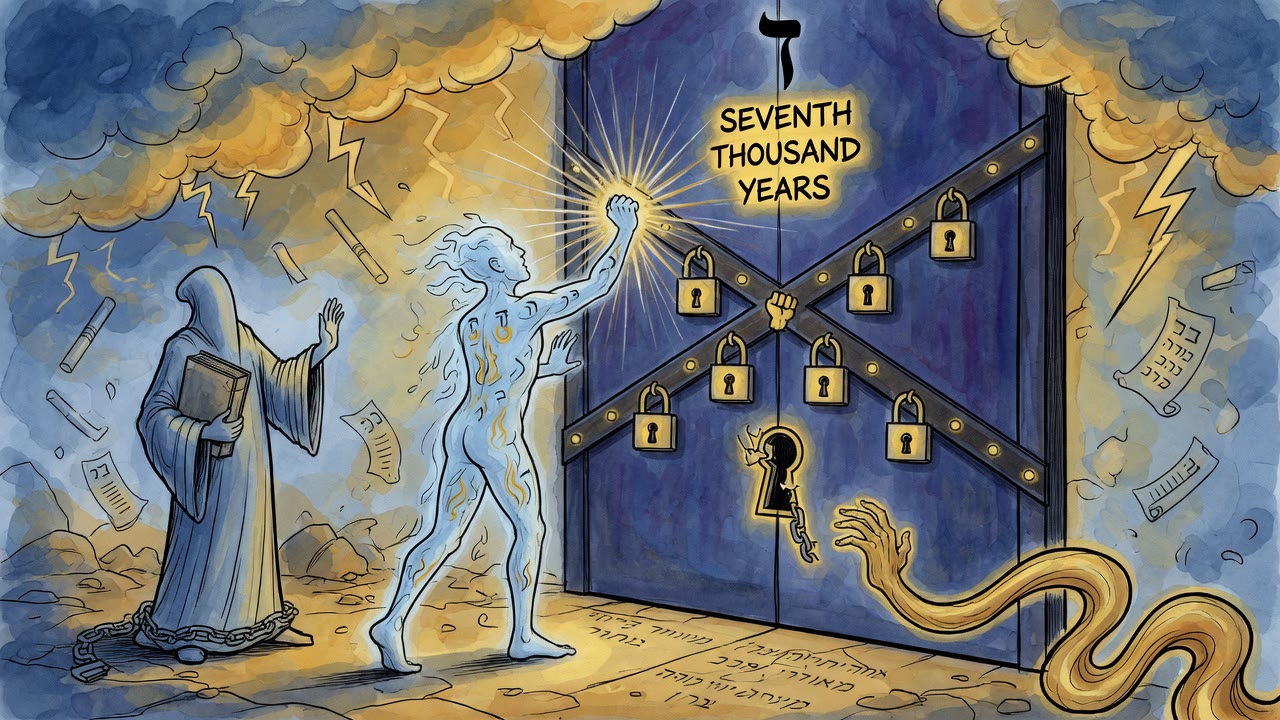
"Are these not hidden from us?" the Soul asked. "How can we begin to discuss them?"

The question was not cowardice. It was honesty with a sealed lock. Most maps stop where the cartographer has never stood and then invent coastlines anyway. This map admitted the blank and let the blank remain blank without apology.

Heat still came through. Hidden is not cold.

What May Be Grasped

"If so," the Soul said after a long breath that tasted of dust and iron, "let us discuss that which we are permitted and able to grasp." The sentence changed the room the way a lamp changes a cellar. Ambition bent its neck. Study resumed on the side of the door that still had floor.

Knowledge is not one stone in a field. It is many stones, some warm, some cold, some too heavy for a single hand, some sharp enough to cut the palm that brags. The Soul saw that one matter held many kinds of knowing inside it, and refused to flatten them into a slogan for the market of clever tongues. Properties must settle. Names must fit. Rushing past that work is how false prophecy is born wearing the clothes of longing.

Behind the sealed door, something larger than slogans waited with a patience that shamed hurry. In front of it, work remained: behavior, repair, the slow training of a vessel that might one day bear more light without cracking into a hundred bright shards that cut everyone nearby.

The Soul listed what it could still hold. Covenant. Choice. The taste of good after lack. The shame of wasted days. Those were enough to fill a life without forging keys for a lock heaven has not offered.

Why Deficiency Was Allowed

A lesser mind would have preferred a world that began already finished, polished, closed. No lack. No climb. Only good from the first hour, like fruit that never needed a tree. The teaching cut that wish at the root with a clean blade. Perfection is not only good. Perfection is the repair of deficiency. Without the break, there is pleasure laid out on a tray. There is not perfection. Souls were not made for a museum of unbroken glass. They were made for the joy that follows a real mending, the kind you can feel in the scar.

That is why the seventh threshold can be named in a whisper and still not opened for a full tour with guides and tickets. The taste of what is coming is given in drops so the tongue learns the flavor without choking on the whole cup and calling the choke vision.

Chochmah keeps watch over what must not flood early. Binah measures. The Soul, standing before the blank door, learned that hunger for the end can become a way of deserting the middle.

The Knock That Does Not Force

The Soul raised a hand and knocked once. Not to break the door. To mark the place the way a traveler marks a river he cannot cross until the season changes. Desire stayed bright. Trespass did not put on boots. In the echo, a second reason lined up behind the first, then a third, each reason leading to another the way stairs lead to a roof you are not yet strong enough to stand on without pitching over.

One reason is never the whole house. The Soul had already learned that lesson in smaller rooms. Here the lesson grew teeth. Promises of a second teaching are debts. Debts must be collected without storming the treasury.

Somewhere below, a body kept Shabbat when the week frayed. Kept judgment when flattery paid better. Kept kindness in measures small enough to fit a day. Those acts do not draft blueprints of the seventh age for sale. They train the hands that will one day need steadier light, if that day is given.

Turning Back With the Fire Still Ahead

The Soul turned from the blank door without pretending the corridor was the whole house or that the heat was a fantasy for weak minds. Hidden does not mean unreal. Permitted does not mean trivial. Between those two sentences a life can be lived without fraud and without the counterfeit courage of forced secrets.

The warmth on the far side did not cool to flatter the retreat. It waited. The Soul carried the heat as a debt owed to a future it does not own, not as a trophy for the study hall, and went back to the rooms where speech, choice, and repair still answer when called by their right names.

Behind it, the door without a handle kept its silence. Ahead, the corridor of what may be grasped lit step by step, enough for the next foot, never enough for a god.


← All myths
From the tradition

Sources

4 sources

The texts behind this telling. Some cards carry a translation of the source; others are our own retelling of it, and each card says which. Every card links out to the original.

Da'at Tevunot 93:1Da'at Tevunot

Retold in our words. Read the original at the link below.Sefaria Community Translation · CC-BY

It's all so… shrouded.

In Da'at (Knowledge) Tevunot, a profound Kabbalistic text, this very question is posed, not by me, but by the Soul itself! The Soul asks, and I’m paraphrasing here, "Aren't the seventh millennium and the renewal of the world things hidden from us? How can we even begin to discuss them?"

It’s a fair point. We spend so much time trying to understand the present, wrestling with its challenges and savoring its joys. How can we possibly wrap our minds around something so distant, so… transformative?

The seventh millennium, in Jewish thought, isn't just another thousand years ticking by. It's a period of profound renewal, a cosmic reset button, if you will. It’s a time when, according to tradition, the world will be elevated, perfected, brought closer to its original, intended state. We’re talking about a pretty big deal!

But the Soul's question in Da'at Tevunot cuts to the heart of our human limitations. We are creatures of time, bound by our experiences and perceptions. How can we truly grasp something that transcends all of that?

Maybe the answer isn't about grasping, not in the way we usually think of it. Maybe it's about opening ourselves to the possibility of transformation. Maybe it's about cultivating a sense of hope and anticipation for a future that, while veiled in mystery, holds the promise of profound goodness. We can't know for sure what that future holds. No one can. But by engaging with the question, by allowing ourselves to wonder and imagine, we're already participating in the process of renewal. We’re planting seeds of hope for a world we may never see, but whose arrival we can help usher in.

Full source
Da'at Tevunot 95:1Da'at Tevunot

Retold in our words. Read the original at the link below.Sefaria Community Translation · CC-BY

In Da'at Tevunot the Soul says: "If so, let us discuss that which we are permitted and able to grasp."

The Soul sets a limit: speak only what may be spoken. The discussion has not yet begun.

Full source
Kalach Pitchei Chokhmah 49:14Kalach Pitchei Chokhmah

Retold in our words. Read the original at the link below.138 Openings of Wisdom, trans. Rabbi Avraham Greenbaum, Azamra Institute (2005) · CC-BY

The Kalach Pitchei Chokhmah, a profound Kabbalistic text, offers a really interesting perspective. It suggests that simply having "good" isn't the ultimate goal. True fulfillment, true delight for the soul, lies in perfection, and that perfection, strangely enough, comes from repairing deficiencies. If everything was already perfect, what would be the point? There'd be no growth, no striving, no overcoming challenges. It's the very act of repairing what's broken, of mending the cracks, that allows us to reach new heights. The Kalach Pitchei Chokhmah frames it like this: If there had been no deficiency, the perfection would not have been revealed, but only the good.

This idea is deeply connected to the Kabbalistic concept of tikkun (spiritual repair) olam (repairing the world), a central tenet of Jewish thought.

So, what does this "perfection" actually mean? The text equates it with God's unity. It's about restoring harmony and balance, not just within ourselves, but within the entire cosmos. As the text mentions, this idea has been discussed previously. (see Opening 4).

That our struggles, our imperfections, are not obstacles to be avoided, but rather opportunities to grow, to learn, and to ultimately connect with something far greater than ourselves. It reframes our entire understanding of what it means to be human. It's not about achieving a static state of flawless existence, but about embracing the dynamic process of repair and transformation. Only when the deficiency is overcome can we rise to new levels of attainment.

So, next time you're faced with a challenge, remember that the journey of overcoming it might just be the most meaningful part. Maybe, just maybe, that's where true perfection lies.

Full source
Da'at Tevunot 97:1Da'at Tevunot

Retold in our words. Read the original at the link below.Sefaria Community Translation · CC-BY

It presents a statement, almost a sigh, from the Soul: "Certainly this thing needs to come to its properties, for I see that this knowledge includes many types of knowledge."

What "thing" are we talking about? What "knowledge" is so all-encompassing?

The "thing," in this context, likely refers to a specific concept or aspect of divine wisdom that the Soul is contemplating. It’s something that needs to settle into its rightful place, to fully realize its potential. It needs to "come to its properties," meaning it needs to be understood in all its facets and implications.

The Soul, that eternal spark within us, recognizes that this particular piece of knowledge isn't just an isolated fact. It's a key, a linchpin connecting "many types of knowledge." Think of it like this: imagine a beautiful stained-glass window. Each pane is a piece of knowledge, seemingly separate. But the lead that holds it all together, that’s the "thing" the Soul is talking about. It unites the fragments into a cohesive, radiant whole.

The beauty of this passage lies in its simplicity. It doesn't spell out exactly what this unifying knowledge is. Instead, it invites us to reflect on our own journeys of understanding. A realization that rippled outwards, transforming your perspective on everything?

That's the power of interconnected knowledge. That's the "thing" seeking its properties.

Full source