6 min read

The Teacher Placed His Eye on the Neighbor

A grown educator confesses he cannot stop staring at the woman next door. The infant Ben Sira answers with a coal, a well, and a chase for wisdom.

Curated by Arthur · Told by Maggid ·
Table of Contents
  1. The Coal That Looks Warm
  2. Samech and the Private Well
  3. The Youth Who Chased Wisdom
  4. The Mouth That Would Not Swerve

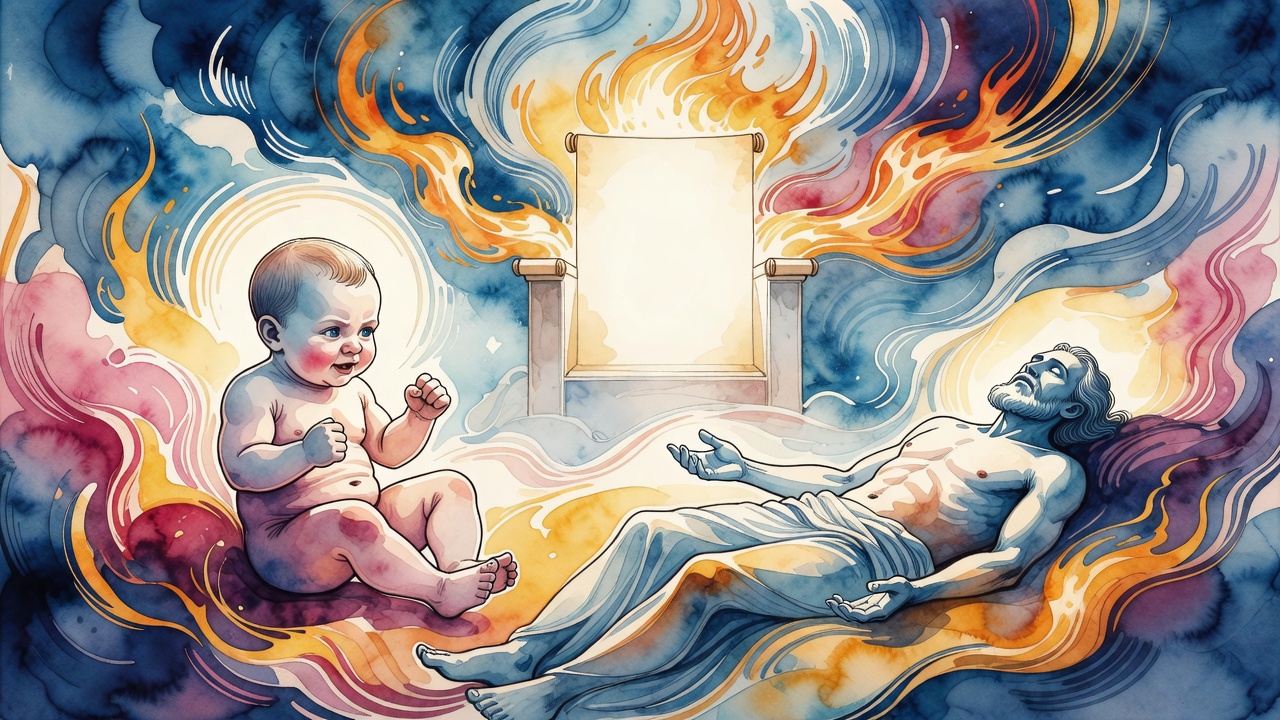
Ben Sira sat on his teacher's lap like any infant, except he already knew the alphabet and the damage a man can do with his eyes. The educator had asked for the letter Dalet. He wanted a proverb for the morning lesson. He got a warning that did not sound like a lesson at all.

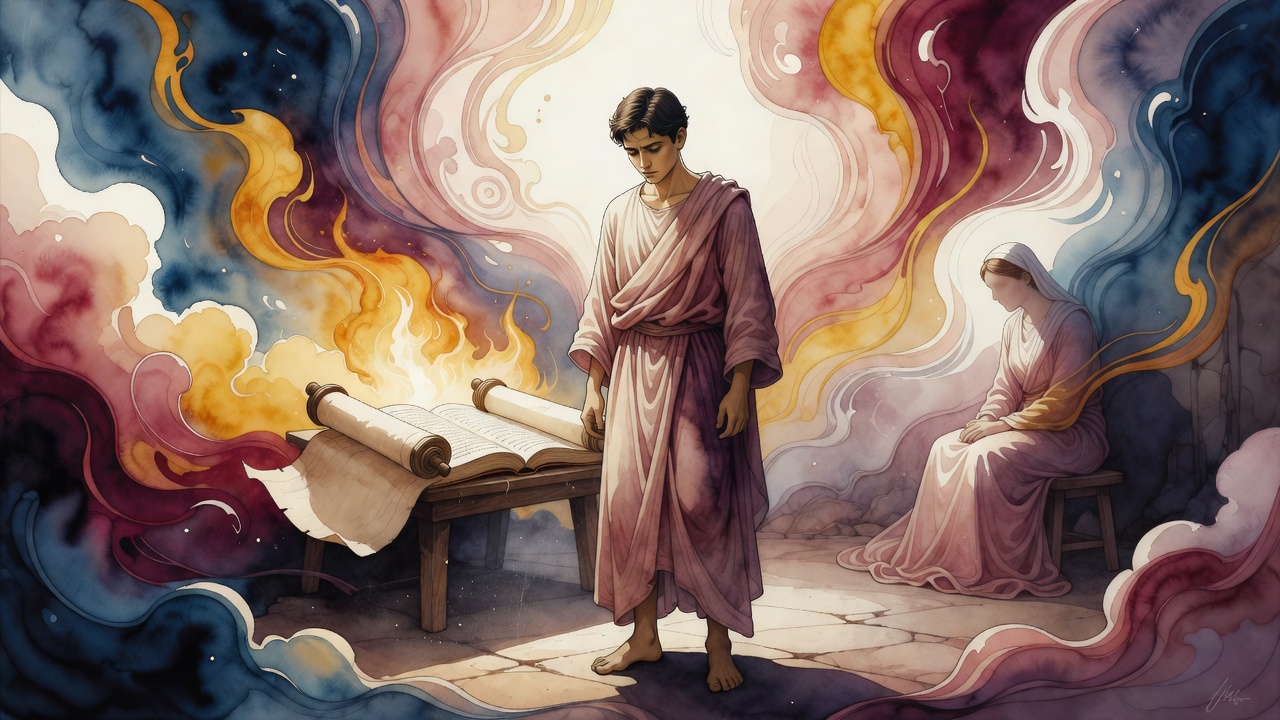
The Teacher Placed His Eye on the Neighbor Click for full size

"Deprive your flesh of a graceful woman, like the flame of a coal."

The teacher did not laugh. He looked toward the wall that shared a house with a neighbor, and the words came out of him as if they had been waiting years for a mouth willing to say them in daylight.

"But what can I do? Every single time that I enter my house, she is laid out before me, and I place my eye on her, since she suits my eye."

The Coal That Looks Warm

He did not say the woman appeared in his path. He said he placed his eye. The difference is the whole story. A coal looks warm from across a room. The heat is real. So is the burn that follows a hand that refuses to believe the glow is a weapon.

In the house next door the graceful woman moved through ordinary work. Bread. Water. A doorway left open for air. The teacher measured his steps so that the doorway would fall into his path on the way from street to table. He called it accident. The infant called it flame.

Outside, students waited for letters and law. Inside, the man who was supposed to form them confessed that his own flesh had already chosen a curriculum. He wanted absolution shaped like advice. Ben Sira gave him a picture he could not argue with. You do not lecture a coal about manners. You keep your skin away from it.

The Alphabet frames the exchange as comedy, an adult begging a baby for help with lust. The comedy is the blade. If a teacher cannot hear the proverb from a student who still drools, he will not hear it from a colleague either.

Samech and the Private Well

The teacher asked for Samech. He hoped for something safer, a rule about writing or posture. Ben Sira gave him marriage.

"A scribe and an educator should marry a virgin woman and not marry a non-virgin woman. Because the waters of a virgin are for you alone, but the waters of a non-virgin have already been drawn by a stranger aside from you."

The image is a cistern, not a romance. (Proverbs 5:15) had already told a man to drink water from his own well and running water from his own spring. Here the proverb tightens around the scholarly class. The man who teaches letters to children must not treat a household like a public fountain where anyone may lower a jar.

The teacher heard the word "scribe" and flinched. He was that scribe. The proverb stopped being abstract the moment he admitted he placed his eye. A private well is not only about first marriage. It is about the refusal to treat another person's body as scenery for a hungry gaze.

He had wanted a letter. He received a fence for his house. The Samech stood between his door and the neighbor's like a post driven into hard ground.

The Youth Who Chased Wisdom

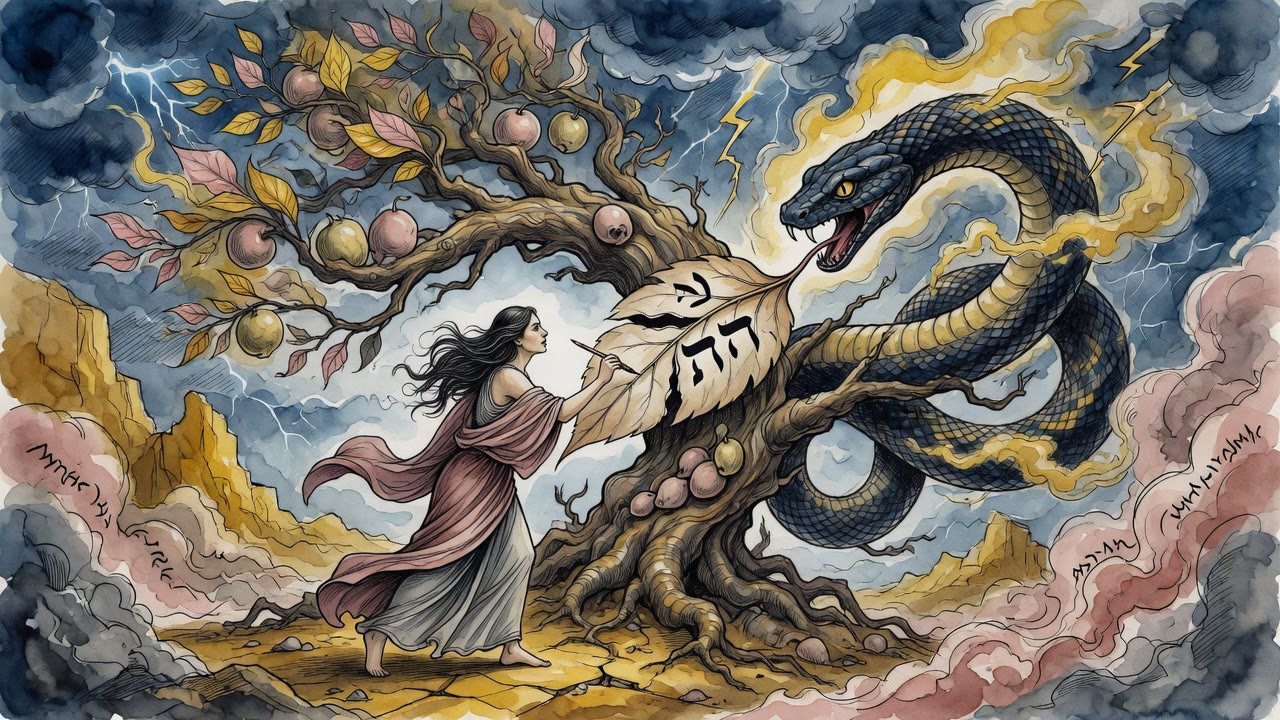
Long before this satirical alphabet, another Ben Sira, the sage of Jerusalem's second century BCE, had written of his own youth as a pursuit that left little spare room for a wandering gaze. "I was a youth; and I delighted in her, and sought her. My foot trod in her truth." Wisdom was not a neighbor across a courtyard. She was a path that demanded the whole foot, heel to toe.

He prayed young and found knowledge thick as grain after rain. "O my Lord, from my youth I learned wisdom." Her yoke was glory, not a weight he dragged through the market. "My soul longed for her; and I would not turn my face from her." When a face is locked on wisdom, it is hard to park that same face on another person's doorway as if the doorway were a free show.

He opened her gates with his hand and looked for her in purity. He took understanding from her beginning and refused to swerve. The infant on the lap and the sage in the scroll are not the same man, but the tradition seats them at one table. One warns the teacher with fire. The other shows what the fire should have been spent on.

The Mouth That Would Not Swerve

The older Ben Sira thanks his teacher. The younger Ben Sira becomes the teacher of his teacher. Between them runs a single stubborn claim. Desire is not an accident that visits a good man. Desire is a placement of the eye, a turning of the face, a choice that can be refused even when the coal still glows across a shared wall.

The educator's house still shares that wall. The coal still looks warm. The well is still either private or already drawn by strangers. Nothing in the proverbs rearranges the architecture of the street. They rearrange the will that walks the street after dark and in the bright noon alike.

He asked for letters. He received a life. Dalet for the coal that must not be touched. Samech for the well that must stay singular. And behind both, a youth who would not swerve from the gate where wisdom waits with a yoke that somehow feels like honor.

By evening the students would still need their alphabet. The neighbor would still cross the courtyard with water on her shoulder. The only change available was the eye of the man who claimed he could not help himself. The infant had already refused that claim, and the older scroll had already shown what a face looks like when it will not turn aside.


← All myths
From the tradition

Sources

3 sources

The texts behind this telling. Some cards carry a translation of the source; others are our own retelling of it, and each card says which. Every card links out to the original.

Alphabet of Ben Sira, Letter DaletAlphabet of Ben Sira

Retold in our words. Read the original at the link below.Sefaria Community Translation · CC0

The letter Dalet brings a warning about desire that cuts right to the bone:

"Deprive your flesh of a graceful woman, like the flame of a coal."

Like the flame of a coal. The metaphor is perfect in its simplicity. You don't touch a burning coal because it looks warm and inviting. You avoid it because it'll destroy you. Ben Sira, still an infant by any reasonable measure, is telling his teacher that the beautiful neighbor woman is exactly that kind of fire.

Does the teacher listen? Of course not.

"But what can I do?" he protests. "Every single time that I enter my house, she is laid out before me, and I place my eye on her, since she suits my eye." The language is revealing. He doesn't say he can't help but notice her. He says he places his eye on her, it's a deliberate act, a choice he makes each time. The Alphabet of Ben Sira doesn't let the educator hide behind passive temptation. His own words betray him.

This exchange sits squarely in a long tradition of rabbinic wisdom about the dangers of the wandering eye. The Talmud (Berakhot 24a) warns extensively about improper gazing. But what makes this version special is the comedic frame, an adult man confessing his inability to stop staring at the neighbor to a baby who's responding with proverbs. The wisdom is ancient. The delivery is something else entirely.

Full source
Alphabet of Ben Sira, Letter SamechAlphabet of Ben Sira

Retold in our words. Read the original at the link below.Sefaria Community Translation · CC0

The Alphabet of Ben Sira, a satirical and provocative medieval text composed between 700 and 1000 CE, doesn't shy away from blunt advice about marriage. In this proverb, tied to the Hebrew letter Samech (ס), young Ben Sira tells his teacher that a scribe or educator should marry a virgin.

The reasoning is given through metaphor. "The waters of a virgin are for you alone," Ben Sira says, "but the waters of a non-virgin have already been drawn by a stranger." It's a water-well image, common enough in ancient Near Eastern literature, where a wife's faithfulness is compared to a private spring. The Hebrew Bible uses similar imagery in (Proverbs 5:15-18), where a man is told to "drink water from your own cistern."

This proverb is part of Ben Sira's alphabetical exchange with his teacher. The structure is simple but memorable. The teacher asks the boy to recite proverbs for each letter of the Hebrew alphabet, and what he gets back is shockingly worldly wisdom from a child who shouldn't know any of this yet. That's the joke at the heart of the text. Ben Sira was supposedly born with adult-level knowledge, and his teacher can barely keep up.

The advice reflects the social values of the medieval Jewish communities that produced and circulated this text, where marital purity was a serious concern for the scholarly class.

Full source
Ben Sira 51:20Ben Sira

Retold in our words. Read the original at the link below.The Wisdom of Ben Sira, Cambridge University Press (1899) · CC-BY

That feeling isn't new. It's been with us for millennia. And it shines through in the ancient wisdom of Ben Sira.

This passage from Ben Sira 51 isn't just about acquiring knowledge; it's about a passionate, lifelong love affair with wisdom. "I was a youth; And I delighted in her, and sought her." Doesn't that just paint a picture? The pursuit isn't a chore; it’s a delight.

This pursuit isn't aimless. "My foot trod in her truth." There’s a sense of purpose, of walking a path guided by truth. From a young age, the speaker has learned wisdom. There's something beautiful in that continuity, in the idea that wisdom isn’t just something we acquire later in life, but something we can cultivate from our earliest years. "O my Lord, from my youth I learned wisdom."

This isn't a solitary journey either. He actively prays, seeking knowledge, and it is given abundantly. "And I prayed a prayer in my youth; And I found knowledge abundantly." There's a recognition that wisdom isn't just earned through effort but also received as a gift. It's a conversation, a give and take.

The passage takes on a deeper layer when it talks about a "yoke." "Her yoke (?) was a glory to me; And to my teacher will I give thanks." Now, a yoke usually implies burden. But here, it's a glory. It suggests that the discipline, the effort required to learn, is actually a source of pride and honor. It also highlights the importance of teachers – those who guide us on this path.

There's an unwavering commitment here. "My soul longed for her; And I would not turn my face from her. I gave my soul after her; And for ever and ever I will not swerve…" This isn't a casual interest; it's a deep, abiding dedication. Wisdom isn't something you dabble in; it’s something you commit your whole self to.

The final lines are particularly evocative: "My hand opened her gates; And I looked for her (?), and beheld her (S); And in pureness I found her. And I gat me (?) understanding from her beginning; Therefore........" It's like the speaker has finally reached the inner sanctum, found the source of wisdom in its purest form. There's a sense of discovery, of unveiling something hidden. The passage unfortunately ends abruptly, leaving us yearning for what comes next, after this profound encounter.

What does it mean to "open her gates"? What does it mean to find wisdom "in pureness"? These are the questions that linger. Perhaps it suggests that true wisdom requires a pure heart, an open mind, and a willingness to delve deep. It's a call to approach learning with humility and reverence, understanding that the journey itself is as important as the destination.

So, what's your relationship with wisdom? Are you actively seeking it, delighting in the pursuit? Are you willing to commit to the lifelong journey, to embrace the "yoke" with a sense of glory? Maybe Ben Sira's words can inspire us to reconnect with that youthful passion for learning and understanding, to open the gates and behold the wisdom that awaits us.

Full source