5 min read

Ten Tribes Sprawled While God Stayed Quiet

Ivory beds, pipe-goblets, and virgin oils filled Samaria while God quieted the world. The midrash calls that calm a prelude, not a blessing.

Curated by Arthur · Told by Maggid ·
Table of Contents
  1. When He Quiets, Who Can Condemn
  2. Cross to Kalne and Measure the Border
  3. Three Sentences Sealed in One Day
  4. The Last Goblet

They sprawled on ivory beds and called it peace.
Ten Tribes Sprawled While God Stayed Quiet Click for full size

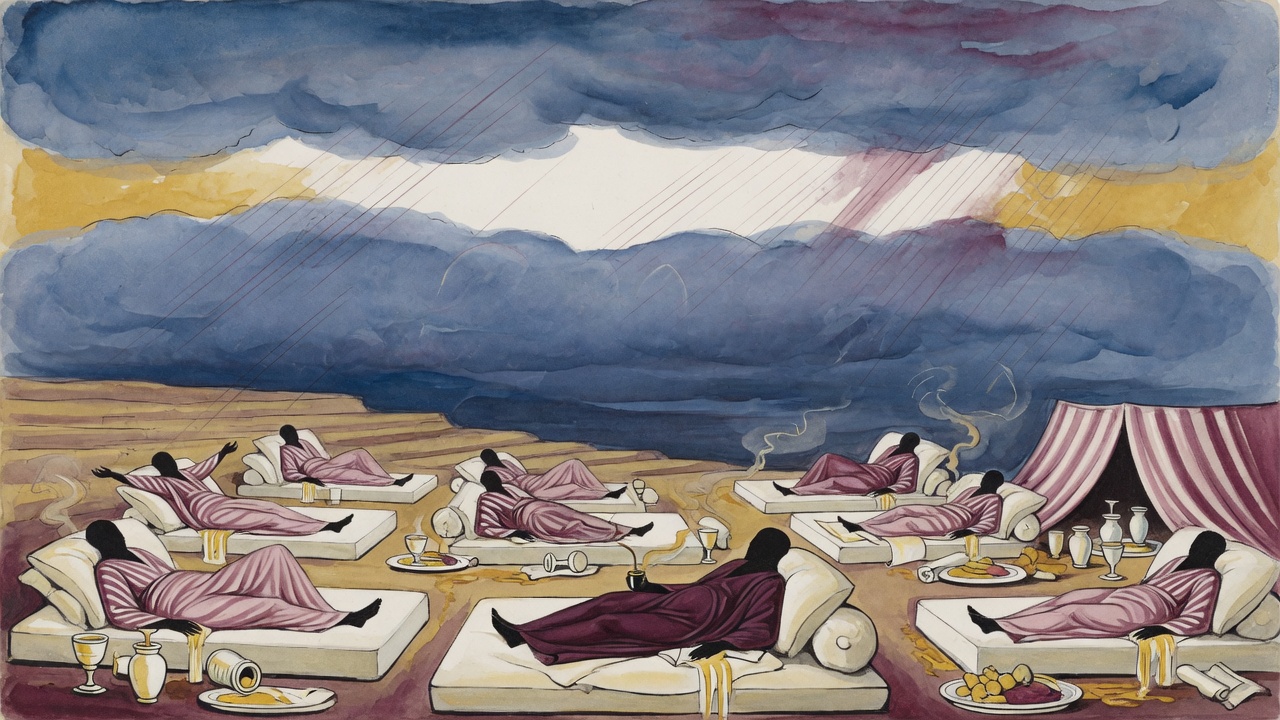
In Samaria the Ten Tribes drank from goblets that some said held congealed wine, tossed without spill, and others said were fitted with pipes so several mouths could drink at once. They anointed themselves with virgin oils, myrrh oil or oil of unripe olives for smoothing skin. The prophet named the scene: beds of ivory, sprawling couches, the music of the harp invented like David's but aimed at nothing holy (Amos 6:4-5). They were not distressed over the ruin of Joseph. That indifference was the real music under the feast.

When He Quiets, Who Can Condemn

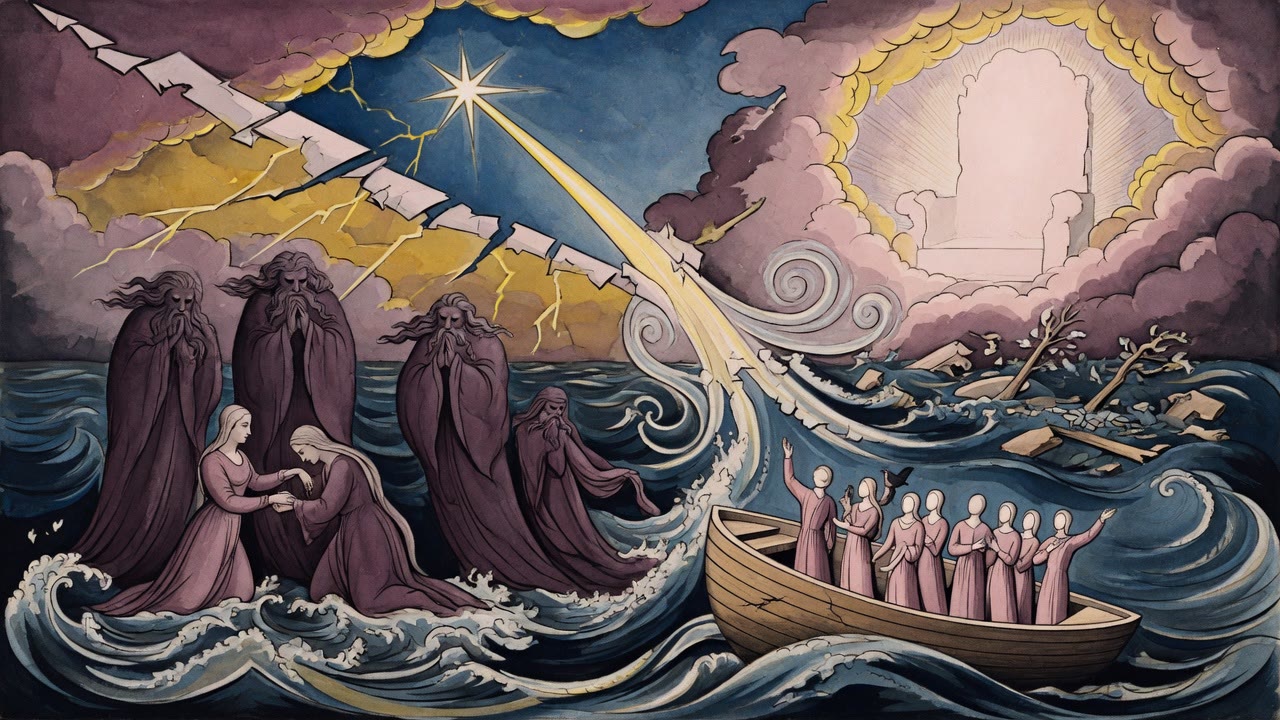
"When He quiets, who can condemn? When He conceals His face, who can see Him?" (Job 34:29). The midrash hears two answers. One is the generation of the Flood, to whom God gave a strange tranquility so complete that women conceived and bore in three days, even in one, as if nature itself had been bent to ease. Children ran out like flocks. Houses stood without fear of demons. The rod of God was not upon them, so they concluded clouds hid Him and He did not see.

The other answer is the Ten Tribes, foremost of the nations in their own eyes, secure on Mount Samaria while Judah sat as the "tranquil of Zion." Their quiet was not favor. It was the closed chamber of a judge who has already heard the case. When He finally acted on the Flood, He obliterated all existence. When He finally acted on Samaria, the revelry of the sprawled ended at the head of the exiles.

Cross to Kalne and Measure the Border

The prophet sent them on a tour of other kingdoms. Cross to Kalne. Go to greater Hamat. Descend to Gath of the Philistines. Are they better? Is their border wider? The question was meant to shrink the boast. Material width is not a verdict from heaven. Nations in peacetime eat, drink, and boast of Balaam, Haman, Goliath. Israel could answer with Ahithophel, Korah, Samson: wisdom, wealth, and might that all ended badly. The comparison was not flattery. It was a warning that lists of strong men do not save a people that denies the evil day.

They advanced the regime of villainy and made themselves like Esau in the midrash's hearing. They put off the thought of exile the way a drunk puts off morning. Wine from Patugta or Palugta, names that echo enticement and exile in the Hebrew, did the rest. Luxury was not the crime alone. Luxury without distress for a brother was.

Three Sentences Sealed in One Day

When Sennacherib came up against Judah, the midrash says three sentences were sealed on a single day: the exile of the Ten Tribes, the fall of Sennacherib, and Uzziah's leprosy. God's rulings do not trade the public for the private. The anointed priest who sins and the congregation that sins both bring offerings. Quiet is not a bribe accepted by heaven. Quiet is the space in which evidence piles up.

The Flood generation had peace without the rod and mistook it for approval. The Ten Tribes had ivory and oil and mistook it for election. Both learned that when He conceals His face, no one standing outside the closed door can force it open with a toast. The hot springs of revelry, thirteen in one reading, dwindled. Iniquities diverted the good that might have stayed.

The Last Goblet

Picture the pipe-goblet still wet, the ivory bed still warm, and a messenger at the door with a name no one wanted: exile at the head of the column. The midrash does not ask for pity for the furniture. It asks whether anyone in the room was distressed over Joseph. That question still sits at every full table. Ease can be a test harder than hunger, because hunger at least argues. Ease only smiles and pours again.

Noah alone, or a nation alone, could have repopulated a world. God did not need the Flood generation's fertility. He did not need Samaria's width of border. He needed a people who would not call His silence a blessing while a brother burned.

Shem and Ever stand in the midrash's genealogy as ancestors who should have known better than to confuse quiet with covenant. The foremost of nations title is a trap when it becomes a pillow. Judah's smaller "tranquility of Zion" looks weaker on a map and stronger in the prophet's math, because distress over Joseph still lives there as a possible virtue.

When the exile column formed, the pipe-goblets stayed on the tables. No one packed the ivory. The midrash wants that image: luxury too heavy to carry into the punishment it earned. Only the sins traveled light.


← All myths
From the tradition

Sources

2 sources

The texts behind this telling. Some cards carry a translation of the source; others are our own retelling of it, and each card says which. Every card links out to the original.

Vayikra Rabbah 5:3Vayikra Rabbah

Retold in our words. Read the original at the link below.The Sefaria Midrash Rabbah, 2022 · CC-BY

" (Job 34:29). What does it mean for God to "quiet"? The Midrash understands this as referring to a period of tranquility granted to the Ten Tribes of Israel. But was this tranquility a blessing, or something else entirely?

In Midrash, this "tranquility" was actually a prelude to disaster. Quoting (Amos 6:1), the text contrasts the "tranquil of Zion" – Judah and Benjamin – with the "secure of Mount Samaria" – the Ten Tribes. The Ten Tribes, descended from Shem and Ever, were considered "the foremost of the nations." They felt secure, perhaps too secure, in their position.

The Midrash paints a vivid picture of the nations during times of peace. They eat, drink, and engage in frivolous pursuits, boasting about figures like Bilam, Haman, and Goliath – characters known for their flaws rather than their virtues. In response, the house of Israel could point to figures like Ahithophel, Korah, and Samson, demonstrating that worldly wisdom, wealth, and might are fleeting.

Then comes a series of pointed questions based on (Amos 6:2). "Cross to Kalne and see," the prophet urges, referring to Katisphon. "And go from there to greater Ḥamat," meaning Ḥamat of Antioch. "And descend to Gat of the Philistines," the fortifications of Philistia. "Are they better than these kingdoms? Is their border wider than your border?" The implication is clear: material success and territorial expansion are ultimately meaningless.

The Midrash then zeroes in on the sins of the Ten Tribes, drawing heavily from Amos 6. They "deny the evil day" (Amos 6:3), meaning they ignore the coming exile. They "advance the regime of villainy" (Amos 6:3), aligning themselves with wickedness, likened to Esau. They indulge in luxury, lying on "beds of ivory" (Amos 6:4) and "sprawling [usruḥim] on their couches" (Amos 6:4), a word play suggesting they "contaminate their beds with sins." Or, alternatively, the "couches" are interpreted as the curtains, from (Exodus 26:12), stretched above them.

Their gluttony is described in gruesome detail. When they want to eat a lamb or calf, they drag the entire flock or herd before them, choosing only the fattest to slaughter. They "strum on the lute [hanavel]" (Amos 6:5), engaging in offensive [nivlut] speech. They compare themselves to David, claiming to possess his musical talent, but lacking his piety.

And the wine! Oh, the wine. They "drink with bowls [mizrekei] of wine" (Amos 6:6). Here, the rabbis offer several interpretations of mizrekei. Rav says it refers to congealed wine, implying they drank so much they could toss the goblets without worry about spilling. Rabbi Yoḥanan suggests they were small goblets, implying they downed the contents in one gulp. The Rabbis say they were goblets with pipes, allowing multiple people to drink at once. Rabbi Abahu, citing Rabbi Ḥanina, identifies the wine's origin as Patugta, known for its licentious effects. The Rabbis, again citing Rabbi Ḥanina, place the origin at Palugta, noting that this was the wine that enticed [nitpatu] the Ten Tribes, leading to their exile [galu]. See the connection? The Hebrew words echo the tragic outcome.

Finally, they "anoint themselves with virgin oils" (Amos 6:6). Rabbi Yehuda bar Yeḥezkel identifies this as myrrh oil, while Rabbi Yanai says it was oil of unripe olives, used for hair removal and smoothing the body.

Despite all this luxury and indulgence, they are "not distressed over the destruction of Joseph" (Amos 6:6). They are indifferent to the suffering of their brethren. As a result, "they will now be exiled at the head of the exiles, and the revelry of the sprawled [mirzaḥ seruḥim] will be discontinued" (Amos 6:7). Rabbi Aivu interprets mirzaḥ seruḥim as referring to thirteen hot springs, one for each tribe and one for all. Their sins led to the loss of all but one, a stark reminder of the consequences of iniquity. "Your iniquities have diverted these, [and your sins have withheld good from you]" (Jeremiah 5:25).

The Midrash concludes with a reference to (Job 34:29): "When He conceals His face, who can see Him?" When God hides His face, who can question His actions? The Midrash connects this to Sennacherib's invasion of Judah (Isaiah 36:1). Rabbi Abba bar Kahana, citing Rabbi Shmuel bar Naḥman, states that three sentences were sealed on that day: the exile of the Ten Tribes, the downfall of Sennacherib, and Uzziah's leprosy. The rulings of God are not like those of humans, who might favor the public over the individual. God's justice applies equally to all, as evidenced by the laws regarding sacrifices for both the anointed priest and the entire congregation (Leviticus 4:3, 4:13-14).

So, what does all this mean? It's a potent reminder that material prosperity and security are not necessarily signs of divine favor. True blessing comes from righteousness, compassion, and a recognition of our shared humanity. The Ten Tribes enjoyed a period of "tranquility," but it was a false peace, built on a foundation of sin and indifference. Their story serves as a cautionary tale, urging us to examine our own lives and ensure that our pursuit of comfort and pleasure does not come at the expense of our values. It calls us to be ever mindful and grateful, even in times of apparent ease. Because sometimes, the greatest danger lurks in the quietest moments.

Full source
Vayikra Rabbah 5:1Vayikra Rabbah

Retold in our words. Read the original at the link below.The Sefaria Midrash Rabbah, 2022 · CC-BY

Our text from Vayikra Rabbah 5, a midrashic (rabbinic interpretive commentary) collection expounding on the Book of Leviticus, grapples with just that question. It starts with a seemingly straightforward verse from Leviticus (4:3) about the anointed priest, the kohen (a priest) ha-mashiah, who sins and brings guilt upon the people, and the required offering: a young bull, unblemished, as a sin offering. But then, it takes a fascinating, if unsettling, detour into the story of the generation of the Flood.

The connection? The verse in Job (34:29): "When He quiets, who can condemn? [When He conceals His face, who can see Him?]" Rabbi Meir, in his interpretation, suggests that God sometimes "quiets His world" and "conceals His face," like a judge who closes himself off and doesn't see what happens outside. He suggests this applied to the generation of the Flood, who falsely believed "Clouds obscure for Him [and He does not see]" (Job 22:14).

The other Rabbis challenged Rabbi Meir. They offered a different understanding: "When He quiets, who can condemn?" means that God gave the generation of the Flood tranquility. So, who could then condemn them? What tranquility? Well, (Job 21:8) tells us, "Their offspring are well placed [nakhon] before them, with them, and their descendants are before their eyes."

Here's where it gets interesting. Rabbi Levi and the Rabbis offer interpretations of the word nakhon ("well placed") that are, frankly, astonishing. Rabbi Levi says that the women of that generation would conceive and give birth in just three days! He connects the word nakhon here to the same word used in (Exodus 19:15), "Be prepared [nekhonim] in three days" before the giving of the Torah at Sinai. The Rabbis take it even further. They suggest that women would conceive and give birth in a single day, linking nakhon to (Exodus 34:2), "Be prepared [nekhon] for the morning." The very laws of nature, it seems, were bent to accommodate this generation.

The text continues painting a picture of unparalleled prosperity and ease. They saw their children and grandchildren flourish. "They send out avileihem like a flock" (Job 21:11). Rabbi Levi explains that in Arabia, avila means "child." Their children danced like demons! Imagine, a woman giving birth at night and telling her son to light a lamp to cut the umbilical cord.

There's even a story about a boy who encounters a demon while trying to light that lamp! The demon only retreats because the rooster crows, signaling dawn. The boy, empowered, boasts that his mother's inability to cut his cord saved the demon's life. "Their houses are peaceful without fear" (Job 21:9) – even fear of demons was absent. "And the rod of God is not upon them" (Job 21:9) – they experienced no suffering.

The question, then, becomes: why? Why such blessings for a generation that ultimately deserved destruction? The text suggests that God concealed his face from them. But, when He did act, who could question His judgment? "He brought the waters of the Flood upon them 'and He obliterated all existence…'" (Genesis 7:23).

The passage concludes with a reflection on God's power: "To nation and man alike" (Job 34:29). "Nation" refers to the generation of the Flood, and "man" refers to Noah. The text argues that God could have repopulated the world from either one person or one nation, demonstrating His absolute control.

So, what are we to make of all this? The midrash suggests that even extreme prosperity and freedom from suffering can be a test. Perhaps the very blessings bestowed upon the generation of the Flood blinded them to their own moral failings. It's a sobering reminder that divine silence isn't always approval, and that true blessing comes not just from material comfort, but from a conscious awareness of our responsibilities to ourselves, to each other, and to the divine.

Full source