Translation of the source text.Pesikta Rabbati, ed. Meir Friedmann (Ish-Shalom), Vienna 1880 · Public Domain
"Speak to the children of Israel, saying: In the seventh month, on the first of the month, you shall have a sabbath, a memorial of the blast, a holy convocation" (Leviticus 23:24). Let our master teach us: how many blessings must a person pray on Rosh Hashanah? Our rabbis taught: a person must pray nine blessings on Rosh Hashanah. Rabbi Isaac says: why do we pray nine and not seven, as on the Sabbath? Nine correspond to the nine mentions of the Name written in the passage of Hannah, and they learned the Rosh Hashanah prayer from the passage of Hannah. Rabbi Abba bar Kahana said: it is written in the passage of Hannah, "The LORD will judge the ends of the earth" (I Samuel 2:10). And when does the Holy One, blessed be He, judge the world and acquit them? On Rosh Hashanah He judges His creatures and acquits them, for He desires to acquit His creatures and not to condemn them, as it is said, "As I live, says the LORD God, I have no pleasure in the death of the wicked" (Ezekiel 33:11). So too it says, "The LORD desired, for the sake of His righteousness" (Isaiah 42:21), meaning that He desires to make His creatures righteous.
Why does He desire to make His creatures righteous? Rabbi Judah bar Nahman said in the name of Resh Lakish: the Holy One, blessed be He, said, "When I win, I lose, and when I am defeated, I gain. I won against the generation of the Flood and lost, for I destroyed all those multitudes, as it is said, 'He blotted out every living thing' (Genesis 7:23). So too with the generation of the Dispersion, and so too with the people of Sodom. But in the episode of the calf, Moses defeated Me, as it is said, 'Why, O LORD, should Your anger burn?' (Exodus 32:11), and I gained all those multitudes." Therefore I acquit all My creatures so that I do not lose. Therefore on Rosh Hashanah I acquit My creatures when I judge them. They should be careful to take shofars and sound them before Me, and I will remember for them the binding of Isaac and acquit them in judgment. From where is this known? From what is read in the matter: "In the seventh month, on the first of the month."
"In the seventh month." Thus Rabbi Tanhuma bar Abba opened: "Forever, O LORD, Your word stands in heaven. Your faithfulness is to generation and generation. You established the earth, and it stands. They stand this day according to Your judgments, for all are Your servants" (Psalms 119:89-91). What is "Forever, O LORD"? David said to Him, "Master of the worlds, You never come against us in judgment except with the attribute of mercy. Were it not so, we could not stand even one hour. It is not written, 'Forever, O God,' but 'Forever, O LORD.' By what do You judge us? By that attribute of mercy contained in the name LORD, as it is said, 'The LORD, the LORD, God merciful and gracious' (Exodus 34:6)."
Not only us, but even Adam the first man, the work of Your hands. Had You not joined the attribute of Your mercy when You judged him, he would not have stood even one hour. As You arranged with him, judging him with mercy and acquitting him, so You are and will be judging his children and acquitting them. How? Rabbi Hanina said: when the Holy One, blessed be He, sought to create His world, He looked at the deeds of the wicked and did not want to create the world: the generation of Enosh, the generation of the Flood, the generation of the Dispersion, and the deeds of the people of Sodom. Then the Holy One, blessed be He, turned and looked at the deeds of the righteous, at Abraham, Isaac, Jacob, and all of them. He turned and looked again and said, "Because of the wicked, shall I not create the world? I will create the world, and one who sins will not be hard for Me to discipline in it."
Therefore He sought to create the world with judgment, but He could not, because of the deeds of the righteous. He sought to create it with mercy, but He could not, because of the deeds of the wicked. What did He do? He joined both of them, the attribute of judgment and the attribute of mercy, and created the world, as it is said, "On the day that the LORD God made earth and heaven" (Genesis 2:4). So too with Adam. When He came to create him and saw that he would sin with the tree, He said, "If I create him with the attribute of judgment, he has no standing. If I create him with mercy, indulgence is bad." What did He do? He joined the two attributes, judgment and mercy, and created him, as it is said, "The LORD God formed the man" (Genesis 2:7).
So He did to Adam when Adam sinned. He judged him with the two attributes, with judgment and with mercy. With judgment, He had said to him, "On the day you eat from it, you shall surely die" (Genesis 2:17), and when Adam ate, He decreed death upon him. With mercy, how did He join mercy to judgment? He had not explained to him whether it meant a day of his own or a day of the Holy One, blessed be He, which is a thousand years, for "a thousand years in Your eyes are like yesterday" (Psalms 90:4). Adam lived nine hundred and thirty years and left seventy years for his children, as it is said, "The days of our years are seventy years" (Psalms 90:10).
More than this: once Adam ate, the angels raised their voice before the Holy One, blessed be He, as it is said, "They heard the voice of the LORD God" (Genesis 3:8). What were they saying? "Master of the Universe, the one in the garden is dead and gone," as it is said, "walking in the garden" (Genesis 3:8). "Did You not decree upon him, 'On the day you eat from it, you shall surely die'?" The Holy One, blessed be He, said to them, "Did I explain to him whether it was a day of Mine or a day of his? I am giving him a day of Mine, 'at the wind of the day' (Genesis 3:8). I give him nine hundred and thirty years and leave seventy years for his children." Therefore David said, "Master of the worlds, if You had not judged Adam the first man with mercy when he ate from the tree, he would not have lived even one hour. And just as You judged him with mercy, so You arranged with him that today You judge his children with mercy."
"Forever, O LORD, Your word stands." What is "stands"? Your word stands firm, the arrangement You made with Adam the first man: just as You judged him with mercy, so You judge all generations after him forever. Therefore it says, "Forever, O LORD." What is "to generation and generation is Your faithfulness"? What is "according to Your judgments they stand this day"? Rabbi Joshua the priest, son of Rabbi Nehemiah, said in the name of Rabbi Huna son of Rabbi Isaac: if you do not learn it from here, you have an explicit verse. Moses said to them in the Torah, "When you are in distress and all these things find you in the latter days, you shall return to the LORD your God... and He will not forget the covenant of your fathers" (Deuteronomy 4:30-31). From where? "For ask now about the former days that were before you, from the day that God created Adam upon the earth" (Deuteronomy 4:32). The Holy One, blessed be He, said: "Just as I judged Adam the first man and acquitted him with a day of Mine, so when you come for judgment before Me on Rosh Hashanah, come with shofars. Even if you have many accusers, I will remember the binding of Isaac and acquit you," as it is said, "Speak to the children of Israel... a memorial of the blast."
Rabbi Ami sent his student to hear Rabbi Levi, and Rabbi Levi was occupied with this passage. He said: one verse says, "a memorial of the blast" (Leviticus 23:24), and another verse says, "a day of blasting it shall be for you" (Numbers 29:1). Rather, when Rosh Hashanah falls on a weekday, they sound the shofar in every place; if it falls on the Sabbath, they sound it only in Yavneh.
Another interpretation of "In the seventh month" opened with, "He shall judge the world in righteousness; He shall judge peoples with equity" (Psalms 9:9). What is "with equity"? Rabbi Alexandri said: He judges the nations by their upright ones, by Rahab, Jethro, and Ruth. How? He says to the nations of the world, "Why did you not draw near to Me?" One says, "I was thoroughly wicked, and I was ashamed." He says to him, "Were you more wicked than Rahab, whose house was in the wall and who received bandits and acted immorally inside it? When she drew near to Me, did I not receive her and establish prophets and righteous people from her? Or Jethro, who was a priest for idol worship. When he came near to Me, did I not receive him and establish prophets and righteous people from him? Or Ruth the Moabite. When she came near to Me, did I not receive her and establish kings from her?"
Another interpretation: Rabbi Levi said He judges them with fairness. He judges them at night. When? While they are asleep from sins, for by day they commit sins, rob, and seize by force. Therefore He judges them at night, when they are asleep, at the hour when they are idle from sins, so that they may have a standing in the world. Why? Because the Holy One, blessed be He, does not desire even the destruction of the wicked, since all are His creatures and the work of His hands. What craftsman wants his vessels broken? Therefore He judges them at night, so they may stand in the world: "He shall judge peoples with equity." But when He judges Israel, He judges them by day, because when they are asleep they are idle from commandments. Once a person wakes from sleep, he immediately rises early to the synagogue, recites the Shema, prays, hears the Torah, and hears the elder.
Rabbi Pinhas said in the name of Rabbi Judah ben Levi in the name of Rabbi Alexandri: why does Israel not sound the shofar from the first prayer, but only in the additional Musaf prayer? So that at the hour they stand in judgment they will be found full of many commandments and merit judgment. David said, "A prayer of David. Hear, O LORD, righteousness; attend to my cry; give ear to my prayer, without lips of deceit. From before You let my judgment go forth; let Your eyes behold equity" (Psalms 17:1-2). "A prayer of David" is the prayer a person prays when he wakes from sleep: Blessed are You, who revives the dead. "Hear, O LORD, righteousness" is the recitation of Shema. "Attend to my cry" is the first prayer. "Give ear to my prayer" is the second prayer. Why "without lips of deceit"? We did not stand for prayer from idle speech or lips of deceit, but from Torah, commandments, and good deeds. Therefore, "From before You let my judgment go forth," and do not look at evil deeds, if we have any, as it is said, "Let Your eyes behold equity."
Another interpretation of "Let Your eyes behold equity." Israel said before the Holy One, blessed be He, "Master of the Universe, You sit in judgment and judge us, and accusers stand before You, and defenders stand before You. These speak merit, and those speak accusation. Do not set Your eyes except on those who teach defense." "Let Your eyes behold equity." The Holy One, blessed be He, said to them, "By your lives, so I do. Why? Because I desire to acquit you," as it is said, "The LORD desired, for the sake of His righteousness" (Isaiah 42:21), and so too, "I speak in righteousness" (Isaiah 63:1). I desire that you merit judgment.
Come and see. Two people enter judgment. One silences his opponent and says, "I will speak first," while the other will not let him but says, "I will speak first." When the Holy One, blessed be He, said to Israel, "Come, let us plead together" (Isaiah 43:26), they said, "Who will speak first?" He said to them, "You speak first: 'Declare, so that you may be justified'" (Isaiah 43:26). Why? "If I defeat you in judgment, I am the one who loses. If you defeat Me, I gain. I defeated the generation of the Flood, and I lost; so too the generation of the Dispersion, and so too the people of Sodom. Did I not lose? I defeated Jeremiah. Did I not lose, when I destroyed My house and exiled My children? But in the episode of the calf, Moses defeated Me, and I gained. My will is that you defeat Me." This is "The LORD desired, for the sake of His righteousness." And because I am called a God of judgment and a God of truth, when you stand before Me on Rosh Hashanah, take shofars and sound them. Even if you have many accusers, they are nullified from you.
Another interpretation: "In the seventh month, a day of blasting it shall be for you" (Numbers 29:1). David said: nothing is greater than the shofar, for it removes the attribute of judgment and brings near the attribute of mercy. When the Holy One, blessed be He, rises and sits on His throne in judgment, Judah bar Nahman said in the name of Resh Lakish: "God has gone up with a blast" (Psalms 47:6). Immediately they sound the shofar, and the attribute of judgment departs and the attribute of mercy draws near: "the LORD, with the voice of the shofar" (Psalms 47:6).
Another interpretation of "In the seventh month, on the first of the month." The Holy One, blessed be He, said to them: "The nations of the world have no ancestral merit on which to rely when they are judged. But you, when you enter before Me in judgment, even if you are liable by the law, I look at ancestral merit and acquit you in judgment." They said to Him, "But on Rosh Hashanah we are judged." He said to them, "Come and see that in one verse I mentioned the patriarchs. 'On the first of the month' is by the merit of Abraham, for 'Abraham was one' (Ezekiel 33:24). 'A memorial of the blast' is by the merit of Isaac. Why by the shofar? As a remembrance of the horns of the ram. 'A holy convocation' is by the merit of Jacob, as it is said, 'Listen to Me, Jacob, and Israel, My called one' (Isaiah 48:12)."
"You shall make a burnt offering to the LORD" (Numbers 29:2). Elsewhere it says, "You shall offer a burnt offering to the LORD," but here, "You shall make." Rabbi Isaac said: why "You shall make"? The Holy One, blessed be He, said to Israel: "Make repentance in these ten days between Rosh Hashanah and Yom Kippur, and I will acquit you on Yom Kippur and create you as a new creature," as in the matter that says, "God made the firmament" (Genesis 1:7). How many offerings are added? He said to them: ten. One bull, one ram, seven yearling lambs, and one goat for a sin offering. That makes ten. Why ten? Corresponding to the ten days of repentance. If you repent during them and come before Me on Yom Kippur, even if you have sins from earth to heaven, I will whiten them like snow.
So the prophet said to them, "Wash yourselves, make yourselves clean" (Isaiah 1:16). Nine measures are written here, corresponding to the nine days between Rosh Hashanah and Yom Kippur: "Wash yourselves," and so on through "judge the orphan, plead for the widow." These are nine measures here. What is written afterward? "Come now, let us reason together, says the LORD. Though your sins are like scarlet, they shall be white as snow" (Isaiah 1:18). Another interpretation: why ten? Corresponding to the ten utterances by which the world was created, for on this day the whole world stands in judgment before the Holy One, blessed be He. The world becomes liable to destruction because His creatures are soiled with sins, but the Holy One, blessed be He, acquits His world. You find yourself saying it is as if on that day the world is created.
Another interpretation: why ten? Corresponding to the Ten Commandments they received at Sinai. They are defenders for Israel, because the nations of the world did not receive them, but Israel received them with love. So too they established ten kingship verses, ten remembrance verses, and ten shofar verses, corresponding to the ten days of repentance. Isaiah said, "Still there shall be a tenth in it, and it shall return and be for burning" (Isaiah 6:13). The Holy One, blessed be He, said: "On Rosh Hashanah I judge My world, and on that day I should complete the judgment. Why do I suspend it for ten days? So that they may still repent. And why 'Still there shall be a tenth'? So that they may repent. 'And it shall return and be for burning,' for if you repent during these days, even if there are many sins in you, I burn them away and acquit you. If you do not repent during them, know that your judgment is decided on Yom Kippur. I did not do it to you. You did it to yourselves. For this is what I arranged for you: that you should sound the shofar on Rosh Hashanah so that you would tremble from the shofar blast and prepare yourselves for repentance." The prophet said, "Shall a shofar be sounded in a city and the people not tremble?" (Amos 3:6). Therefore, "Shall there be evil in a city and the LORD has not done it?" (Amos 3:6).
Another interpretation of "In the seventh month." What is "in the seventh month"? Rabbi Berekhiah said: in the month of the oath. How? When the Holy One, blessed be He, said to Abraham to offer his son, as it is said, "He said, Take now your son, your only one" (Genesis 22:2), Abraham said to Him, "Which of them?" He said to him, "Your only one." He said to Him, "Both are only ones. Isaac is an only one to me, and Ishmael is an only one to his mother." He said to him, "Whom you love." He said, "Master of the worlds, are there borders in the inward parts? This one I love, and that one I love." He said to him, "Isaac." Why all this? In order to make him dear in his eyes. He said to Him, "What shall I do to him?" He said, "Go to the land of Moriah, and offer him there as a burnt offering" (Genesis 22:2).
What is "the land of Moriah"? A bundle of sages speaks here, each one giving an interpretation. Rabbi Yannai said: what is Moriah? The place from which awe and fear go out to the world, as it is said, "O God, You are awesome from Your sanctuary" (Psalms 68:36). Rabbi Hiyya the Great said: the land from which instruction goes out, as it is said, "For Torah shall go forth from Zion, and the word of the LORD from Jerusalem" (Isaiah 2:3). Another interpretation of Moriah: Rabbi Samuel said, the land from within which the Holy One, blessed be He, is destined to instruct concerning the wicked, that they go down to Gehinnom, as it is said, "Like sheep they are set for Sheol; death shall shepherd them... their form shall waste away in Sheol" (Psalms 49:15). From where? From His habitation.
Another interpretation of "the land of Moriah": Rabbi Joshua ben Levi said, the land from within which the righteous issue instruction and decree upon the Holy One, blessed be He, and He does it, as it is said, "David and the elders, covered with sackcloth, fell on their faces," and David said to God, "Was it not I who said to count the people?... Let Your hand, please, be against me and against my father's house, but not against Your people for a plague" (I Chronicles 21:15-17). Another interpretation of "the land of Moriah": Rabbi Judah bar Pedayah said that Moriah means, "To where?" He said to him, "To the land that I show you." Another interpretation: Abraham said to Him, "Master of the worlds, am I fit to offer him? Am I a priest? Shem is a high priest. Let him come and receive him from me." The Holy One, blessed be He, said to him, "When you reach the place, I will sanctify you and make you a priest." What is Moriah? Shem's replacement, his exchange, as it says, "He shall not exchange it nor substitute it" (Leviticus 27:10).
Another interpretation: what is Moriah? Rabbi Pinhas said: the land in which the Ruler of the world has His ruling presence, as it is said, "My eyes and My heart shall be there all the days" (I Kings 9:3), and the place rules over all places, as it is said, "David and all Israel went up to Baalah" (I Chronicles 13:6). Another interpretation: Rabbi Shimon ben Yohai said, the land that was adorned opposite the altar above, as in "he shall surely be shot" (Exodus 19:13), using a play on the word. Another interpretation: the land in which the incense of spices is offered, "I will go to the mountain of myrrh" (Song of Songs 4:6). Speak it in the name of your teachers.
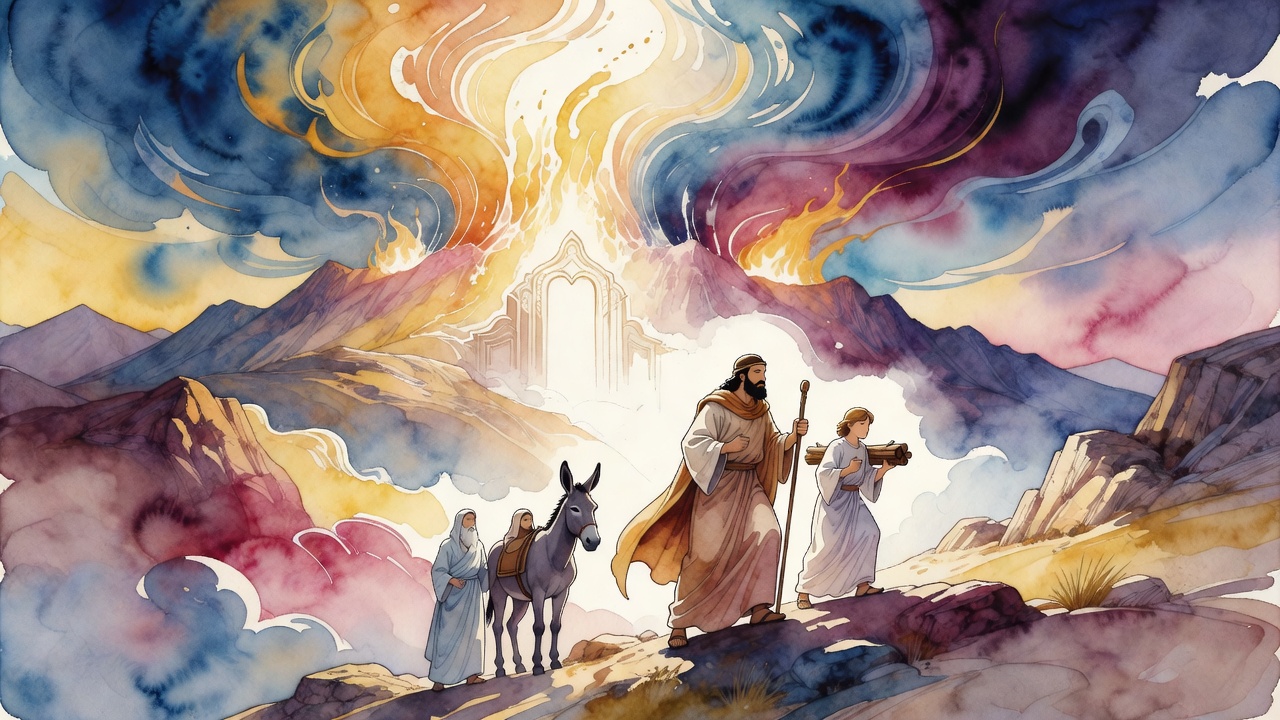
Immediately, "Abraham rose early in the morning, saddled his donkey, and took his two young men with him" (Genesis 22:3). He approached and descended. He went on the first day and walked the whole day. Since he saw nothing, he turned back until the third day. "Abraham lifted his eyes and saw the place from afar" (Genesis 22:4). Why did he not see it on the first day? So that the nations of the world would not say, "He was panicked and did not know where he was going." Therefore he did not see it on the first day or the second day. Only on the third day did he see from afar a cloud tied to one mountain. He said to Isaac, "My son, do you see anything on the mountain?" Isaac said to him, "I see one cloud tied upon the mountain." He asked the young men and said to them, "Do you see anything?" They said to him, "No." He said to them, "Since my donkey does not see it and you do not see it, 'Stay here with the donkey'" (Genesis 22:5).
"I and the lad will go ad koh" (Genesis 22:5). It is not written "until here," but "ad koh." Rabbi Joshua ben Levi said: let us go and see what comes of the speech He said to me, "So shall your seed be" (Genesis 15:5). What is "and we will return to you" (Genesis 22:5)? Since he did not say, "I will return," you first derive that he did not inform them that he was going for a sacrifice. Another interpretation: "and we will return to you." "The arrangements of the heart belong to man, but the answer of the tongue is from the LORD" (Proverbs 16:1), for he was given tidings that Isaac would return to him.
Immediately, "Abraham took the wood of the burnt offering and placed it upon Isaac his son, and he took in his hand the fire and the knife... Isaac said to Abraham his father... Behold the fire and the wood, but where is the lamb for a burnt offering?" (Genesis 22:6-7). Abraham said to him, "God will see for Himself the lamb" (Genesis 22:8). He will prepare His offering. And if there is no lamb for the burnt offering, my son, then the phrase means, in an obscure Greek gloss preserved by the source: you are the offering. Even so, "the two of them went together" (Genesis 22:8). What is "together"? Isaac was not distressed by what his father said to him. Just as this one was glad to offer, so this one was glad to be offered. Abraham was glad to bind, and Isaac was glad to be bound. Abraham was glad to slaughter, and Isaac was glad to be slaughtered.
As Isaac was walking with his father, what did Ha-Satan do? He came and stood to Isaac's right. He said to him, "Poor son of a poor woman. How many fasts did your mother fast, and how many prayers did she pray before you came to her? And this old man has become deranged in his old age and is going to slaughter you." Immediately Isaac turned his face to his father. He said to him, "Father, see what this man said to me." Abraham said, "He came to weary you. 'God will see for Himself the lamb.'"
Immediately, "They came to the place that God had told him, and Abraham built the altar there" (Genesis 22:9). Why did Isaac not build with him? Abraham said, "Lest a stone or pebble fall on him, make a blemish in him, and disqualify him from the offering." He built the altar, arranged the wood, and bound Isaac upon it. Abraham took the knife to slaughter him. Isaac said to him, "Father, bind me by my hands and my feet, for the soul is bold. I may see the knife coming upon me, jerk, and be disqualified from the offering." His father tied him. When he came to place the knife on his neck, the angels came and wept and cried out before the Holy One, blessed be He, as it is said, "Behold, their valiant ones cry outside" (Isaiah 33:7).
What were they crying? "The highways are desolate; the wayfarer has ceased; he has broken the covenant" (Isaiah 33:8). Where is the reward of those who pass on the roads, to whom Abraham made You known in the world? "The wayfarer has ceased." The reward of the guests who came from every place and lodged with Abraham to eat freely and make You blessed in the world has been nullified. "He has broken the covenant." Are You breaking the covenant that You said to Abraham, "My covenant I will establish with Isaac" (Genesis 17:21)? The knife is on his neck. Until when will You wait? Rabbi Berekhiah said: "They cried outside" is written as if "outside" means "the barrier is in Your hand," in an obscure wordplay preserved by the edition.
Immediately the Holy One, blessed be He, said to Michael, "Why are you standing? Do not let him." Michael began to call him: "The angel of the LORD called to him from heaven and said, Abraham, Abraham" (Genesis 22:11), twice, because Abraham was hastening to slaughter him. Michael was crying to him like a person shouting from distress, "What are you doing?" Abraham turned his face toward him. He said to him, "What are you doing? Do not stretch out your hand against the lad" (Genesis 22:12). Abraham said to him, "Then I will strangle him." He said, "Do not do anything to him" (Genesis 22:12). Abraham said to him, "Apart from this and apart from that, the Holy One, blessed be He, told me to offer my son, and you tell me not to offer him?" Immediately the Holy One, blessed be He, leapt upon him, as it were, and said, "By Myself I have sworn, says the LORD, because you have done this... your son, your only one" (Genesis 22:16).
What is "your only one"? It teaches that Abraham said to the Holy One, blessed be He, "When a person tests his fellow, he does not know what is in his heart. You know what is in hearts, and still You tested me. Was it not revealed before You, Merciful One, that I would slaughter him?" The Holy One, blessed be He, said to him, "It was revealed and foreseen before Me. Even your own life, if I had asked it from you, you would not have withheld it. 'Deliver my soul from the sword, my only one from the hand of the dog'" (Psalms 22:21). Abraham said to Him, "Why did You do this to me?" The Holy One, blessed be He, said to him, "Because I wanted to make you known in the world, that I did not choose you from all the nations for nothing: 'For now I know that you fear God'" (Genesis 22:12).
Immediately, "Abraham called the name of that place the LORD will see, as it is said today, On the mountain of the LORD it shall be seen" (Genesis 22:14). Rabbi Jeremiah said: Abraham said to Him, "Master of the Universe, it was revealed before You that I had what to answer You when You told me to offer Isaac. If I had answered You, You would have had nothing to answer me, for I would have said to You: yesterday You told me, 'In Isaac shall seed be called for you' (Genesis 21:12), and now You tell me to slaughter him. But I did not answer You. I made myself like a mute and like a deaf man: 'I am like a deaf man; I do not hear, and like a mute man who does not open his mouth' (Psalms 38:14). When Isaac's children are judged before You on this day, even if they have many accusers accusing them, just as I was silent and did not answer You, so You should not set them against them."
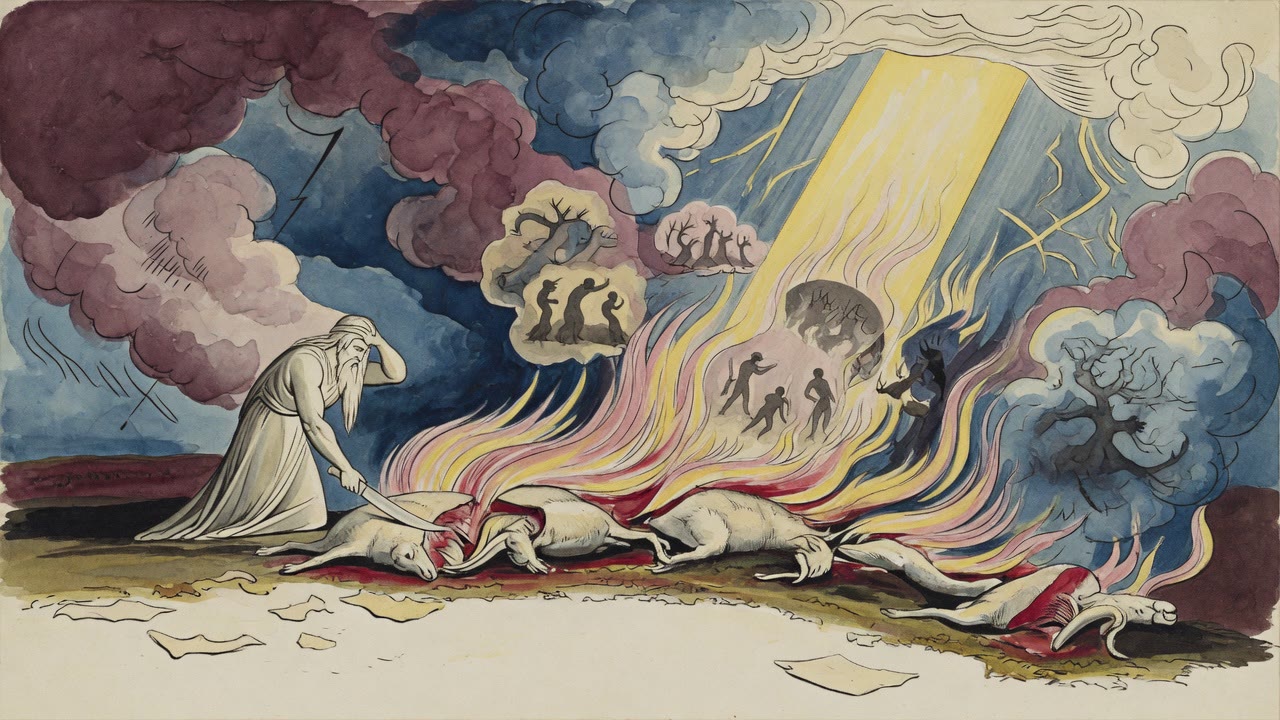
"Abraham called the name of that place the LORD will see, as it is said today" (Genesis 22:14). What is "today"? It means a day like this day, because it was Rosh Hashanah. The Holy One, blessed be He, said to him, "So I will do." Abraham said to Him, "Swear to me." Immediately, "By Myself I have sworn, says the LORD" (Genesis 22:16). This is "in the seventh month." Rabbi Berekhiah said: in the month of the oath. Abraham said to Him, "Am I going away without an offering?" The Holy One, blessed be He, said to him, "Lift your eyes and see the offering behind you." "Abraham lifted his eyes and saw, and behold, a ram" (Genesis 22:13). "He offered it up as a burnt offering in place of his son" (Genesis 22:13). Rabbi Benayah said: Abraham offered its sacrificial portions and said, "These are the sacrificial portions of Isaac my son." For each thing he said, "Let this be before You as if I had offered Isaac my son," as in the matter that says, "Jotham his son reigned in his place" (II Kings 15:7).
What is "behind, caught in the thicket" (Genesis 22:13)? The Holy One, blessed be He, said to him, "See what is before you. Your children who stand after you, when they are entangled and caught in transgressions, what do they do? With its horns. They take these horns and sound them, and I remember the binding of Isaac and acquit them in judgment." What is the business of the shofar? Like a person who brings in through this one and brings out through that one, so your children, even if they have many accusers, I bring them in through this and bring them out through this. Moses said to them, "Thus the shofar is your defender. Take shofars on Rosh Hashanah and sound them: 'In the seventh month, on the first of the month.'"
Another interpretation of "In the seventh month." This is what Scripture says, "Surely all human beings are vapor; the sons of man are deceit. In the balances they rise; together they are lighter than vapor" (Psalms 62:10). What is "surely vapor are they"? All the vapors and all the falsehoods that Israel falsely does all the days of the year come into account in the balances to rise in the seventh month, under the seventh constellation, which is Libra, the scales. And which month is this? Tishrei. Thus Rabbi ben Marya expounded: what is Tishrei? Tishrei, release and forgive our debts. When? "In the seventh month." The Holy One, blessed be He, said: "In this world, through the shofar I had mercy on you. In the future too, I will have mercy on you through the shofar and bring your redemption near." From where? From what is read in the Prophets: "Blow the shofar in Zion; sound an alarm... for the day has come, for it is near" (Joel 2:1).

 Click for full size