Parshat Lech Lecha6 min read

Abraham Saw Gehinnom in the Smoke Between the Pieces

Abraham cuts the covenant animals at God's command. When darkness falls, fire passes through the pieces and shows him hell.

Curated by Arthur · Told by Maggid ·
Table of Contents
  1. The Animals and Their Secret Weights
  2. The Deep Sleep That Was Not Sleep
  3. What Waited in the Smoke
  4. The Smoking Furnace Speaks Two Things at Once
  5. What God Promised in the Dark

The Animals and Their Secret Weights

Abraham had fought kings and stood before God and argued over Sodom, but this command was different. God told him to bring a heifer, a goat, a ram, a turtledove, and a pigeon. To cut the larger animals in half and lay the pieces opposite each other. To wait.

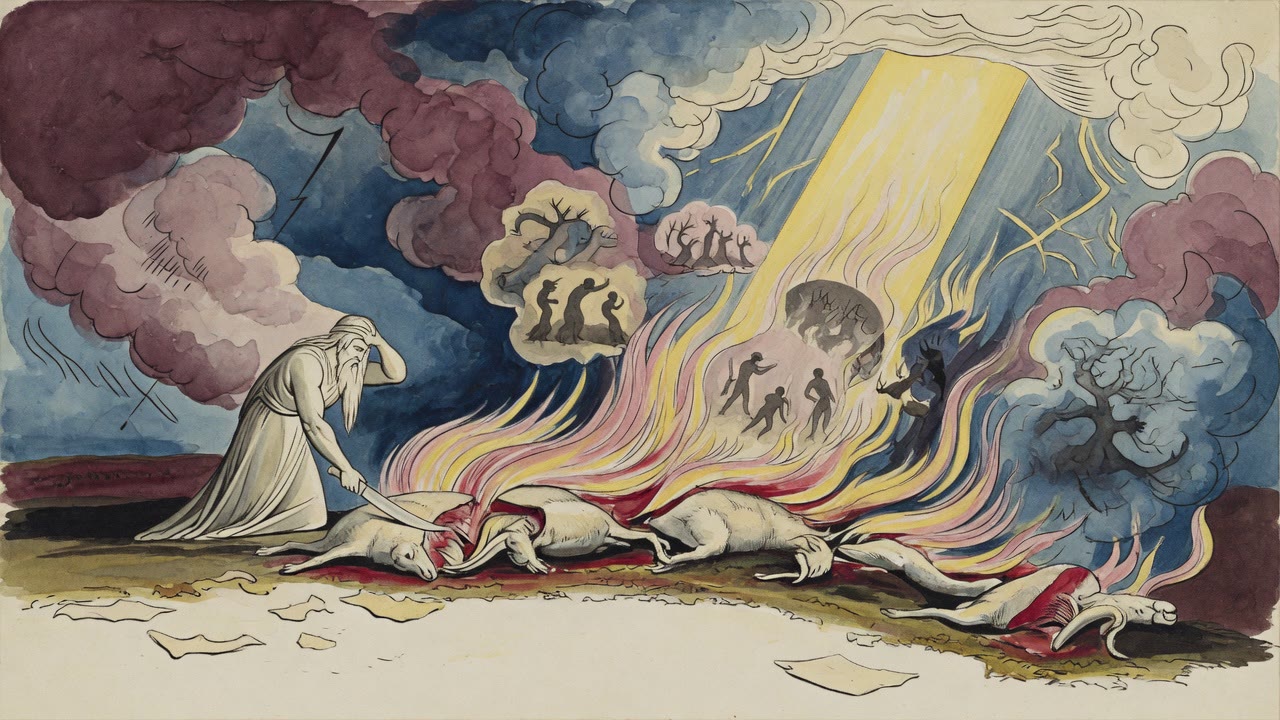
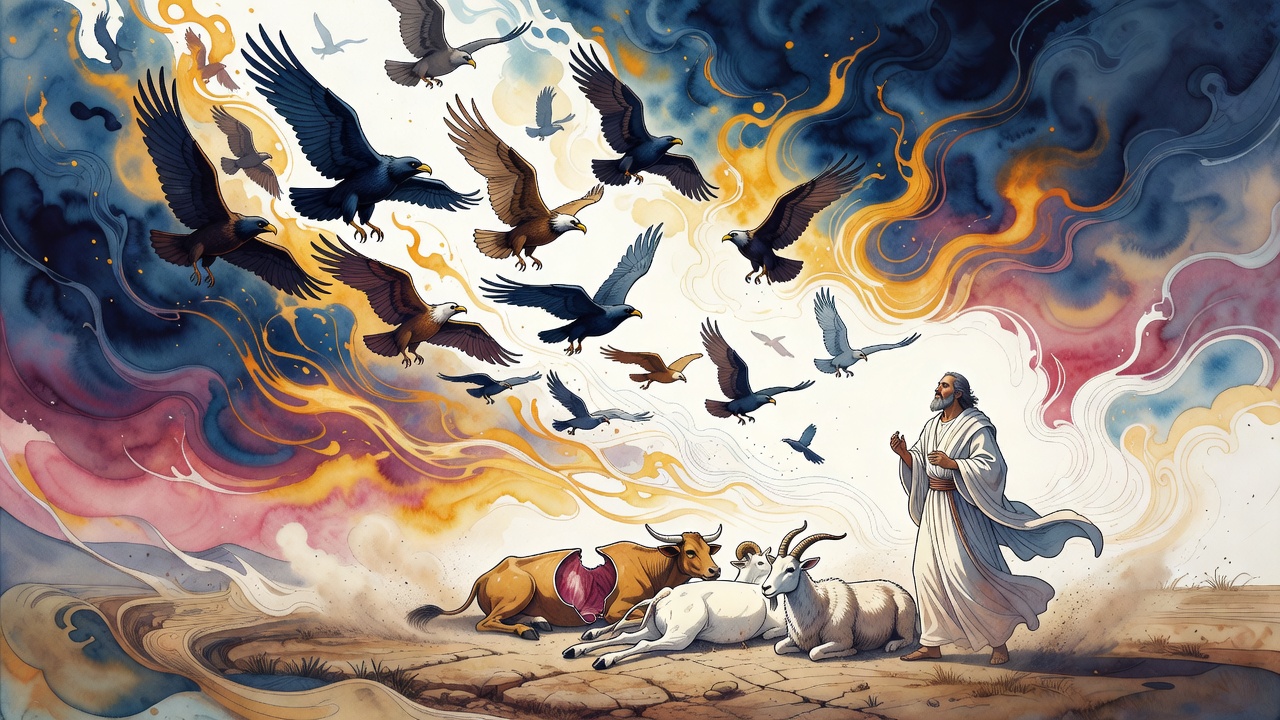
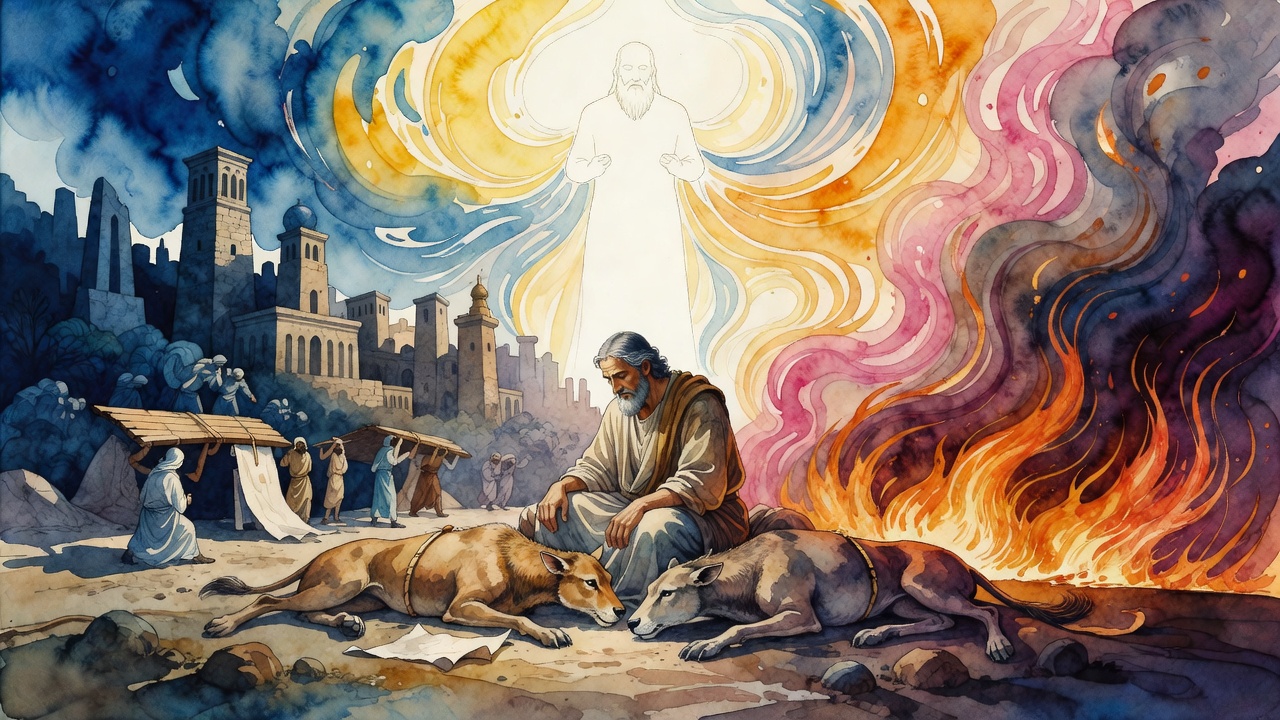
Abraham brought the animals and did what was required. He laid the pieces on the ground and drove away the birds of prey that descended to feed on the carcasses. He waited for evening. What he did not know, and what the sages later revealed, was that each of those animals carried a hidden weight. The three-year-old heifer was not simply a heifer. She held within her form all the bulls Israel would one day offer on the altar: the bull of Yom Kippur, the communal bull for forgotten commandments, the bull sacrificed when the whole congregation had strayed into idolatry. The goat held the Yom Kippur goat, the New Year goat, the goat offered for idolatry. Every animal split open on that ground was a prophecy about every altar that would be built centuries later.

Abraham was cutting into the future of his descendants' worship, dividing it and laying it open, without knowing what he held.

The Deep Sleep That Was Not Sleep

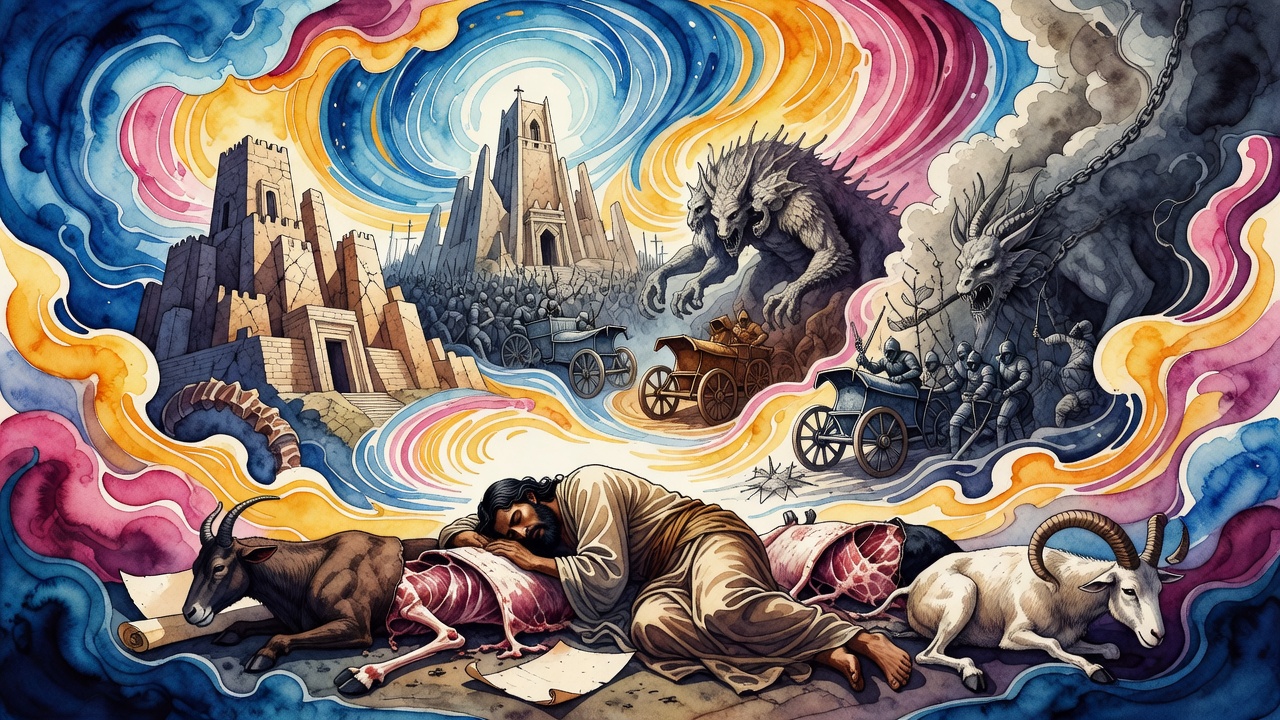
As the sun moved toward the horizon, a deep sleep fell on Abraham. But this was not ordinary rest. In the tradition, it was a divinely induced trance, what the text calls tardemah, the same word used when God put Adam under before taking his rib. Abraham's body was still but his mind was traveling.

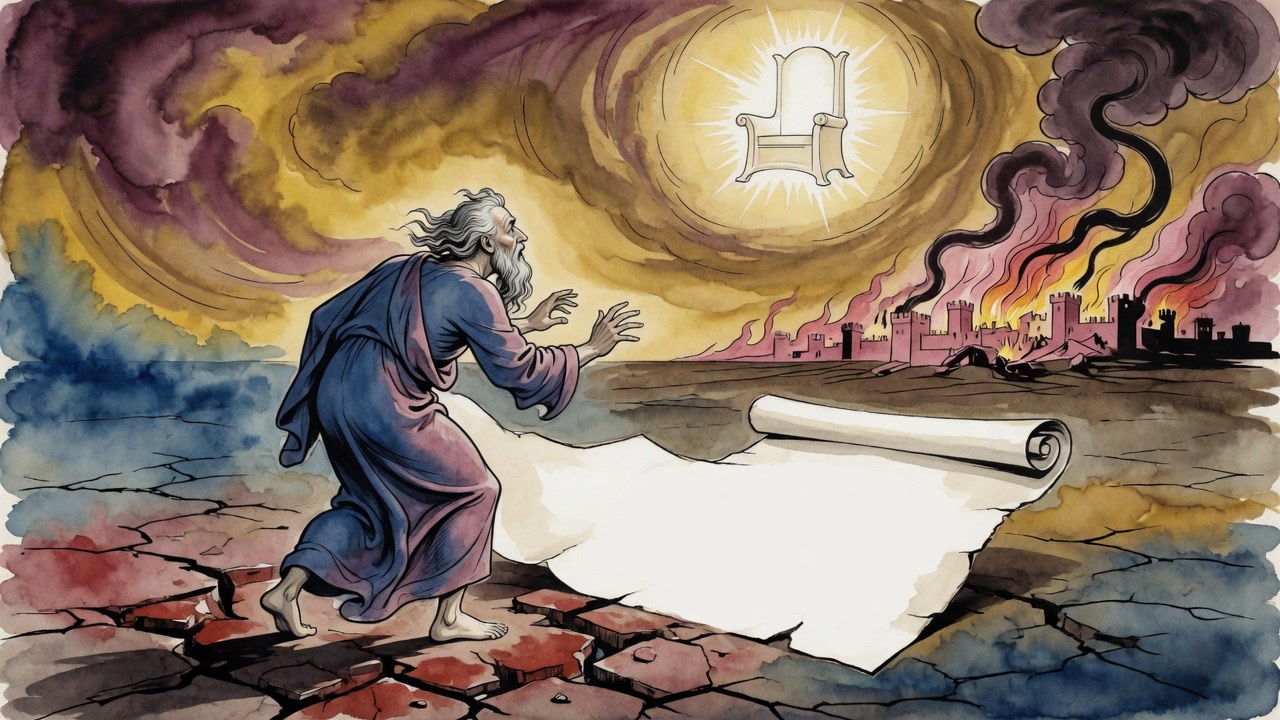
He saw four things descend upon him in that dark hour: terror, and darkness, and great fear, and dread. Each one was a separate weight. The commentators read these as four distinct futures: four empires that would successively oppress his descendants. Babylon, Persia, Greece, Rome. Each one pressing down in the vision with its own specific quality of darkness, its own texture of subjugation. Abraham felt the weight of Egypt, Babylon, Persia, and Rome all at once, in his body, before any of them existed.

What Waited in the Smoke

Then the sun went down completely, and the thick darkness came.

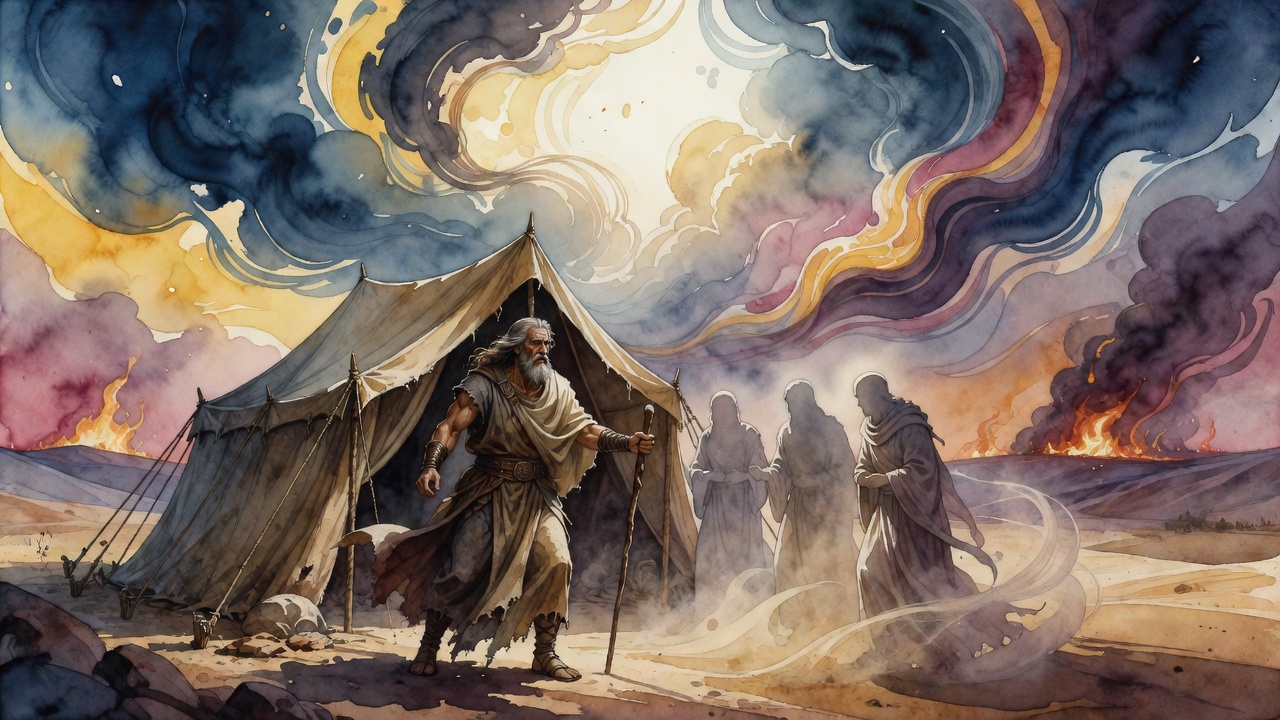
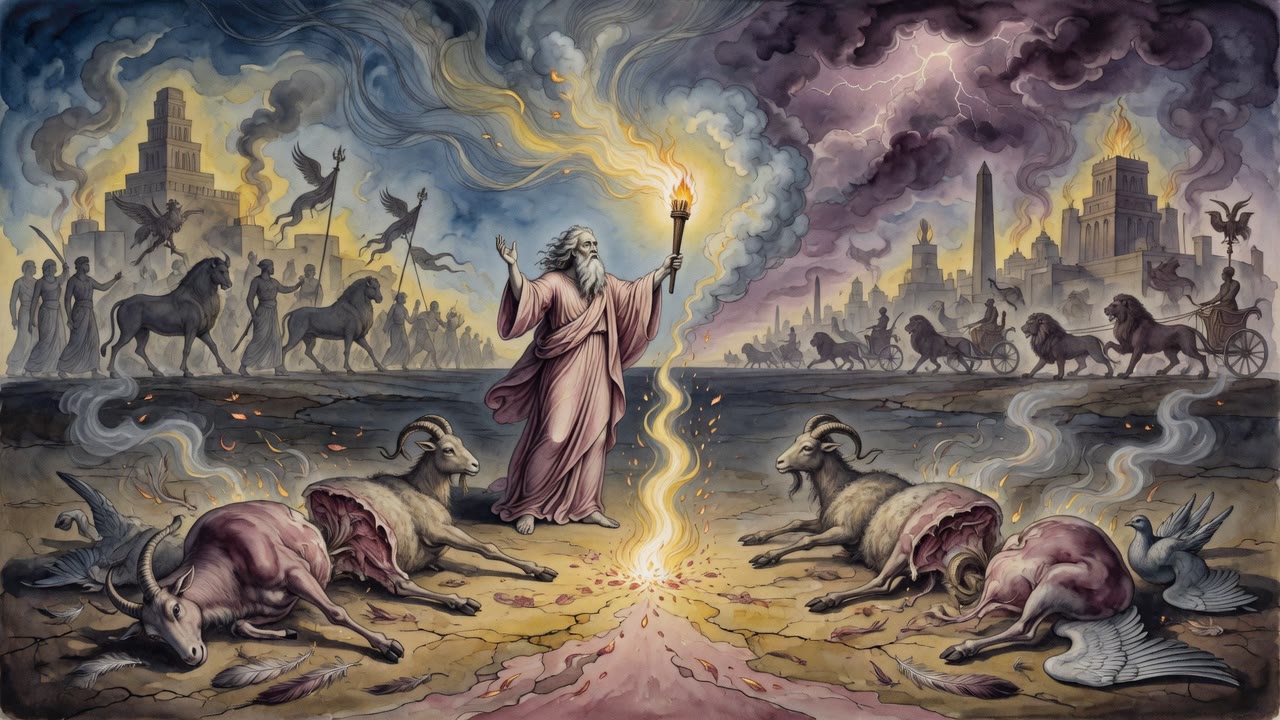
Targum Pseudo-Jonathan, translating the verse, does not soften what Abraham saw in the smoking furnace. The Aramaic text is direct: Abraham saw Gehinnom itself rising. Smoke. Flaming coals. Burning flakes of fire. The place where the wicked are judged. This was not a metaphor about difficult times. This was the actual abyss, visible to Abraham between the pieces of the covenant animals he had cut.

Through that fire, the glory of God passed.

The covenant was not being sealed in a garden, in a place of beauty and safety. It was being sealed in the presence of the worst thing Abraham could be shown. The agreement between God and Abraham's line was made with hell visible, with the consequence of wickedness burning in plain sight. Whoever entered this covenant had to know what lay outside it.

The Smoking Furnace Speaks Two Things at Once

Bereshit Rabbah, the great midrashic commentary on Genesis, read the scene as speaking in two directions simultaneously. The smoking furnace was the exile of Israel, the long subjugation under foreign powers, the suffering promised in the covenant alongside the promise of survival. But it was also Gehinnom, the judgment that awaited those nations which had oppressed Abraham's children. The same fire. Two different meanings depending on which direction you were looking.

The flaming torch that passed between the pieces was God's own presence, moving through the divided animals, completing the covenant in the ancient form of treaty-making in which both parties walk through the halved carcasses and commit themselves to the terms. For God to walk between those pieces was for God to say: if I break this covenant, let what happened to these animals happen to me.

It was an extraordinary commitment, and Abraham saw it from the ground, in the dark, with the smoke of Gehinnom still rising beside him.

What God Promised in the Dark

Out of the vision came the covenant's terms. The descendants of Abraham would be strangers in a land not theirs. They would be afflicted four hundred years. Then judgment would come on the nation that had enslaved them, and his descendants would go free with great wealth. Abraham himself would die in peace at a good old age. And in the fourth generation they would return, because the sin of the Amorites was not yet complete enough for their expulsion.

The land was named: from the river of Egypt to the great river, the Euphrates. The borders of an inheritance that did not yet exist, drawn out in the dark beside the divided animals, with Gehinnom burning nearby and the torch of God's presence passing between the pieces.

Abraham had asked God for proof. God had given him a vision that would be harder to forget than reassurance.


← All myths
From the tradition

Sources

6 sources

The texts this telling draws on, in full. Open a card to read inline, or expand it for a wider, quieter read.

Legends of the Jews, V. Abraham, The Covenant Of The PiecesLegends of the Jews

God revealed Himself to Abraham shortly after, to ease his conscience about the spilling of innocent blood, a scruple that caused him great anguish. God assured him that pious men would arise from his descendants, shielding their generations just as he had.

That wasn't all. God granted Abraham a rare gift: the permission to ask for anything he desired – a grace given to very few others, including Jacob, Solomon, Ahaz, and even the Messiah.

Abraham, ever mindful of his future generations, responded, "O Lord of the world, if in time to come my descendants should provoke Thy wrath, it were better I remained childless!" He even suggested that Lot, for whose sake he had journeyed to Damascus, would make a fine heir. Abraham, after all, believed he had read in the stars that he would have no children.

God, in a powerful moment, raised Abraham above the vault of the skies and declared, "Thou art a prophet, not an astrologer!"

Abraham, convinced, didn't even demand a sign regarding offspring. His simple faith earned him a share in this world and the world to come. The redemption of Israel from exile would be a reward for his unwavering trust.

However, Abraham, while believing in the promise, still wanted to know how his descendants would maintain themselves. Therefore, God instructed him to bring a sacrifice: three heifers, three she-goats, three rams, a turtle dove, and a young pigeon. These animals, God explained, represented the various sacrifices to be brought in the Beit Hamikdash, the Temple, to atone for Israel's sins and ensure their well-being.

But what would become of them, Abraham asked, after the Temple’s destruction? God responded that if they read the order of sacrifices as written in the Scriptures, He would consider it as if they had offered the sacrifices, forgiving their sins.

Then, God revealed to Abraham the sweep of Israel's history and the history of the world itself. According to tradition, the three-year-old heifer symbolized the dominion of Babylon, the she-goat represented the Greek empire, and the ram stood for the Medo-Persian power. The rule of Ishmael was also represented by a ram, and Israel was symbolized by the innocent dove.

Abraham took the animals and divided them in the middle, a symbolic act that, had it not been performed, would have left Israel unable to resist the power of the four kingdoms. The birds, however, he did not divide, signifying that Israel would remain whole. When birds of prey descended upon the carcasses, Abraham drove them away, foreshadowing the arrival of the Messiah, who would cut down the heathen. Yet, Abraham bid the Messiah to wait until the appointed time.

This scene, often called the Brit Bein Habetarim, the Covenant of the Pieces, is described in Genesis 15.

Not only was the Messianic time revealed to Abraham, but also the time of the resurrection of the dead. As he arranged the halves of the animals, they miraculously came back to life as the bird flew over them.

While preparing these sacrifices, Abraham received a vision of profound significance. As the sun set, a deep sleep fell upon him, and he saw a smoking furnace – Gehenna, the place God prepares for sinners. He also beheld a flaming torch, representing the revelation at Sinai, where the people saw flaming torches. He saw the sacrifices to be brought by Israel. And then, an "horror of great darkness" fell upon him, symbolizing the dominion of the four kingdoms.

God spoke to Abraham, explaining that as long as his children fulfilled the two duties of studying the Torah and performing the service in the Temple, they would be spared Gehenna and alien rule. However, if they neglected these duties, they would suffer the consequences. God then offered Abraham a choice: punishment through Gehenna or through the dominion of strangers.

All day long, Abraham wavered. Finally, God urged him to decide on one, and to choose the dominion of the stranger. Then, God revealed the four hundred years of bondage in Egypt, reckoning from the birth of Isaac. However, Abraham himself was promised that he would go to his fathers in peace, untouched by the arrogance of the oppressor.

As we find in Midrash Rabbah, it was also revealed to Abraham that his father, Terah, would have a share in the world to come, having repented for his sins. Ishmael would turn toward righteousness while his father was still alive, and Esau would not begin his impious ways until after Abraham’s death.

And so, alongside the promise of deliverance, Abraham received the announcement of slavery for his descendants in a foreign land. But it was also revealed to him that God would judge the four kingdoms and ultimately destroy them.

The Covenant of the Pieces, then, is not just a story about sacrifice and prophecy. It's a story about faith, responsibility, and the enduring relationship between God and Israel. It's a reminder that even in the darkest of times, there is always hope for redemption. And perhaps most powerfully, it is a reassurance that our actions, both good and bad, have consequences that ripple through generations. What kind of legacy are we building today?

Full source
Midrash Aggadah, Genesis 15:9Midrash Aggadah

"And He said to him: Take for Me a three-year-old heifer." This is the bull of the Day of Atonement, and the bull of the congregation for the other commandments, and the bull of idolatry. "And a three-year-old female goat." These are three goats: the goat of the Day of Atonement, the goat of the New Year, and the goat of idolatry. "And a three-year-old ram." These are the three rams that Israel would offer: the guilt-offering ram for one who commits sacrilege against holy things, and the guilt-offering ram for one who misappropriates a deposit, and the ram of the Nazirite. "And a turtledove and a young pigeon." Turtledoves and young pigeons that the poor man brings, as it is said, "and he shall bring his guilt-offering to the LORD" (Leviticus 5:6).

Full source
Legends of the Jews 5:125Legends of the Jews

The Torah touches on this in the Brit Bein Habetarim (ברית בין הבתרים), the Covenant Between the Pieces, in Genesis 15. But the story doesn't end there. The Legends of the Jews fills in some fascinating details, giving us a glimpse into a profound vision Abraham himself experienced.

Abraham is preparing sacrifices, a sacred act of devotion. As the sun dips below the horizon, a deep slumber overtakes him. But this is no ordinary sleep; it’s a divinely granted vision, a window into the future of his descendants.

What does he see? He beholds a terrifying image: a smoking furnace, none other than Gehenna (גהנם), the Jewish concept akin to hell, the place God prepares for the wicked. Then, a flaming torch appears, representing the revelation at Sinai, where the entire nation witnessed fiery displays of God’s power. He sees the sacrifices that Israel will offer, a continuation of his own sacred service. And finally, a chilling darkness descends, the oppression of four kingdoms that will rule over his people. Then, God speaks to Abraham. According to Ginzberg's retelling in Legends of the Jews, God explains that as long as Abraham's children uphold two crucial duties – studying the Torah (תורה), and performing the Temple service – they will be spared the horrors of Gehenna and foreign domination. But if they neglect these duties, they will face these very punishments.

Here’s the kicker: Abraham is given a choice. Should his descendants suffer punishment in Gehenna, or through subjugation by foreign powers?

Can you imagine the weight of that decision? All day long, Abraham struggles, torn between these two terrible options. Finally, God intervenes, urging him to choose the dominion of the stranger.

Why?

Perhaps because earthly suffering, while painful, is temporary. As we find in Midrash Rabbah, the bondage of Israel in Egypt for four hundred years was revealed to him, calculated from the birth of Isaac. It was also revealed that Abraham himself would not experience the full brunt of this oppression. A promise was given that he would go to his fathers in peace. At the same time, his father Terah, who had repented for his sins, would have a share in the world to come.

Abraham learns that his son Ishmael will find righteousness during Abraham's lifetime, and his grandson Esau will not begin his wicked ways until after Abraham's death. It’s a interplay of good and bad, of promise and suffering, all interwoven.

But the vision doesn't end with doom and gloom. Just as Abraham received the prophecy of his descendants' enslavement, he also received the assurance of their ultimate deliverance. God would judge the four kingdoms and ultimately destroy them.

So, what are we to make of this ancient story? Is it a comforting tale? A terrifying warning? Perhaps it's both. It reminds us that our choices have consequences, not just for ourselves, but for generations to come. And it offers a glimmer of hope, a promise that even in the darkest of times, redemption is always possible. The Zohar tells us that even the darkest night eventually gives way to dawn.

Full source
Targum Pseudo-Jonathan on Genesis 15:17Targum Pseudo-Jonathan on Genesis

When the sun went down on the covenant between the pieces, Targum Pseudo-Jonathan on (Genesis 15:17) turns the Hebrew's smoking furnace and flaming torch into something far more vivid. Abraham, the Targum says, saw Gehinnam itself rising, smoke, flaming coals, and burning flakes of fire, the place wherewith the wicked are to be judged.

Through that fire, the glory of the Lord passed between the divisions of his offering.

The imagery is meant to unsettle. The covenant is not being sealed in a gentle cloud. It passes through the future itself, through the fires of judgment, through the smoking furnace of empires and exiles and moral accounting. And emerges on the other side unbroken. The Lord is the One who walks between the pieces. The Lord is also the One who walks through Gehinnom's smoke.

The Maggid hears the message Abraham received that night. Your descendants will pass through terrible fires (Genesis 15:12). Empires will try to harvest them like birds of prey (Genesis 15:11). A furnace is coming. But the same Presence that sets the flame is also walking through it, from your side to the far side, on behalf of your children (Genesis 15:17). You are not alone in the fire. The covenant is exactly what stays lit when everything else burns.

Full source
Bereshit Rabbah 44:21Bereshit Rabbah

What in the world is going on here?

The Rabbis of the Midrash (rabbinic interpretive commentary), those ancient interpreters of scripture, were just as captivated by this verse as we are. They saw in it layers of meaning, a glimpse into the future of Abraham's descendants, the Jewish people. Bereshit Rabbah, a classic collection of rabbinic interpretations on the Book of Genesis, dedicates a section to unpacking this very scene.

The verse begins, “It was when the sun had set, that there was extreme darkness [alata].” Now, alata is a pretty rare word. So, the Midrash explains it by connecting it to the Aramaic word arafel, which Onkelos uses in his translation of (Exodus 20:18) to mean "thick mist." (Onkelos was a famous translator of the Torah into Aramaic). So, this darkness wasn't just ordinary darkness; it was a heavy, almost tangible darkness, a mist that obscured everything.

Then, things get even more intense: "Behold, there was a smoking furnace, and a flaming torch.” Rabbi Yoḥanan, in the name of Shimon bar Abba, offers a powerful interpretation. He says that God showed Abraham four things in this vision: Gehenna (hell), the Four Kingdoms, the giving of the Torah, and the Temple service. A smoking furnace representing Gehenna… a flaming torch symbolizing the giving of the Torah (think of the fire at Mount Sinai!). It's a potent and symbolic scene.

Rabbi Yoḥanan continues, telling us that as long as Abraham's descendants are engaged in two of these four things – Torah study and Temple service – they will be saved from the other two, Gehenna and subjugation by the Four Kingdoms. But if they abandon these two, they'll be subject to the punishments of the others. Heavy stuff. Then comes a fascinating question: which punishment did Abraham choose for his descendants? Did he choose Gehenna, or did he choose to be dominated by earthly Kingdoms? Rabbi Ḥanina bar Pappa suggests that Abraham chose the Kingdoms, seeing it as the lesser of two evils. He believed God agreed with his choice.

But, according to Rabbi Yudan, Rabbi Idi, and Rabbi Ḥama bar Ḥanina, Abraham actually chose Gehenna! But God, in his mercy, overruled him and chose the Kingdoms instead. They find support for this idea in (Deuteronomy 32:30): “Had their rock not given them over…and the Lord delivered them.” The "rock" refers to Abraham (as (Isaiah 51:1)–2 reminds us), and God ultimately made a different decision.

Rabbi Huna, citing Rabbi Aḥa, paints a picture of Abraham agonizing over this choice all day long. Finally, God tells him to stop worrying and that He will choose the Kingdoms.

What does all of this mean? It suggests that even in moments of divine covenant, there's still a human element, a wrestling with difficult choices. Abraham, the patriarch, is not just a passive recipient of God's promise; he's an active participant, confronting the potential consequences for his children.

The passage concludes with the verse, “On that day, the Lord established a covenant with Abram, saying: To your descendants I have given this land…” The Midrash circles back to the debate about Abraham's choice. Rabbi Ḥanina bar Pappa says that "saying" implies God agreed with Abraham's decision to choose the Kingdoms. But Rabbi Yudan, Rabbi Idi, and Rabbi Ḥama bar Ḥanina understand "saying" to mean that God disagreed with Abraham's choice of Gehenna and told him to choose differently. They see support for this in (Psalms 66:12): “You let people stand over our heads; we would have gone through fire and water” – meaning, God chose subjugation by the Kingdoms instead of the punishments of Gehenna.

And then, one final, beautiful image: Rabbi Yehoshua ben Levi sees in the phrase "passed between those pieces [gezarim]" a reference to the splitting of the Red Sea (which is also described using the word gezarim in (Psalms 136:1)3). So, within this vision of darkness and fire, there's also a hint of future redemption, a promise of salvation.

So, what do we take away from this intense and layered Midrash? Perhaps it's a reminder that even in our darkest moments, even when faced with impossible choices, there's always hope. There's always the possibility of divine intervention, a chance for redemption, and the enduring promise of a covenant that stretches across generations. And maybe, just maybe, that flaming torch is still guiding us today.

Full source
Pirkei DeRabbi Eliezer 28:9Pirkei DeRabbi Eliezer

The familiar version gives us the big moments in his life – the covenant, the almost-sacrifice of Isaac. But sometimes the quiet moments, the unspoken fears, reveal the deepest longings of the heart.

In Pirkei DeRabbi Eliezer, a fascinating text that weaves together biblical narrative and rabbinic interpretation, Abraham prayed that his descendants wouldn’t be enslaved by the four kingdoms. This wasn't a casual wish; it was a prayer of such intensity that it sent him into a deep sleep.

Wait a minute, you might be thinking. Sleep during prayer? Seems counterintuitive. The text acknowledges this, posing the question: "Does then a man lie down and sleep, and yet be able to pray?" It explains that Abraham's sleep wasn't ordinary. It was a direct result of the sheer power and desperation of his prayer. He was so consumed with protecting his children that the effort exhausted him.

The verse in (Genesis 15:12), "A deep sleep fell upon Abram," is then unpacked, layer by symbolic layer. And what follows is a powerful piece of allegorical interpretation. The "horror of great darkness" that fell upon him? It's a coded vision of the future.

"Horror," we're told, symbolizes the kingdom of Edom, often associated with Rome. The text points to (Daniel 7:7): "And behold a fourth beast, terrible and powerful, and strong exceedingly." This beast, this "horror," represents the oppressive force that would challenge Israel.

"Darkness" represents those who would try to obscure the light of Torah, preventing the Jewish people from observing its precepts. They cast a shadow, dimming the spiritual vision.

"Great" refers to the kingdom of Media and Persia, a kingdom so vast and wealthy that they could afford to "sell Israel for nought." It speaks to a time when the value of the Jewish people would be tragically underestimated.

"Fell" signifies the kingdom of Babylon, the empire that brought down the crown of Israel. As (Isaiah 21:9) declares, "Babylon is fallen, is fallen." The crown, a symbol of sovereignty and divine favor, was lost to them.

Finally, "Upon him" alludes to the Ishmaelites, upon whom the Son of David will flourish. The text sees a future where even those who might seem like adversaries will ultimately play a role in the redemption, as (Psalm 132:18) promises: "His enemies will I clothe with shame: but upon him shall his crown flourish." Abraham, lying in a deep sleep induced by his own fervent prayer, receives a glimpse into the future struggles of his descendants. He sees empires rise and fall, sees periods of darkness and oppression, but also glimpses the promise of ultimate redemption.

What does it mean to pray with such intensity that it changes your very state of being? And what can we learn from Abraham's fears about the future of his children, fears that resonate even today? Perhaps the lesson is that even in the face of "horror" and "darkness," the hope for a flourishing future, a future crowned with righteousness, remains a powerful force. A force powerful enough to move mountains, and perhaps, even to induce a prophetic sleep.

Full source