Parshat Lech Lecha5 min read

Abraham Fell on His Face Until the Covenant Let Him Stand

Before circumcision Abraham fell on his face at every word from heaven. After the covenant he stood, and the gate of Gehinnom (afterlife of judgment) closed.

Curated by Arthur · Told by Maggid ·
Table of Contents
  1. Face in the Dust
  2. The Cut That Taught Him to Stand
  3. A Chair at the Gate
  4. Free Will at the Edge of the Knife
  5. From Dust to Doorpost of Fire
Abraham Fell on His Face Until the Covenant Let Him Stand Click for full size

Face in the Dust

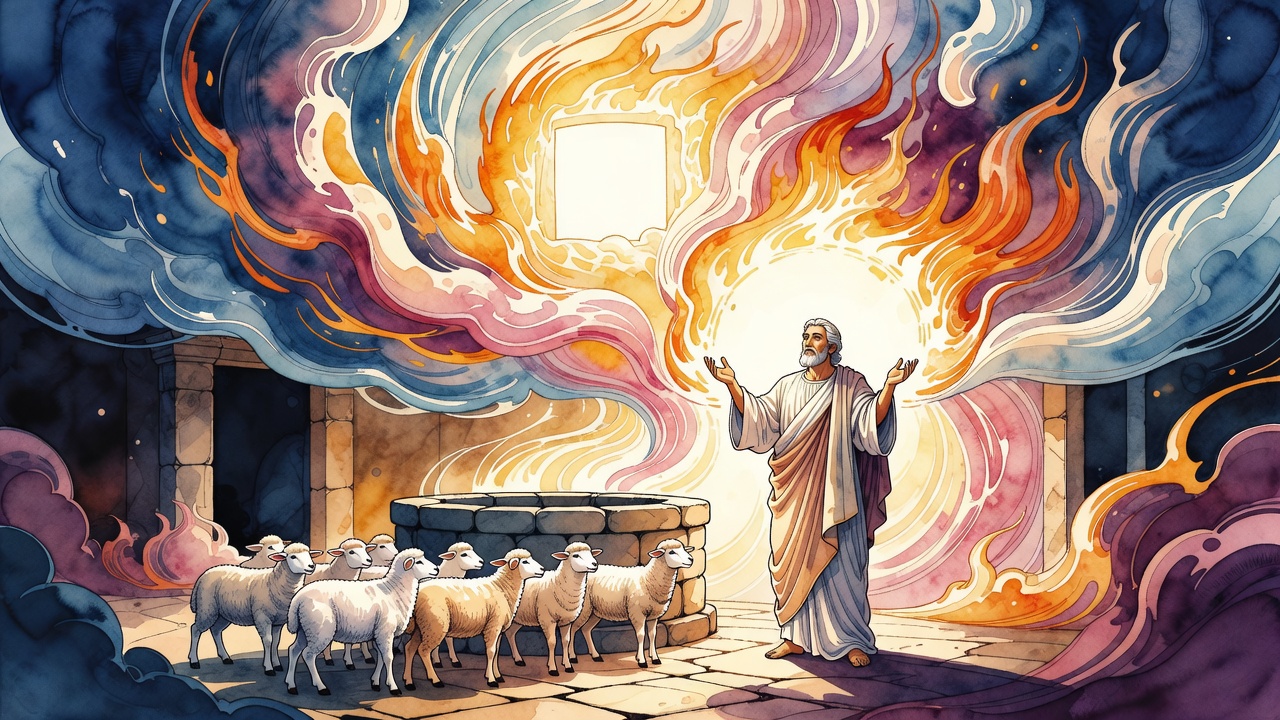
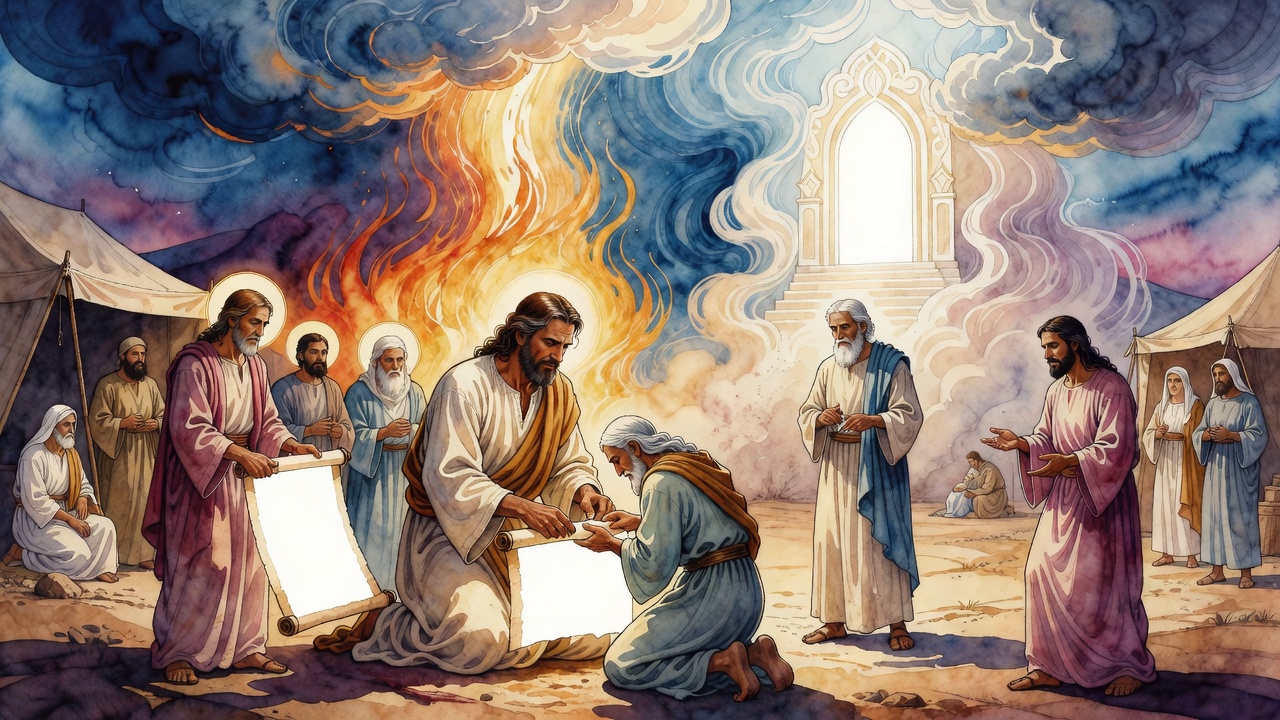
Before the knife of the covenant, Abraham could not meet the Shekhinah (God's indwelling Presence) on his feet. Whenever the Presence addressed him, he fell on his face, body lowered under the weight of a holiness he had not yet sealed in flesh. The midrash is exact about the posture. Prostration was his only grammar of approach. The ground knew his forehead better than any throne room would know his name.

He had already left home at the command to go, already fought kings for Lot, already cut animals for a covenant of pieces while a deep sleep and a dread of great darkness fell upon him. The mark in the body still waited. Until it came, standing before the Lord as a partner in speech was not his portion. Dust was.

The Cut That Taught Him to Stand

After circumcision, the posture changed. Abraham stood yet before the Lord, as the Torah shows him standing in the scene of Sodom's plea, bargaining numbers downward while the visitors looked toward the plain. The Holy One also appeared to him as he sat at the tent door in the heat of the day, a visit that honored a man recovering from the brit itself, God arriving before the angels in a condescension the midrash loves to notice.

Sitting and standing both became possible. The face-down terror was no longer the only way heaven and this man could occupy the same patch of earth. Circumcision, the Tanchuma insists, is so precious that the Holy One assured Abraham no one marked by this covenant would descend to Gehinnom (the fiery place of punishment after death). The uncircumcised nations listed after the land promise, Kenite and Kenizzite and Kadmonite and their company, are read as those who go down. Ezekiel and Isaiah supply the prophets' choruses of the uncircumcised laid in the netherworld, Asshur and Meshech and Tubal among the company of the sword.

The sign on the body became a seal against the pit. The man who wore it first learned to rise when spoken to.

A Chair at the Gate

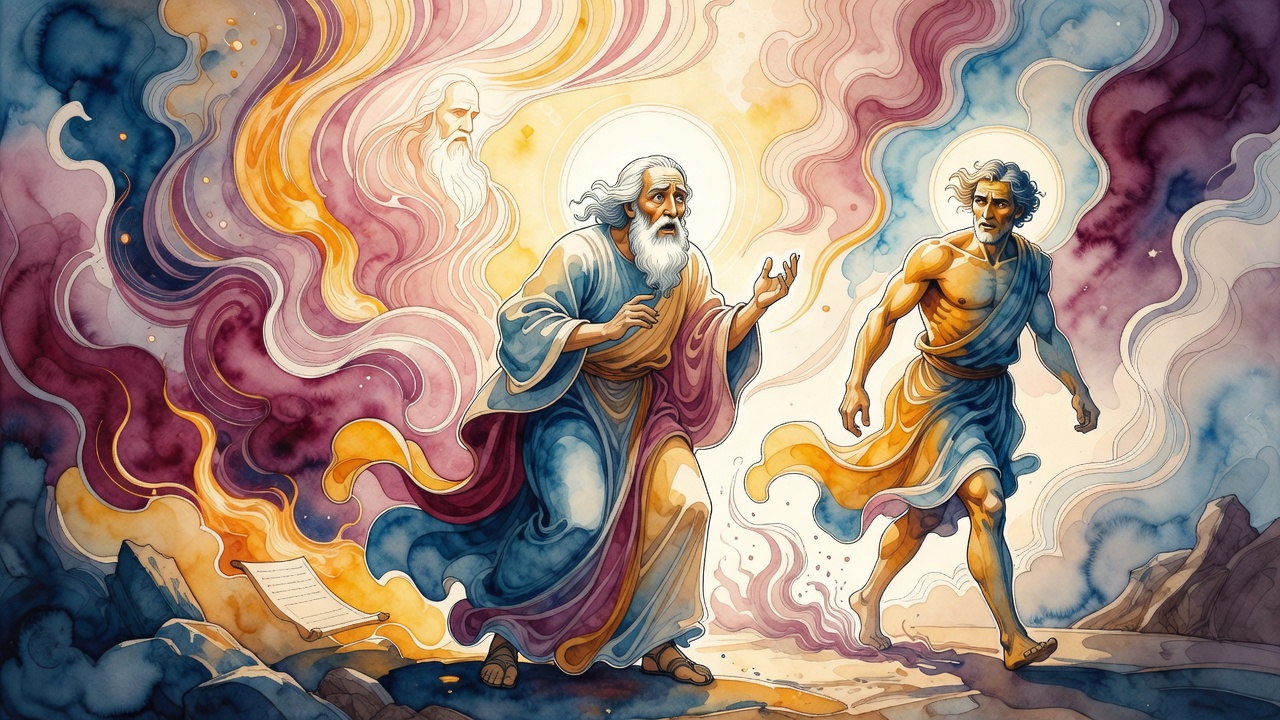
Later legend seats Abraham at the gates of Gehinnom on the Day of Judgment. He does not rule the fire. He intercedes and checks the line. Those who kept the covenant of circumcision are turned aside from entry by a grandfather who still works after death for sinners who carry his sign. The patriarch who once fell on his face now keeps a post at the edge of ruin, still arguing, still shielding, still taking responsibility for a mark that began with his own blood and pain.

The same streams of tradition remember Abraham's hospitality living on in Hebron, where Jews at the Cave of Machpelah argued for the right to host strangers who came to pray, as if each guest were spoil found in war and the winner of the argument rejoiced. The man of the brit was also the man of the open tent. Gate of judgment and door of welcome belonged to one character stretched across worlds.

Free Will at the Edge of the Knife

Rabbi Chanina ben Dosa's line of teaching, preserved in the circle of Pirkei DeRabbi Eliezer, stresses that those who come into the covenant from outside do so by consent and fear of Heaven, not by chain dragged across a courtyard. The mark is not a brand forced on the unwilling convert in the same mechanical way empire brands cattle. Abraham's household and the later gerim enter a bargain that must be wanted if it is to mean what the midrash says it means at Gehinnom's gate.

Abraham's own standing after the cut is the first image of that willing nearness. He does not become God. He becomes able to stand in conversation without collapsing, partner more than dust alone, still a creature, newly able to hold his spine under glory.

From Dust to Doorpost of Fire

The arc runs from face in the dirt to feet on the ground beside the tent to a chair at Gehinnom 's (the realm of judgment after death) mouth where names are sorted. Each stage is the same loyalty under a different height. The God who asked for the sign also changed how close the man could stand without breaking. The nations without the sign, in this severe midrashic map, still face the open mouth of the netherworld that Isaiah saw enlarged beyond measure for those without law.

Abraham's story does not end at the terebinths of Mamre with cakes and a calf. It ends, for these sources, wherever a marked soul is pulled back from the fire by a grandfather who once could not even stand when heaven spoke and who learned, through blood and obedience, how to rise, how to argue for Sodom, and how to keep a gate.


← All myths
From the tradition

Sources

3 sources

The texts behind this telling. Some cards carry a translation of the source; others are our own retelling of it, and each card says which. Every card links out to the original.

Midrash Tanchuma, Lech Lecha 20Midrash Tanchuma

Retold in our words. Read the original at the link below.Townsend 1989 translation of Midrash Tanhuma, S. Buber Recension · CC-BY

And Abraham fell upon his face (Gen. 14:3). Prior to his circumcision, Abraham prostrated himself whenever the Shekhinah (the Divine Presence) addressed him, but after he was circumcised, He remained standing, as it is said: And Abraham stood yet before the Lord (ibid. 18:22)., the Holy One, blessed be He, also revealed Himself unto Abraham while he sat, as it is said: And the Lord appeared unto him by the terebinths of Mamre, as he sat in the tent door (ibid., v. 1).

Circumcision is so precious to the Holy One, blessed be He, that He assured Abraham that no one who had been circumcised would descend unto Gehenna, as it is said: In that day the Lord made a covenant with Abraham, saying: “Unto thy seed I have given this land” (ibid. 15:18). Who will descend to Gehenna? The verse that follows informs us that the Kenites, the Kenizzites, and the Kadmonites, etc., will descend into Gehenna, since they were all uncircumcised. Ezekiel observed the uncircumcised descending to Gehenna, as it is said: Son of man, wail for the multitudes of Egypt, and cast them down, even her, with the daughters of the mighty nations, unto the nether parts of the earth…. go down, and be thou laid with the uncircumcised. They shall fall in the midst of them that are slain by the sword…. Asshur is there and all her company … There is Meshech, Tubal, and all her multitude; all round about her are her graves; all of them uncircumcised, slain by the sword (Ezek. 32:18–30).

Similarly, Isaiah declared: Therefore, the netherworld has enlarged her desire, and opened her mouth for those without law (hoq) (Isa. 5:14); that is, for those who have not observed the law of circumcision. Whence do we know that circumcision is called a law (hoq)? We know it from the verse And He established it unto Jacob for a statute (hoq), and to Israel for an everlasting covenant (Ps. 105:10). The Holy One, blessed be He, pulls down the foreskins of infidels and sinners in Israel who deny God and imitate the practices (huqim) of the nations, and even though they may be circumcised they descend to Gehenna, as is said: He hath put forth his hands against them that were at peace with him; he hath profaned his covenant (Ps. 55:21).

King Agrippa asked R. Eliezer: Inasmuch as the Holy One, blessed be He, considered circumcision so very important, why did He not include this precept among the Ten Commandments? He replied: Long before the Ten Commandments were given to Israel, the Holy One, blessed be He, had warned Israel concerning the fulfillment of the precept of circumcision, as it is said: Now, therefore, if you hearken unto My voice, and keep My covenant, ye shall be Mine own treasure from among all peoples (Exod. 19:5), and He said also: If My covenant be not with day and night (Jer. 33:25). The covenant referred to in these verses is the covenant of circumcision (b’rit milah).

Prior to this verse it is written: Considerest thou not what this people have spoken, saying: “The two families which the Lord did choose, He hath cast them off?” and they condemn My people, that they should be no more a nation before them (ibid., v. 24). What does this verse indicate? He saw how the men of Jerusalem provoked the Holy One, blessed be He, to anger, for even the priests who offered sacrificed in the Temple were uncircumcised, as it is said: In that ye have brought in aliens, uncircumcised in heart and uncircumcised in flesh, to be in My sanctuary, to profane it, even My house, when ye offer My bread, the fat and the blood, and they have broken My covenant, to add unto all your abominations (Ezek. 44:7), and it is written elsewhere: Thus saith the Lord God: No alien, uncircumcised in heart and uncircumcised in flesh, shall enter into My sanctuary, even any alien that is among the children of Israel (ibid., v. 9).

The kings of the House of David likewise abolished the precept of circumcision. Jehoiakim extended his own foreskin (to hide his circumcision), as it is said: Now the rest of the acts of Jehoiakim, and his abominations which he did, and that which was found upon him (II Chron. 36:8). What is the meaning of was found upon him? It means that he stretched his foreskin. Others maintain that this verse indicates that he tattooed his skin. Hence, we learn that both the priests and the kings abrogated the covenant of circumcision. The Holy One, blessed be He, declared: “I informed Aaron and David that their offspring would survive forever, as it is said: Ought you not to know that the Lord, the God of Israel, gave the kingdom over Israel to David forever, even to him and to his sons by a covenant of salt? (ibid. 13:5). And unto Aaron I swore: It is an everlasting covenant of salt before the Lord unto thee and to thy seed with thee (Num. 18:19). But they (their offspring) abrogated the covenant of circumcision!” The Holy One, blessed be He, declared unto the prophet: Go and say unto them: If ye can break My covenant with the day, and My covenant with the night, so that there should not be day and night in their season; then may also My covenant be broken with David, My servant, that he should not have a son to reign upon his throne; and with the Levites the priests, My ministers (Jer. 33:20–21). When the Israelites heard this, they cried out: Woe unto us, the two families which the Lord did choose, He cast them off (ibid., v. 24). The Holy One, blessed be He, responded to them: Consider thou not what this people have spoken, saying: The two families, etc. (ibid.). And He asked: “When were they cast off?” At the time they abrogated the commandment mentioned in the verse that follows: Thus saith the Lord, If My covenant be not with day and night, etc. (ibid., v. 25), and it says: Awake, awake, put on thy strength, O Zion, put on thy beautiful garments, O Jerusalem, the Holy City, for no more shall enter into thee henceforth the uncircumcised and the unclean (Isa. 52:1). Amen and so may it be Thy will.

Full source
Legends of the Jews 5:312Legends of the Jews

Retold in our words. Read the original at the link below.The Legends of the Jews by Louis Ginzberg (1909) · Public Domain

Not necessarily!

The Legends of the Jews hints that even after Abraham's passing, his work wasn't finished. It paints a picture of him continuing to intercede for sinners, not just in this world, but in the world to come!

It gets even more vivid. The tradition goes on to say that on the Day of Judgment – Yom haDinAbraham will be sitting right there at the gates of Gehenna, that's Hell, making sure that anyone who kept the covenant of circumcision, the brit milah, won’t have to enter. Now

About the lasting impact of our actions, and the possibility that goodness can ripple outwards, even beyond our own lives.

Speaking of goodness, the Legends of the Jews also shares a story about the Jewish community of Hebron, a place steeped in history because it houses the Cave of Machpelah, Me’arat haMachpelah in Hebrew. This is where Abraham, Sarah, Isaac, Rebekah, Jacob, and Leah are believed to be buried.

Back then, the Jewish community in Hebron was small, but what they lacked in numbers, they more than made up for in piety, goodness, and especially hospitality, hachnasat orchim. Whenever strangers arrived at the Cave of Machpelah to pray, these residents would practically argue over the privilege of hosting them!

A friendly squabble, all vying for the chance to offer food, shelter, and companionship. The one who "won" the argument, who got to welcome the visitor into their home, rejoiced, the story says, as though they had found a "great spoil." It wasn't about personal gain; it was about the joy of giving, the blessing of connecting with another human being.

What a beautiful contrast to our often self-centered world. This little story from Hebron shows us how a community, even a small one, can embody profound values and create a powerful sense of welcome. Maybe that's a little piece of what Abraham's legacy is all about, too.

Full source
Pirkei DeRabbi Eliezer 29:4Pirkei DeRabbi Eliezer

Retold in our words. Read the original at the link below.Pirke de Rabbi Eliezer, trans. Rabbi Gerald Friedlander, London (1916) · CC-BY

Within this ancient ritual, there's a curious detail, a specific day that holds particular significance.

The Pirkei DeRabbi Eliezer, a fascinating collection of stories and interpretations from the Talmudic period, explores this very topic. It brings up a teaching attributed to Rabbi Chanina ben Dosa, a sage renowned for his piety and miraculous deeds. What did Rabbi Chanina say? He noted that the third day after circumcision is often the most painful. As the Torah tells us regarding Jacob's sons and the people of Shechem, "And it came to pass on the third day, when they were sore" (Gen. 34:25).

Why this focus on the third day? Is it merely a biological observation, or is there something deeper at play? Perhaps it is a reminder that even in moments of profound connection, there can be discomfort, a challenge to overcome.

Here’s a crucial point: Jewish law, or halakha, prioritizes life and well-being above nearly all else. The Pirkei DeRabbi Eliezer goes on to say that if the third day falls on Shabbat, the Sabbath, we are still permitted to wash the child. All actions necessary for the circumcision itself are permitted on Shabbat. This highlights the delicate balance within Jewish tradition: honoring the sanctity of the Sabbath while prioritizing the health and welfare of the child entering into the covenant.

It's evidence of the flexibility and compassion built into the framework of Jewish law.

The text doesn't stop there. It emphasizes the importance of circumcision itself. "Every uncircumcised man shall not eat (of the Paschal offering), and shall not touch the sanctuary." Circumcision isn't just a physical act; it's a prerequisite for full participation in the community, particularly in sacred rituals like the Passover sacrifice.

And then comes the starkest statement of all: "He who separates himself from circumcision is like one separated from the Holy One, blessed be He." Strong words, aren’t they? It emphasizes the profound spiritual significance of brit milah. It's not merely a tradition; it’s a fundamental bond connecting us to God and to the generations that came before us.

So, what do we take away from this small but potent passage in Pirkei DeRabbi Eliezer? It’s a reminder that even ancient rituals are full of nuance and meaning. It’s about pain and healing, law and compassion, connection and separation.

It's a reminder that sometimes, the most profound connections require us to embrace moments of discomfort, knowing that on the other side lies a deeper sense of belonging. The commitments we make, and the price. And the reward, of keeping them.

Full source