The Eighth Day Knife and the Open Household
A newborn waits through one Shabbat, then the covenant knife gathers home-born, bought, and foreign sons under Abraham's tent.
Table of Contents
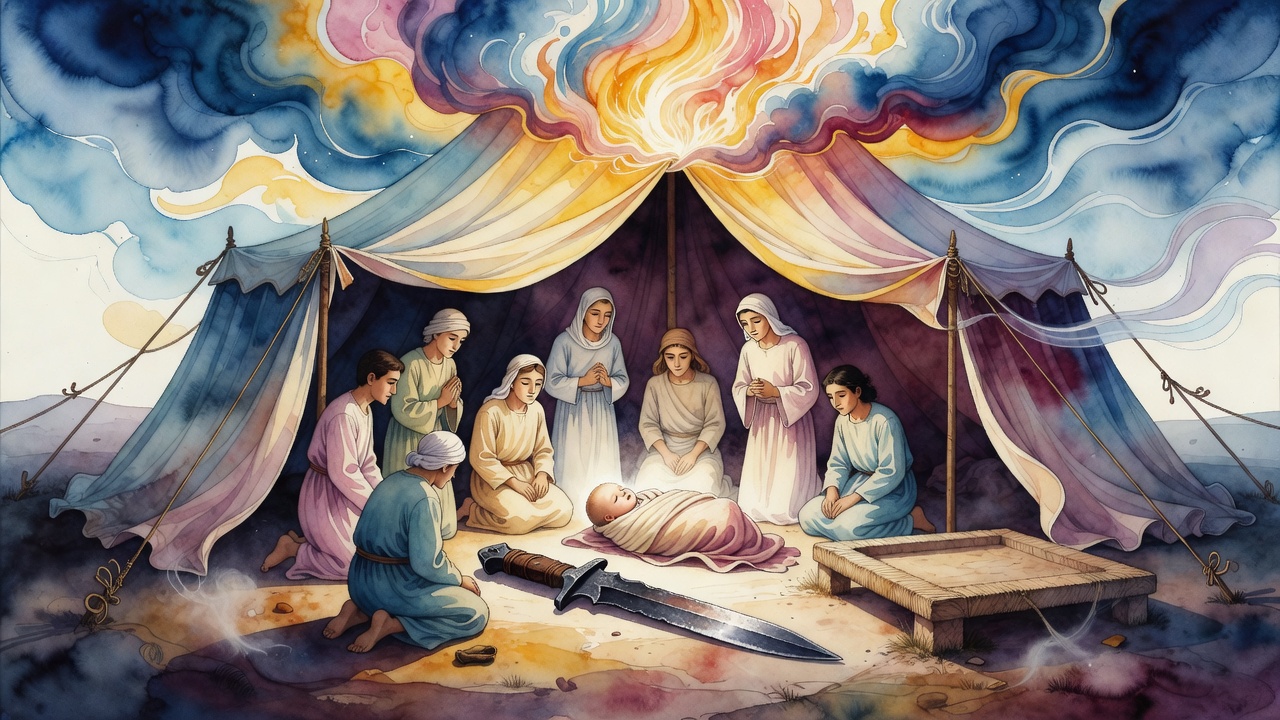
The infant slept through his first Shabbat without a mark on his body. The household counted the days with a care that made the servants walk softer. On the eighth morning the knife was ready, and the Targum's reading of the promise stood in the room like another relative. Every male in your generations. On the eighth day.
 Click for full size
Not only the child of the bloodline. Also he who is brought up in your house. Also he who is bought with your silver. And every son of the peoples who is not of you, any male from outside who has entered the household's life. The covenant refuses to stay a private gene.
Why the Universe Greets Him First
The eighth day is already heard in rabbinic thought as a late-Sabbath timing. The child lives through one full Shabbat before he is covenanted, as if the universe itself must greet him before the knife does. Creation's rhythm gets the first claim. Then the household's rhythm answers.
Abraham's tent does not rush the mark. It also does not leave the mark optional for those who live under its cloth.
The Servant Is Not a Tool
A foreign servant bought with silver is not inventory. He is a future covenant-bearer. The knife travels wherever the household travels. Ethical and theological work happen in one gesture. The body of the outsider is not excluded from the sign that binds the family to the Holy One.
On the eighth day the line between us and them thins at the skin. Belonging is a threshold, not a closed blood vault. Anyone inside Abraham's tent long enough receives the mark that says this house has one Owner.
When the Mark Is Treated as False
Centuries later the Tikkunei Zohar names the cost of treating that bond as theater. One who is false with the covenant of circumcision causes the Shekhinah (God's indwelling presence in the world) to withdraw, for She is the unity of the blessed Holy One. Into the vacated space comes a shed, a demon called other.
The eighth-day generosity and the later warning are one teaching in two times. Widen the circle of the mark. Then do not hollow the mark out. Presence clings to integrity. Otherness rushes into fraud.
Morning Light on a Small Body
The mohel's hand is steady. The infant's cry is short and large. Wine touches a lip. A name is spoken into the air of the tent. Around the circle stand free sons and bought sons and sons whose mothers came from other peoples. The knife does not ask for a pedigree chart. It asks for the household's truth.
Outside, the week will resume with goats and bargaining and dust. Inside, a body now carries a sign that the Shekhinah (the Divine Presence) recognizes as unity rather than as decoration. If that sign is kept, Presence has a place to rest. If it is falsified, the room cools, and something other takes the chair.
The Tent's Long Memory
Abraham looked at a child who was not only his and heard a promise that would outlast empires. The Targum keeps the circle wide. The Zohar keeps the stake high. Between them the eighth day remains a narrow gate with a wide welcome: wait for Shabbat's greeting, then cut a bond that even a foreign son may wear, then live as if the bond were real enough to host the Divine Presence or to lose Her.
The infant sleeps again. The household breathes. Somewhere above the tent the unity that the mark declares either draws near or, if the years ahead turn the sign into a lie, begins the long withdrawal that leaves only otherness behind.
Sarah is not in every version of the eighth-day scene, but the household is never only men with knives. Women count the days. Servants heat water. A bought son watches a free son and learns that the mark does not sort them into human and tool. The tent's theology is enacted in logistics: who holds the child, who says the blessing, who brings the cup.
Abraham heard that kings would come from him and that the covenant would cut through generations. The Targum insists the cut also runs sideways, into the economic life of the house. Silver can buy a body into the family's sacred schedule. That is a hard sentence for any age that prefers pure bloodlines or pure contracts. The Torah prefers a household holy enough to mark everyone it keeps.
When later ages treat the covenant as fashion or as empty ethnicity, the Zohar's warning activates. Shekhinah withdraws. Otherness rules. The eighth day's welcome becomes a door without a house behind it. Inclusion without integrity is a crowd. Integrity without inclusion is a locked room that was never Abraham's way. Both edges must be held edges of the blade.
Years after the cry of the infant, a man may touch the mark in private and remember that Presence once had an address on his body. If he has lived as if the address were real, the Shekhinah has somewhere to rest in his days. If he has lived as if the address were a joke, the room is already cooling, and the other is already pulling up a chair.
← All myths