Parshat Lech Lecha6 min read

Terah Hid Baby Abraham in a Cave to Save Him From Nimrod

The Torah introduces Abraham as a grown man. The older traditions say his father had already saved his life once by swapping him for a slave child.

Curated by Arthur · Told by Maggid ·
Table of Contents
  1. The Star That Swallowed Four Kingdoms
  2. Terah's Answer and Terah's Plan
  3. Ten Years in the Dark
  4. The Idols in His Father's House
  5. The Father Who Started the Journey

The Star That Swallowed Four Kingdoms

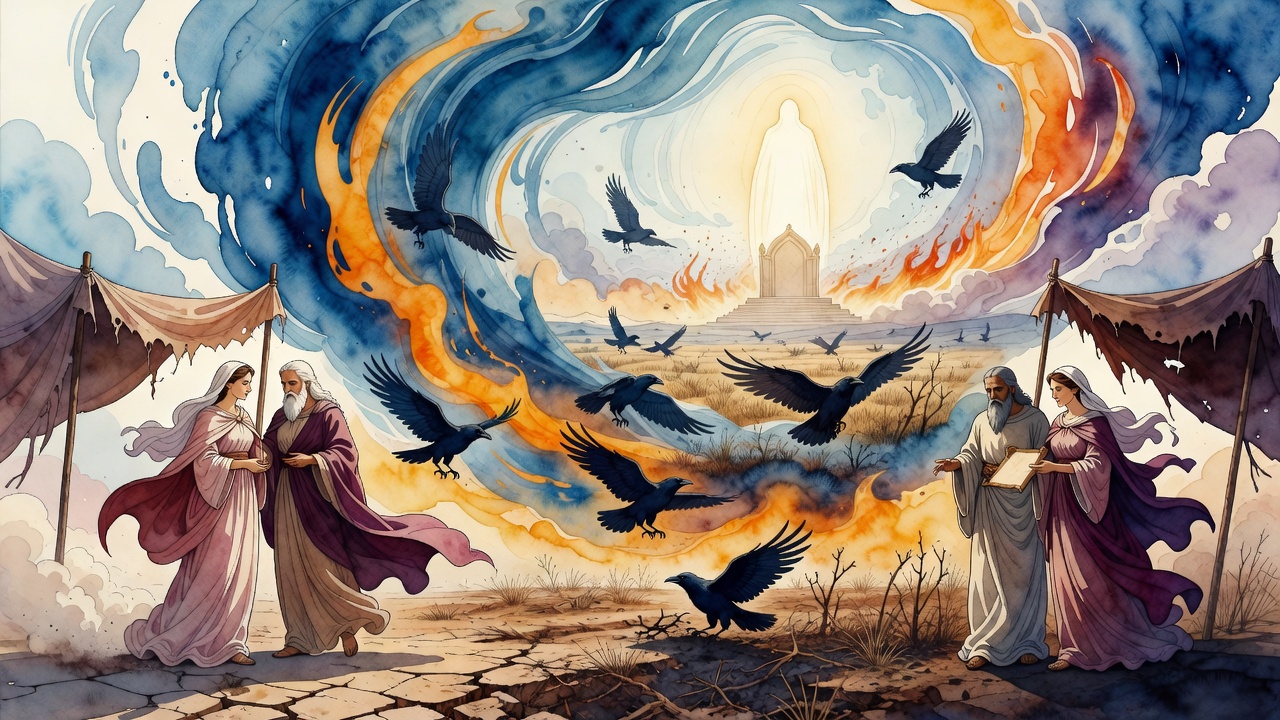
The night Abraham was born, Terah's house was full of guests. Not ordinary guests: the servants of Nimrod, the wise men, the astrologers. They had come to honor the birth of the son of the king's trusted minister. They ate and drank, and when it was time to leave they stepped outside into the night air and looked up at the sky and stopped moving.

A great star rose in the east. It crossed the sky and swallowed four stars, one from each of the four corners of the heavens. The astrologers stood in the road outside Terah's house looking at what had just happened and knew immediately what it meant. They had trained for this. They had catalogs of portents. A star swallowing four kingdoms meant exactly one thing.

They went back inside.

They told Nimrod: the child born tonight in this house will inherit the world. Buy him from his father and kill him now.

Terah's Answer and Terah's Plan

Nimrod sent for Terah. He made his offer: your son's life for a house full of silver and gold. The Book of Jasher, a medieval Hebrew compilation preserving older traditions, records what Terah said in response. He answered with a parable. A king once asked his minister to give him his finest horse. The minister said: here is a better offer. Take everything I own except the horse. The king said he wanted the horse or nothing. The minister said: then take the horse, but let me think about it for three days first.

That was Terah's answer. Give me three days.

On the third day, Nimrod sent again. Give me the boy or everything you own burns.

Terah had used the three days. He had gone to a slave in his household who had delivered a son that same night, and he had bought the child. He wrapped the slave's baby in Abraham's clothes, carried it to Nimrod, and collected the gold.

The baby in Abraham's clothes was killed. Abraham was hidden.

Ten Years in the Dark

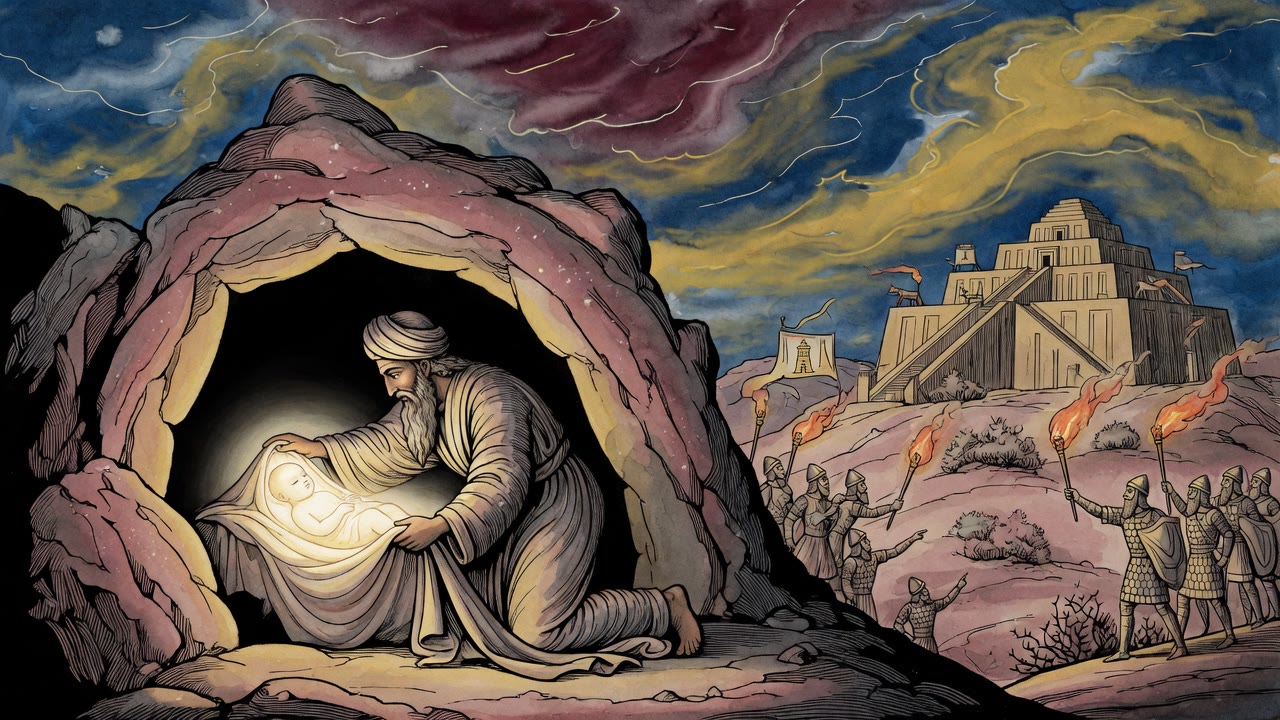
He was hidden in a cave for ten years. Not three days. Not a season. Ten years in a cave, tended by his mother and, the tradition says, fed miraculously. The rabbinic sources preserved by Ginzberg describe the cave as lit by the child's own spiritual radiance, the same light that later traditions would call the primordial holy light, hidden away and given to the righteous.

Abraham came out of the cave already reading the sky. He had watched the stars from the cave's mouth, observed the sun and moon and their patterns, and arrived at his first theological conclusion without a teacher: the world had a maker, and the maker was not the stars, because the stars moved and anything that moved was subject to something that did not. He was ten years old and he had worked out monotheism in a cave by himself.

The Idols in His Father's House

When Abraham rejoined his father's household, Terah was a maker and seller of idols. This is in the tradition. Terah manufactured the gods of the ancient Near East in wood and stone and sold them to customers who needed divine protection and were willing to pay for it in a portable format.

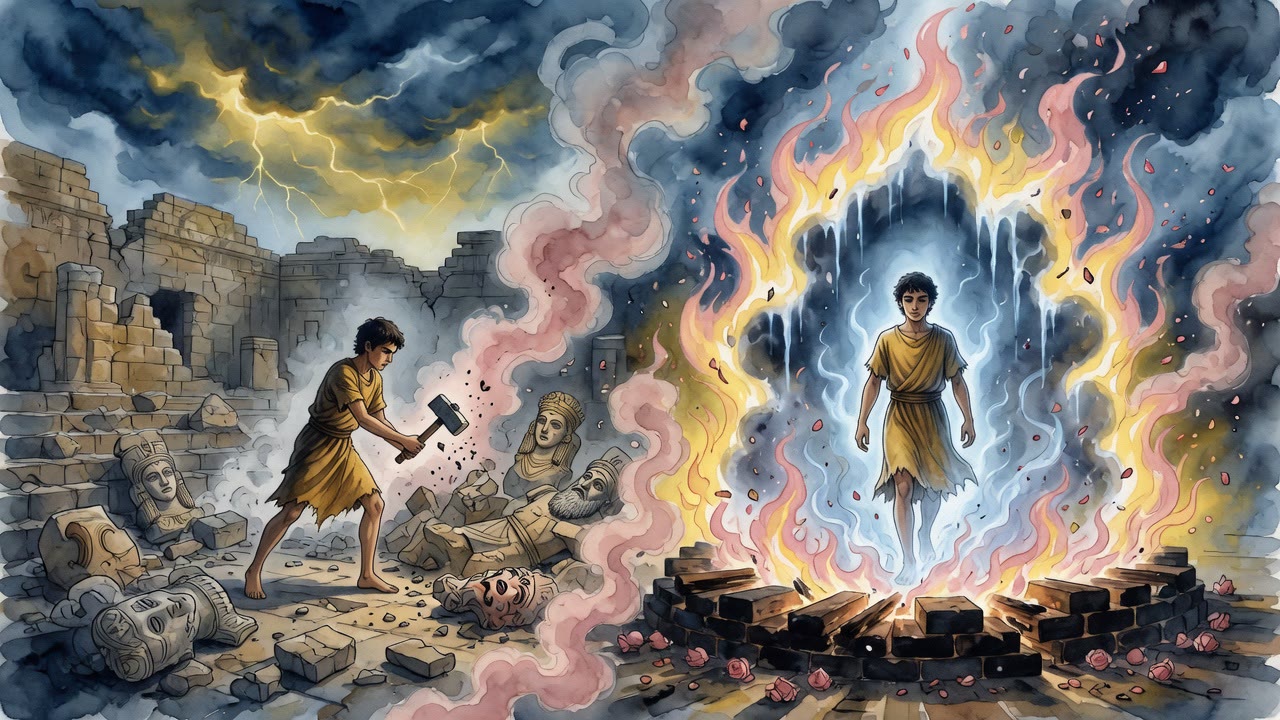
Abraham walked into his father's workshop and met the products. The Apocalypse of Abraham, a first-century Jewish text, records the scene: Abraham trying to right a fallen idol named Marumath, which was too heavy for him alone. He called his father to help. As they lifted it, the head broke off. They put the head on a different body, a smaller idol. Abraham looked at what they had built and could not make himself believe it was a god.

Ginzberg's synthesis adds the episode that ended with Terah throwing his son out of the house. Abraham had criticized the idols openly, and Terah's customers had heard. A man who sells gods cannot have his own son telling the neighborhood that the goods are inert. Terah sent Abraham out and then called him back, because Terah was the man who had once paid a slave woman for her newborn child to protect this same son, and the mathematics of that did not resolve itself easily into an expulsion.

The Father Who Started the Journey

The Torah records that Terah set out from Ur of the Chaldeans to go to the land of Canaan, and he brought Abraham and Lot, and they stopped in Haran and Terah died there. The journey is credited to Terah, not yet to Abraham.

The tradition preserved in Ginzberg's compilation notes that Noah and Shem, those figures from the ark, had urged Terah to leave his homeland. They had seen something in the trajectory of this family and wanted Terah to move it in the direction it needed to go. Terah agreed. He packed the household that had already survived Nimrod's soldiers and a decade underground and a workshop full of silent gods, and he pointed it toward Canaan.

He stopped at Haran and did not make it the rest of the way. But he had started the journey, and the son he had swapped for a slave child and hidden in a cave for a decade finished it.


← All myths
From the tradition

Sources

6 sources

The texts this telling draws on, in full. Open a card to read inline, or expand it for a wider, quieter read.

Jasher 8Book of Jasher

One fascinating source for these expanded narratives is the Book of Jasher, a work of Jewish folklore and legend. Now, it's important to note that this isn't the Sefer haYashar (סֵפֶר הַיָּשָׁר) mentioned in the Bible itself (Joshua 10:13 and (2 Samuel 1:1)8). Instead, it's a much later work, likely medieval, that draws upon and expands biblical narratives. And Chapter 8 tells a truly captivating tale surrounding the birth of Abraham.

The Book of Jasher recounts that on the very night Abram (later Abraham) was born, a grand feast was held at Terah's house. Terah, as you may know, was Abram's father. But this wasn't just a family affair. The servants of Nimrod, yes, that Nimrod, the mighty hunter and king, were there, along with all of Nimrod's wise men and conjurors! Quite the guest list. They ate, they drank, they rejoiced. But as the night deepened, something extraordinary happened.

As the wise men and conjurors left Terah's house, they looked up at the heavens. And what did they behold? According to the Book of Jasher, a massive star appeared in the east, streaking across the sky. But here's the kicker: it swallowed up four other stars, one from each corner of the heavens! Imagine seeing that!

Understandably, the wise men were astonished. But these weren't just casual stargazers. They were sages, skilled in interpreting celestial signs. They put their heads together and, understood the meaning of this cosmic event. This star, they declared, signified the child born to Terah that very night. This child would grow to be powerful, fruitful, and would possess the entire earth, he and his descendants forever. This child and his offspring would slay great kings and inherit their lands. A pretty weighty prediction, wouldn't you say?

So, what did they do with this earth-shattering prophecy? They knew they couldn't keep it a secret from Nimrod. If the king found out later that they had concealed such a significant omen, they feared severe punishment. So, they went to Nimrod and told him everything. They described the star, its trajectory, and their interpretation: that Terah's newborn son would become a powerful ruler, overthrowing kings and seizing their lands.

Naturally, Nimrod wasn't thrilled. The wise men suggested a preemptive strike: "Give his father value for this child," they urged, "we will slay him before he shall grow up." In other words, buy the baby from Terah and kill him to eliminate the threat.

Nimrod liked the sound of that. He summoned Terah and demanded the child, promising to fill Terah's house with silver and gold in exchange. Talk about a terrible bargain!

But Terah was cunning. He pretended to agree but asked for a moment to share something with the king first, a story to get his advice. He told Nimrod of a man who wanted to trade him silver, gold, straw and animal feed for the king's beautiful, prized horse. Terah then feigned seeking the king's wisdom, asking if he should make the trade.

Nimrod was incensed! "Art thou so silly, ignorant, or deficient in understanding, to do this thing, to give thy beautiful horse for silver and gold or even for straw and provender?" The king's reaction was exactly what Terah was hoping for.

Terah then cleverly turned the king's words back on him: "Like unto this has the king spoken to his servant. what shall I do with silver and gold after the death of my son? who shall inherit me?" Ouch!

Nimrod was furious, but Terah, seeing the king's anger, played his final card. He offered Nimrod anything he wanted, even his son, saying all he had was the king's. He then begged for three days to consider the matter, a request Nimrod granted.

During those three days, Terah concocted a plan. When Nimrod sent for the child, Terah substituted a baby born to one of his servants that very day! Terah brought this child to Nimrod, received the payment, and watched in horror as Nimrod, believing it was Abram, dashed the baby's head against the ground.

The Book of Jasher tells us that "the Lord was with Terah in this matter, that Nimrod might not cause Abram's death." It was, the text says, "the will of Providence" that Abram should live.

After this deception, Terah secretly hid Abram, along with his mother and nurse, in a cave, providing them with monthly provisions. Abram remained hidden for ten years. Nimrod and his advisors believed they had killed the prophesied child, never knowing the truth.

What are we to make of this story? It's a thrilling tale of intrigue, deception, and divine intervention. It highlights the lengths to which people will go to protect their power, and the resourcefulness of those who resist tyranny. It also emphasizes a key theme in Jewish tradition: that God works in mysterious ways, often using human agency to fulfill divine purposes. The Book of Jasher, in this chapter, gives us a glimpse into the anxieties and hopes surrounding the birth of one of the most important figures in Jewish history, and how those anxieties played out in a world filled with magic, prophecy, and political intrigue.

Full source
Legends of the Jews 5:64Legends of the Jews

Legends of the Jews turns to Terah Swapped Baby Abraham for a Slave's Child.

That's exactly the predicament Terah, Abraham's father, found himself in. The story, as told in Ginzberg's Legends of the Jews, unfolds like this: A king, upon hearing of Abraham's birth and a strange, portentous sign in the heavens, summons Terah. He’s terrified! This new baby, the king believes, is a threat.

"Give me the boy," the king demands, "that we may slay him before evil comes upon us from him, and I will give thee thy house full of silver and gold in exchange for him."

Can you imagine that offer? Your son's life for a house overflowing with riches.

Terah's response is fascinating, a blend of shrewdness and defiance. He doesn't immediately refuse. Instead, he answers with a parable. "This thing which thou promisest unto me," he says, "is like the words which a man spoke to a mule, saying, 'I will give thee a great heap of barley, a houseful thereof, on condition that I cut off thy head!' The mule replied, 'Of what use will all the barley be to me, if thou cuttest off my head? Who will eat it when thou givest it to me?'"

What a brilliant retort! He's essentially saying, "What good is all the wealth in the world if my son is dead? Who will inherit it?" It's a moment of surprising wisdom from a figure often overlooked in the grand narrative of Abraham.

But here's where things get even more interesting. Terah, sensing the king's rising anger, quickly backtracks. "Whatever the king desireth to do unto his servant, that let him do, even my son is at the king's disposal, without value or exchange, he and his two older brethren."

Wait, what? He just compared the king to a murderer offering a useless bribe, and now he's offering up not just Abraham, but his other sons too? It's a puzzling shift. Is he trying to appease the king? Is he testing him? Or is there something else at play here that we don't see?

This moment in Legends of the Jews really makes you think. It's easy to focus on Abraham, the hero, the patriarch. But what about the people around him? What were their motivations, their fears, their hopes? Terah's actions, in this brief exchange, are complex and leave you pondering the difficult choices people face when caught between power, prophecy, and family. What would you have done?

Full source
Legends of the Jews 5:66Legends of the Jews

The stories surrounding Abraham's birth are filled with suspense, danger, and a father's desperate choices.

The king, in his paranoia and cruelty, demanded Terah hand over his youngest son, Abraham. "I will purchase thy youngest son for a price," he declared.

Terah, caught in a terrible bind, played for time. "Let my king give me three days' time to consider the matter and consult about it with my family," he pleaded. Think about the weight of that request. Three days to decide the fate of his child.

The king, suspicious but willing to humor Terah, agreed. But on the third day, the threat came: "Give me thy son for a price, as I spoke unto thee, and if thou wilt not do this, I will send and slay all thou hast in thy house, there shall not be a dog left unto thee." A terrifying ultimatum!

What would you do?

Terah, in a moment of cunning and, perhaps, desperation, devised a plan. As Ginzberg tells us in Legends of the Jews, Terah presented the king with a child his handmaid had just borne. The king, deceived into thinking this was Abraham, seized the infant and, in a horrific act, dashed his head against the ground. He believed he had eliminated the threat, the prophesied Abraham.

But Terah had outsmarted him, at least for the moment.

Terah took his son Abraham, along with the child's mother and his nurse, and hid them in a cave. There, in the darkness, they found refuge. Once a month, Terah secretly brought them provisions. "The Lord was with Abraham in the cave, and he grew up," Ginzberg recounts. While the king and his servants believed Abraham was dead, he was alive, protected by his father's courage and, as the story tells us, by divine providence.

Isn't it incredible to consider the lengths to which parents will go to protect their children? Terah's actions, though fraught with deception and danger, highlight the profound love and dedication that can drive us in the face of overwhelming adversity. It makes you wonder about the hidden stories, the secret acts of bravery that shape the destinies of those destined for greatness.

Full source
Legends of the Jews 5:70Legends of the Jews

It wasn't exactly a straight and narrow path, at least according to some fascinating stories tucked away in Jewish tradition.

Let's go way back. Young Abraham is living with his father Terah, a man who makes and sells idols. Imagine the scene: a house filled with gods of wood, stone, and metal. One day, Abraham walks into the temple – their version of a showroom, really – to bring sacrifices to these… deities.

That's when things get interesting.

He finds one idol, called Marumath, lying face down before the iron god of Nahor. Marumath – a stone statue, remember – is heavy. Too heavy for young Abraham to lift alone. So, he calls his father Terah for help.

According to Ginzberg's retelling in Legends of the Jews, as they're struggling to right the idol, disaster strikes! The head of Marumath falls off and smashes on the floor.

Oops.

Now, what do you do when your idol loses its head? If you're Terah, you grab a stone and chisel a new body for the old head! Problem solved. But Terah doesn’t stop there. He goes on to create five more gods. Six idols in total! And then, he hands them over to Abraham with instructions to sell them in the city.

Can you imagine? Abraham, the future patriarch, peddling idols on the street corner! It’s a far cry from the image we usually have of him.

This story, though seemingly simple, is packed with meaning. It highlights the absurdity that Jewish tradition ascribes to idolatry. The idols are helpless, needing human assistance. They break! They are replaced with ease. How can these be gods?

It's a stark contrast to the one, unseen, all-powerful God that Abraham would eventually discover and champion. It’s almost comical, and perhaps that's the point. The story challenges us to think critically about the beliefs and practices we inherit. What are we blindly accepting? What needs a closer look?

It makes you wonder, doesn't it? Maybe Abraham's journey to monotheism wasn't just a divine calling, but also a very practical realization. Maybe, after witnessing the head of Marumath crumble, he thought to himself, "There has to be a better way."

Full source
Legends of the Jews 5:73Legends of the Jews

It wasn't exactly a smooth transition. to a story from Legends of the Jews by Louis Ginzberg, a collection that pieces together fascinating narratives from the Talmud, Midrash, and other Jewish sources.

It begins with Abraham's father, Terah, a maker and seller of idols. Imagine the scene: Abraham, already questioning the validity of these gods, openly criticizing them. Understandably, Terah isn't thrilled. According to Ginzberg's retelling, Terah, furious at Abraham's dissent, throws him out of the house.

Terah, perhaps conflicted, calls him back. He gives Abraham a task: gather the wood chips from which he carved his idols, and prepare dinner. It's a test, maybe a chance for Abraham to prove his loyalty.. or perhaps, to prove something else entirely.

As Abraham gathers the wood, he finds a small idol among the chips, bearing the inscription "God Barisat." Now, Abraham, with a plan brewing, throws the chips on the fire, placing Barisat right next to the flames. He says, "Attention! Take care, Barisat, that the fire doesn't go out until I return. If it burns low, blow on it and make it flame up again." A bit sarcastic, don't you think?

He leaves, and when he returns, what does he find? Barisat, flat on his back, badly burnt! Abraham, with a wry smile, says to himself, "In truth, Barisat, you can really keep the fire alive and prepare food!" And as he speaks, the idol is consumed to ashes.

He brings the prepared dishes to his father, who eats, drinks, and blesses his god, Marumath. But Abraham interjects, "Bless not thy god Marumath, but rather thy god Barisat, for he it was who, out of his great love for thee, threw himself into the fire that thy meal might be cooked!"

"Where is he now?" Terah asks, bewildered.

"He hath become ashes in the fierceness of the fire," Abraham replies.

Terah, still not getting it, exclaims, "Great is the power of Barisat! I will make me another this day, and to-morrow he will prepare my food for me." The irony, of course, is thick enough to cut with a knife.

What does this story tell us? It's not just a funny anecdote. It shows Abraham's early rejection of idolatry, his sharp wit, and the almost absurd devotion people had to these powerless objects. It highlights the clash between a new way of thinking and the old, a clash that would ultimately shape the course of religious history. It also shows how deeply ingrained these beliefs were, if Terah couldn't see the obvious even when it was right in front of him.

It makes you wonder, doesn't it? What "Barisats" are we clinging to in our own lives? What idols, big or small, are preventing us from seeing the truth? Perhaps, like Abraham, we need to let them burn.

Full source
Legends of the Jews 5:59Legends of the Jews

It wasn't quite as simple as a divine command, at least not at first. The traditional narrative often focuses on Abraham's calling, but let's rewind a bit and look at the fascinating role Terah played, according to the legends.

The story goes that Noah and Shem – yes, that Shem, the son of Noah from the ark – actually helped Abraham in his mission. They encouraged Terah to leave his homeland! Imagine Noah and Shem, those figures from the distant past, actively supporting Abraham in his quest to sway his father. Finally, Terah agreed, and he, Abraham, and Lot (Haran’s son) set off for Haran with their families. They found Haran a pleasant place. Its people were open to Abraham's teachings, adopting his moral principles and becoming God-fearing individuals.

Terah’s decision to leave his native land for Abraham's sake – his willingness to venture into the unknown even before Abraham received a direct divine call – was seen by God as a great act of merit. This is according to the Legends of the Jews.

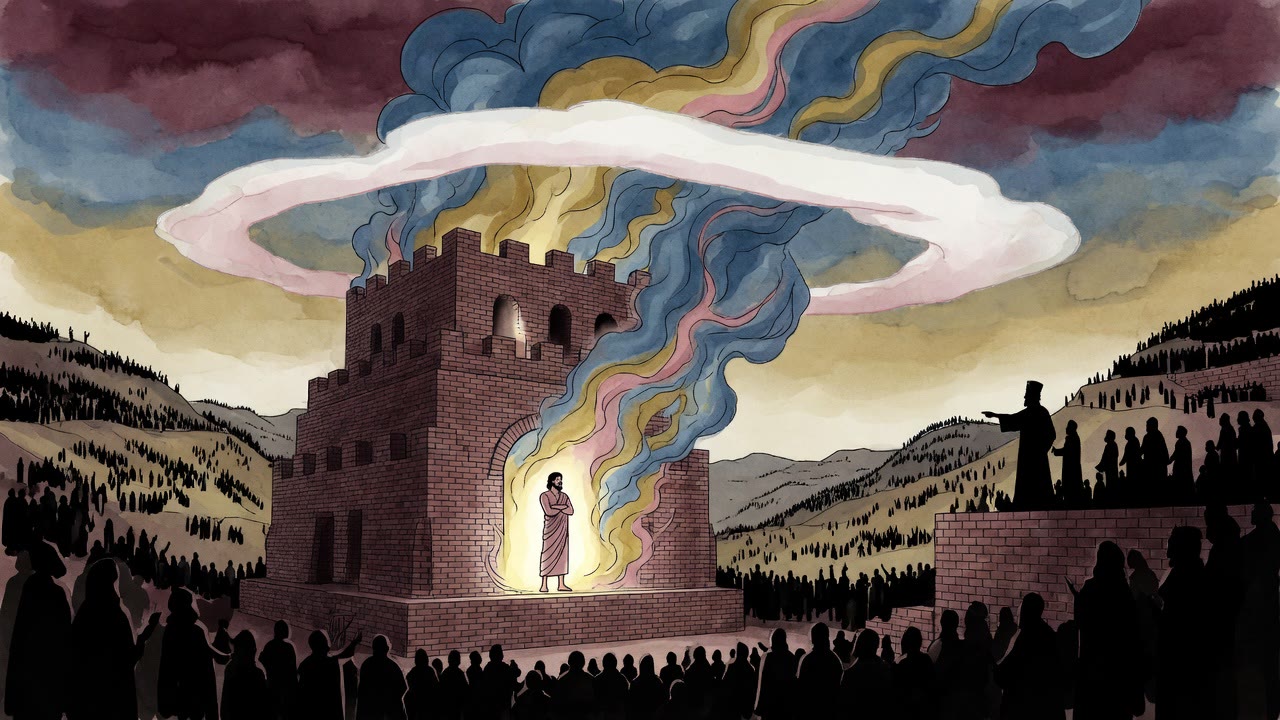
What was his reward? He was allowed to witness his son Abraham become a ruler over the entire world! How did this happen? Well, remember the miraculous birth of Isaac to the elderly Abraham and Sarah? The world was astonished. People flocked to Abraham and Sarah, wanting to know what they had done to deserve such a miracle. Abraham, being Abraham, used this as an opportunity to teach them about his experiences with Nimrod, about his willingness to be burned for God's glory, and about how God had saved him.

The people, in awe of Abraham's faith and teachings, appointed him their king! And get this: to commemorate Isaac's miraculous birth, Abraham minted coins. According to Ginzberg's retelling in Legends of the Jews, these coins bore the image of an elderly couple on one side and a young couple on the other. This was because Abraham and Sarah were both rejuvenated at Isaac's birth. Abraham's white hair turned black, and the wrinkles on Sarah's face disappeared!

So, what can we take away from this? It's a reminder that even seemingly small acts of faith and support can have profound consequences. Terah’s willingness to follow his son, even before a direct divine command, was recognized and rewarded. It also shows us that the concept of reward and recognition in Jewish tradition can manifest in unexpected ways, like witnessing the success and influence of one's children. It also demonstrates that even the elders can be rejuvenated and made new!

Full source