Parshat Bo6 min read

The Angel Uzza Sued Israel Before the Throne of God

Above every nation stands a heavenly prince, and Egypt's angel Uzza sues to drag the freed Israelites back into three more centuries of bondage.

Curated by Arthur · Told by Maggid ·
Table of Contents
  1. The Prince of Egypt Files a Suit
  2. Michael Is Summoned to Contend
  3. The Decree Born From Abraham's Doubt
  4. Holding God to His Own Word
  5. The Guardian Bound to a Doomed Land

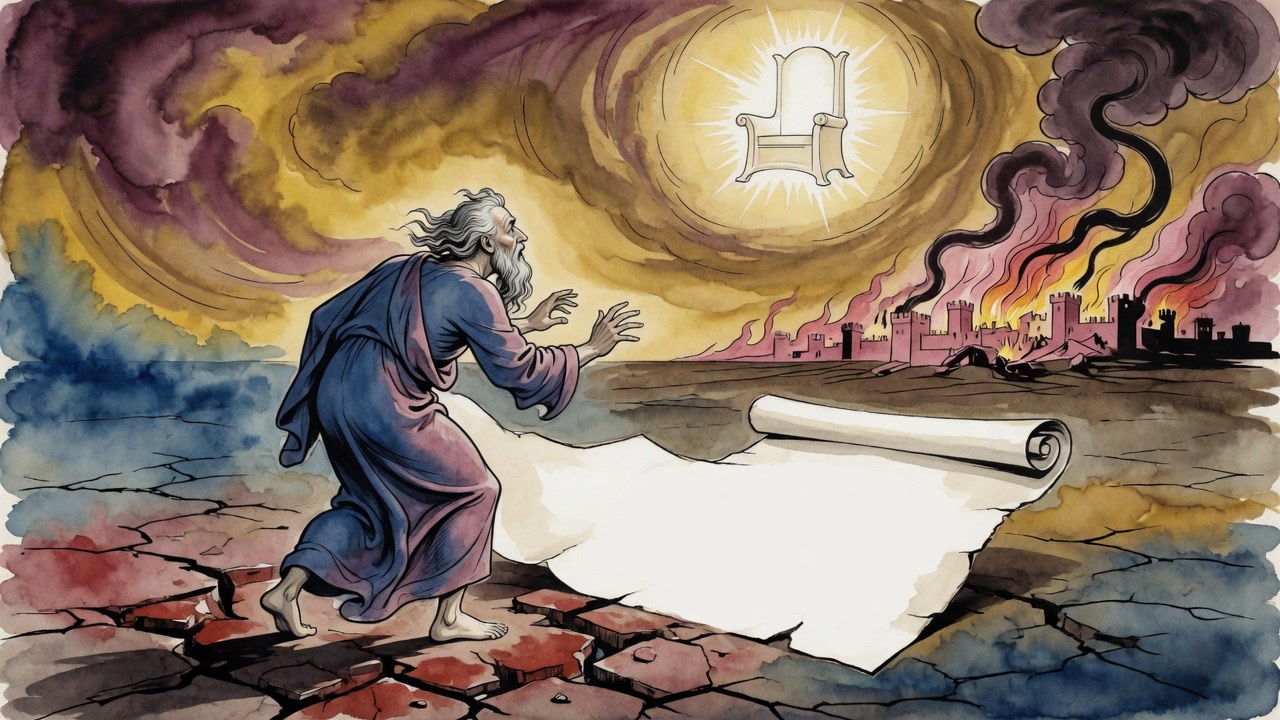
The sea had not yet split. Israel was somewhere on the road out of Goshen, dust on their sandals, dough still flat on their backs, when a complaint reached the high court of heaven and stopped the rejoicing cold.
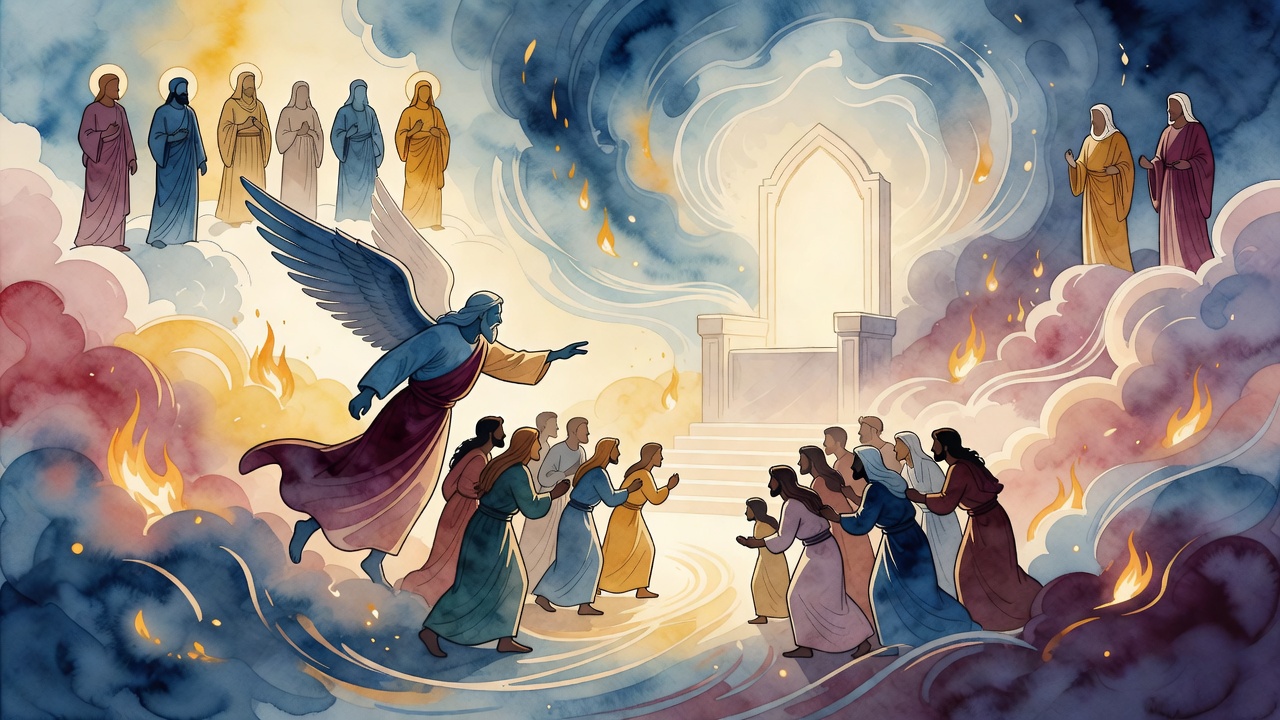
It came from Uzza, the angel set over Egypt. Every nation on earth has one. A prince stands in heaven for each kingdom below, and when the kingdom rises or falls, its prince rises or falls with it. Uzza had stood over Egypt through generations of its glory, through the building of its cities and the filling of its granaries, and he had watched a foreign people raise those cities with bricks and tears. Now those people were walking free, and Uzza was not finished with them.

The Prince of Egypt Files a Suit

He did not whisper. He came before the Throne and spoke as a litigant who believes the law is on his side.

"O Lord of the world," Uzza said. "I have a suit against this nation which Thou hast brought forth out of Egypt. If it seemeth well to Thee, let their angel Michael appear, and contend with me before Thee."

The audacity of it rang through the court. An angel does not summon the Holy One to arbitration. An angel does not demand a trial over a people God had just redeemed with a stretched-out arm. But Uzza was not asking. He was filing. And the Throne did not refuse him.

Michael Is Summoned to Contend

God called for Michael, the archangel who stands for Israel as Uzza stands for Egypt. The two princes faced each other in the light, the one who had lost a workforce and the one who guarded the freed.

Uzza laid out his case like a being who has rehearsed it for centuries. He did not appeal to mercy. He appealed to the record.

"O Lord of the world," he argued. "Thou didst decree concerning this people of Israel that they shall be held in bondage by my people, the Egyptians, for a period of four hundred years. But they had dominion over them only eighty-six years. Therefore the time of their going forth hath not yet arrived."

Eighty-six against four hundred. The number was his weapon, and he held it up where the whole court could see it. Three hundred and fourteen years of servitude, he said, were still owed. The ledger was open and the column did not balance. And Michael, the defender of Israel, stood there and said nothing. He had no answer to the arithmetic. The hope of an entire nation hung on a silence in heaven, and for a moment it looked as though Uzza had won.

The Decree Born From Abraham's Doubt

Then God Himself answered the prince of Egypt, and He answered him from the deep past.

The four hundred years had a beginning, and the beginning was a question. Long before, God had raised Abraham above the vault of the sky and promised him the land. Abraham had believed the promise, but he had asked how he would know it. "Whereby shall I know that I shall inherit it?" he said. That small human flinch of doubt had a price, and the price was written into his children. From that question came the sentence that his seed would be strangers in a land not their own, and would serve, and would be afflicted. Uzza had not invented the bondage. He had only memorized it, counting the years on his fingers while Israel groaned in the mortar pits, and he had reached his sum.

Holding God to His Own Word

So he pressed his demand, and he made it without flinching.

"If it be Thy will," Uzza pleaded, "give me permission to take them back to Egypt, that they may continue in slavery for the three hundred and fourteen years that are left, and Thy word be fulfilled."

Take them back. Drag the freed people off the road, turn them around in the wilderness, march them down again into the brick yards, and shut the gate of Goshen behind them for three more centuries. That was the relief Uzza sought from the court. Not blood. Just the restoration of the schedule.

Then Uzza reached for the one argument no angel had ever dared to aim at the Throne. He turned God's own nature into a chain.

"As Thou art immutable," he said, "so let Thy decree be immutable."

The sentence hung in the court. Uzza was binding the Holy One with the Holy One's own perfection. You do not change, he was saying. You cannot take back what You have spoken. You sealed four hundred years against this people, and a being who never alters cannot now alter it for love of them. The mercy that had just broken Egypt open with frogs and hail and the death of the firstborn, Uzza turned that very rescue into a breach of contract. He had found the seam where justice and love pull against each other, and he set his whole weight on it.

The Guardian Bound to a Doomed Land

He was the prince of a kingdom that lay in ruins. Its firstborn were buried, its army was about to be swallowed, its god-king had been humbled in his own palace. And still Uzza stood in the highest court and fought for it, year by stolen year, because that is what a guardian angel does. He does not get to choose a winning side. He is given a nation and he is bound to it, and when the nation is doomed he is doomed with it, pleading its ledger before the Throne while the waters gather to drown the last of its chariots.

The court fell quiet around the two princes. Michael stood for the people on the road. Uzza stood for the people in the grave. And between them sat the One who had made the decree, and made the promise, and would have to answer for both.


← All myths
From the tradition

Sources

4 sources

The texts this telling draws on, in full. Open a card to read inline, or expand it for a wider, quieter read.

Legends of the Jews 1:24Legends of the Jews

If we, as individuals, are said to have angels watching over us, guiding us (or sometimes, perhaps, shaking their heads at our choices!), why not entire nations? The Legends of the Jews, that incredible compilation by Louis Ginzberg drawing from centuries of rabbinic lore, certainly suggests so.

One striking story involves Uzza, described as the tutelary angel – the guardian angel – of Egypt. According to the legend, Uzza had a bone to pick with the Israelites.

"O Lord of the world!" Uzza declares, "I have a suit with this nation which Thou hast brought forth out of Egypt. If it seemeth well to Thee, let their angel Michael appear, and contend with me before Thee."

The audacity! And the stakes were incredibly high. God summons Michael, the archangel often seen as Israel's protector, and Uzza lays out his case.

"O Lord of the world!" he argues. "Thou didst decree concerning this people of Israel that they shall be held in bondage by my people, the Egyptians, for a period of four hundred years. But they had dominion over them only eighty-six years, therefore the time of their going forth hath not yet arrived."

Uzza’s argument hinges on divine decree. He claims God Himself had ordained a 400-year period of servitude. And since the Israelites were freed after only 86 years, Uzza demands justice, a cosmic course correction.

"If it be Thy will," Uzza pleads, "give me permission to take them back to Egypt, that they may continue in slavery for the three hundred and fourteen years that are left, and Thy word be fulfilled. As Thou are immutable, so let Thy decree be immutable!"

Wow. Talk about holding God to His word! Uzza invokes the very nature of God – His immutability, His unchanging character – as the basis for his demand. He's essentially saying: "You can't go back on your word, even for the sake of freeing your chosen people!"

What a chilling perspective. It forces us to consider: What does it truly mean for God to be bound by His own pronouncements? And what role do these angelic representatives play in the unfolding of divine will? Is it just a story, or a deeper reflection on the complexities of justice, mercy, and the very nature of God's relationship with humanity?

Full source
Legends of the Jews 1:25Legends of the Jews

Take this story, for example, about the angel Michael, the angel Uzza, and a really sticky situation regarding the enslavement of the Israelites in Egypt.

Here's the setup: the Israelites are suffering under Pharaoh's rule, and Michael, the archangel often seen as Israel's defender, is arguing for their release. But the angel Uzza is putting up a fight. Why? Because from Uzza's perspective, the Israelites are bound by a divine decree.

The text simply states that Michael was silent, seemingly unable to argue against Uzza's points. It looked like Uzza had won! Can you imagine the weight of that moment? The hopes of an entire nation seemingly dashed by celestial bureaucracy.

Then, something extraordinary happens. God Himself intervenes. God speaks directly to Uzza, and this is where it gets really interesting.

God says "The Israelites were meant to serve their time because of something Abraham said." Remember when God promised Abraham the land of Israel? God says, "I am the Lord that brought thee out of Ur of the Chaldees, to give thee this land to inherit it." But Abraham, understandably wanting reassurance, asked, "Whereby shall I know that I shall inherit it?" (Genesis 15:7-8).

According to this tradition, that question – a perfectly human moment of doubt – had consequences. God continues, "Therefore did I say to him, 'Thy seed shall be a stranger.'" In other words, because of Abraham’s question, his descendants were destined for a period of servitude.

But here's the kicker, the loophole, the divine grace: God states that He knows that the period of "strangers" has already begun with the birth of Isaac, and that the four hundred years of the decree had already elapsed. The time was up! Uzza, according to God, no longer had the right to keep the Israelites in bondage.

So, what do we take away from this? It's a powerful reminder that even divine decrees aren't set in stone. There's room for interpretation, for mercy, and ultimately, for justice. It also speaks to the enduring power of human action – even a single question asked generations ago can have ripple effects through history. It makes you wonder about the unseen consequences of our own words and actions, doesn't it?

Full source
Legends of the Jews, V. Abraham, The Covenant Of The PiecesLegends of the Jews

God revealed Himself to Abraham shortly after, to ease his conscience about the spilling of innocent blood, a scruple that caused him great anguish. God assured him that pious men would arise from his descendants, shielding their generations just as he had.

That wasn't all. God granted Abraham a rare gift: the permission to ask for anything he desired – a grace given to very few others, including Jacob, Solomon, Ahaz, and even the Messiah.

Abraham, ever mindful of his future generations, responded, "O Lord of the world, if in time to come my descendants should provoke Thy wrath, it were better I remained childless!" He even suggested that Lot, for whose sake he had journeyed to Damascus, would make a fine heir. Abraham, after all, believed he had read in the stars that he would have no children.

God, in a powerful moment, raised Abraham above the vault of the skies and declared, "Thou art a prophet, not an astrologer!"

Abraham, convinced, didn't even demand a sign regarding offspring. His simple faith earned him a share in this world and the world to come. The redemption of Israel from exile would be a reward for his unwavering trust.

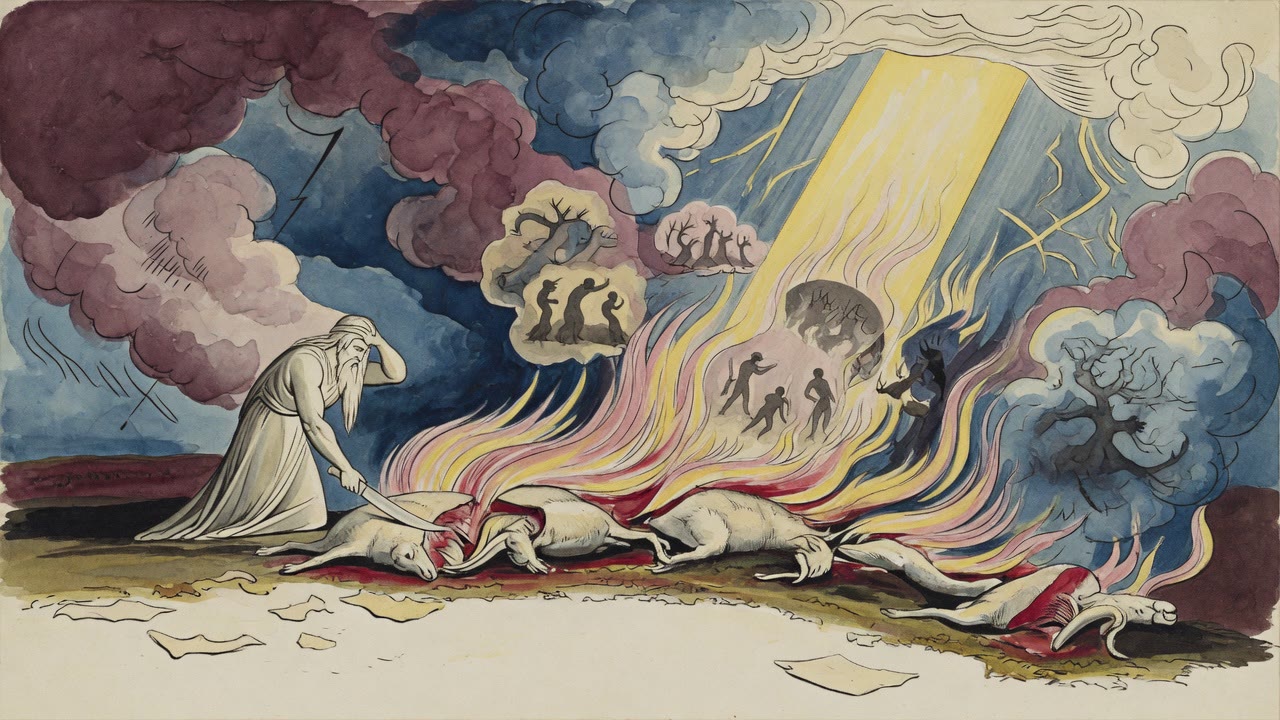
However, Abraham, while believing in the promise, still wanted to know how his descendants would maintain themselves. Therefore, God instructed him to bring a sacrifice: three heifers, three she-goats, three rams, a turtle dove, and a young pigeon. These animals, God explained, represented the various sacrifices to be brought in the Beit Hamikdash, the Temple, to atone for Israel's sins and ensure their well-being.

But what would become of them, Abraham asked, after the Temple’s destruction? God responded that if they read the order of sacrifices as written in the Scriptures, He would consider it as if they had offered the sacrifices, forgiving their sins.

Then, God revealed to Abraham the sweep of Israel's history and the history of the world itself. According to tradition, the three-year-old heifer symbolized the dominion of Babylon, the she-goat represented the Greek empire, and the ram stood for the Medo-Persian power. The rule of Ishmael was also represented by a ram, and Israel was symbolized by the innocent dove.

Abraham took the animals and divided them in the middle, a symbolic act that, had it not been performed, would have left Israel unable to resist the power of the four kingdoms. The birds, however, he did not divide, signifying that Israel would remain whole. When birds of prey descended upon the carcasses, Abraham drove them away, foreshadowing the arrival of the Messiah, who would cut down the heathen. Yet, Abraham bid the Messiah to wait until the appointed time.

This scene, often called the Brit Bein Habetarim, the Covenant of the Pieces, is described in Genesis 15.

Not only was the Messianic time revealed to Abraham, but also the time of the resurrection of the dead. As he arranged the halves of the animals, they miraculously came back to life as the bird flew over them.

While preparing these sacrifices, Abraham received a vision of profound significance. As the sun set, a deep sleep fell upon him, and he saw a smoking furnace – Gehenna, the place God prepares for sinners. He also beheld a flaming torch, representing the revelation at Sinai, where the people saw flaming torches. He saw the sacrifices to be brought by Israel. And then, an "horror of great darkness" fell upon him, symbolizing the dominion of the four kingdoms.

God spoke to Abraham, explaining that as long as his children fulfilled the two duties of studying the Torah and performing the service in the Temple, they would be spared Gehenna and alien rule. However, if they neglected these duties, they would suffer the consequences. God then offered Abraham a choice: punishment through Gehenna or through the dominion of strangers.

All day long, Abraham wavered. Finally, God urged him to decide on one, and to choose the dominion of the stranger. Then, God revealed the four hundred years of bondage in Egypt, reckoning from the birth of Isaac. However, Abraham himself was promised that he would go to his fathers in peace, untouched by the arrogance of the oppressor.

As we find in Midrash Rabbah, it was also revealed to Abraham that his father, Terah, would have a share in the world to come, having repented for his sins. Ishmael would turn toward righteousness while his father was still alive, and Esau would not begin his impious ways until after Abraham’s death.

And so, alongside the promise of deliverance, Abraham received the announcement of slavery for his descendants in a foreign land. But it was also revealed to him that God would judge the four kingdoms and ultimately destroy them.

The Covenant of the Pieces, then, is not just a story about sacrifice and prophecy. It's a story about faith, responsibility, and the enduring relationship between God and Israel. It's a reminder that even in the darkest of times, there is always hope for redemption. And perhaps most powerfully, it is a reassurance that our actions, both good and bad, have consequences that ripple through generations. What kind of legacy are we building today?

Full source
Yalkut Shimoni on Torah 241:1Yalkut Shimoni on Torah

Another interpretation: "And the LORD saved that day." But were Israel in the hand of Egypt? Rather, at the hour Israel went out from Egypt, Uzza, the heavenly prince of Egypt, opened before the Holy One, blessed be He, and said before Him: Master of the universe, this nation that You are bringing out of Egypt - I have a legal claim against it. Let Michael, their prince, come and plead before You against me. At that hour the Holy One, blessed be He, said to Michael: Come and plead with him.

Uzza, the prince of Egypt, opened and said before Him: Master of the universe, You decreed upon this nation that they be enslaved under the hand of my nation four hundred years, as it is said, "and they shall serve them, and they shall afflict them" (Genesis 15:13), and they have served among them only eighty-six years from the time Miriam was born, and their time to go out has not yet come. Rather, grant me permission and I will return them under the hand of my nation until four hundred years; as You endure, so does Your oath endure. At that hour the Holy One, blessed be He, told Michael to give him an answer. Immediately Michael was silent.

At that hour the Holy One, blessed be He, answered and said to Uzza: I can argue the merit of My children. Were they made liable to servitude except on account of one word that Abraham My beloved spoke before Me when he said, "Whereby shall I know that I will inherit it?" (Genesis 15:8), and I said to him, "Know surely that your seed will be a stranger" (Genesis 15:13)? Did I say "in the land of Egypt"? I said "in a land not theirs." And it is already revealed and known that from the time Isaac was born they became strangers, and the four hundred years are already complete. You have no claim to enslave My children at all. At that hour the Holy One, blessed be He, saved Israel; therefore it is said, "And the LORD saved that day," and so forth.

"And Israel saw the great hand." At the hour the Holy One, blessed be He, sought to drown the Egyptians, Uzza, the prince of Egypt, stood before the Holy One, blessed be He, and said before Him: Master of the universe, You are called righteous and upright, and there is before You no injustice, no favoritism, and no taking of bribes - why do You wish to drown Egypt? Did they drown any of Your children, or kill any of them? Because they enslaved them, do You wish to drown them? They have already received their wage - all their silver and all their gold.

At that hour the Holy One, blessed be He, gathered all the retinue of heaven and said to them: Judge between Me and Uzza, the prince of Egypt. At first I brought famine upon them and set up for them Joseph, who by his wisdom understood, and they all became his slaves. And in the end My children came as strangers and they enslaved them with harsh servitude, until their outcry rose before Me. And I sent them Moses and Aaron My servants, and they said to their king, "Thus says the LORD, the God of the Hebrews," and all the kings of east and west were sitting before him, and he began to boast before them and said, "Who is the LORD?" (Exodus 5:2) - one who had brought no tribute all those years, in the manner of every deity - "I do not know the LORD" (Exodus 5:2); rather, wait and I will search in my books whether His name is written with me. He searched and did not find it. Moses and Aaron answered and said to him: He created heaven and earth, and He forms the fetus in its mother's womb, and He makes the winds blow and brings down the rains and makes the dew sprout and grows trees and grasses and kills and gives life; the soul of every living thing is in His hand. He answered My messengers: There is no god in the world that does these deeds; I created myself and my river the Nile, as it is said, "My river is my own, and I made myself" (Ezekiel 29:3). He answered and said to his sages: Have you ever heard of this god? They said to him: We have heard that He is a son of sages, a son of the kings of old, as it is said, "How can you say to Pharaoh, I am a son of sages" (Isaiah 19:11), and so forth. He answered My messengers, "I do not know" (Exodus 5:2). Since he denied Me, I sent upon him ten plagues, and it availed nothing, and still he denied Me, and he added to enslave My children; and after I made known to him My power and My might, he sent them out against his will, and now he has pursued them to bring them back to servitude. One who does such a thing and did not understand - is he not fit that I drown him in the sea, he and all his host? All the retinue of heaven answered Him: The judgment is with You; do as You desire.

At that hour Uzza answered and said: Master of the universe, I know within myself that they are guilty, but sit upon them with the attribute of mercy. At that hour Gabriel stood and took a mold of clay and stood before the Holy One, blessed be He, and said: Master of the universe, did Your children not labor in servitude as harsh as this - have mercy upon them? Immediately the Holy One, blessed be He, turned and sat upon them with the attribute of judgment, and He turned back and drowned them in the sea; therefore it is said, "And Israel saw the great hand."

Full source