5 min read

The Child in the Roman Prison Who Became a Torah Giant

A rabbi enters a Roman prison to test a captive child with a verse, and what the boy answers changes the course of a life.

Curated by Arthur · Told by Maggid ·
Table of Contents
  1. The Report From Rome
  2. A Voice From Inside the Cell
  3. The Ransom and What Followed
  4. Two Other Children in the Same Collection
  5. What a Verse Completion Can Mean

The Report From Rome

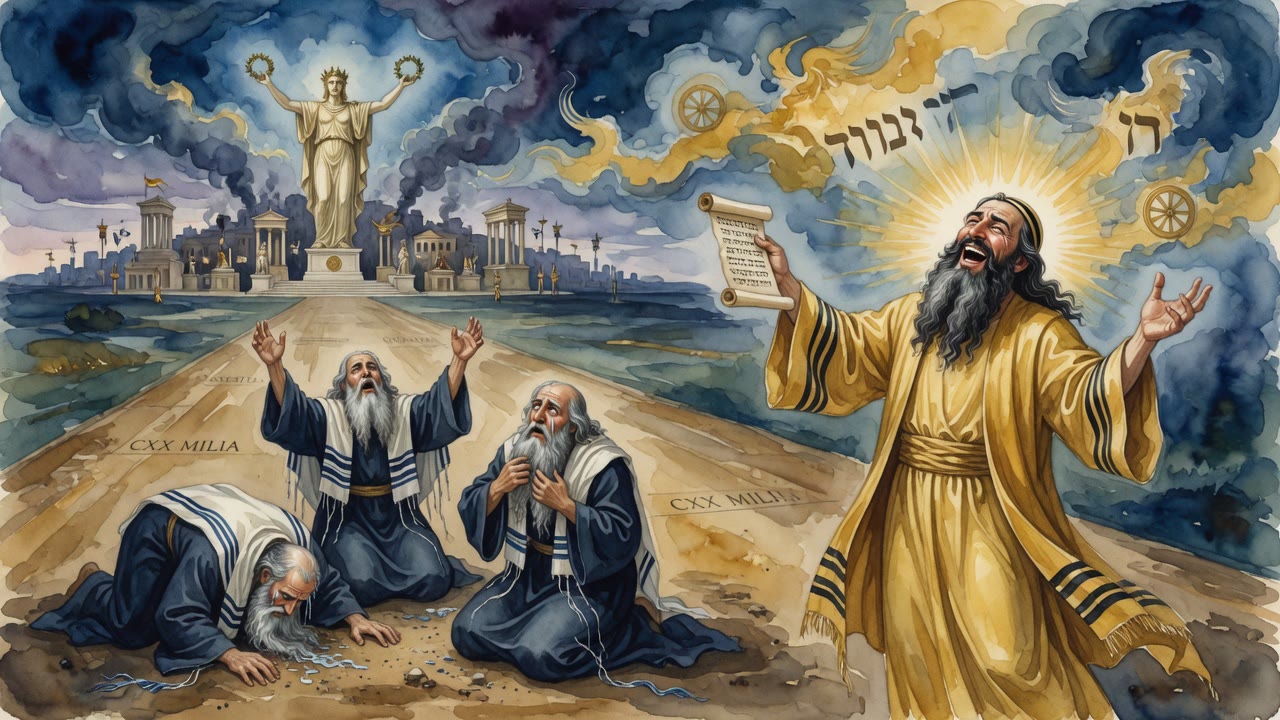
Rabbi Yehoshua ben Hananiah had traveled to Rome, and someone there gave him a report he could not ignore. There was a Jewish child being held in a Roman prison. The word the source used was disgrace. In the context of Roman captivity, in a city that understood how to break people in every way available, the word disgrace did not require further elaboration.

Rabbi Yehoshua went to the prison entrance.

He did not go in immediately. He did not announce himself or demand an audience with the child. He stood at the entrance and recited a verse from Isaiah: who gave Jacob over to the plunderers and Israel to the robbers?

He left the verse unfinished and waited.

A Voice From Inside the Cell

A child's voice came back through the prison wall, completing the verse without hesitation: was it not God, against whom we sinned, in whose ways they refused to walk and whose Torah they did not obey?

The response was not just a child reciting scripture. It was a child who understood which part of the verse carried the weight. The verse from Isaiah does not stop at accusation. It does not let the question rest as a complaint about suffering. It answers itself: God permitted this because Israel strayed. And the child inside the Roman prison had held that answer ready.

Rabbi Yehoshua swore then: I will not move from this place until I have ransomed him, whatever the cost.

The Ransom and What Followed

He paid for the child's release. The text records that Rabbi Yehoshua did not leave Rome without him, and that the boy later became a significant figure in the tradition. Some sources preserve his name as Rabbi Ishmael ben Elisha, who would go on to become one of the great talmudic sages of his generation, a man known for both his legal precision and his mystical insight.

The story does not dwell on the mechanics of the ransom. It dwells on the test. Rabbi Yehoshua walked to a prison entrance, spoke half a verse, and listened. What he heard told him everything he needed to know about whether this child was worth the cost of rescuing.

This is a disturbing calculus if you think about it long enough. Not every Jewish child in Roman captivity got a rabbi at the door reciting Isaiah. Rabbi Yehoshua was not running a general rescue operation. He came to evaluate this specific child, and what he was evaluating was scholarship. Torah retention. The capacity to complete a verse about communal sin with the correct theological framing.

Two Other Children in the Same Collection

The midrash places that account in a series of accounts about the children of Jerusalem's great families brought low after the Temple's destruction. Two other children appear in the same cycle: a boy and a girl, the children of a priest named Tzadok, who were sold into captivity separately, each of them to different Roman officers. The two children ended up in the same house by coincidence, unaware that they were siblings. When they finally recognized each other, they wept together and died from the grief.

Their story is not a rescue story. It is a record of loss that has no redemption in it, two children broken beyond any verse of comfort. The contrast with the child in the prison sharpens what the Rabbi Yehoshua story is saying: some children are saved and some are not, and the one who is saved is saved because something in him was still intact. Still answering. Still completing the verse.

What a Verse Completion Can Mean

The half-verse Rabbi Yehoshua chose was not random. The question form, who gave Jacob over to the plunderers, was the kind of question a child in a Roman prison might have been screaming internally every hour of captivity. Why did God allow this? Who is responsible for this? The Torah answer embedded in the verse's second half is not a comfortable one: we are. Our failures, our refusals. Rabbi Yehoshua needed to know if this child had internalized that framework or had been broken past the threshold of theological coherence.

The child answered correctly. He answered with the part of the verse that accepts responsibility rather than assigning blame outward. That answer was the proof Rabbi Yehoshua needed.


← All myths
From the tradition

Sources

2 sources

The texts this telling draws on, in full. Open a card to read inline, or expand it for a wider, quieter read.

Eikhah Rabbah 4:4Eikhah Rabbah

There was an incident involving Rabbi Yehoshua ben Ḥananya, who went to the great city of Rome. They said to him: ‘There is a certain child in prison in disgrace.’10The Romans were exploiting him, or planned to exploit him, for homosexual relations. He went there and saw a certain child with beautiful eyes, good looking, with his hair arranged, standing in disgrace. He stood at the entrance to test him, and he read this verse in his regard: “Who delivered Jacob to plunder and Israel to looters?” (Isaiah 42:24). The child answered after him: “Was it not the Lord against Whom we have sinned? They did not wish to go in His ways and did not listen to His Torah” (Isaiah 42:24). When Rabbi Yehoshua heard this, he read in his regard: “The precious sons of Zion, who were valued in gold,” and his eyes shed tears. He said: ‘I call upon the heavens and the earth as witnesses that I am certain that this [child] will issue halakhic rulings in Israel. By the Temple service, I will not move from here until I redeem him for all money that they demand for him.’ They said: He did not move from there until he redeemed him for a substantial sum of money. It was only a short time later when he issued halakhic rulings in Israel. Who was he? He was Rabbi Yishmael ben Elisha.Another matter, in what way was their preciousness manifest? It was that not one of them would attend a feast until he knew with whom he would be dining, nor would he sign [a document] until he knew with whom he would be signing, to fulfill what is stated: “Do not extend your hand with the wicked to be a corrupt witness” (Exodus 23:1).Another matter, in what way was their preciousness manifest? It was that not one of them would attend a feast unless he would reverse his sleeve. Why to that extent? It was so that no one else could make an unsubstantiated claim.11They would not accuse them of misappropriating food from the host and tucking it into their sleeve, the front of which had a cuff (Yefe Enayim). Alternatively, in what way was their preciousness manifest? It was that none of them would make an unsubstantiated claim. Rabban Shimon ben Gamliel says: This was a great custom in Jerusalem: They would spread a cloth above the entrance. As long as the cloth was spread, guests would enter. When the cloth was removed, there was permission for guests to enter only three strides.Another matter, in what way was their preciousness manifest? They would entrust the meal to the cook. If any component of the meal would be ruined, they would punish the cook,12They would penalize him for the embarrassment that he caused the host. all calculated in accordance with the standing of the host and all calculated in accordance with the standing of the guests.13This policy ensured that the food was always of a high standard and the honor of the host and guests was preserved.Another matter, in what way was their preciousness manifest? When one of them would make a feast, he would tie all the courses of the meal in a cloth.14He would send a bit of each item to the guests in advance. Alternatively, this may be translated to mean that he would list all the courses on a cloth. In any event the point was that guests would know what was on the menu so that they could choose to eat only what they liked. Why to that extent? It is because of the delicate people, so no one would eat something that does not agree with him. Rabbi Ḥiyya Kara said in the name of Rabbi Shmuel bar Naḥman: From the day that the Temple was destroyed, congealed wine15This was considered a delicacy. and white glass ceased. Why was it called white? Because it was pliant.16It was therefore similar to a white cloak, which would commonly be folded (Etz Yosef).

Full source
Eikhah Rabbah 4:3Eikhah Rabbah

There was an incident involving a certain man in Jerusalem, who made a feast. He said to a member of his household: ‘Go and bring me my friend, Kamtza.’ He went and brought his enemy, bar Kamtza. He entered and sat among the guests. [The host] entered and found him among those invited to the feast. He said to him: ‘You are my enemy, and you are sitting in my house? Get up and leave my house.’ He said to him: ‘Do not shame me, and I will give you the cost of my meal.’ He said to him: ‘You will not recline [at the feast].’ He said to him: ‘Do not shame me and I will sit, but I will not eat and I will not drink.’ He said to him: ‘You will not recline [at the feast].’ He said to him: ‘Do not shame me and I will give the cost of this entire feast.’ He said to him: ‘Get up [ and leave].’Rabbi Zekharya ben Avkulas was there and it was within his ability to protest, but he did not protest. Immediately, [bar Kamtza] left. He said to himself: ‘These who are reclining at the feast are sitting in serenity; I will slander them.’7This was out of vengeance for the fact that the other guests sat by serenely while bar Kamtza was being humiliated. What did he do? He went to the ruler and said to him: ‘Those offerings that you send to the Jews for them to sacrifice, they eat them and sacrifice others in their stead.’ [The ruler] reprimanded him. He went to him again and said to him: ‘All those offerings that you send to the Jews for them to sacrifice, they eat them and sacrifice others in their stead. If you do not believe me, send with me one official and offerings, and you will immediately know that I am not a liar.’ While they were traveling on the way, the official fell asleep. [Bar Kamtza] arose during the night and rendered them all blemished animals in a discreet manner.8To the Roman eye they would appear unblemished, but according to the laws in the Temple, they would be found blemished and unfit for sacrifice. When the priest saw them, he sacrificed others in their stead. The emissary of the king said: ‘Why did you not sacrifice these offerings?’ He said to him: ‘[I will sacrifice them] tomorrow.’ The third day arrived and he did not sacrifice them. He sent and said to the ruler: ‘The matter that the Jew said, he spoke the truth.’ Immediately, [the ruler] ascended to the Temple and destroyed it. That is what the people say: ‘Because of the differences between Kamtza and bar Kamtza the Temple was destroyed.’ Rabbi Yosei said: ‘The humility of Rabbi Zekharya ben Avkulas burned the Sanctuary.’9Had Rabbi Zekharya been more forceful and expressed aloud his disapproval of the host’s treatment of bar Kamtza, the Temple would not have been destroyed.Alternatively, in what way was their preciousness manifest? Not one of them would bear a child missing a limb or blemished.

Full source