Parshat Naso5 min read

The Day the Sanctuary Drove the Demons From the World

Moses set the last board of the sanctuary in place. Rabbi Yochanan heard a word for wiping out in that verse, and said the demons lost the earth that day.

Curated by Arthur · Told by Maggid ·
Table of Contents
  1. The Last Board Goes Up
  2. The Song Moses Carried Down the Mountain
  3. The Thing With the Calf's Head
  4. The Presence Enters the Tent of Goats' Hair
  5. A Shield for Anyone Who Holds the Torah
The Day the Sanctuary Drove the Demons From the World Click for full size

The Last Board Goes Up

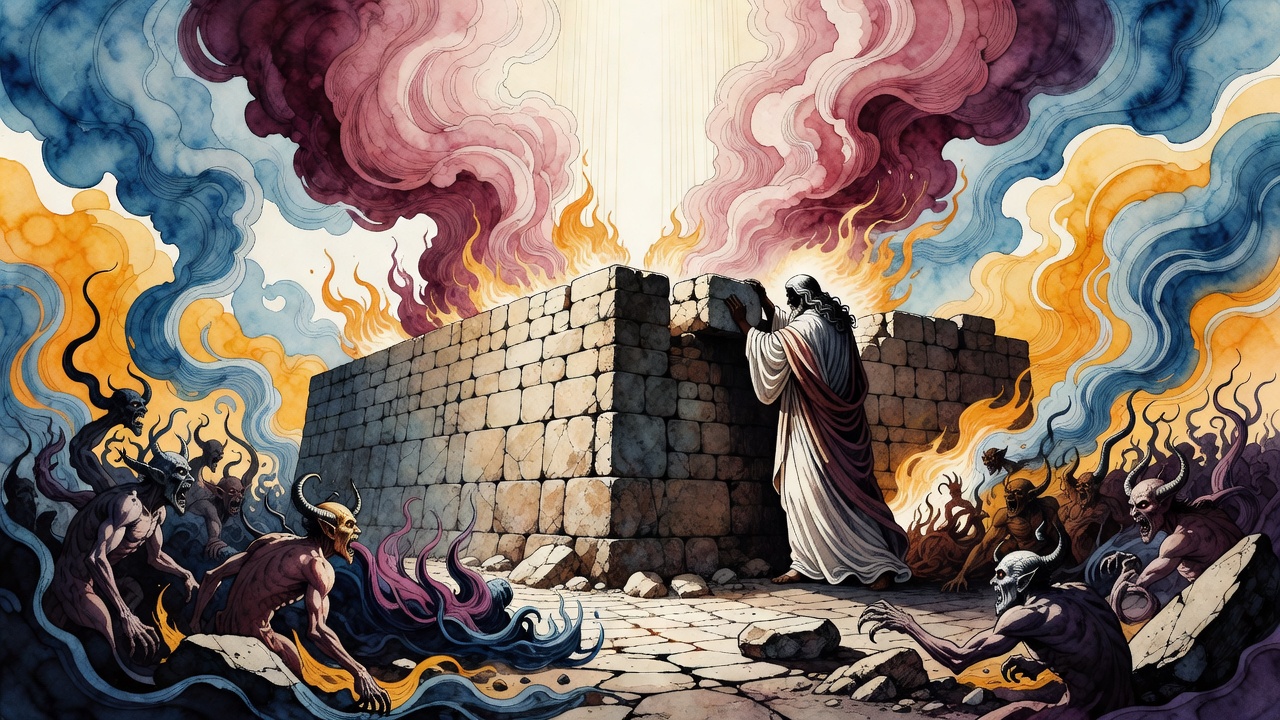
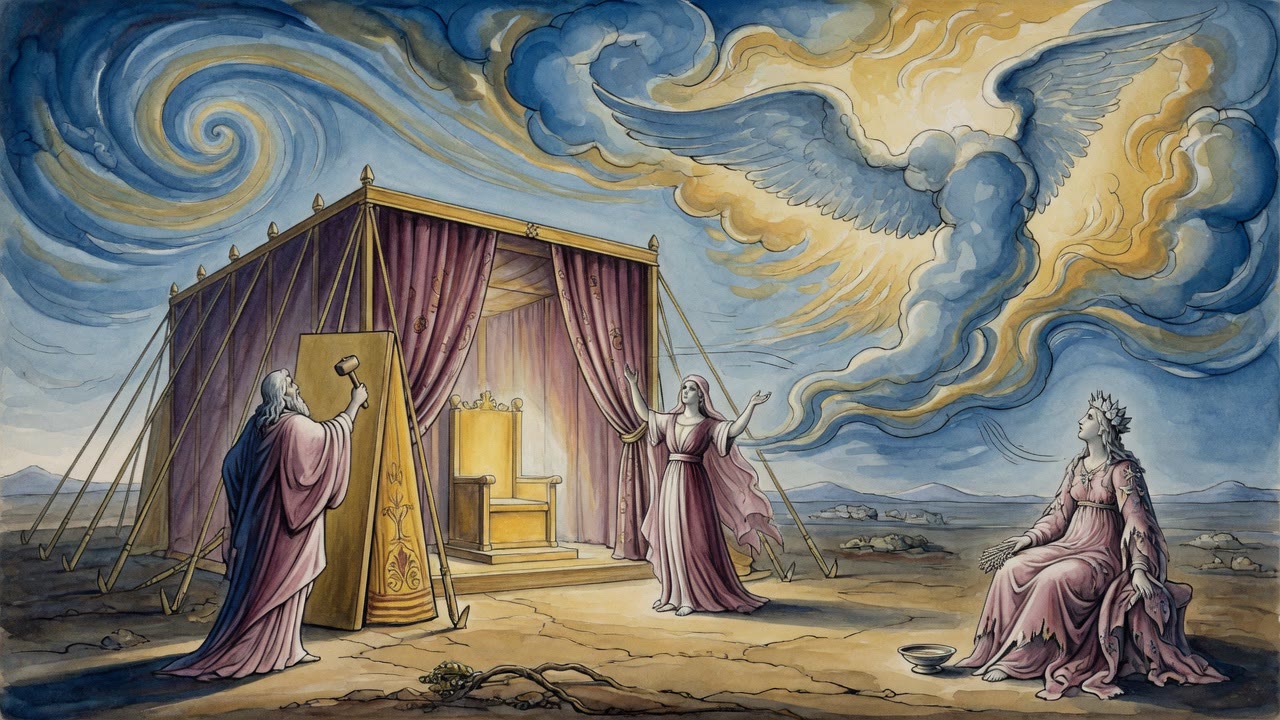
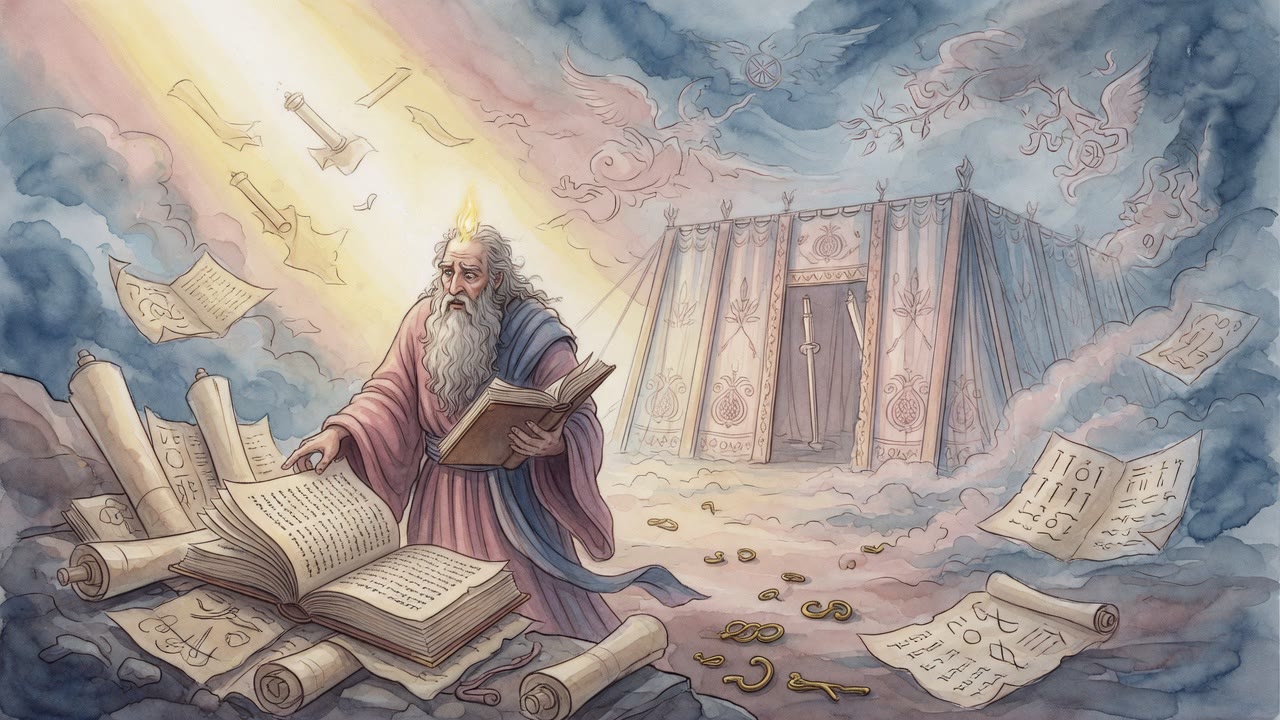
Moses set the final board into its silver socket, and the walls of goats' hair stood closed at last. Scripture marks the moment with one strange word. "So it came to pass on the day that Moses finished setting up the Tabernacle." The word for finished is kalot. Rabbi Yochanan turned it on his tongue and heard something buried under it. Kalot, he said, is close kin to kiluy, annihilation. On the day the sanctuary was raised, something was wiped out of the world.

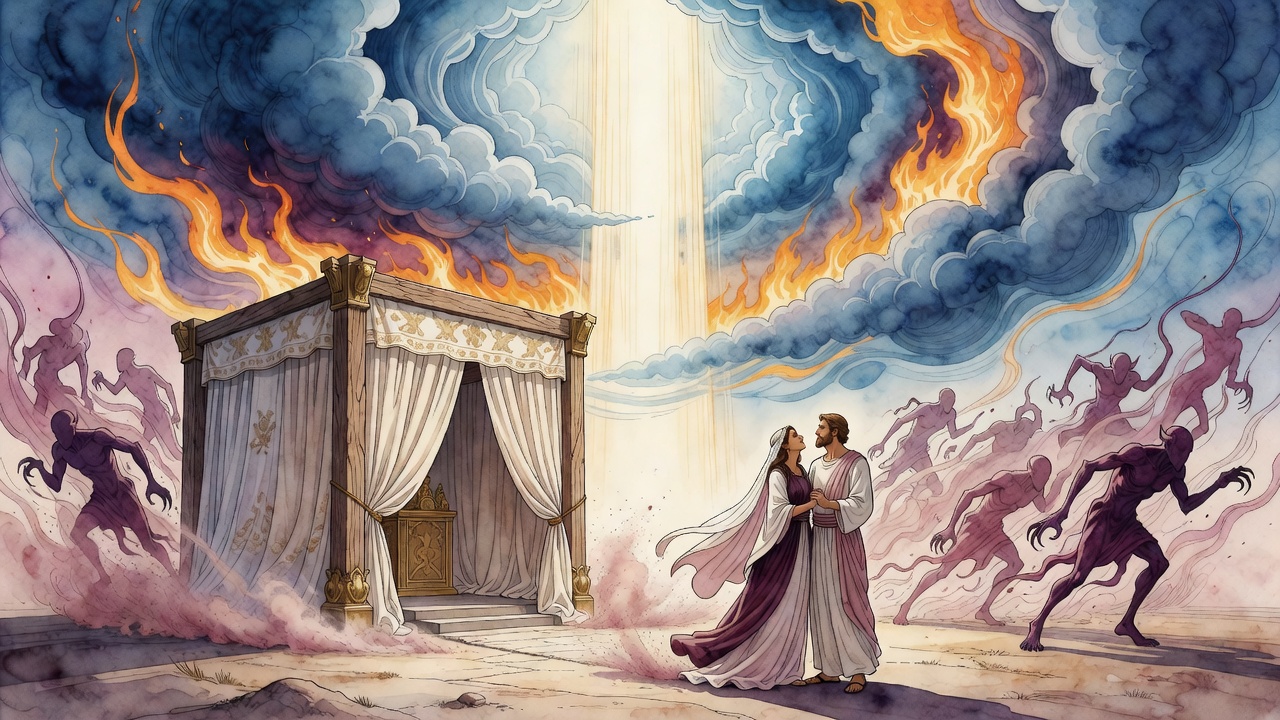
Not a nation. Not an army. The mazikin, the destroying spirits that had ranged loose across creation, prowling the dark and the noon light alike. Until that morning they held the earth. When the last board rose, the ground closed under their feet.

The Song Moses Carried Down the Mountain

He had learned their names on the mountain. One hundred and twenty days Moses lodged in the secret place of the Holy One, and each time he climbed he carried the same psalm up with him like a torch. "He who dwells in the shelter of the Most High abides in the shadow of the Almighty." He said it the way a man says a password at a gate he is not sure will open. "I say of the Lord, my refuge and my fortress, my God, in whom I trust."

The Holy One answered him. "You have trusted in Me. By your life, I will stand up for you." Then He named the dangers the psalm would guard against, one after another, and they were not swords or Egyptians. They were the things that move when no one is watching.

The Thing With the Calf's Head

"You shall not fear the terror of the night," the psalm went, and from that single line the sages learned a plain and unsettling fact. There was something to fear. Rabbi Berekhyah the Priest knew one of them by sight. There is a demon, he said, that flies like a bird and strikes like an arrow, and that is the meaning of "the arrow that flies by day."

Worse came at noon. "Nor the destruction that lays waste at noon." This is Ketev Meriri. Whoever looks on it does not live, not man, not beast, not wild animal. Its head is shaped like a calf's, and a single horn juts from the middle of its forehead, and it rules the hours from the seventeenth of Tammuz to the ninth of Av, the deep of summer when the light itself turns cruel. It does not creep in the dark like the pestilence. It comes in full noon and lays the world waste while the sun looks on.

The Presence Enters the Tent of Goats' Hair

Then the psalm reached the line that ended the reign of all of them. "No evil shall befall you, nor any plague come near your tent." As far as the tent, the sages heard, and no farther.

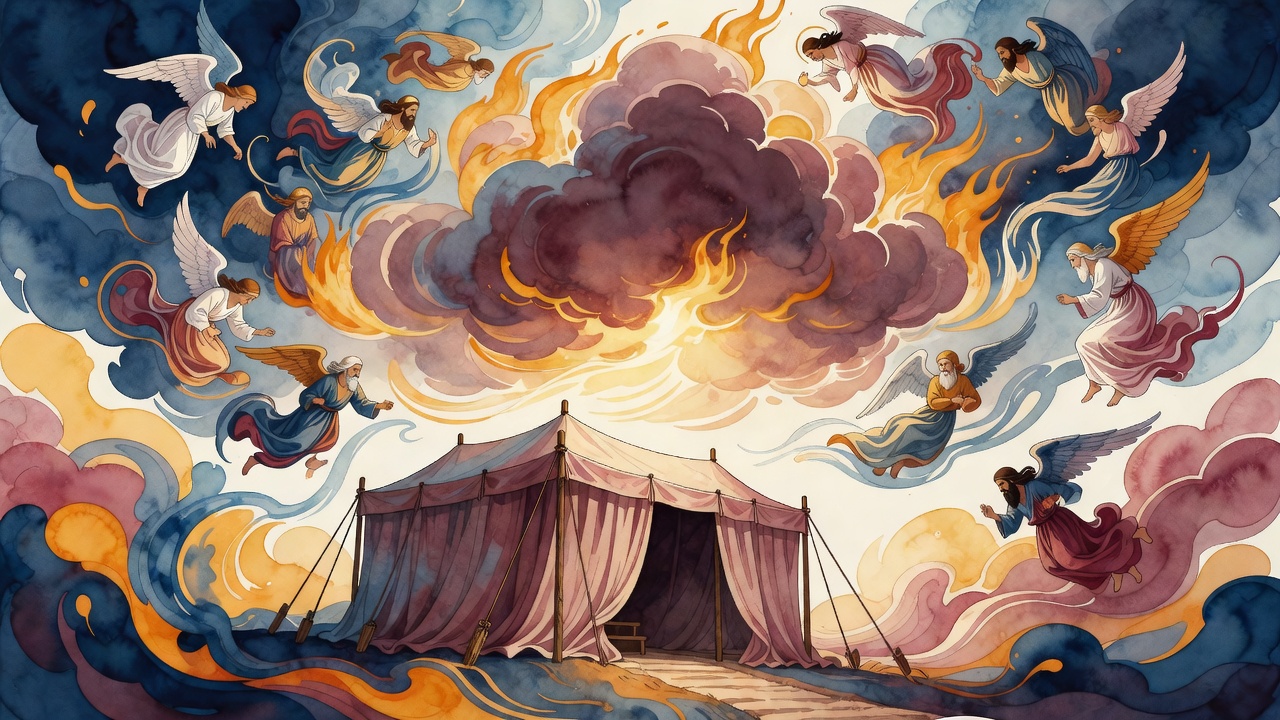
For into that tent of goats' hair the Shekhinah came down. The Divine Presence, unhoused since the world began, gathered into the small dark space between the boards Moses had just closed. And where it settled it did not stir. Whether the sanctuary stood whole or fell one day to rubble, the sages taught, the Presence would never move from its place. It was in His holy house, and it stayed. Even from behind a broken wall it would go on standing.

The mazikin had no answer to that. A destroying spirit needs a foothold, a loose and unhoused world to range through. The Presence took the ground out from under them. The noon of Ketev Meriri lost its dominion. The arrow that flew by day fell. The terror of the night had nowhere left to stand.

A Shield for Anyone Who Holds the Torah

Resh Lakish put it plainest. Why travel all the way to the book of Psalms for this, he asked. Learn it from its own place. "The Lord bless you and keep you." Bless you, from the destroying demons. Keep you, from every evil. And when is that blessing first spoken over Israel? On the day the Tabernacle was raised, the day the word kalot came true.

He said one thing more. I become a shield to any man who busies himself with the Torah. So it was not the tent alone that held the mazikin back. The words kept inside it did, carried in any mouth that would study them, long after the goats' hair rotted and the boards were shouldered away. The demons were driven out once, on a spring morning, when a man finished closing four walls around the presence of God. They have been held out ever since by anyone willing to say the words.


← All myths
From the tradition

Sources

2 sources

The texts behind this telling. Some cards carry a translation of the source; others are our own retelling of it, and each card says which. Every card links out to the original.

Midrash Tanchuma Buber, Nasso 27:1Midrash Tanchuma Buber, Nasso

Translation of the source text.Midrash Tanchuma (Buber), Public Domain, on Sefaria · CC-BY-SA

Another interpretation of (Numbers 7:1): "So it came to pass on the day that Moses finished setting up the Tabernacle." Rabbi Yochanan said: What is the meaning of "on the day Moses finished" (kalot)? It is a term of annihilation (kiluy). On the day the Tabernacle was erected, the destructive demons (mazikin) were annihilated from the world. For until the Tabernacle was erected, the destructive demons were prevalent in the world.

When Moses ascended the mountain, he would recite this psalm: "He who dwells in the shelter of the Most High" (Psalms 91:1), for he dwelt in the secret place of the Holy One, blessed be He. "He abides in the shadow of the Almighty" (ibid.), for he lodged there one hundred and twenty days. "I say of the Lord, my refuge" (Psalms 91:2), He is my refuge, and they made me as a wall. "My God, in whom I trust" (ibid.), the Holy One, blessed be He, said to him: You have trusted in Me; [by your life,] I will stand up for you. "For He will save you from the snare of the fowler" (Psalms 91:3), [what is "from the snare of the fowler"?] From the trap of the hunter.

"He will cover you with His pinions, and under His wings you will take refuge; His truth is a shield and buckler" (Psalms 91:4). Resh Lakish said: I become a shield (tzinah) to anyone who engages in (socher) the Torah. "You shall not fear the terror of the night" (Psalms 91:5), [from here] we learn that they were afraid. "Nor the arrow that flies by day." Rabbi Berekhyah the Priest [Berabbi] said: There is a destructive demon that flies like a bird and shoots like an arrow.

"Nor the pestilence that walks in darkness, nor the destruction that lays waste at noon" (Psalms 91:6), this is Ketev Meriri, for anyone who sees it has no life [in the world], whether man, beast, or wild animal. How is it formed? Its head resembles a calf, and one horn comes out from the middle of its forehead, and it has dominion from the seventeenth of Tammuz until the ninth of Av. Therefore it is written, "the destruction that lays waste at noon." "No evil shall befall you, nor any plague come near your tent" (Psalms 91:10), up to "your tent." Thus, until the day the Tabernacle was erected, the destructive demons were prevalent, and on the day the Tabernacle was erected they were annihilated.

Said Resh Lakish: What need have I to learn this from the book of Psalms? Let us learn it from its own place (Numbers 6:24): "The Lord bless you", from the destructive demons, "and keep you", from all evil. When? On the day the Tabernacle was erected: "So it came to pass on the day that Moses finished."

Full source
Midrash Tanchuma Buber, Shemot 10:1Midrash Tanchuma Buber, Shemot

Translation of the source text.Midrash Tanchuma (Buber), Public Domain, on Sefaria · CC-BY-SA

[(Exodus 3:1:) NOW MOSES WAS TENDING THE FLOCK.] This is what Scripture says (in Psalms 11:4): THE LORD IS IN HIS HOLY TEMPLE.... Rabbi Samuel bar Nahman said: Until the Temple was destroyed, the Divine Presence (Shekhinah) was set in the Temple, as it is said: THE LORD IS IN HIS HOLY TEMPLE; but once the Temple was destroyed, (the same verse continues:) THE LORD'S THRONE IS IN THE HEAVENS, He removed His Divine Presence to the heavens.

Rabbi Eleazar ben Pedat said: Whether destroyed or not destroyed, the Divine Presence does not stir from its place, as it is said: THE LORD IS IN HIS HOLY TEMPLE. And from where? As it is said (in I Kings 9:3): AND MY EYES AND MY HEART SHALL BE THERE ALL THE DAYS. And so it says (in Psalms 3:5): WITH MY VOICE I CALL UNTO THE LORD, AND HE ANSWERS ME FROM HIS HOLY MOUNTAIN, SELAH, for even as a mountain it remains in its holiness. Rabbi Eleazar ben Pedat said: See what is written (in Ezra 1:3): AND LET HIM BUILD THE HOUSE OF THE LORD, THE GOD OF ISRAEL, HE IS THE GOD WHO IS IN JERUSALEM; He does not stir from there. Rabbi Aha said: Never does the Divine Presence stir from the Western Wall of the Temple, as it is said (in Song of Songs 2:9): BEHOLD, HE STANDS BEHIND OUR WALL. Thus, THE LORD IS IN HIS HOLY TEMPLE.

Rabbi Yannai said: Even though they said, THE LORD IS IN HIS HOLY TEMPLE, THE LORD'S THRONE IS IN THE HEAVENS, (the verse continues:) HIS EYES BEHOLD, HIS EYELIDS TEST THE CHILDREN OF MAN (Psalms 11:4). To what is the matter comparable? To a king who had an orchard, and he brought the laborers into it; and at the gate of the orchard there was one storehouse full of all good things. The king said: Whoever does his work with all his soul shall take his reward from here, and whoever does not do his work with all his soul, I shall sit within my palace and judge him. Who is this king? This is the King of the kings of kings, the Holy One, blessed be He. And what is this orchard? This is this world. The Holy One, blessed be He, placed the children of man within it, that they should keep the Torah; and He made a condition with them and said to them: Whoever truly keeps the Torah, behold the Garden of Eden is before him; and whoever does not truly keep the Torah, behold Gehinnom is before him. The Holy One, blessed be He, said: Even though I appeared to remove My Divine Presence from the Temple, yet MY EYES BEHOLD whom He tests. THE LORD, THE RIGHTEOUS HE TESTS. And why does He not test the wicked? Rabbi Yannai said: This flax worker, when he is beating and sees that the flax is good, beats it much; but when he sees that it is not good, he does not beat upon it, lest it break apart. Therefore, HIS EYES BEHOLD, HIS EYELIDS TEST THE CHILDREN OF MAN. [And whom does He test? The righteous, as it is said (in the same, verse 5):] THE LORD TESTS THE RIGHTEOUS.

Full source