5 min read

The Five Times Moses Forced God to Answer

Five times Moses demanded answers directly from God. He did not always get what he wanted. He always got an answer.

Curated by Arthur · Told by Maggid ·
Table of Contents
  1. Prayer as a Form of Combat
  2. The First Time He Refused Silence
  3. Standing at the Sea
  4. The Final Blessing and What It Contained
  5. The Three Times He Acted Before Being Told

Prayer as a Form of Combat

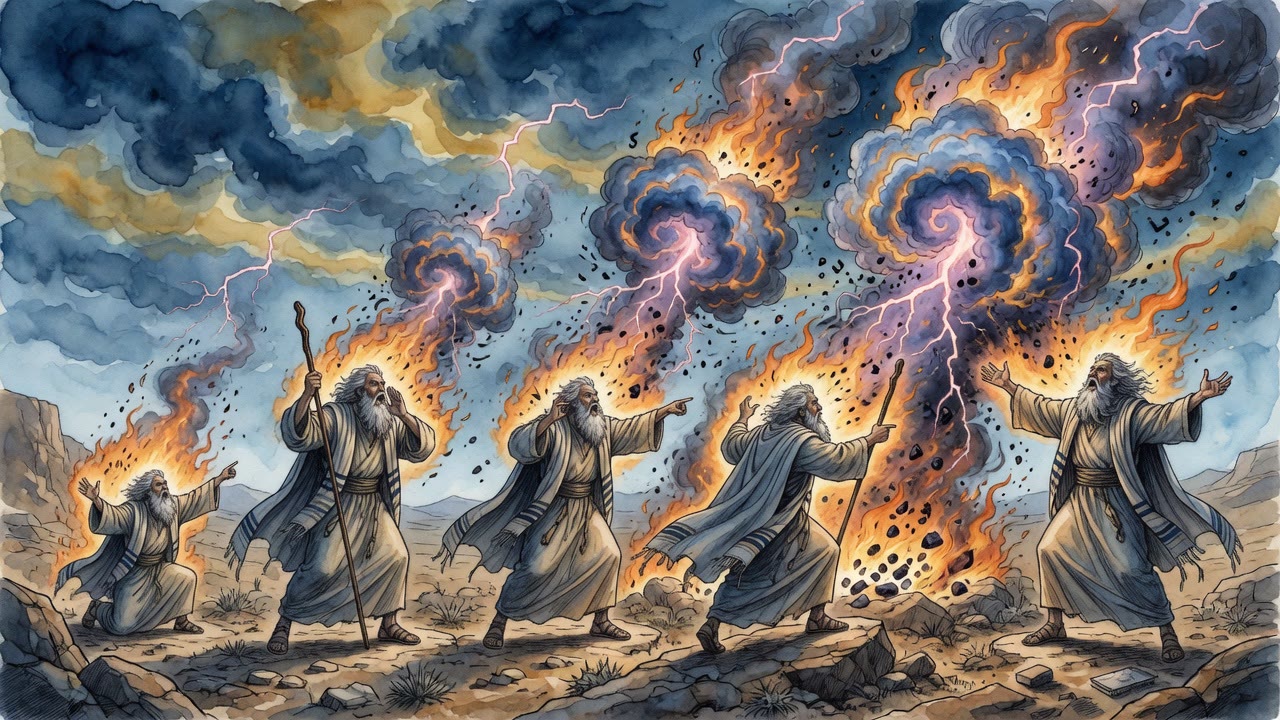
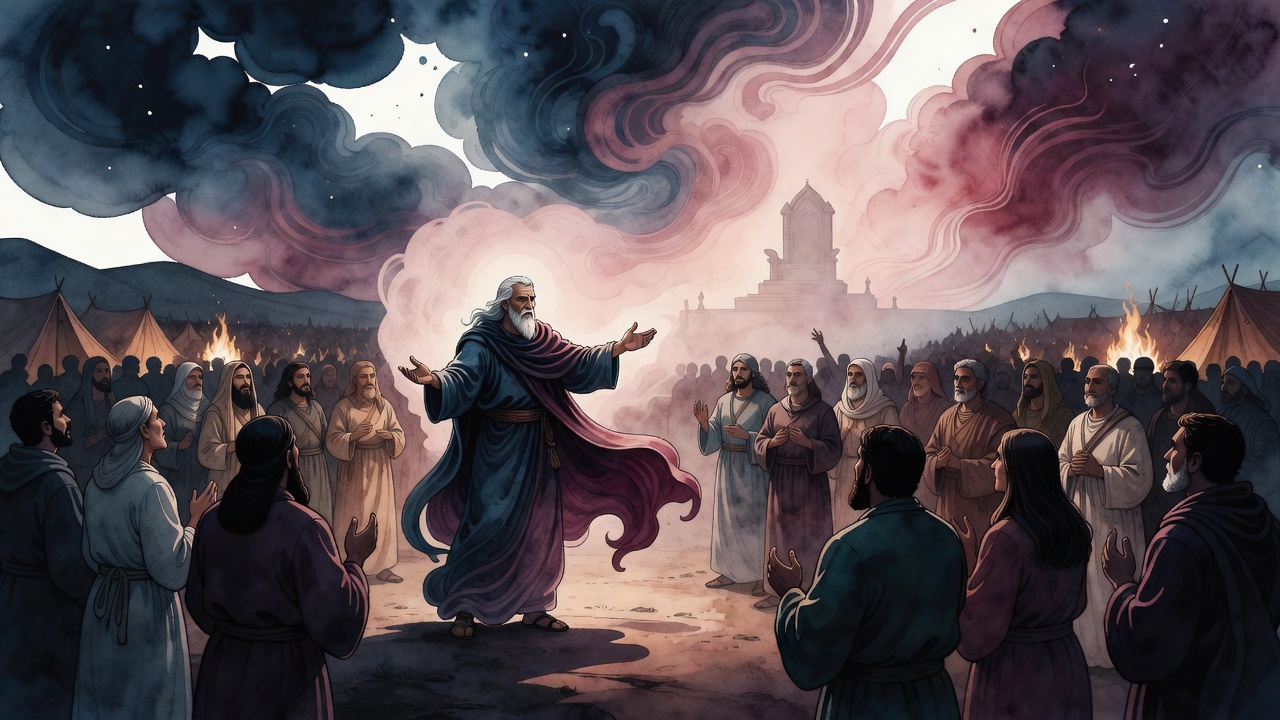
At Rephidim, Amalek attacked Israel from behind, striking the weak and the exhausted at the rear of the column. Joshua led the army in the field. Moses stood on the hill above with his arms raised. When his arms were up, Israel prevailed. When his arms dropped, Amalek prevailed. Aaron and Hur stood on either side and held his arms through the afternoon.

The Tikkunei Zohar, a Kabbalistic text expanding on the Zohar, described this not as symbolic but as literal spiritual combat. Moses was holding something in place with his arms that, when released, allowed a different force to gain ground. The Legends of the Jews, drawing on the same tradition, records another battle where Moses prayed that the sun stand still so Israel could finish what it had started before night fell. The sun held its position. The prayer worked as a direct intervention in the mechanics of the sky.

The First Time He Refused Silence

Ginzberg's compilation counted five specific occasions when Moses confronted God and demanded not just an answer but the right answer. The first was in Egypt, when Pharaoh's response to Moses's initial demand had made things worse for the Israelites. Their brick quotas increased. Their straw supply was cut off. The people turned on Moses for making their lives harder.

Moses went back to God and asked, with considerable bluntness, why he had been sent at all. He had done exactly what God had told him to do and the result was more suffering, not less. God did not answer the question as phrased. God told Moses that Abraham, Isaac, and Jacob had trusted without demanding explanations, and that Moses would see what happened next. Moses accepted this, though the rabbis noted that accepting it was not the same as being satisfied by it.

Standing at the Sea

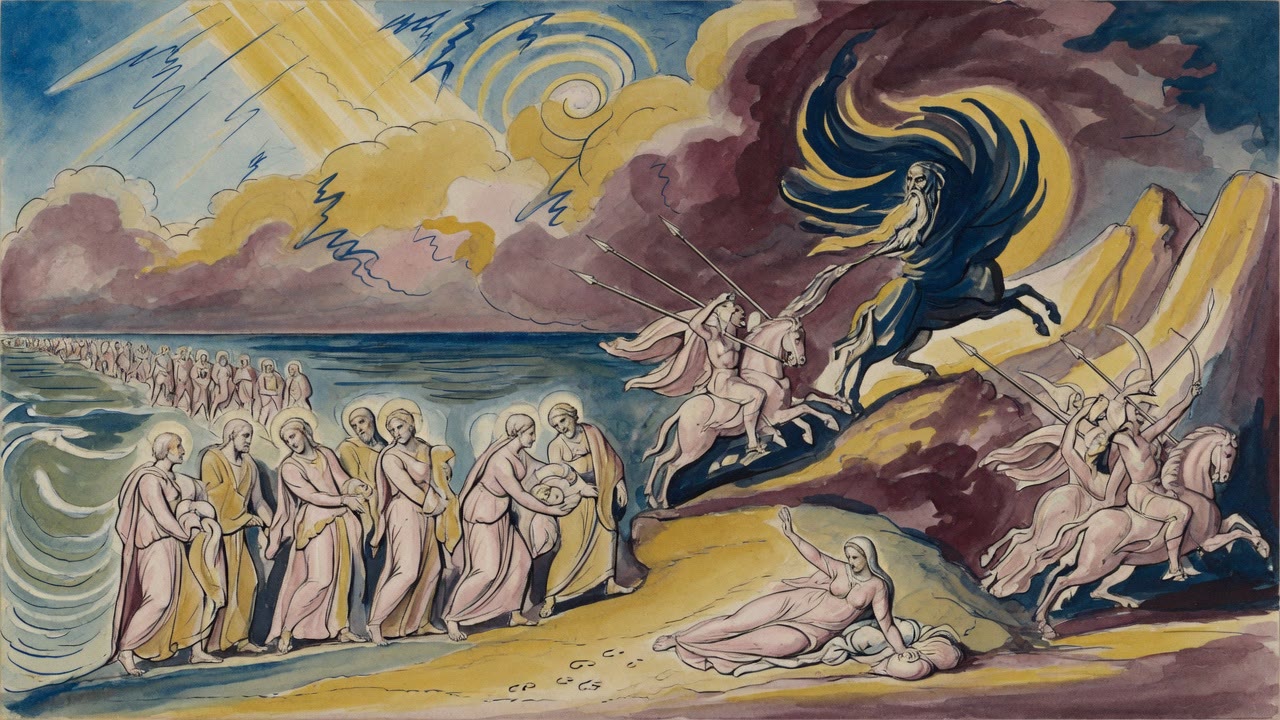
At the sea, with Pharaoh's army approaching from behind, Moses prayed. God's response was abrupt: why are you crying out to me? Tell the people to move forward. The prayer was sound. The timing of the prayer was wrong. This was a moment for action, not petition, and God told Moses so without ceremony.

The rabbis found this notable because it inverted the usual expectation. Moses, the greatest prophet, was told that in this specific moment his praying was the wrong thing to do. The sea would not part in response to prayer. It would part in response to Israel walking into it. That distinction, between trusting God enough to pray and trusting God enough to walk into the water, was the difference that moved the sea.

The Final Blessing and What It Contained

At the end of his life, Moses gathered all the blessings he had prepared for each tribe and delivered them in a single declaration: happy are you, Israel, who is like you, a people saved by God. The Legends of the Jews recorded that Moses had been running out of time when he spoke this, and he compressed everything that remained into one sentence rather than leave the tribes with incomplete blessings.

The rabbis read the compression as a kind of final argument with what was happening. Moses did not want to stop blessing. He had been blessing Israel his entire adult life, first by interceding for them and then by teaching them and then by arguing their survival before God after every catastrophe they created for themselves. The single final declaration was the last refusal to accept a silence he had not finished filling.

The Three Times He Acted Before Being Told

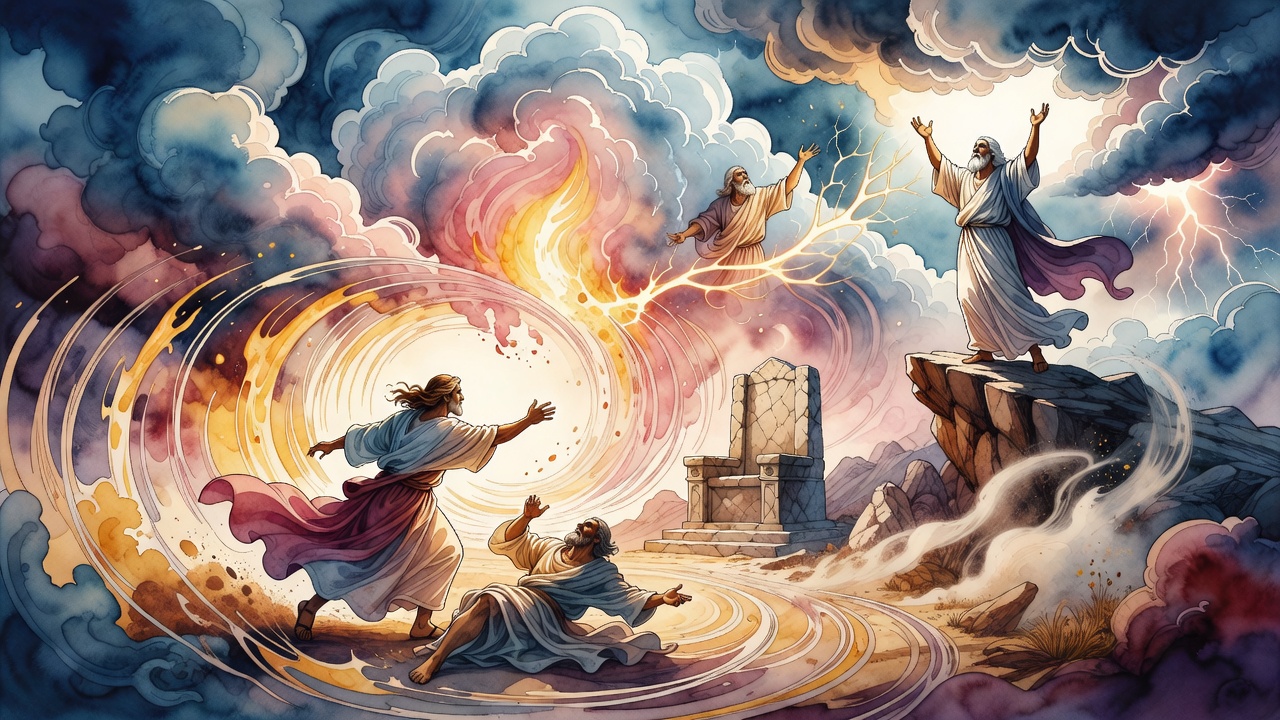
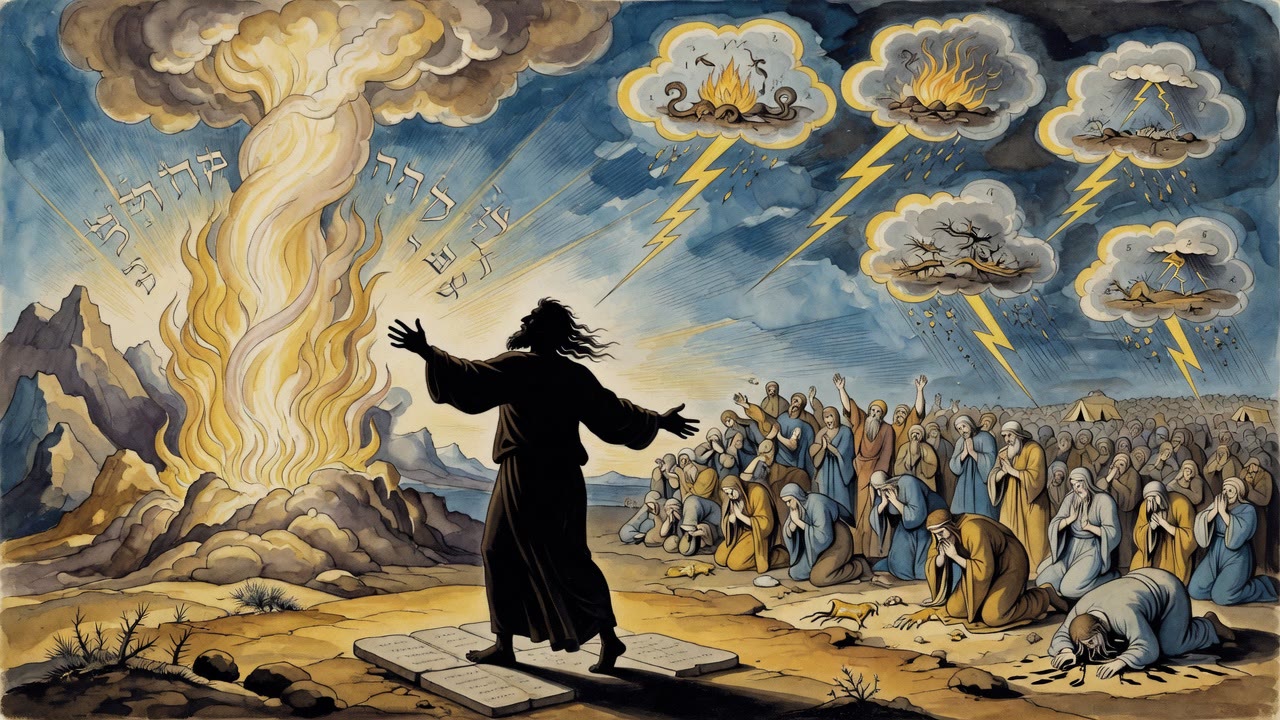
Shemot Rabbah, the Palestinian midrash on Exodus, preserved three decisions Moses made on his own initiative that turned out to match God's will exactly. He separated from his wife when he understood that his access to prophecy required constant readiness. He broke the first set of tablets when he came down from Sinai and found Israel dancing before the calf. He added an extra day to the preparation period before the revelation at Sinai.

In each case, God confirmed after the fact that Moses had reasoned correctly. He had not been told to do any of these things. He had looked at the situation and understood what the situation required, and then acted. The rabbis called this alignment between Moses's independent reasoning and God's own will the highest possible form of service. Not obedience to instruction but comprehension deep enough to reach the same conclusion without being given it.


← All myths
From the tradition

Sources

5 sources

The texts this telling draws on, in full. Open a card to read inline, or expand it for a wider, quieter read.

Legends of the Jews 6:85Legends of the Jews

It’s a daunting enough task already, but what do you do when your efforts seem to make the situation even more dire for your people?

That’s exactly the place Moses found himself in, and it led him to some pretty intense conversations with God.

According to Ginzberg’s Legends of the Jews, there were five times when Moses practically begged God for a straight answer. This moment with Pharaoh was one of those times. He basically said, "Look, I'm putting myself on the line here. Are you going to deliver them now, or not?" Can you hear the frustration in his voice? The weight of responsibility?

Pharaoh wasn't the only challenge. Remember Rephidim? That place where the Israelites were dying of thirst and ready to turn on Moses? In that desperate moment, facing the anger of his people, Moses again implored God for clarity. "Am I going to fall into their hands, or are you going to protect me?" he asked.

These weren't just casual inquiries. These were moments where the fate of a nation, and Moses's own life, hung in the balance. He needed reassurance, a sign, something.

And it didn’t stop there. When his sister, Miriam, fell ill, Moses turned to God again, pleading, "Tell me, will you heal her, or won’t you?" The personal and the communal were deeply intertwined for Moses; his family’s well-being was inseparable from his leadership.

Perhaps the most poignant instance came after years of wandering in the desert. After enduring hardship after hardship, Moses yearned to enter the Promised Land, Eretz Yisrael. He prayed, pouring out his heart, and finally asked God point blank, "Let me know if I am to enter the Holy Land, or not." Imagine the anticipation, the hope, the fear of being denied after all that struggle.

These weren’t just questions, were they? They were cries from the heart of a leader burdened with immense responsibility, desperate for guidance, for a glimpse of the divine plan. They show us a very human side of Moses – a side that resonates with anyone who has ever felt overwhelmed and in need of answers. And maybe, just maybe, they remind us that even the greatest leaders sometimes need to ask for help.

Full source
Tikkunei Zohar 58:13Tikkunei Zohar

It’s not always with swords and shields. Sometimes, it's with words. Powerful, directed words of prayer.

The Tikkunei (spiritual repair) Zohar, a later expansion and “correction” of the Zohar itself, gives us a truly striking image of this kind of spiritual warfare. Imagine the scene: Moses, here referred to as the “Faithful Shepherd” (Ra’aya Meheimna), arrives with a multitude of animals – sheep, oxen, goats – and his trusty staff. It's a pastoral image, almost idyllic. But then, the focus shifts.

He looks up at a tower, and there he sees a young man. This isn't just any young man,. He's called Tzadiq, “Righteous One.” And he’s not relaxing; he’s at war.

He sits atop the tower, bow in hand, firing arrows at a snake. This isn't a literal snake, slithering around; it's a symbol of evil, of the forces that seek to undermine the good in the world. And the arrows? They represent something quite profound.

The Tikkunei Zohar spells it out for us. The bow itself is the tongue. The “nut of the bow,” that central point of tension and release, is the mouth. The thread of scarlet – some versions specify it as the lip – represents the power of speech, the potential for both blessing and curse contained within our words. And the cord of the bow, sometimes understood as Hesed, loving-kindness, is the force that propels those arrows.

So what are these arrows? They are the utterances of prayer. Every word, every intention, every heartfelt plea aimed at the heavens. Prayer as weaponry. The Righteous One, perched high, using the power of speech, channeled through love and intention, to combat the forces of negativity. It’s a potent image. And notice the phrase, "the great pazer." While the exact meaning is debated, it suggests a powerful force, perhaps a scattering or dispersal of negativity. This Righteous One is actively working to dismantle evil’s influence.

What does this all mean for us? It suggests that we, too, have a role to play in this cosmic battle. We may not be sitting atop a tower, bow in hand, but we each have a tongue, a mouth, and the capacity for prayer. Our words matter. Our intentions matter. Our willingness to speak truth, to offer blessings, to engage in acts of loving-kindness – these are all arrows we can fire into the world, contributing to the ongoing struggle against darkness.

So the next time you find yourself in prayer, remember the Righteous One on the tower. Remember that your words have power. Remember that even the smallest act of kindness, the simplest expression of faith, can be a powerful weapon in the fight for good. What kind of arrow will you choose to launch today?

Full source
Legends of the Jews 1:127Legends of the Jews

Legends of the Jews turns to Moses Prays for the Sun to Stand Still in Battle.

Moses, in this moment of desperate need, turned to God. He prayed that God might stay the setting of the sun, holding back the night so that the Israelites could finish what they started and secure victory. And, incredibly, God answered! The sun, obedient to the Divine will, remained suspended in the sky, prolonging the day. Israel utterly destroyed their enemy under the unwavering gaze of the sun.

It’s a pretty wild image, isn’t it?

After this incredible victory, Moses, filled with gratitude and perhaps a touch of prophetic insight, blessed Joshua. He said, "Some day the sun shall stand still for thy sake, as it did to-day for mine." It's a beautiful moment of passing the torch, acknowledging that Joshua, too, would face monumental challenges and would also be worthy of divine assistance.

And wouldn't you know it, tradition tells us that this blessing came to fruition later, at Gibeon. Joshua was leading the Israelites in battle against the Amorites, and, just as with Moses before him, the sun stood still to aid Joshua in his fight. A direct echo of the earlier miracle. Two leaders, facing critical moments, both experiencing the extraordinary intervention of God in the most dramatic way possible. It speaks volumes about their leadership, their faith, and the power of prayer. It also raises questions: What does it mean for the sun – a symbol of cosmic order – to simply stop? What kind of faith is required to even ask for such a thing?

These aren't just stories about battles won. They're about the relationship between humanity and the Divine, about faith, leadership, and the enduring power of a well-placed prayer. These moments, frozen in time (literally!), remind us that sometimes, just sometimes, the universe itself might pause to give us the time we need.

Full source
Legends of the Jews 7:46Legends of the Jews

He had so much wisdom to impart, so many blessings yet to bestow upon each tribe of Israel. But time, as it always does, was running short.

So, he gathers all those individual blessings into one powerful declaration: "Happy art thou, O Israel: Who is like unto thee, a people saved by the Lord, the shield of thy help, and that is the sword of thy excellency!" (From Legends of the Jews).

The people, ever inquisitive, had a burning question for their teacher. "O tell us, our teacher Moses," they pleaded, "what is the blessing that God will bestow upon us in the future world?" What awaits us in the Olam Ha-Ba, the world to come?

Moses, even with all his prophetic insight, couldn't fully articulate it. Imagine trying to describe the indescribable! He simply responded, "I cannot describe it to you, but all I can say is, happy ye that such is decreed for ye!" The ultimate blessing isn't something we can grasp with our limited human understanding. It's something we can only experience. It's a state of being, a profound joy that transcends words.

But the story doesn't end there. Moses, ever the advocate for his people, makes one final plea to God. He begs that in the future world, God might restore to Israel the heavenly weapon – the spiritual power – that was taken from them after the sin of the Golden Calf. That devastating moment of idolatry had cost them dearly.

And God, in His infinite mercy, responds, "I swear that I shall restore it to them."

What does this heavenly weapon represent? Is it literal? Or is it a metaphor for something deeper? Perhaps it's the restored connection to the Divine, the ability to access higher levels of consciousness, or the power to manifest good in the world. Maybe it’s the potent combination of faith and action.

The promise of its restoration offers a profound sense of hope. Even after moments of profound failure, even after losing our way, the possibility of redemption remains.

So, as we ponder the blessings in our own lives, let's also consider the blessings yet to come. The ones beyond our current comprehension. And let's strive to reclaim that "heavenly weapon" within ourselves, that spark of divinity that connects us to something far greater than ourselves. Because maybe, just maybe, that's the real blessing we're all searching for.

Full source
Shemot Rabbah 46:3Shemot Rabbah

These three actions originated from Moses' own reasoning, and, remarkably, his reasoning turned out to be in sync with God's own.

The first instance involves Moses separating from his wife. Now, this is a loaded topic. Shemot Rabbah 46 presents different viewpoints on this. Rabbi Shimon ben Yoḥai offers a compelling argument: If even the temporarily sanctified Mount Sinai demanded abstinence ("Do not approach a woman," (Exodus 19:1)5), then Moses, who was in constant communication with God, should certainly abstain. – constant, direct communication! That's intense.

Rabbi Akiva throws another log on the fire, suggesting God commanded Moses to separate. He points to (Numbers 12:8), "Mouth to mouth I speak with him," arguing this was God's justification after Miriam and Aaron questioned Moses' decision. Then Rabbi Yehuda chimes in with a third possibility, that the decree "Do not approach a woman" during the Sinai revelation included Moses, but when God later said, "Return you to your tents" (Deuteronomy 5:27), Moses was told, "you stay here with Me" (Deuteronomy 5:28).

It's a fascinating glimpse into rabbinic debate – different interpretations, all seeking to understand the motivations and divine will behind Moses' actions.

The second instance revolves around the Ohel Moed, the Tent of Meeting. Moses reasoned that if God only spoke to him at Sinai after explicitly calling him ("The Lord called to him from the mountain, saying," Exodus 19:3), then surely the same principle applied, even more so, at the permanently sanctified Tent of Meeting. So Moses waited for the call, and as we see in (Leviticus 1:1), "He called to Moses…[from the Tent of Meeting]." Again, Moses's own logic mirrored God's protocol.

And finally, the big one: the breaking of the tablets. This is huge. Shemot Rabbah tells us Moses reasoned that if even the lesser sanctified paschal offering was forbidden to strangers ("No stranger shall partake of it," (Exodus 12:4)3), then surely the Tablets, the very handiwork of God, should not fall into the hands of idolaters. So, in a moment of profound and perhaps impulsive action, he shattered them.

The text emphasizes the sheer force of will Moses displayed. Aaron and the seventy elders physically tried to stop him, but they couldn't. It was a powerful act, defying even the elders!

But here's where it gets really interesting. The text notes that even the will of God was that he not break them! (Deuteronomy 34:11) refers to "all the signs and the wonders," and according to some interpretations (like the Etz Yosef), Moses' breaking of the tablets was a "wonder" precisely because it occurred without God's explicit prior approval. Or perhaps, God wanted Moses to withhold them, not destroy them.

So why didn't God punish Moses? Because, as the text concludes, God ultimately approved of Moses' zeal. "Let there be peace for that hand," God says, referring to the hand that broke the tablets ("And with all the mighty hand," (Deuteronomy 34:1)2). As the Rashash commentary notes, this was God's retroactive endorsement of Moses's action.

What does this all mean? It’s a powerful reminder that even our greatest leaders confront interpreting God's will. It highlights the importance of human reasoning, sechel, in our tradition. And it suggests that sometimes, acting with righteous intention, even if it seems to defy expectations, can ultimately align with the divine plan.

It makes you wonder, doesn't it? Are there times in our own lives when our intuition, our own sense of what's right, might actually be a subtle form of divine guidance? Perhaps the story of Moses and the tablets encourages us to trust our own moral compass, even as we strive to understand and follow the path laid out before us. Just like Moses, we must strive to make the right choices, and hope that our reasoning aligns with the will of the Holy One.

Full source