6 min read

The Husks That Hardened Around God's Own Light

The Other Side is no rival to God but God's own overflow, husks that harden around every falling spark to hoard the light they never made.

Curated by Arthur · Told by Maggid ·
Table of Contents
  1. The Giver Who Had No One to Take
  2. The Peel That Grew Around the Fruit
  3. The Husks Learned to Keep and Never Give
  4. Called Dead While It Still Devoured
  5. The Flaw Was Planted So It Could Be Healed
The Husks That Hardened Around God's Own Light Click for full size

The Giver Who Had No One to Take

Before there were husks, there was only pouring. The Ein Sof, the Infinite with no edge and no end, was pure giving and nothing else. No hunger lived in it, no need, no reaching. It wanted only to hand over, to flood outward, to fill. And this was its problem. A gift with no one to catch it falls into empty space. A river of light with no vessel to hold it lights nothing at all.

So the Infinite pressed a will into being that it did not carry itself. It made a desire to receive. It carved out a mouth that could open under the flow, take the light in, and keep it. This was the first cracked thing, the one flaw the Giver had to invent, because a Giver alone in a full and shining nothing has no way to give.

The light came down through worlds, dimming as it went, thickening as it fell, until it reached the low place where bodies could be made. And there, at the bottom of the descent, the desire to receive stood with its mouth wide, ready to swallow everything that dropped.

The Peel That Grew Around the Fruit

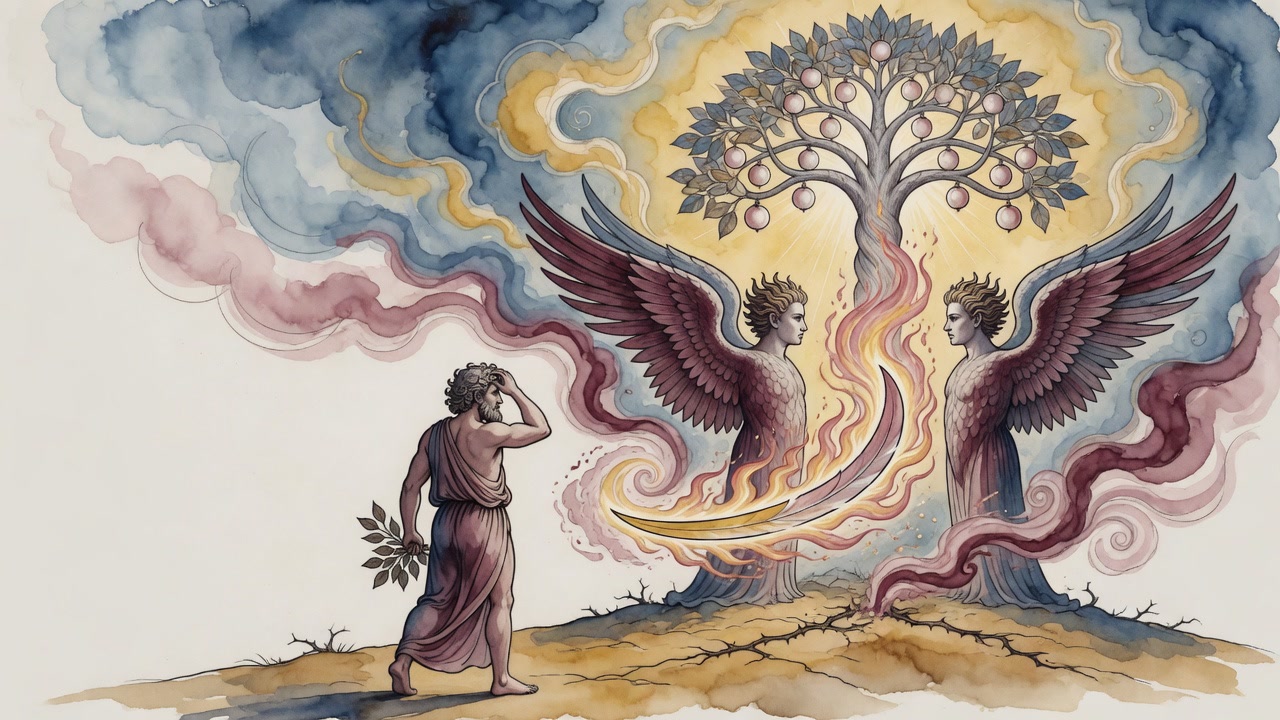
A bare desire to receive is dangerous. Left uncovered it grabs at holiness directly, and holiness will not survive being grabbed. So a shell formed around it. A peel does not oppose the fruit. It guards the fruit while the fruit is still soft and unripe, still forming, still unable to bear the sun.

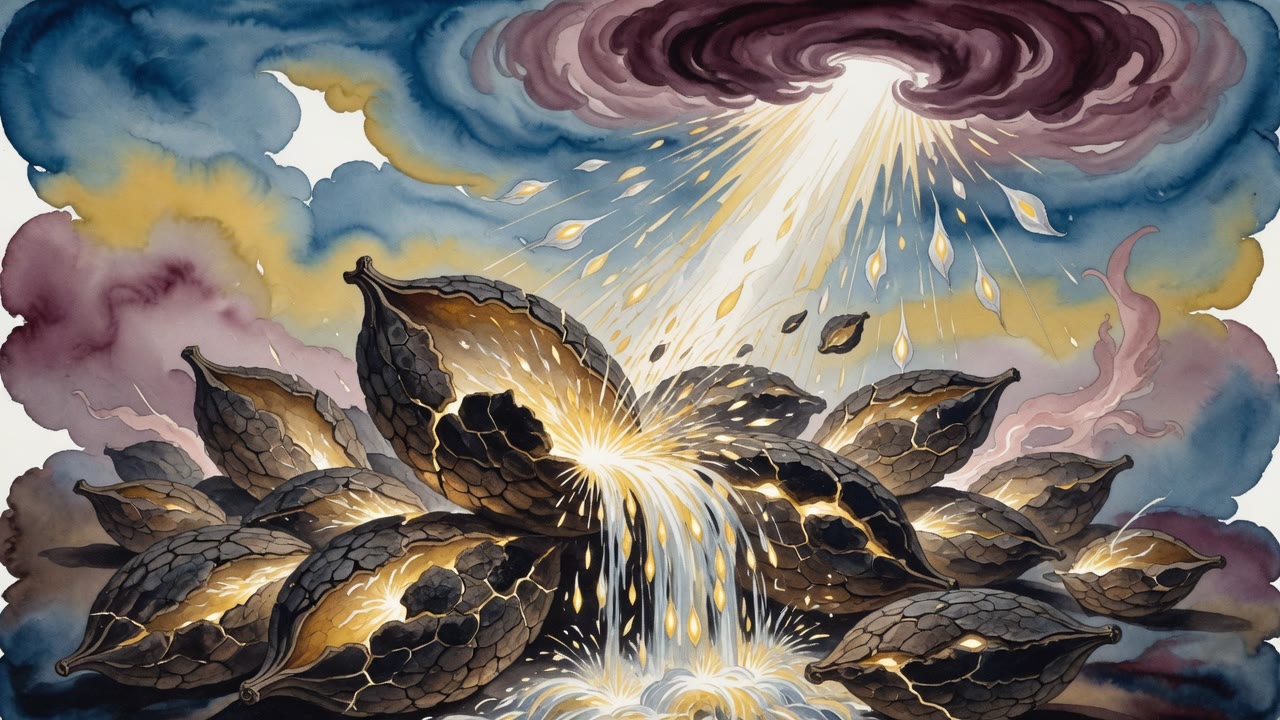
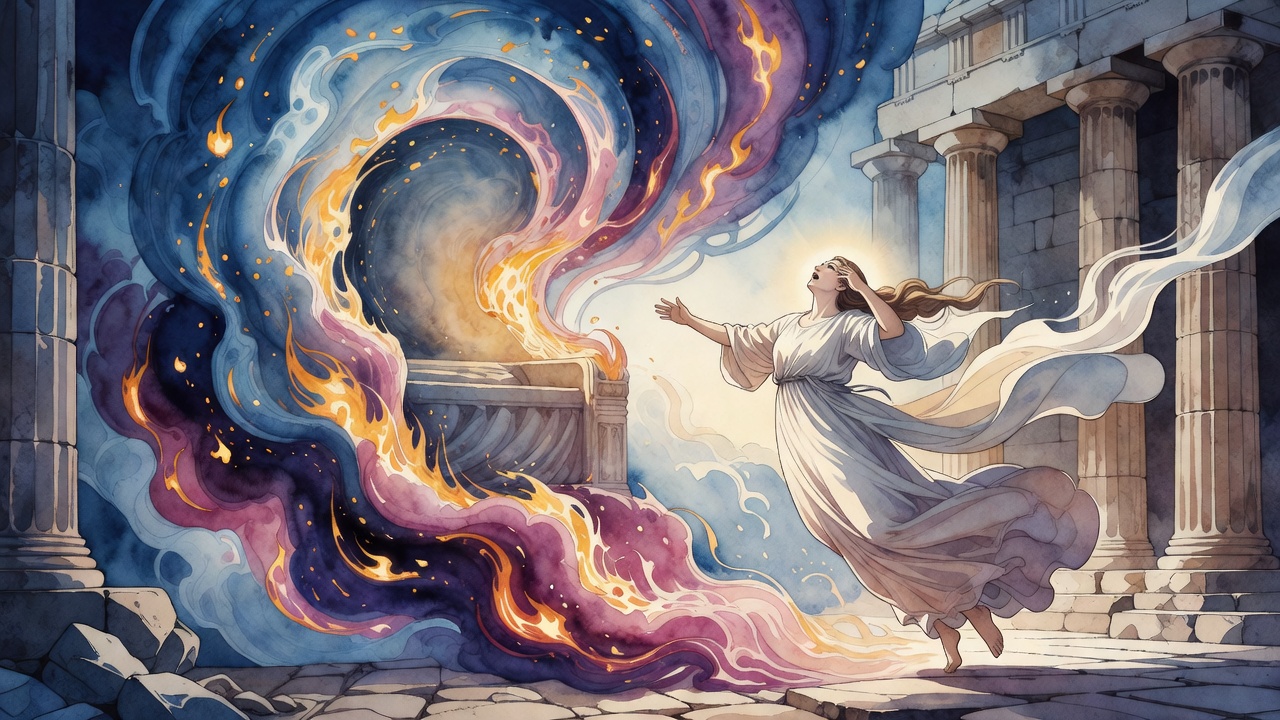
These shells had a name. The kelipot, the husks, the rinds of impurity. And this should not have been possible: they came out of God's own sanctity. Not from some rival kingdom, not from an enemy of heaven, not from a second god at war with the first. They came down from the same source as every clean and shining thing, hardening as they went, the way water turns to ice the further it drifts from the fire.

The husks wrapped the desire to receive the way a rind wraps a seed, and for a while they did their work. They held the raw hunger in place. They kept it from tearing at the light before the light was ready to be held.

The Husks Learned to Keep and Never Give

Then the peel forgot it was a peel.

A husk is built to take. That is its whole nature, to receive and hold and enclose. But it was made to take in service of the fruit, to guard something that would one day give itself away. The husks took the second half of that and buried the first. They received, and they kept. They wrapped around every spark of light that fell past them, and they would not let go.

This was the birth of the Sitra Achra, the Other Side. In the old tongue the words mean only that, the Other Side, the country that stands against holiness. It has no light of its own. It never made a single spark. Everything it holds it stole on the way down, and everything it stole it hoards, because its one law is to receive for its own pleasure and give away nothing at all. The husk said only "Mine" over every trapped spark, and it said nothing else, because it knew no other word.

So the tug-of-war began, and it runs through everything still. On one side, pure giving, the open hand of the Infinite. On the other, pure taking, the closed fist of the shell. Between them, caught and imprisoned, every spark of light that ever fell.

Called Dead While It Still Devoured

The sages kept a hard name for the husks. They called them dead.

Not dead the way a stone is dead, inert and harmless. Dead the way the wicked are called dead even while they walk and eat and breathe, cut from the current that keeps living things alive. "The wicked, even in their lives, are called dead," the old teachers said, and they meant it about the husks first of all. God is the Life-Force of the living, and God is pure giving. A husk that receives only and gives never has severed the one cord that carries life. It grips its stolen sparks in a dead hand.

The distance between the two did not start wide. It began as the smallest bend, a hair's turn away from giving toward taking. But a slight deviation at the top opens into a chasm at the bottom, until the giver and the taker stand on separate levels of being, extreme opposites, unable even to see each other across the gap.

The Flaw Was Planted So It Could Be Healed

The wrong question is how filth came out of the Infinite. The plan did not spring a leak. The plan needed the husks.

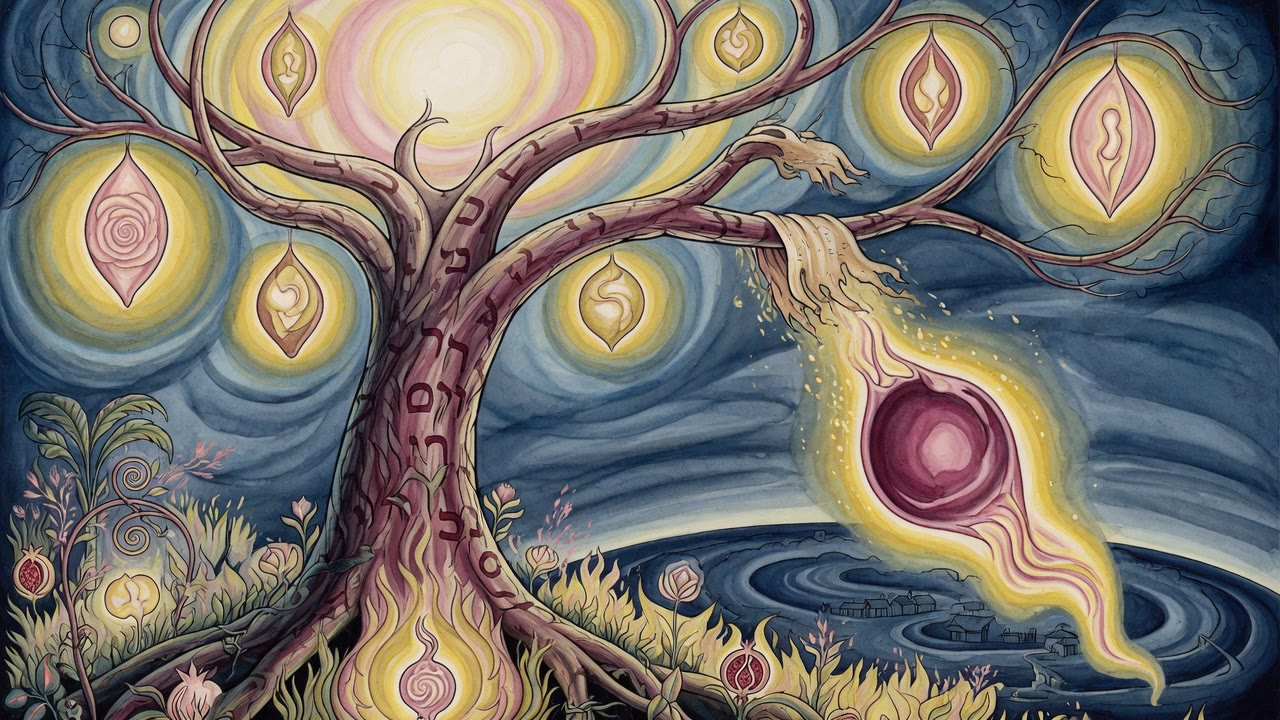
A seed already holds the whole tree inside it. The full grown world, finished and perfected, was folded into the Ein Sof (the Endless) before a single spark went down. But a seed still has to crack, and sprout, and push through dirt, and stand through storms before it becomes the tree it already is. The husks are the dirt and the storm. The darkness is not a wound in the plan. It is a stage of the plan.

And it comes down, in the end, to one person standing in one body, carrying both inheritances at once. Inside every human the desire to receive still hungers, the yetzer hara, the crooked pull toward taking. Beside it the yetzer hatov (the good inclination) leans the other way, toward giving. The two must part. They must come into open conflict, body against soul, because there is no other way for the flaw to be mended.

A person cannot repair what he does not possess. Hand someone a clean and empty vessel, and there is nothing to fix. The crack has to be there first. The selfish hunger has to be real, and felt, and carried, before Torah and mitzvot (commandments) can take it in hand and turn it, slowly, from taking toward giving, from a dead grip into an open one. The husk was never the enemy of the plan. The husk was the raw material the whole plan had been waiting for.


← All myths
From the tradition

Sources

4 sources

The texts behind this telling. Some cards carry a translation of the source; others are our own retelling of it, and each card says which. Every card links out to the original.

Baal HaSulam's Introduction to Zohar 3:1Baal HaSulam's Introduction to Zohar

Retold in our words. Read the original at the link below.Sefaria-hosted English translation · CC-BY

It's precisely the question that Baal HaSulam, that great 20th-century Kabbalist, tackles head-on in his introduction to the Zohar. Specifically, in the third section of his introduction, he's confronting the problem of the sitra achra (the Other Side, the realm of impurity) and the kelipot (the shells of impurity).

The sitra achra. In Aramaic, it literally means the “Other Side." It’s the antithesis of holiness, the source of all that is dark and destructive.

The kelipot? Those are the "husks" or "shells." It's a Kabbalistic term for the negative aspects of reality. They conceal the divine light, preventing us from seeing the truth of God's presence in everything. They're like the obstacles on our path, the challenges that obscure our vision.

So, Baal HaSulam's question is this: How can the sitra achra and the kelipot, things so unimaginably distant from God’s sanctity, even emerge from God's sanctity? Is it possible that God's holiness somehow exists within them? I mean, the idea is almost…unthinkable. It challenges our fundamental understanding of good and evil, of the divine and the profane. It's like saying darkness is just a twisted form of light.

This isn't just some abstract theological debate. It goes to the heart of how we understand the world and our place in it. If evil truly comes from the same source as good, what does that say about our choices? About the nature of reality itself? It's a question that demands we look deeper, beyond the surface, to understand the hidden connections that bind all things together. As we continue to explore the wisdom of Kabbalah, we'll see how these ancient texts offer profound insights into this enduring mystery.

Full source
Baal HaSulam's Introduction to Zohar 13:1Baal HaSulam's Introduction to Zohar

Retold in our words. Read the original at the link below.Sefaria-hosted English translation · CC-BY

In Kabbalistic thought, these kelipot, these "husks of impurity," actually emanate from God's own sanctity! Sounds contradictory. But bear with me. Think of it this way: these negative forces are a necessary stepping stone for the creation of physical bodies. Think of husks as the peel of a fruit. The peel is not the fruit itself, but it protects the fruit while it grows.

These kelipot are like a protective shell for the desire to receive, the very thing that, when untamed, can lead us astray. This desire to receive, to take in for oneself, is often seen as the root of negativity. But as Baal HaSulam, one of the greatest Kabbalists of the 20th century, explains in his introduction to the Zohar, if we didn't have this "defective desire to receive," we wouldn't be able to repair it!: how can you fix something you don't even have?

This idea is profound. We can only transform and elevate what we already possess. And how do we do that transformation? Through Torah and mitzvot (commandments) – through studying Jewish wisdom and performing good deeds. These practices act as the tools, the instruments, the very method by which we can refine our desires. They allow us to take that raw, self-centered desire and channel it towards something higher, something more selfless.

This leads us to an even bigger question: If this selfish desire is so negative, how could the Ein Sof (the Infinite One), conceive of it in the first place? How could absolute goodness create something that seems so… not good?

The Ein Sof is, by definition, beyond our comprehension. It is absolute unity, a state of being that we, as finite beings, can barely grasp. And yet, within that unity lies the potential for everything, even those things that seem to contradict it.

As we delve deeper into the mysteries of Kabbalah, we find that the existence of negativity, of the kelipot, isn't a flaw in the divine plan, but an integral part of it. They are the raw materials with which we are meant to work, the challenges that give meaning and purpose to our spiritual journey. And ultimately, they are a reflection of the hidden unity that underlies all of creation. An opportunity to repair, to transform, and to draw closer to the Ein Sof.

Full source
Baal HaSulam's Introduction to Zohar 10:4Baal HaSulam's Introduction to Zohar

Retold in our words. Read the original at the link below.Sefaria-hosted English translation · CC-BY

This tension, this cosmic tug-of-war between giving and receiving, is actually a central theme in the mystical teachings of the Zohar.

The Zohar, a foundational text of Kabbalah, dives deep into the hidden dimensions of reality. And in his "Introduction to Zohar," the great Kabbalist Baal HaSulam (Rabbi Yehuda Leib Ashlag) illuminates a critical concept: the nature of what's called the "husks," or Klipot (singular: Klipah).

These "husks" aren't some abstract philosophical idea. They represent something very real: the forces of negativity, selfishness, and separation that keep us from experiencing the fullness of life, the divine flow. Think of them as shells that block the light.

Baal HaSulam explains why the Klipot are referred to as "dead," referencing the verse, "sacrifices of the dead" (Psalm 106:28). And the Sages, in Berakhot 18b, even say, "The wicked, [even] during their lives, are called dead.” Harsh? Maybe. But think about what it means. It's not just about physical death, but a spiritual death, a severing of connection.

What severs that connection? The inherent desire to receive, purely for oneself. This is key. It’s "the opposite of the form that stems from God’s sanctity," Baal HaSulam tells us. It separates us "from the Life-Force of the Living." God is pure giving. There’s no desire to receive, “but only to give to others.” The Klipot, on the other hand, have "no element of giving, but only receiving for their own pleasure."

Think about the implications of that. The more we focus solely on our own needs and desires, the more we cut ourselves off from the source of life, from the divine flow.

Baal HaSulam points out that these are "extreme opposites." It’s a radical difference, a distance that begins with a small deviation and ends up on "another level entirely." It's a powerful reminder that even small acts of selfishness can contribute to a larger separation.

It's an invitation to be mindful of our motivations. To question whether we are acting from a place of genuine giving or from a place of self-serving desire. It’s not about being perfect, but about striving to align ourselves with the divine quality of giving, of sharing, of contributing to something larger than ourselves.

The teaching about the Klipot isn't meant to scare us, but to empower us. By understanding the nature of selfishness and separation, we can make conscious choices to cultivate generosity, compassion, and connection. And in doing so, we can move closer to the Life-Force, and further from the “deadness” of the husks.

Full source
Baal HaSulam's Introduction to Zohar 15:2Baal HaSulam's Introduction to Zohar

Retold in our words. Read the original at the link below.Sefaria-hosted English translation · CC-BY

Darkness isn't an accident, but… a necessity?

That's the mind-bending idea explored in the writings of Baal HaSulam, particularly in his introduction to the Zohar. Now, the Zohar itself is a foundational text of Kabbalah, Jewish mysticism. And Baal HaSulam (Rabbi Yehuda Leib HaLevi Ashlag) was a 20th-century Kabbalist who dedicated his life to making its wisdom accessible.

He tackles this very difficult concept head-on: the existence of evil, or what he calls the "system of impurity." It stems from the idea of Ein Sof, literally "without end," which represents the infinite, undifferentiated Divine essence.

Baal HaSulam poses a fascinating idea. If the ultimate, perfected state – a state of complete unity and goodness – is already contained within Ein Sof, then the process of reaching that state requires the intermediate steps. It's like saying the seed already contains the tree, but the seed still needs to sprout, grow, and weather storms to become that tree.

Think of it in terms of the human soul. We're a mix of the yetzer hara, the "evil inclination" or the selfish desire to receive, and the yetzer hatov, the good inclination, the desire to give and connect. According to Baal HaSulam, these two systems – the "body" and the "soul," if you will – must separate and come into conflict. Why? So that the defective desire to receive, the yetzer hara, can be repaired.

This is where things get really interesting. He argues that without the "system of impurity," without that very yetzer hara, we wouldn't even possess the desire to receive in the first place. And if we don't have that desire, how can we possibly transform it? How can we elevate it and use it for good?

A person, Baal HaSulam writes, "cannot repair what he does not possess."

So, don't ask how impurity emerges from the Divine source. The opposite is true! The initial, perfect state requires the existence of this "system of impurity" as a necessary stage in the process of growth and transformation. That darkness isn't just something to be avoided, but something to be engaged with, transformed, and ultimately, used to fuel our journey towards wholeness.

It's a challenging concept, and one that invites us to look at the world – and ourselves – with new eyes. Maybe the struggles we face, the darkness we encounter, isn't a deviation from the path, but an integral part of it. Maybe, just maybe, it's the very thing that allows us to become who we are meant to be.

Full source