5 min read

The Innocent Sotah Drank and Gehinnom Held Its Fire

A suspected wife drank bitter water under oath and curse. If pure, she left unharmed, sometimes to conceive, while fire waited for the guilty.

Curated by Arthur · Told by Maggid ·
Table of Contents
  1. Going Astray Named Without Soft Edges
  2. The Warning and the Seclusion
  3. If She Is Pure, She Conceives
  4. Fire Waiting on the Other Path
  5. The Law That Outlives One Generation

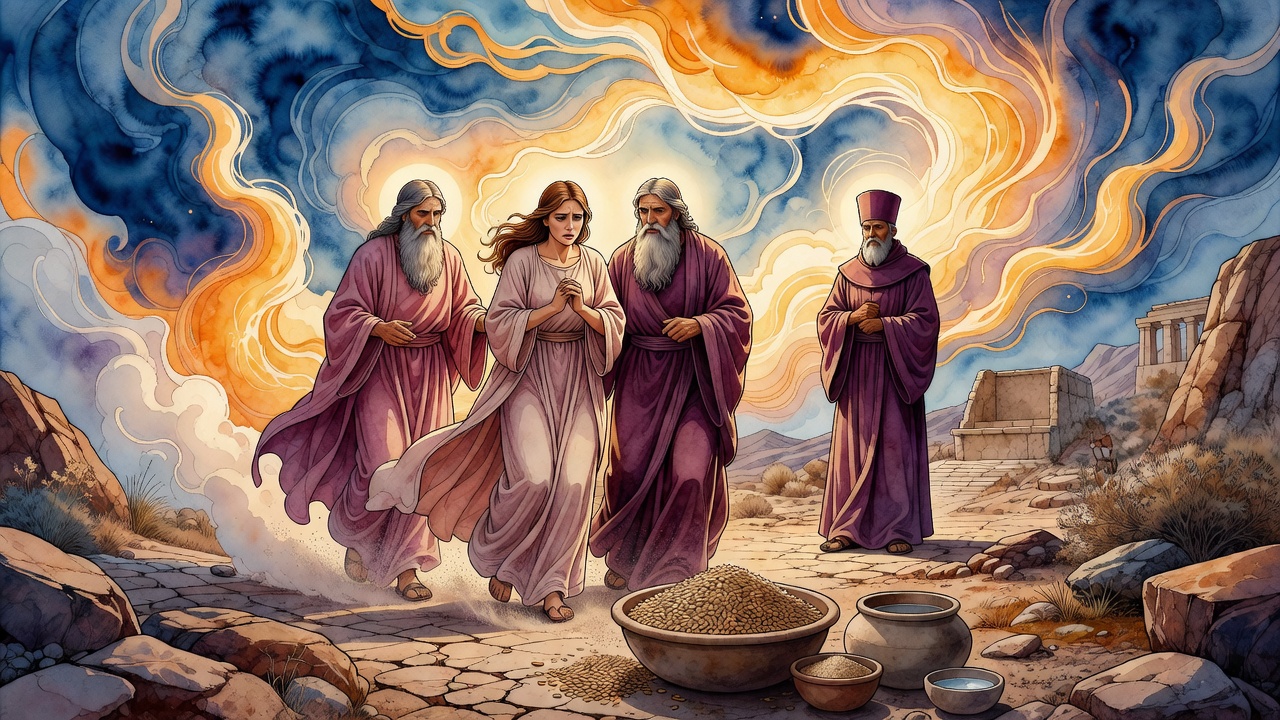
The bitter water did not care about gossip. It cared about truth under oath. A husband seized by jealousy brought his wife to the place where names of God and dust of the sanctuary mixed into a cup no one wanted to hold.
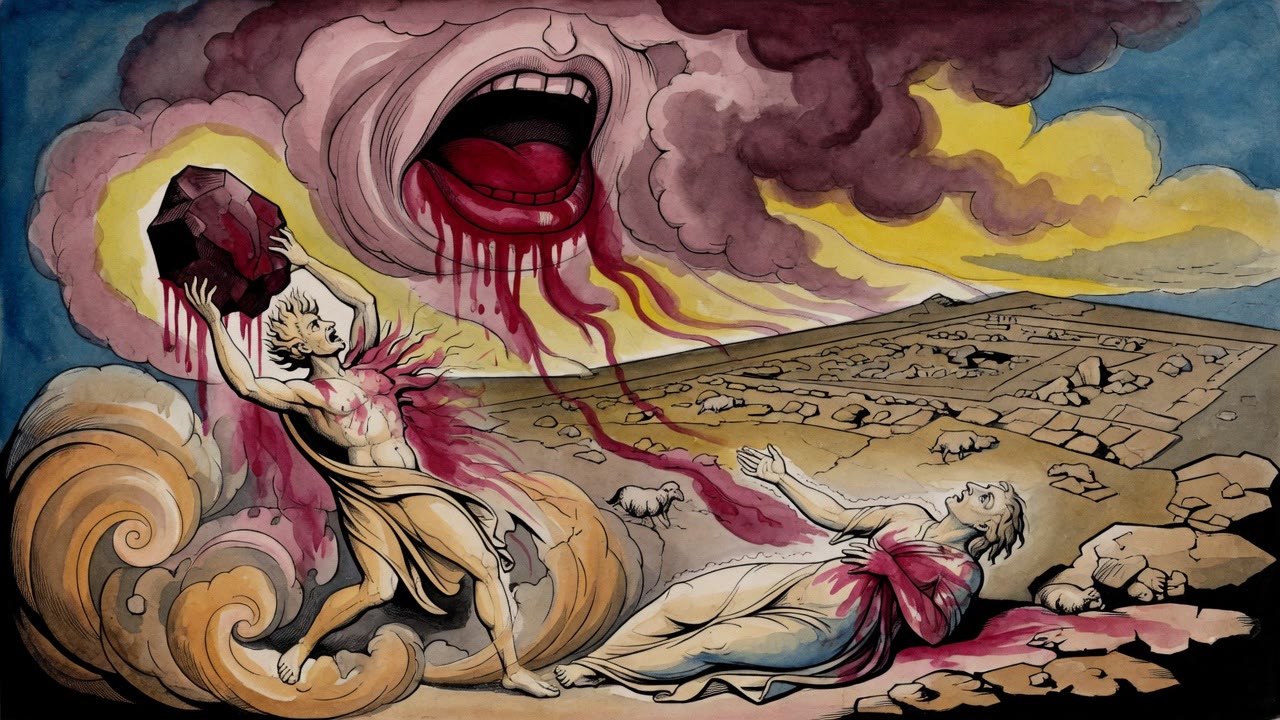
The Innocent Sotah Drank and Gehinnom Held Its Fire Click for full size

If she had gone astray, the curse written and washed into the water had a body to find. If she had not, the same cup became a door back into life.

Going Astray Named Without Soft Edges

The law of the sotah does not hide behind euphemism. Going astray, becoming unclean, a man putting his lying with her, language that the tannaim pressed until even irregular modes and cases without seed still counted as betrayal of the bond (Numbers 5). Aside from your husband meant the boundary was the marriage, not a technicality about fertility.

Impotent husbands, betrothal edges, a woman waiting for levirate decision, the sages argued which cases entered the ordeal. Rabbi Yoshiyah heard "this is the law" as a statute for all generations. Rabbi Yonathan heard formula language. The debate itself shows how long the cup stayed in Israel's legal imagination.

The Warning and the Seclusion

Before water, there was speech. A husband warned. A seclusion followed that made the warning bite. The ritual was not a casual accusation shouted in a market. It was a sequence that forced jealousy into procedure so that private rage would not become private violence without heaven's court.

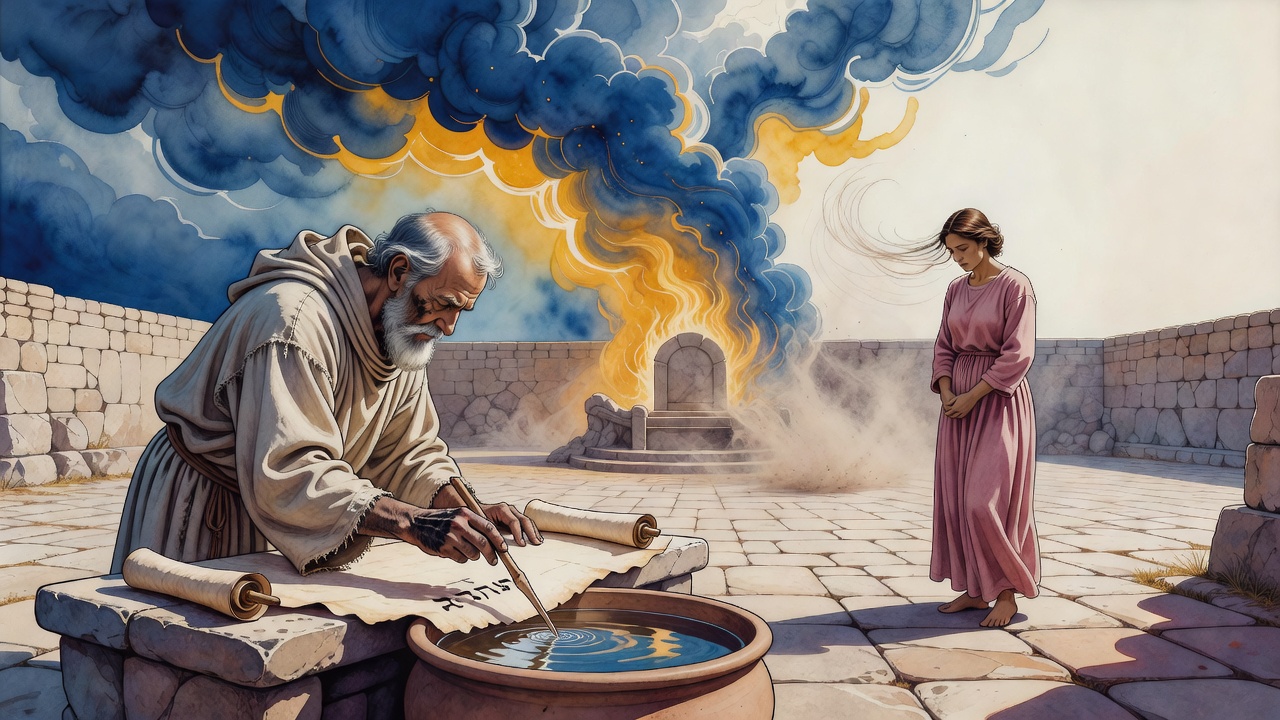
Dust from the Tabernacle floor entered the mixture. The divine Name written and dissolved. The woman answered amen to curses that would either miss her or unmake her. The Temple air held its breath with her.

If She Is Pure, She Conceives

And if the woman was not defiled, and she is pure, she will be absolved and will conceive offspring (Numbers 5:28). Rabbi Eliezer heard reward inside the verse. Past innocence. Future purity. Absolution from curse and oath. Then, if she had been barren, conception as recompense for the ordeal's terror.

Rabbi Yehoshua objected with a hard practical fear. Would barren women stage jealousy, invite warning and seclusion, drink for a miracle child? He refused to turn the ritual into a fertility scheme. His reading steered the promise away from loophole and toward justice that does not advertise itself as a clinic.

Fire Waiting on the Other Path

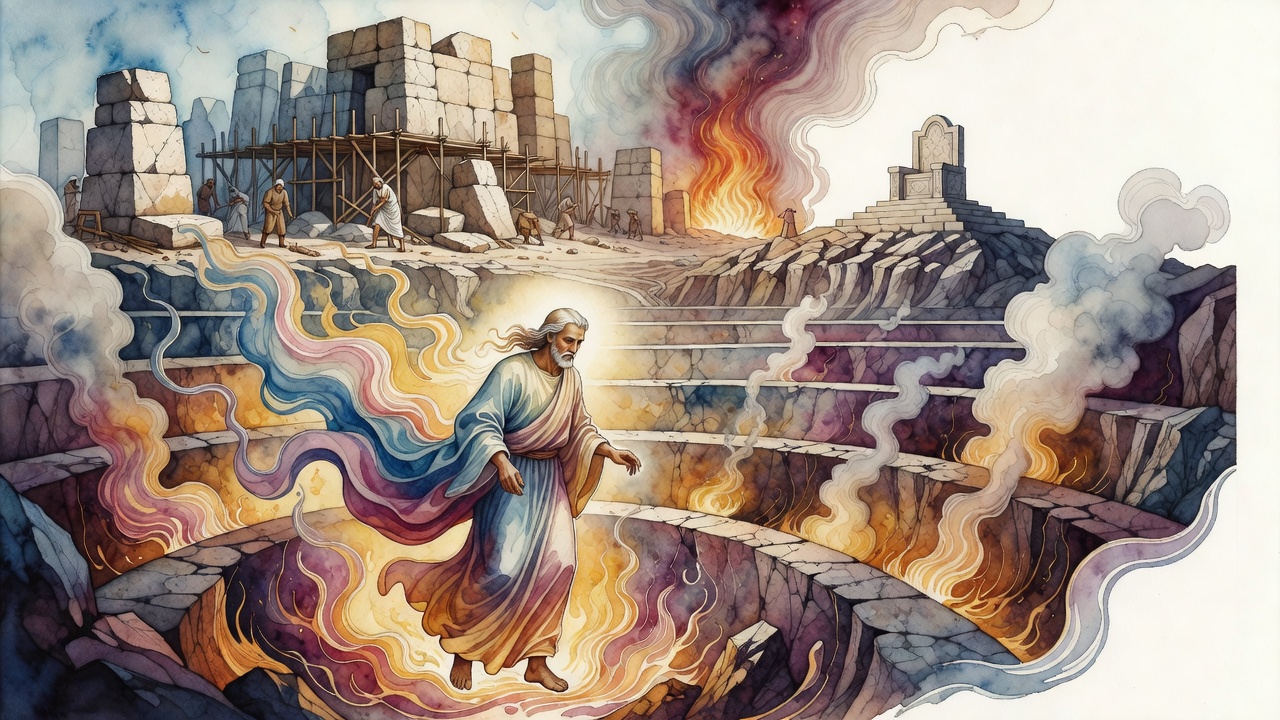
The same midrashic field that measures the pure woman's future also knows the fire of Gehinnom (the place of punishment after death) for paths that end guilty. The ordeal's other edge is not a slap on the wrist. Bodies and names and public knowledge are at stake. The pure woman walks out. The guilty trajectory points toward fire the tradition will not pretty up.

That double door is why the cup is terrible even when it saves. Innocence must still drink. Vindication arrives only after the throat has already accepted the risk.

The Law That Outlives One Generation

Whether every generation keeps the same ordeal mechanics, the moral structure remains. Marriage can be wounded by secrecy. Communities need more than rumor. Sometimes the only clean ending is a test no human judge can fake. The innocent sotah leaves with a womb that may open and a name cleared in public. Gehinnom, in the guilty telling, does not clear names. It burns what secrecy built.

When the pure woman lowered the cup, the court watched for a body to fail and saw a body remain whole. Public jealousy had dragged her to the threshold. Public truth had to walk her back out. If Rabbi Eliezer's reading held, a closed womb might open after the ordeal's terror. If Rabbi Yehoshua's caution held, the law still refused to become a trick for the desperate. Either way the cup was never casual.

The guilty path, in the same library of teaching, does not end with a shrug. Gehinnom 's (the realm of judgment after death) fire is how the tradition keeps the other exit from looking cheap. Innocence drinks and lives. Guilt, once proven, does not get a soft epilogue.

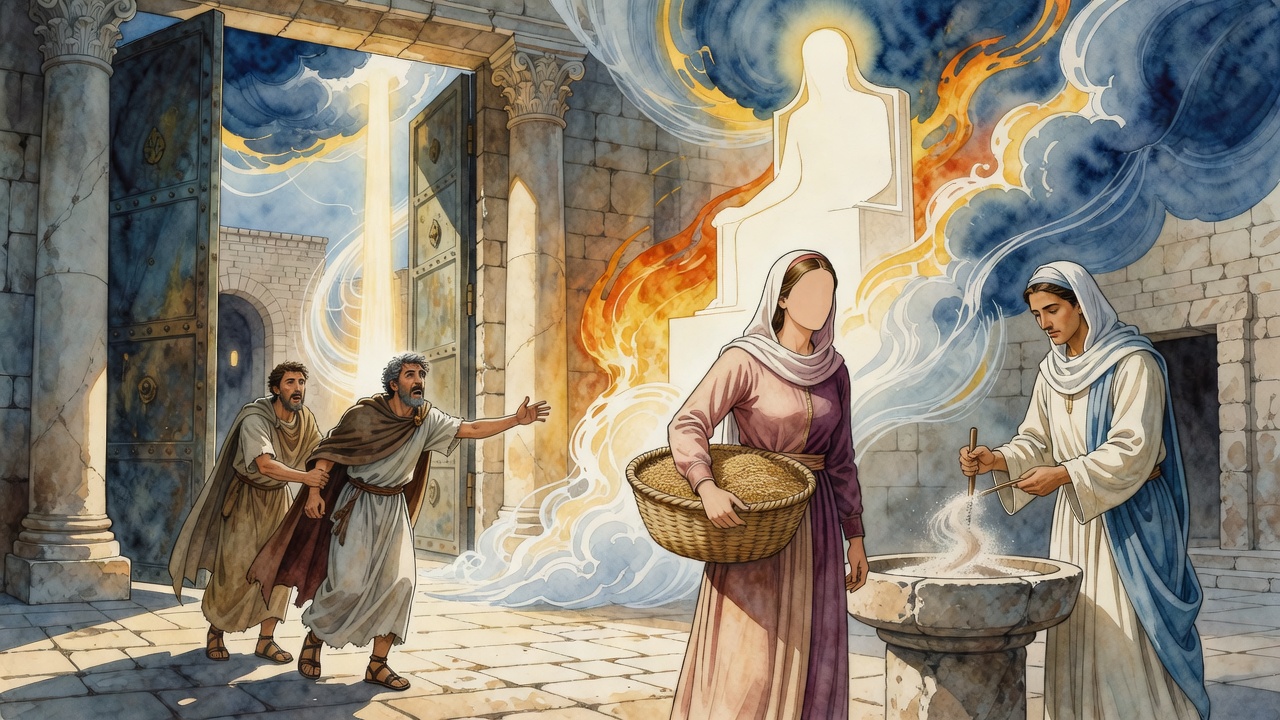
Dust from the holy floor is a strange ingredient for justice. It says the place itself testifies. The Name dissolved in water says heaven is not too pure to enter a cup that will judge a marriage. Amen said by a woman under suspicion is one of the hardest words in the legal library. She agrees to a verdict she cannot edit.

If she walks out whole, the community must swallow its gossip. If she does not, the community must swallow its pity. Rabbi Eliezer's hope of conception after innocence tries to repay terror with life. Rabbi Yehoshua's fear of staged jealousy tries to keep the ritual from becoming a market. Between them the cup stays heavy, and Gehinnom stays on the map for the path that ends unclean.


← All myths

From the tradition

Sources

3 sources

The texts behind this telling. Some cards carry a translation of the source; others are our own retelling of it, and each card says which. Every card links out to the original.

Bamidbar Rabbah 9:25Bamidbar Rabbah

Retold in our words. Read the original at the link below.The Sefaria Midrash Rabbah, 2022 · CC-BY

It’s a wild story involving bitter waters, oaths, and divine judgment. But what happens if the woman is innocent? What's her reward for enduring such a trial?

That’s what Bamidbar Rabbah 9 grapples with, specifically focusing on (Numbers 5:28): “And if the woman was not defiled, and she is pure, she will be absolved and will conceive offspring.” The Rabbis see so much more than a simple statement of innocence here. They see layers of meaning, promises, and even a bit of controversy.

This teaching breaks down the verse: “And if the woman was not defiled” – meaning, in the past, she was innocent. “And she is pure” – meaning, she will remain so in the future. It’s a double assurance, a guarantee of her ongoing fidelity. At that moment, after drinking the water and remaining unharmed, "she is absolved from the curses and the oath."

Then comes the really interesting part: “And will conceive offspring.” What does this mean? Rabbi Eliezer has a powerful idea. He suggests that the suffering the woman endured is enough to warrant a reward: if she was barren, she will now conceive! – a trial by ordeal leading to the fulfillment of a lifelong dream.

However, Rabbi Yehoshua isn't so sure. He raises a crucial objection: If that’s the case, wouldn’t all barren women try to game the system? As he puts it, they might "engineer a situation where their husbands will warn them and then they would enter into seclusion," hoping for a miraculous pregnancy. He worries that "the one who sits idle loses," suggesting that the ritual would become a manipulative tool.

So, if it’s not a guaranteed cure for barrenness, what does the verse mean? Rabbi Yehoshua proposes a different understanding: "So that if she would give birth in pain, from then on she will give birth with ease; if females, she will give birth to males; if black, she will give birth to white children; if short, she will give birth to tall; if she would give birth every two years, she will give birth each year; if she would give birth to one, she will give birth to two." In other words, her future pregnancies will be blessed with ease, health, and abundance. It’s not just about conceiving, but about the quality of her future children and her experience giving birth.

Then comes Rabbi Shimon, offering yet another perspective. He states firmly, "One does not give reward for transgression." You can't reward someone for potentially committing adultery, even if they were ultimately proven innocent. Instead, he suggests that the blessing addresses a temporary prohibition. Perhaps she was forbidden to her husband from the time of her seclusion until she drank the bitter water. So the verse, "She will be absolved and will conceive offspring" simply means that from now on, marital relations are permitted, and conception is possible again.

Each Rabbi offers a different understanding of the verse, reflecting the complexity of the sotah ritual and the questions it raises about justice, reward, and divine intervention. We see them wrestling with the implications of the text, trying to reconcile its literal meaning with their understanding of God's ways.

The passage in Bamidbar Rabbah invites us to consider: What does it mean to be absolved? Is it merely the absence of punishment, or does it also entail a blessing, a restoration, a chance for a better future? And how do we reconcile the idea of divine reward with the reality of human transgression? These are questions that continue to resonate, prompting us to delve deeper into the nuances of Jewish tradition and its enduring wisdom.

Full source
Sifrei Bamidbar 13:1Sifrei Bamidbar

Retold in our words. Read the original at the link below.Sifrei by Rabbi Shraga Silverstein · CC-BY

Sometimes, they are! But even when translated, the nuances… well, they can be tricky. The source explores a passage from Sifrei Bamidbar, specifically Bamidbar 5:20, and see if we can unpack what it’s really getting at.

The verse reads, "And you, if you have gone astray." Okay, straightforward enough. But the text immediately throws us a curveball. "This tells me only of the regular mode." What’s the "regular mode?" Here, it refers to conventional sexual intercourse. But the text isn't content to stop there. It then asks, "Whence do I derive (that the same applies for) the irregular mode (i.e. anal intercourse)?"

Why this line of questioning? What's at stake? The text is concerned with defining the boundaries of marital fidelity, particularly in the context of the sotah ritual – a trial by ordeal for a woman suspected of adultery. To understand, we need to know that the stakes are high.

The text then brings in another phrase from the verse: "and if you have become unclean." This seemingly broadens the scope of what constitutes infidelity. It's not just about the "regular mode."

Next, we encounter the phrase, "and a man has put his lying in you." This is where things get even more interesting. The text explains that this includes "one who is impotent, (where there is only 'lying,' but no seed.)" Why is this included? The text is expanding the definition of sexual relations beyond procreative potential. It's about the act itself, the intimacy, the potential for betrayal, regardless of whether conception is possible.

Finally "aside from your husband": to include the wife of one who is impotent. "He stipulates all (contingencies) with her." So, even if a woman's husband is unable to father children, she's still bound by the same marital constraints.

It's clear that this passage from Sifrei Bamidbar is meticulously defining the boundaries of marital fidelity. It's not just about the physical act of intercourse, but also about the intention, the relationship, and the potential for betrayal. It leaves little room for ambiguity.

Now, these ancient texts can feel distant from our modern lives. But think about it: We're still confronting questions of fidelity, commitment, and the meaning of intimacy. Perhaps revisiting these ancient discussions can offer us new perspectives on these timeless human concerns.

Full source
Sifrei Bamidbar 20:1Sifrei Bamidbar

Retold in our words. Read the original at the link below.Sifrei by Rabbi Shraga Silverstein · CC-BY

Sifrei Bamidbar asks whether the law of the sotah belongs only to one moment or to every generation.

The verse in question, (Numbers 5:29), states, "This is the law of the rancors." Rabbi Yoshiyah takes this as a starting point. He asks, does this law apply only to that specific time, or does it extend to all generations? His answer? The phrase "zoth torath" – "this is the law" – implies a timeless quality. It’s a law for all generations. Zoth torath, in this context, is understood as encompassing all time.

Rabbi Yonathan has a different take. He argues that "zoth torath" is just conventional language, a way to conclude a topic rather than introduce a new, all-encompassing principle. So, who's.

Let's examine the phrase "a woman who goes astray under her husband." Does this mean that the law applies equally to men and women? The text suggests yes! It's about likening the woman to the man and the man to the woman. If either is blind, for example, the sotah ritual, which involves drinking a special potion, doesn't apply.

But here's where it gets even more complex. What about a woman awaiting levirate marriage, a shomereth yavam? This is a woman whose husband has died childless, and she's waiting for his brother to either marry her or perform a ceremony releasing her from the obligation. Should she be included in this law?

To answer this, the text points us back to (Numbers 5:12), which uses the phrase "a man, a man" twice. Rabbi Yoshiyah understands this repetition as including the shomereth yavam. But hold on – could this also include a betrothed woman, someone who is engaged but not yet married?

Not so fast! The phrase "under her husband" excludes a betrothed woman, according to Rabbi Yoshiyah. She isn't "under" his authority in the same way a married woman is.

Rabbi Yonathan, ever the contrarian, has yet another interpretation. He uses the phrase "under your husband" (from (Numbers 5:1)9) to exclude the shomereth yavam. According to him, this exclusion wouldn't extend to a betrothed woman. To solve this issue, the text goes back to "for a woman who goes astray under her husband" to exclude the betrothed woman.

Okay, so if we're excluding the betrothed woman and potentially including the shomereth yavam, what's the point of the double "a man, a man"? Ah, this is where we bring in some other cases: the wife of an imbecile, a deaf-mute, a dullard, someone who's gone abroad, or someone who's been incarcerated. In these cases, the court warns the woman, potentially disqualifying her from receiving her kethubah – her marriage contract.

But does this warning extend to making her drink the bitter waters? The text clarifies: no. (Numbers 5:15) states, "Then the man shall bring his wife to the Cohein (priest)." Rabbi Yossi adds that this also applies when the husband is released from prison. The husband needs to be present and active in the process.

So, what do we take away from all this? There are layers upon layers of meaning, debate, and nuance. The rabbis of the Talmud weren't just passively receiving information; they were actively engaging with it, challenging assumptions, and building upon previous interpretations. The goal wasn't necessarily to find one "right" answer, but to explore the complexities of the law and its application to different situations. It's in the wrestling with these complexities that we gain a deeper understanding of the text and its enduring relevance.

Full source