6 min read

Barley Meal Without Oil for a Suspected Wife

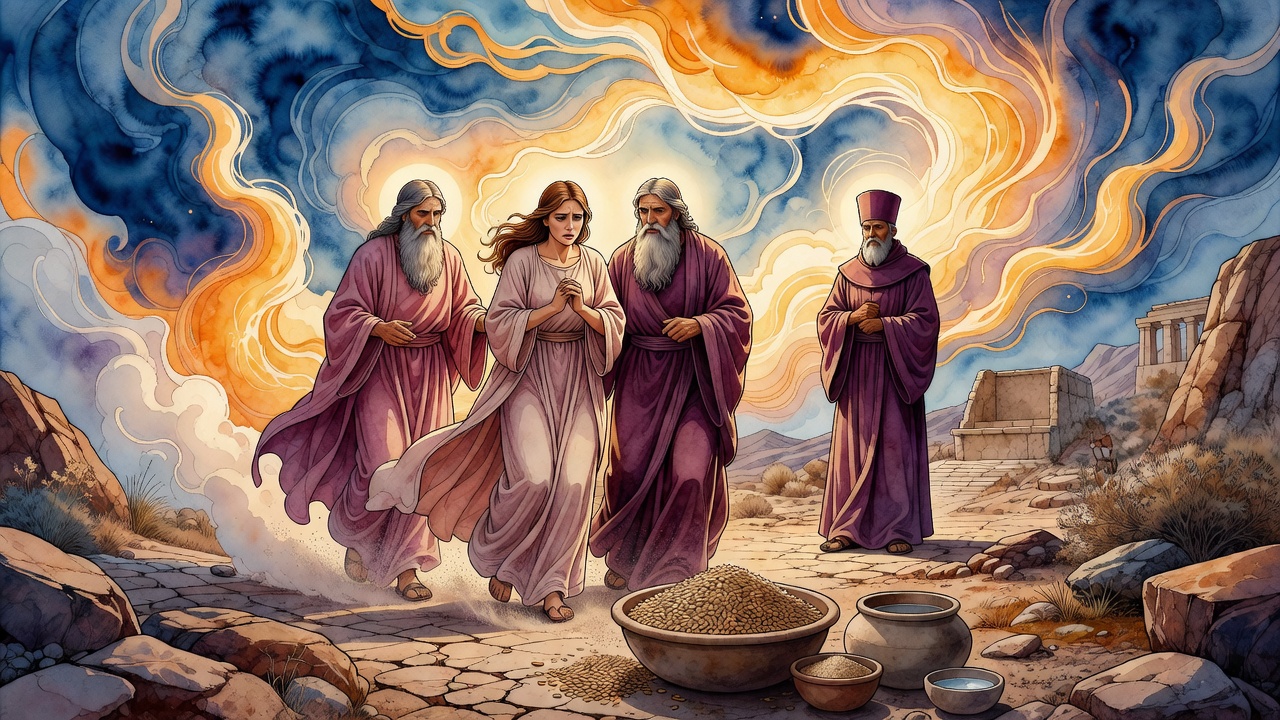
Two scholars walk a trembling wife to the priest. Her meal is barley, dry of oil and frankincense, dust and water waiting as witnesses.

Curated by Arthur · Told by Maggid ·
Table of Contents
  1. The Road Between Two Scholars
  2. Barley, Not Wheat
  3. Who Pays, Who Walks
  4. The Cup That Judges
  5. What the Dry Meal Leaves
Barley Meal Without Oil for a Suspected Wife Click for full size

The Road Between Two Scholars

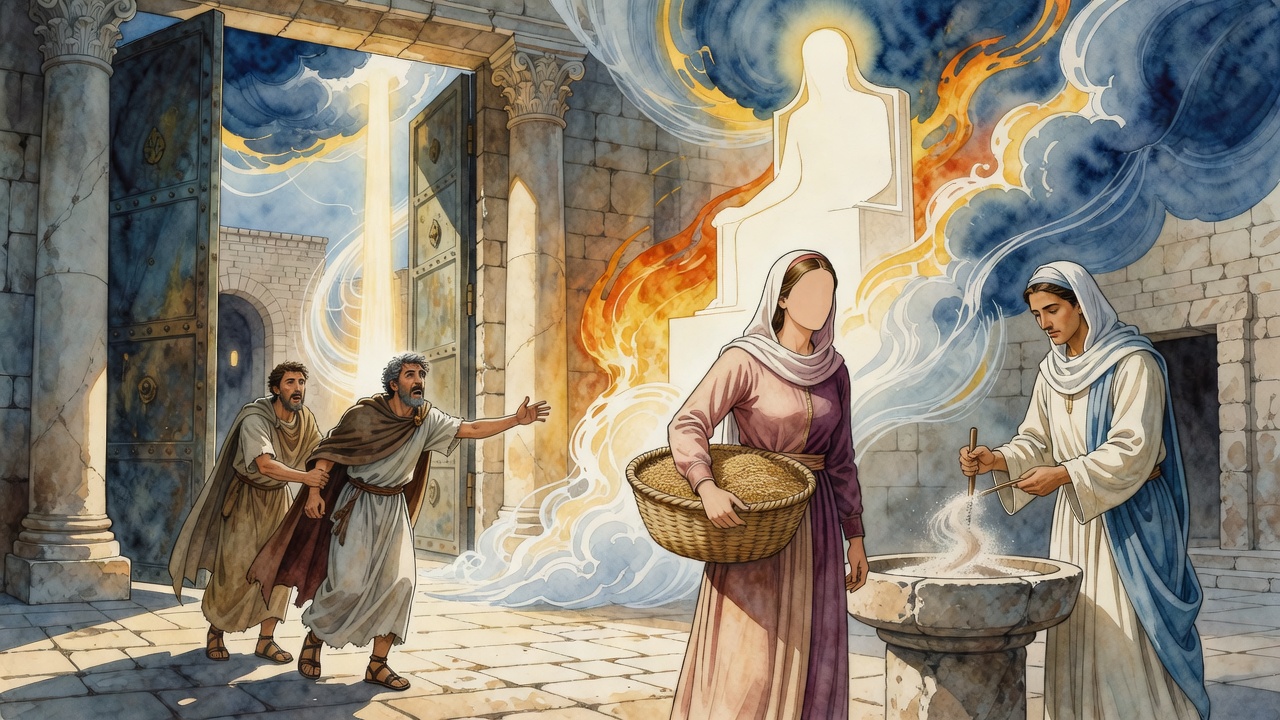
The wife kept her eyes on the dust between her sandals. Two scholars walked one on each side, close enough that she could not turn aside, far enough that no one would call the walk a private meeting. Her husband strode ahead with a cloth bag of barley flour, not wheat. The grain scraped softly against itself. He did not look back.

They were going to the priest because a spirit of jealousy had entered the house. The Torah named the case with hard edges. A husband suspects. A wife is brought. An offering is prepared that looks nothing like the sweet meals of ordinary worship. The local court had already spoken. Accompany her. Do not leave her alone with him on the road. Stolen water is sweet, the elders muttered from the old proverb, and clandestine bread is pleasing (Proverbs 9:17). Trust is a thin wall when desire wants a hole in it.

One of the scholars stopped to drink. The other stayed. Three pairs of eyes were better than two. The husband rented a room for the night before they reached the sanctuary courts, paid for her bread, and sat only where the children could see them. He sighed like a man who had not found rest.

Barley, Not Wheat

In the morning the priest took the bag. Barley. Animal fodder. The sages would later say she had acted in the manner of a beast with a lover, so she brought the food of a beast. No oil was poured. Oil is light; the Hebrew root of yitzhar shines. This woman, if guilty, had loved the dark. Let her meal hold no light. No frankincense was set on top. Frankincense belongs to remembrance of the matriarchs, the mountain of myrrh and the hill of frankincense in the Song. She had stepped off that path. Her meal became a reminder of sin, never a reminder of merit.

The priest poured holy water into an earthen vessel and scraped dust from the Tabernacle floor into the same cup. Water and dust. Adam was formed from dust. Woman was formed from the side that the midrash links to water's softness. By water and dust she would be examined, whether she remained as pure as on the day of her making. Heaven and earth stand as witnesses elsewhere in the Torah. Here the floor of the sanctuary and the water of holiness took that role in a small clay cup.

She watched the dust darken the water. The offering of jealousy is also called a meal of remembrance, a reminder of iniquity. Names pile up on a single tenth of an ephah. The body in front of the priest was still a person with a pulse. The law did not forget that. It also did not soften the symbols.

Who Pays, Who Walks

The verse says the man shall bring his wife to the priest, and he shall bring her offering on her behalf (Numbers 5:15). The rabbis argued over trust on the road. Rabbi Yehudah said, if we trust a husband with a menstruant wife, where the penalty of karet hangs over careless contact, how much more should we trust him here. The others refused the comparison. Men of Israel, they answered, are more suspect regarding a sotah than regarding a menstruant. The sweetness of the forbidden is a different fire.

Rabbi Ḥiyya bar Rav Yosef sent three scholars after such a woman, so that if one turned aside for his own need, two would remain. Rabbi Avin counted the husband as a third and insisted on rented walls, food, and no solitude except before her children. The law of jealousy did not begin at the altar. It began in the awkward logistics of getting a body there without creating a second scandal on the way.

The Cup That Judges

The priest set her before God and unbound her hair. The bitter water waited. If she had been clean, the ritual would clear her name and return her to the house with a kind of hard mercy. If not, the Torah's own words about the thigh and the belly would fall on her like a sentence spoken by the sanctuary itself. The midrash does not linger on spectacle. It lingers on why the meal looks poor.

No oil. No frankincense. Barley. Dust. Water. Each refusal is a sentence about light, beasts, matriarchs, and first creation. The woman who stands there is not a theory. She is a life pressed between suspicion and procedure, between a husband's fear and a court's escort.

What the Dry Meal Leaves

When the rite ended, someone would walk home. Either the house would open again, or the name would break. The bag of barley, empty now, had done its work without ever smelling like a festival. That is the midrash's blunt craft. It will not let jealousy dress itself in wheat and perfume. It forces the suspicion into a meal that looks like what the sages claim the act was, low, dark, and cut off from the fragrance of the mothers.

Outside the court the two scholars wiped dust from their hems. The husband held nothing. The earthen vessel had already been emptied where the priest emptied such things. Above them the ordinary sky kept its ordinary light. Below them the floor of the sanctuary still held more dust for the next bitter cup, if the next house should ever need one.


← All myths
From the tradition

Sources

2 sources

The texts behind this telling. Some cards carry a translation of the source; others are our own retelling of it, and each card says which. Every card links out to the original.

Midrash Tanchuma Buber, Nasso 5:1Midrash Tanchuma Buber, Nasso

Translation of the source text.Midrash Tanchuma (Buber), Public Domain, on Sefaria · CC-BY-SA

"And he shall bring her offering for her, a tenth of an ephah of barley meal" (Numbers 5:15). Why does she bring barley meal? Because she behaved with him in the manner of a beast; therefore she brings as her offering the food of a beast. "He shall pour no oil upon it" (ibid.). Why shall he pour no oil upon it? Because oil is light and is called yitzhar, and this woman loved the darkness; therefore he shall pour no oil upon it. "Nor shall he put frankincense upon it" (ibid.). Why shall he not put frankincense upon it? Because the frankincense is a remembrance of the matriarchs, [as it is said:] "I will get me to the mountain of myrrh, and to the hill of frankincense" (Song of Songs 4:6); and this woman has separated herself from their ways; therefore it shall be a reminder of iniquity and not a reminder of merit. "And the priest shall take holy water in an earthen vessel, and of the dust that is on the floor of the Tabernacle" (Numbers 5:17). He was created from the dust, and she was formed from the water; therefore she was examined with water and with dust, whether she is pure as at her creation or not. And further, why is she examined with water and with dust? Because they are her witnesses, as it is said: "I call to witness against you this day the heaven and the earth" (Deuteronomy 30:19).

Full source
Bamidbar Rabbah 9:31Bamidbar Rabbah

Retold in our words. Read the original at the link below.The Sefaria Midrash Rabbah, 2022 · CC-BY

The verse sets the scene: "The man shall bring his wife to the priest, and he shall bring her offering on her behalf, one-tenth of an ephah of barley flour; he shall not pour oil upon it, and he shall not place frankincense upon it, for it is a meal offering of jealousy, a meal offering of remembrance, a reminder of iniquity. And right away, the Rabbis in Bamidbar Rabbah jump in to unpack it.

The text emphasizes, "The man shall bring his wife." This seemingly simple phrase sparks a debate. Who's responsible for bringing her? The husband, yes, but according to Torah law. But the Rabbis, ever keen on adding layers of protection and nuance, ask: how does he actually do it?

They suggest he take her to the local court, and they assign two scholars to accompany them, ensuring they don't… well, "consort" on the way. Rabbi Yehuda raises an interesting point. He argues that the husband should be trusted, drawing an a fortiori argument – a "how much more so" inference. If we trust a husband regarding a menstruant wife (where violating the rules carries a severe penalty, karet), shouldn’t we trust him here, where the penalty isn’t as severe?

The other Rabbis disagree. They counter that the allure of forbidden fruit, as (Proverbs 9:17) says – "Stolen waters are sweet, and clandestine bread is pleasing" – makes the situation different. They believe that the men of Israel are more suspect regarding a sotah – a woman suspected of adultery – than regarding a menstruant.

Rabbi Ḥiyya bar Rav Yosef even sends three scholars after the woman, just to be extra safe! He reasons that if one scholar turns away for his own purposes, she'll still be with two others. Rabbi Avin adds that the husband makes it three, and elaborates that he would rent a house for her, provide her with sustenance, and only be alone with her before her children. The text says of him, "I have grown weary in my sighing, and I have not found rest" (Jeremiah 45:3). It's a tense and uncomfortable situation for everyone involved.

What about the offering itself? "And he shall bring her offering on her behalf.” The Rabbis distinguish between offerings that "qualify" her for him (like after she's been a zava – a woman with an unusual discharge – or after childbirth) and those that don't (like if she violated a nazirite vow or desecrated the Sabbath). In the former case, he pays for the offering himself, without deducting it from her marriage contract (ketubah). In the latter, he can deduct it.

Then comes the description of the offering: "One-tenth of an ephah…flour…barley." It's barley flour, not fine flour, Rabban Gamliel points out. He offers a clever analogy: just as her actions are base, like an animal, so too is her offering the food of an animal. Harsh. And no oil or frankincense! That's because, as the text says, "it is a meal offering of jealousy, a meal offering of remembrance, a reminder of iniquity.”

Now, this "reminder of iniquity" sparks another debate between Rabbi Tarfon and Rabbi Akiva. Rabbi Tarfon sees it as purely negative – a reminder of punishment. But Rabbi Akiva, ever the optimist, argues that it's also favorable. He points to (Numbers 5:28): "And if the woman was not defiled, [and she is pure, she will be absolved and will conceive offspring]." So, where does the favorable remembrance come from? From the phrase "a meal offering of remembrance" – in every sense!

Rabbi Yishmael weighs in, offering a legalistic interpretation: "A meal offering of remembrance" is a generalization, while "a reminder of iniquity" is a specific detail. But this raises a problem: wouldn't that distort justice? Shouldn't the attribute of favor be greater than the attribute of punishment? He concludes with a Torah principle: When a generalization and detail distort logic, let both coexist. So if she was defiled, the punishment affects her immediately. But if she has merit, it will defer the punishment.

How long will it defer it? Abba Yosef ben Ḥanan says three months, the point at which the fetus is noticeable. Elazar ben Yitzḥak of Kefar Darom says nine months, aligning with the length of pregnancy. Rabbi Yishmael stretches it to twelve months, citing an allusion in the story of King Nebuchadnezzar in Daniel.

But Rabbi Shimon ben Yoḥai throws a wrench into the works. He argues that merit doesn't defer the effects of the bitter water. If it did, it would undermine the entire process! People would say that innocent women were actually guilty but escaped punishment because of their merit.

Finally, Rabbi Yehuda HaNasi offers a reconciliation: If she was pure, she will ultimately die in a way typical of people. But if she was defiled, she will ultimately die through "her belly will distend, and her thigh will fall" (Numbers 5:27). Though Rabbi Shimon ben Yoḥai questions how bystanders would know the cause of death, he notes that at the time of drinking, her face would turn sallow, her eyes would bulge, and her tendons would become visible, and they would say, "Hurry and take her out so she will not impurify the Temple Courtyard."

What are we left with after this deep dive? A complex and nuanced picture of ancient anxieties about infidelity, the delicate balance between justice and mercy, and the relentless efforts of the Rabbis to protect both the sanctity of marriage and the dignity of the accused. It's a reminder that even in the most seemingly straightforward passages of the Torah, there are layers upon layers of interpretation, debate, and human struggle.

Full source