5 min read

The Wife Who Carried Barley to Nicanor Gate

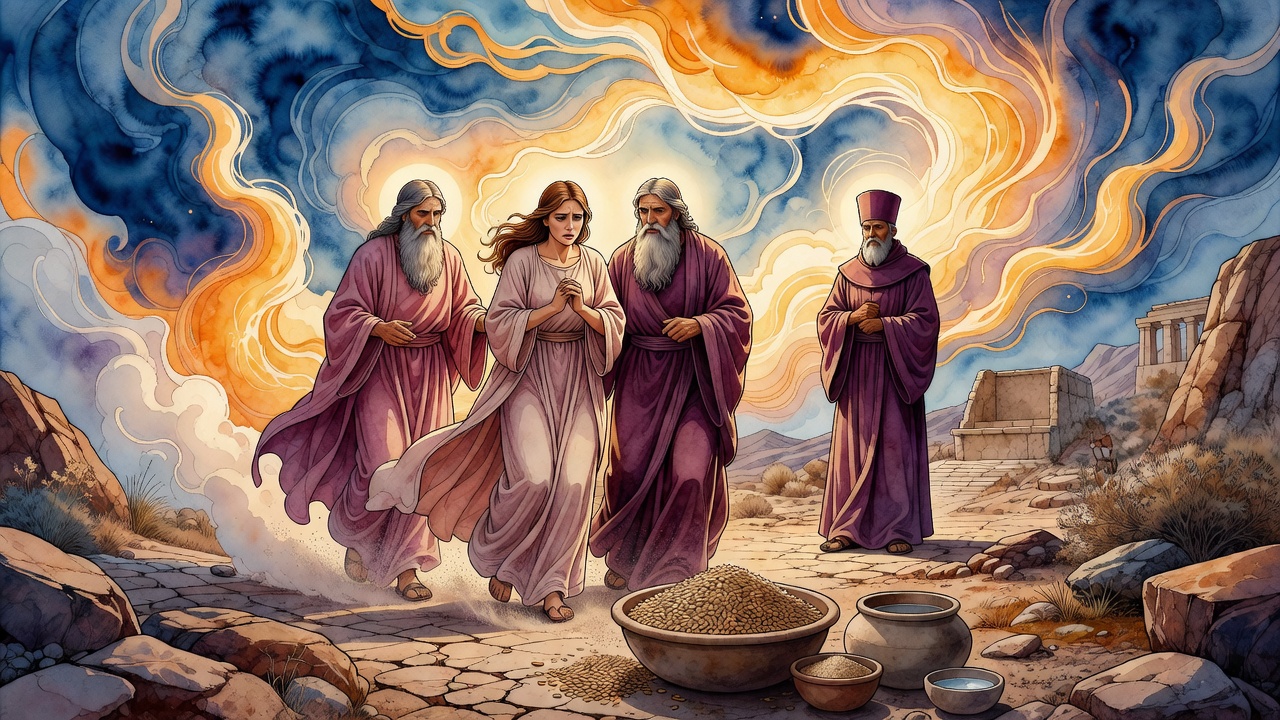
A husband dragged suspicion to Jerusalem's great court. At Nicanor Gate a priest mixed dust and water while her barley offering held no oil.

Curated by Arthur · Told by Maggid ·
Table of Contents
  1. Dust Under the Marble Ring
  2. Barley Without Oil
  3. The Drink That Tests Two
  4. Seven Things the Night Teaches

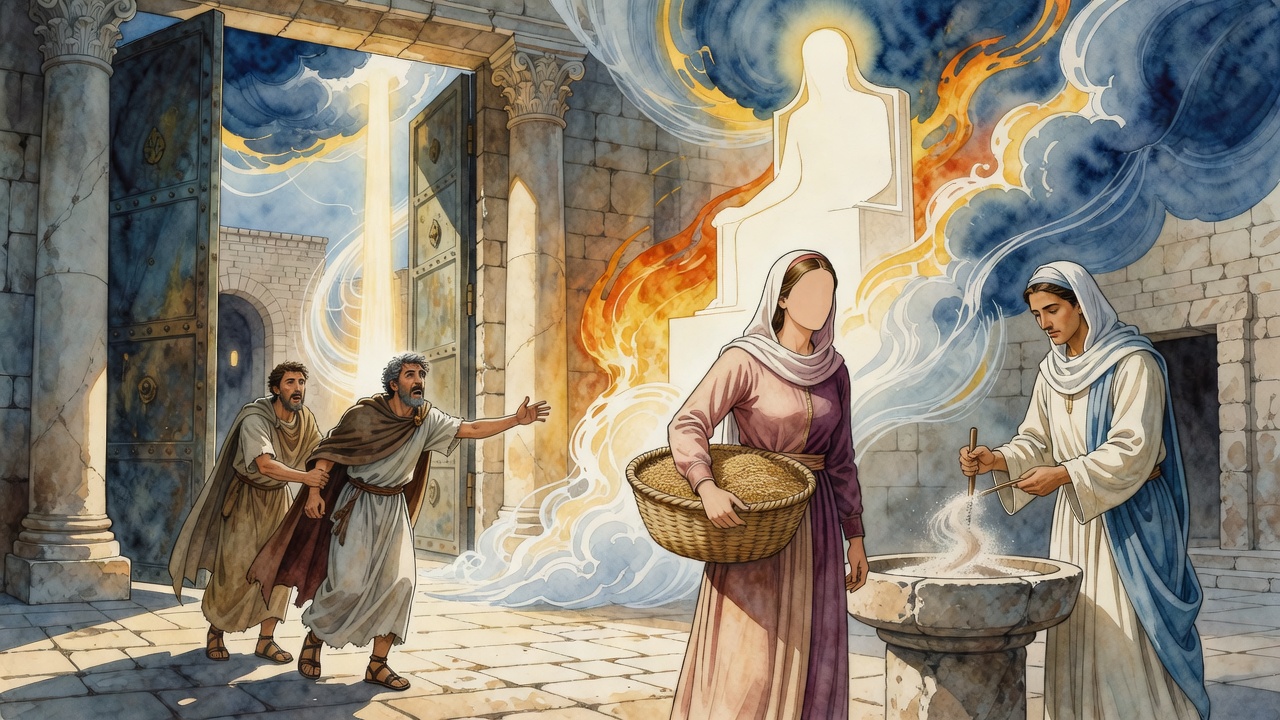
The woman felt the rope of the journey before she felt the court. Her husband had named a fear and would not unname it. They climbed toward Jerusalem with a tenth of an ephah of barley meal in a sack that smelled of animal feed, not of feast flour.
The Wife Who Carried Barley to Nicanor Gate Click for full size

At the great court they alarmed her the way they alarmed capital witnesses. Voices pressed. Questions circled. Then they took her east, to the Gate of Nicanor, where birthing mothers and people marked by skin affliction also stood for rites that decided pure from impure. The same threshold now waited for a wife under the shadow of jealousy (Numbers 5:12).

Dust Under the Marble Ring

A priest brought an earthenware bowl and poured half a log of water from the basin. He entered the Temple and turned right. On the floor a marble flagstone, one cubit square, held a ring. He lifted the stone, scraped dust from the Tabernacle floor, and mixed it into the water (Numbers 5:17).

He wrote a scroll that began with acquittal. "If no one has slept with you..." The court opened capital cases with the case for life, and the bitter water rite followed that mercy first. Only after the clean path did the ink turn hard: "And if you have gone astray..." Then the curse that Solomon's dedication had imagined when oaths rose before the altar (I Kings 8:31-32).

She watched the Name written where it would be blotted into the drink. The Holy One had told Moses to write this section so she would know which Name the priest erases for her, and how public the erasing becomes.

Barley Without Oil

Her offering was barley, not wheat. The sages said she had acted in the manner of a beast with a man, so she brought the food of a beast. No oil was poured on it. Oil is light, and yitshar can mean it will shine; a woman who loves darkness, they said, receives no shine in her meal. No frankincense either. Frankincense remembers the matriarchs, the mountain of myrrh and the mound of frankincense (Song of Songs 4:6). A woman who has stepped off their path does not get their fragrance as a reminder of merit. The offering is meant to remember iniquity.

She held the sack and felt the coarseness of the grain. The court was not whispering kindness. It was staging a theater of shame that the Torah itself had legislated, and the props were dust, water, and animal meal.

The Drink That Tests Two

If she was defiled, the tradition says she would not finish the cup before her face turned green, her eyes protruded, and her veins swelled. The priest would cry, "Take her out, take her out," so the Temple court would not be defiled by a body collapsing mid-rite. The water tests the woman, and the doubled phrasing of the verse is read to test the man as well. Guilt is not a one-way gate.

If she drank and was found pure, the story turned inside out. A barren woman would conceive. Painful births would become quiet ones. Ugly children, dark, short, female births in the midrash's list would flip toward beauty, fairness, height, sons. "She shall be guiltless and shall conceive seed" (Numbers 5:28) became a flood of compensatory blessing for the cleared name.

Merit, some said, could suspend the bitter water a year or two or three. Rabbi Simeon refused that mercy. If merit delays the sign, he argued, every clean woman who drinks will be slandered as guilty-but-lucky. Rabbi Meir held that merit does suspend, yet a truly defiled woman will never again prosper in birth and will die the same death in the end. The court itself split over how much grace can hide inside a public ordeal.

Seven Things the Night Teaches

Rabbi Jose the Galilean counted seven abominations from (Proverbs 6:16-19) and set them on the adulteress and her partner: haughty eyes that look past a husband; hands ready for blood if caught; hearts planning place and hour; feet quick to the meeting; false witnesses if discovered; and a quarrel sown among brothers, since all Israel are brothers and a friend's wife becomes a knife between houses.

At Nicanor Gate those seven were not abstract. They were the reason a priest's hand scraped dust under marble. The woman stood between a husband's jealousy and a Name dissolved in water. The barley in her sack had no oil to soften it.

When the cup rose, the courtyard held its breath for green skin or for a future child. Either way, the gate had already done its work: it had made private fear into Temple procedure.

On the road home, if the water cleared her, the barley sack would be empty and her name would try to walk back into the market. Some neighbors would still count months. The Torah had given her a public tool and a public scar at once. She would learn whether vindication is louder than the first rumor. The Gate of Nicanor would keep receiving other women, other bowls, other names dissolved in dust-water, because jealousy does not retire when one case ends.


← All myths
From the tradition

Sources

2 sources

The texts behind this telling. Some cards carry a translation of the source; others are our own retelling of it, and each card says which. Every card links out to the original.

Midrash Tanchuma, Nasso 1Midrash Tanchuma

Retold in our words. Read the original at the link below.Townsend 1989 translation of Midrash Tanhuma, S. Buber Recension · CC-BY

(Numb. 5:12), “If anyone has his wife go astray.” Let our master instruct us: When someone wanted to accuse his wife (of infidelity), how did he accuse her? Thus have our masters taught (in Sot. 1:4-5; 2:2-3.): One accusing his wife brought her to the great court which was in Jerusalem, and they would alarm her in the way that they would alarm witnesses in capital cases. Then afterwards they would bring her up to the eastern gate, to the Gate of Nicanor, where they would purify birthing mothers and lepers and give drink to suspected adulteresses. A priest would bring an earthenware bowl and put a half log of water into it from the basin. He would enter the Temple and turn to his right. Now a place was there one cubit square with a marble flagstone and a ring fixed in it. He would raise it, take dust from underneath, and put it upon the water, as stated (in Numb. 5:17), “and some of the dust which is in the floor of the Tabernacle, [the priest shall put it into the water].” Then he would write the scroll (in the wording of Numb. 5:19), “If no one has slept with you […].” From here our masters have taught, “When one opens capital cases, one begins with [the case for] acquittal.” Then he writes further (in vs. 20), “And if you have gone astray […].” What is written after it (in vs. 21)? “May the Lord make you a curse […].” And so Solomon has said (in I (Kings 8:31)–32 // II Chron. 6:22–23), “Whenever one sins against his neighbor, and he gives him an oath for him to swear, then when he comes for the oath before Your altar in this house; You will hearken in heaven, take action, and judge Your servant, in order to condemn the wicked so as to set his conduct upon his own head and justify the righteous so as to render to him according to his righteousness.” (Numb. 5:28:) “But if the woman has not defiled herself [and is pure, she shall be guiltless and shall conceive seed].” If she was defiled, (according to Sot. 3:4; 5:1) she would not have finished drinking before her face turns green, her eyes protrude, and she is full of [swollen] veins. Then the priest says, “Take her out, take her out,” so that she does not defile the Temple court. Just as the water tests the woman, so does the water test the man, since it is stated [twice] (in Numb. 5:22 & 24), “And it (i.e. the water that causes the curse] shall go.” Just as she is forbidden to her husband, so is she forbidden to the lover, since it is stated [twice] (in Numb. 5:13 & 14), “she has defiled herself.” If, however, she drinks [the potion] and is found pure; then if she was barren, she is [now] visited (i.e. given conception). If she used [to] give birth in pain, she [now] gives birth with tranquility; if she used [to] bear ugly [children], she [now] bears beautiful ones; [instead of] dark [children], she bears fair ones; [instead of] short [children], she bears tall ones; [instead of] females, she bears males. Thus it is stated (in Numb. 5:28), “But if the woman has not defiled herself [and is pure, she shall be guiltless and shall conceive seed].” The Holy One, blessed be He, said to Moses, “Write a section on the adulteress so that she may know which name the priest blots out for her and how it will be made public.” How is this shown? From what they have read on the matter (in Numb. 5:12), “If anyone has his wife go astray.” If she has merit, it suspends [the effect of the bitter water] a year or two or three. R. Simeon says, “Merit does not [suspend the effect of] the [bitter] water; for if you say so, you will be found postponing [the effect] for all women who drink it and spreading slander about undefiled women who have drunk it. [This slander] says, ‘They were [really] defiled, but the merit has suspended [the effect of the water] for them.’” R. Meir says, “Really, the merit suspends the [effect of] the bitter water. If she was defiled, however, she will never again bear [children] and prosper but degenerate more and more, and in the end she will die of the same death, as stated (in Prov. 6:16), ‘Six things the Lord hates, and seven are an abomination for His soul.’” R. Jose the Galilean says, “[These] seven things were said about the adulteress. (Prov. 6:17:) ‘Haughty eyes,’ in that the adulterous woman raises her eyes to another man; and so it says (in Is. 3:16), ‘Because the daughters of Zion are haughty, and walk with extended neck and roving (mesakarot) eyes.’ That is an expression of untruth (sheker), in that she commits adultery with another man and becomes pregnant from him, and then lies and says to her husband, ‘I am pregnant from you.’ (Prov. 6:17, cont.) ‘Hands that shed innocent blood,’ in that the adulterer goes in on condition that, if he is caught, he will kill or be killed. (Prov. 6:18:) ‘A heart devising wicked thoughts,’ in that the adulterer and the adulteress have thoroughly wicked thoughts all the time, when they sin in telling each other in which place and at what time. (Prov. 6:18, cont.) ‘Feet quick (memaharot) to run to evil,’ in that they certainly are hastening (memaharim) to commit the sin. (Prov. 6:19:) ‘A false witness that spreads a lie,’ in that, if they are caught, they speak falsely and lie, when they swear and say, ‘We were talking about other things.’ (Prov. 6:19, cont.) ‘And one that instigates a quarrel among brothers,’ in that all Israel are brothers, as it stated (in Ps. 122:8), ‘For the sake of my brothers and friends’; and in the case of one who commits adultery with his friend's wife, when her husband hears of it, he hates him. This adulterer cannot look at [the husband]. Ergo, ‘and one that instigates a quarrel among brothers.’” Ergo, [there are] seven injurious things which the adulteress does.

Full source
Midrash Tanchuma, Nasso 3Midrash Tanchuma

Retold in our words. Read the original at the link below.Townsend 1989 translation of Midrash Tanhuma, S. Buber Recension · CC-BY

(Numb. 5:15:) “Then he shall bring the offering for her, one-tenth an ephah of barley meal.” Why does she bring barley meal? Because she behaved in the manner of a beast with him, she therefore brings the food of a beast as her offering. (Ibid. cont.) “He shall pour no oil upon it.” Why does he not pour oil upon it? Because the oil is a light and is [also] called yitshar (a word which can mean "it will shine"); while this woman loves the darkness. Therefore there should be no light in her offering. [(Ibid., cont.) Nor shall he put frankincense upon it.”] Why does he not put frankincense upon it? Because the frankincense is a remembrance of the matriarchs, [as stated] (in Cant. 4:6), “I will go unto the mountain of myrrh and unto the mound of frankincense,” while this woman has withdrawn from their ways. Her offering should [therefore] be a reminder of iniquity and not a reminder of merit.

Full source