Translation of the source text.Pesikta Rabbati, ed. Meir Friedmann (Ish-Shalom), Vienna 1880 · Public Domain
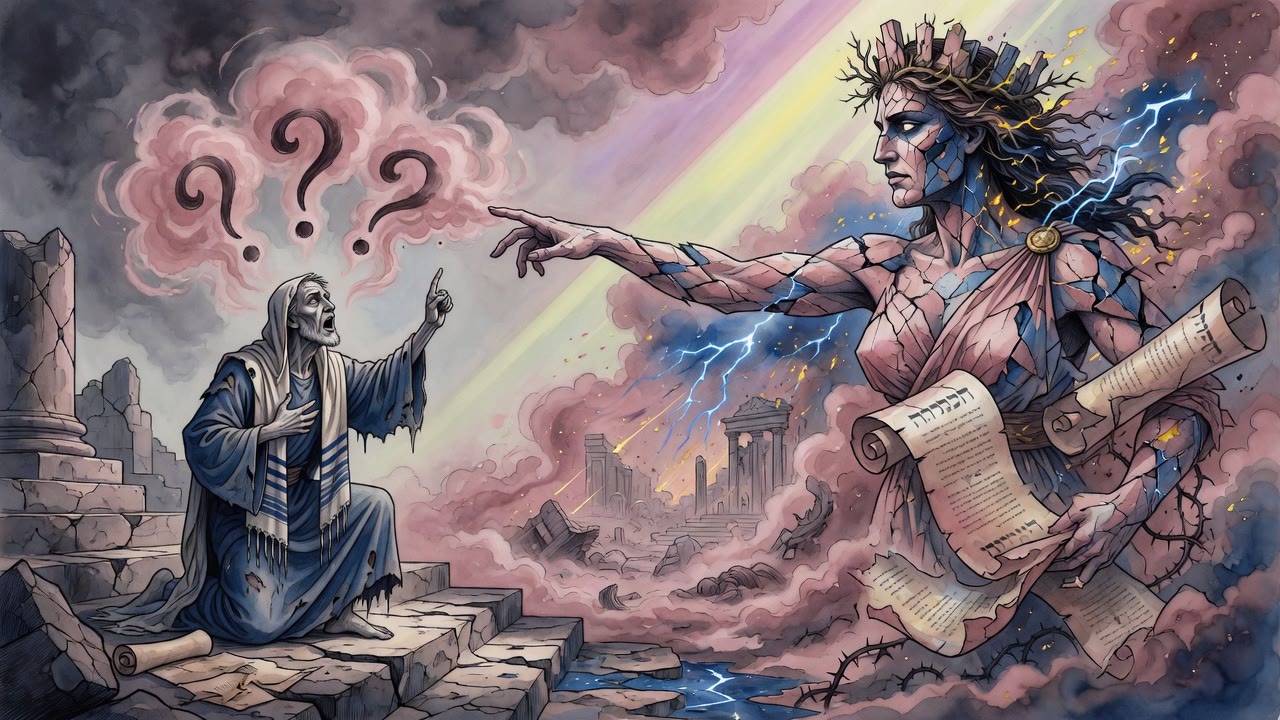
"Comfort, comfort My people, says your God" (Isaiah 40:1): this is what was said through the Holy Spirit, "What can I testify for you, to what can I liken you?" (Lamentations 2:13). Against whom did Jeremiah say this verse? He said it only against Jerusalem, for all the prophets were seeking a match for Jerusalem and did not find one. A parable: to a man whose wife died, and his companions came in to comfort him; if they comfort him over his wife and he is not comforted, they say to him, "Was your wife more beautiful than the wife of so-and-so, who died, and he accepted comfort over her?" If over his son, so do they say to him, "Was your son more handsome than the son of so-and-so?" So do you [find] that when the Holy One, blessed be He, brings calamity upon a province, He pairs another province with it to be comforted by it. When He brought the calamity upon Nineveh, He paired Alexandria of Egypt with it, as it is said, "And it shall come to pass that all who look upon you [shall flee from you... Nineveh is laid waste... whence shall I seek comforters for you? Are you better than No-amon, that was situated among the rivers... yet she too went into captivity"] (Nahum 3:7-9). With Alexandria He paired Nineveh to comfort, as it is said, "Say to Pharaoh [... behold, Assyria was a cedar in Lebanon"] (Ezekiel 31:2-3), and at the end it is written, "And strangers, the terrible of the nations, cut him off" (Ezekiel 31:12). But for the Assembly of Israel He found no one to pair [with her] until Israel said, "Behold, as the eyes of servants look to the hand of their masters, and as the eyes of a maidservant to the hand of her mistress, so our eyes look to the LORD our God, until He be gracious to us" (Psalms 123:2). Joel came and paired with her: "And you children of Zion, be glad and rejoice in the LORD your God" (Joel 2:23), and it is written, "And I will rejoice in Jerusalem and be glad in My people, and the voice of weeping shall be no more heard in her, nor the voice of crying" (Isaiah 65:19). When Israel was exiled from their land, the Holy One, blessed be He, said to them: With whom do you wish? With your early ancestors, that I should raise him up from his grave and he will walk at your head? If with Abraham, Isaac, and Jacob; if with Moses and Aaron, I will raise him up from his grave and he will walk at your head; if you wish for David and Solomon, I will raise him up from his grave and he will walk at your head. Israel said to Him: Master of the universe, we do not wish for these, but for You, as it is said, "For You are our father, though Abraham does not know us and Israel does not acknowledge us; You, O LORD, are our father, our redeemer from of old is Your name" (Isaiah 63:16). The Holy One, blessed be He, said to them: Since you have spoken thus, I Myself will go up with you to Babylon, as it is said, "For your sake I have sent to Babylon" (Isaiah 43:14), "and I will set My throne in Elam" (Jeremiah 49:38). A parable to a king who married a woman, and she was with him for many years and he had no children from her. He said to her: My daughter, go, marry another man; perhaps you will have children from him. But take every precious vessel that I have in your house and go out. She said to him: If it is so, I will make a feast for you, and we will eat and drink, and I will part from you, so that they will not say, "See the wife of the king, because he hates her, he has put her out of his house." He said to her: Yes. Immediately she made a feast. The king ate and drank and became drunk, and she commanded her servants, and at midnight they rose and carried him out on the bed to her father's house. When the king awoke from his sleep, he said, "In what place am I reclining?" She said to him, "In my father's house." He said to her, "And what is my concern in your father's house?" She said to him, "Thus did you say to me: take every precious vessel that I have and go out; I have nothing more precious to my eyes and that gladdens my soul than you." So too the Assembly of Israel, at the time the Holy One, blessed be He, said to them, "With whom do you wish, [that I should raise] him up from his grave and he walk at your head to Babylon?" they said to Him, "We do not wish for anything but You," as it is said, "For You are our father." Immediately the Holy One, blessed be He, said to them: I Myself will be your match, and I Myself will bring you up, as it is said, "For your sake I have sent to Babylon" (Isaiah, as above). Another interpretation: "Comfort, comfort", why twice? Only because of "she weeps sore" (Lamentations 1:2). The Holy One, blessed be He, said: Now [I] comfort you twice: "Comfort, comfort My people." Another interpretation: The Holy One, blessed be He, said to Abraham: Go and comfort Jerusalem; perhaps she will accept comfort from you. Abraham went and said: Accept comfort from me. She said to him: How can I accept comfort from you, who made me [like a mountain, as it is said,] "In the mount of the LORD it shall be seen" (Genesis 22:14)? He said to Isaac: Go and comfort Jerusalem, perhaps she will accept comfort. Isaac went and said [etc. She] said to him: How can I accept comfort from you, from whom went forth the wicked Esau, and you made me like a field, as it is said, "And Esau went out to the field" (Genesis 27:5), and his sons burned me with fire? He said to Jacob: Go and comfort Jerusalem [etc.]. She said to him: How can I accept comfort from you, who made me as though I were nothing, as it is said, "This is none other than the house of God" (Genesis 28:17)? He said to Moses: Go and comfort, etc. She said to him: How can I accept comfort from you, who wrote against me curses and harsh decrees, "the wasting of hunger and the devouring of the fiery bolt," etc. (Deuteronomy 32:24)? Immediately they all returned and said to the Holy One, blessed be He: She has not accepted comfort from him, as it is said, "O afflicted one, storm-tossed, not comforted" (Isaiah 54:11). Immediately the Holy One, blessed be He, said: It is upon Me to comfort Jerusalem, for thus I wrote, "He that kindles the fire shall surely make restitution" (Exodus 22:5). I kindled her with fire, as it is said, "From on high He sent fire" (Lamentations 1:13); I comfort her, as it is said, "And I will be to her, says the LORD, a wall of fire round about," etc. (Zechariah 2:9). The Holy One, blessed be He, said: I wrote in the Torah, "You shall not deliver a slave to his master" (Deuteronomy 23:16), yet I delivered them into the hand of the nations of the world, as it is said, "unless their Rock had sold them and the LORD had delivered them up" (Deuteronomy 32:30). I wrote, "You shall not wholly reap the corner of your field" (Leviticus 19:9), yet I spent My wrath fully, as it is said, "The LORD spent His wrath" (Lamentations 4:11). And were it not for the iniquities for which they are delivered up, no creature could prevail against Israel. There was an incident with a certain gentile who pursued a Jew to kill him, and he did not reach him until a serpent came and encircled him and threw him down. He said to him: Wait [until I tell you a thing]: had the Holy One, blessed be He, not delivered us into your hand, you could not prevail against us, as it is said, "unless their Rock had sold them" (Deuteronomy 32:30). And when they killed Ben Koziba, [they brought his head to Hadrian]. He said to them: Bring me his body. And they found a serpent coiled around his heart. He said [to them]: It was not we who killed him, but the Holy One, blessed be He, delivered him into our hands, for so it is written in your Torah, "unless their Rock had sold them." And in the time to come the Holy One, blessed be He, will say to Jerusalem: Accept comfort from Me, as it is said, "Open to me, my sister," etc. (Song of Songs 5:2). She will say to Him: She does not accept comfort from You until I and You are speaking reproofs, as it is said, "Come, my beloved, let us go forth into the field" (Song of Songs 7:12), to a place where there is no commerce, "let us lodge in the villages" (ibid.): I will show the nations of the world that You bestow good things upon them and they deny You. She said before Him: Master of the universe, why did You not do for me as for Joseph, as it is said, "O that You were as a brother to me" (Song of Songs 8:1)? Joseph's brothers dealt evilly with him and sought to kill him, and when they came into his hand he dealt with them in goodness, and he himself comforted them, as it is said, "And he comforted them and spoke to their heart" (Genesis 50:21). And Shimei son of Gera too said to David, "Behold, I have come this day the first of all the house of Joseph" (II Samuel 19:21). He said to him: Did they distress you as Joseph's brothers distressed him, and they accepted from him? David turned back and said before Him: Master of the universe, when You gave the Torah to Israel, You took it around to all the seventy nations and they did not accept it, until Israel accepted it; and now that they have accepted it, will You do thus? Immediately the Holy One, blessed be He, instructed her and said: I have regarded you, as it is said, "for I am married to you" (Jeremiah 3:14). She said before Him: Master of the universe, it is right that You say so between Me and Yourself; who will make known about me to the nations of the world that I have done Your will? They will revile and reproach and shame me and say to me, "You rebelled against your God and you trespassed against Him." Immediately the Holy One, blessed be He, said to her: I will make known about you to the nations of the world your deeds of righteousness, as it is said, "For I will declare your righteousness and your deeds" (Isaiah 57:12). And the Holy One, blessed be He, makes known the righteousness of Israel to the nations of the world. In that hour Michael and Jerusalem [said]: "The LORD has brought forth [our righteous deeds; come and let us declare in Zion the work of the LORD our God"] (Jeremiah 51:10).

 Click for full size