The Menorah That Burned for Israel Not for Heaven
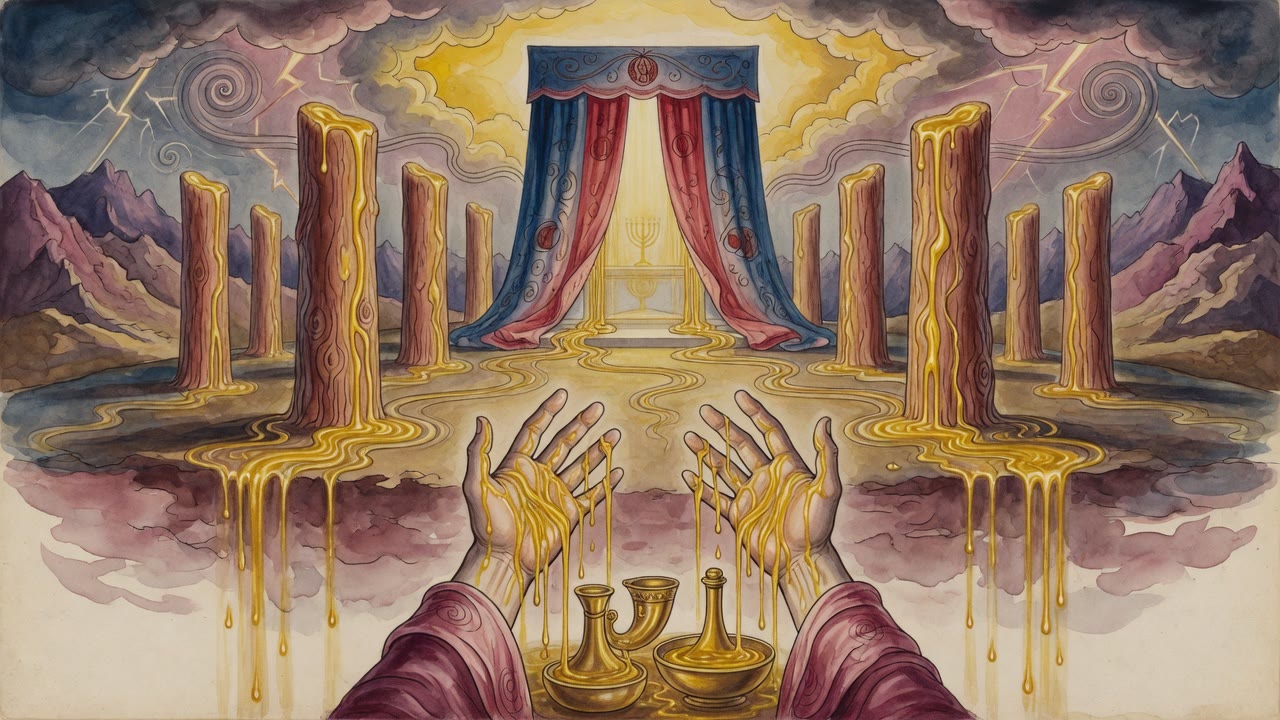
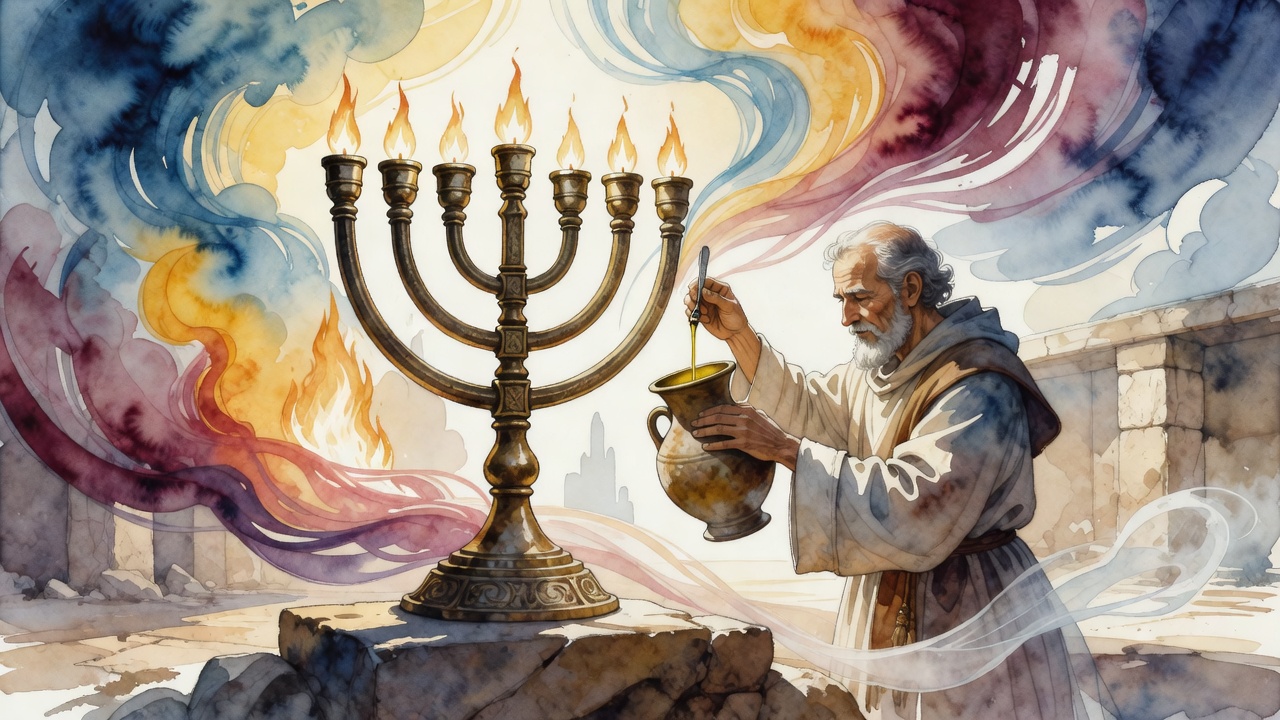
A priest presses olive oil into the cups and trims the wicks. God needs none of it. The flame burns for the hands that light it, not for heaven.
Table of Contents
 Click for full size
The Lamp That Faced Outward
A priest stands before the golden lampstand and tips the vial of oil carefully into each cup. He has pressed it himself, or overseen the pressing, cold-drawn from the first weight of the olives so that no sediment clouds the pour. He trims the wicks. He strikes the flame. And then the Yalkut Shimoni, the great Torah anthology, stops him with a question he was not expecting.
Who is this flame for?
The obvious answer is God. This is the house of God. The lamp burns in God's sanctuary. But Rabbi Yohanan refused the obvious answer. He went first to the human eye. The white of the eye is large, he said, and the dark pupil is small, and still sight comes only through the dark center. A man cannot even stare into the white of his own eye without going blind. If a person cannot bear to look directly into the light inside his own face, how does he propose to supply something God is short of? The Temple lamp was not there because heaven sat in darkness waiting.
Rabbi Avin the Levite moved from the eye to the architecture. Ordinary windows are built to pull light in from outside, to pull the day into a dim room. The windows of the Temple were built the other way. They were set in the walls to push light outward, to let the sanctuary shine out into the world. The building was not a beggar gathering brightness from the sun. It was a source. So the lamp inside it was not compensating for some divine deficiency. It was an announcement, pointed at the people outside.
What the Oil Was Actually For
Then came the question of which oil. The Torah specifies pure olive oil, beaten, and the sages did not take that word beaten lightly. The olive had to be struck, not ground on a millstone but broken by the first pressure, and the first drop that ran clear was holy. After that the olives could be crushed again for ordinary use, but the lamp would take nothing except the first and cleanest press.
Why? Not because God could taste the difference. Because Israel had to learn to bring their best to a place where nothing less was acceptable. The difficult oil, the oil that required patience and restraint and a refusal to take the easier yield, that was the offering. The flame was the proof that the offering had been made honestly.
This is what the Yalkut Shimoni saw in the command. Israel was being trained. Not to feed God but to become the kind of people who could stand before God without shame. The lamp taught Israel to give without holding back the first pressing for yourself.
The Wick That Could Not Rise on Its Own
There was one more constraint. Certain materials were forbidden as wicks for the sanctuary lamp. Not because they would not burn but because of how they burned. Some wicks draw the flame downward, toward the oil, toward the hand, toward the earth. The Temple required a wick that allowed the flame to rise on its own, to lift away from the cup and stand upright in the air. If the flame guttered and clung and pulled downward, it was the wrong wick, regardless of whether it lit at all.
The rabbis who made this rule were saying something about the nature of holy fire. It rises. It does not cling. It moves upward not because anything pulls it up from outside but because that is the direction flame naturally wants to go when nothing impedes it. The wick's only job was to get out of the way.
Israel's offering was supposed to work the same way. Israel brings the cleanest oil, uses the right wick, and steps back, and holiness rises of itself. The offerer does not manufacture it. He does not perform it for a crowd. He prepares the conditions and lets it go.
The Windows That Proved the Point
Long after the Temple was gone, the rabbis kept reading those verses about the windows. A building that sends light outward from a lamp that does not feed God's need for brightness is a building doing something strange. It is not a place where Israel goes to give God something He lacks. It is a place where Israel receives something they cannot find anywhere else, the discipline of bringing what is best and the discovery that the act of bringing transforms the one who brings it.
The Menorah (the lampstand) was not for God's eyesight. It was for Israel's hands. And the moment a priest understood that, the oil he pressed and the wick he trimmed and the flame he lit were no longer a service performed for a patron. They were the form of a people becoming what they were commanded to become.
← All myths