The Angel Beat Jacob, Blessed Him, and Honestly Could Not Name Himself
Jacob held the wrestler until the sky paled. He wanted a name in return. The angel reached for one and found the mission already gone.
Table of Contents
Jacob had sent everyone across. Wives, children, servants, livestock, the gifts loaded onto camels for the brother marching toward him with four hundred men. The far bank was full of his household. Jacob stood on this side, alone, in the dark.
 Click for full size
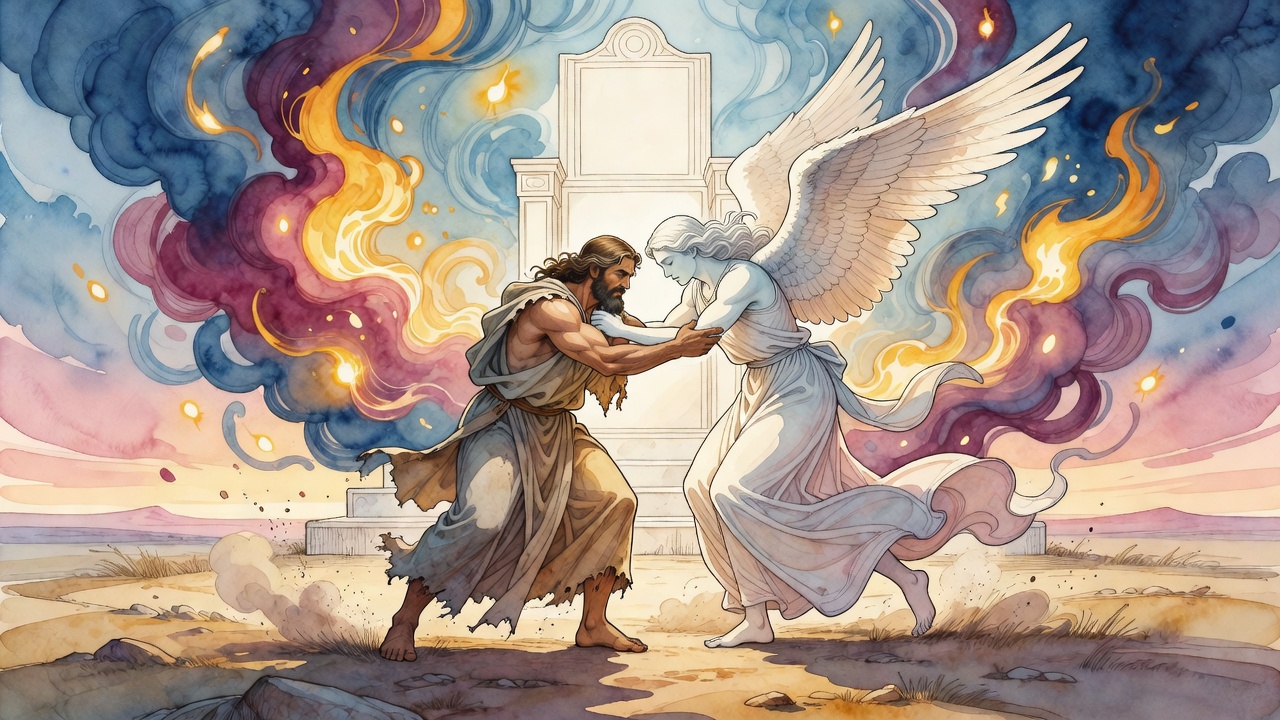
Something jumped him.
Everyone Else Was Already Across
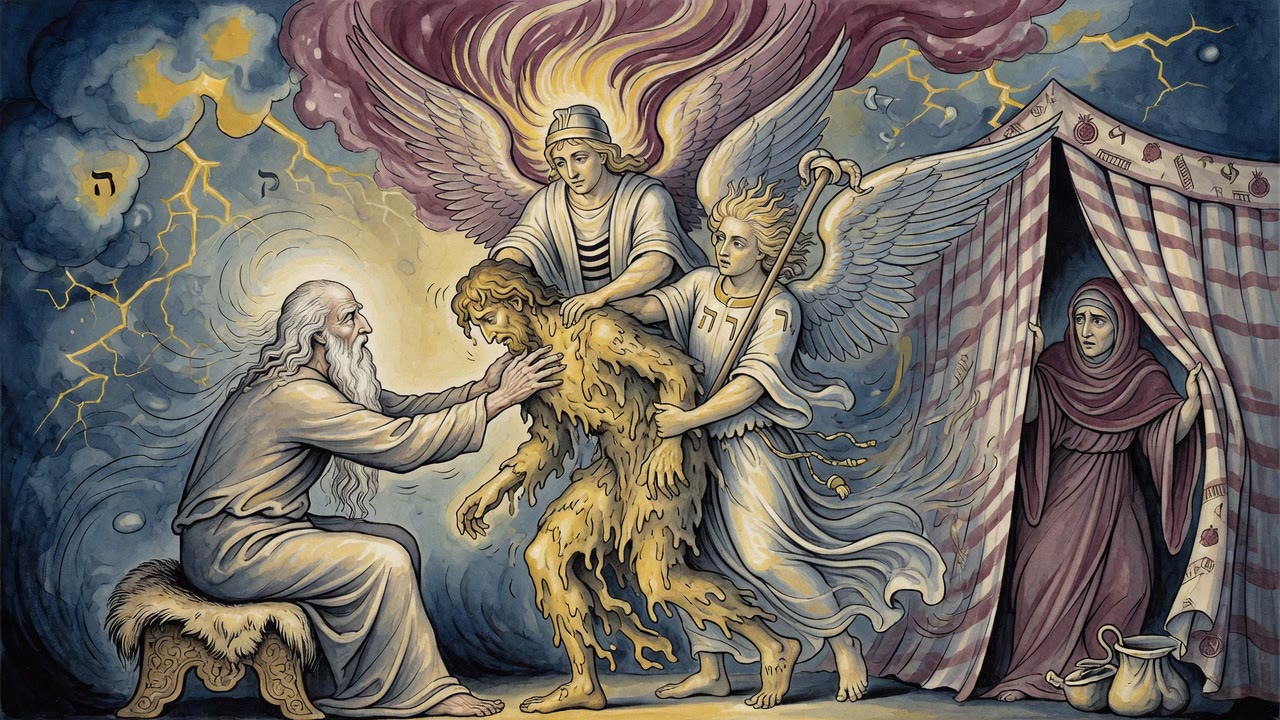
The Torah calls it a man. Jacob later called it God. The angel beat Jacob until the sky began to lighten. He struck the hip socket and dislocated it. Jacob, hip out of joint, would not release the grip. He held on until the stranger blessed him. The blessing came with a new name. Jacob became Israel, because he had struggled with God and with men and had prevailed (Genesis 32:29).
Then Jacob asked his own question.
"Tell me your name."
The Hip Gave but the Hands Held
The stranger's breath was hot on his ear. Daybreak was a thin line over the Jabbok. Jacob's hip screamed and his hands stayed locked, because a blessing without a name is half a gift. He had given his own name up in the dark. He wanted one back.
The stranger answered with a question.
"Why do you ask my name?"
No name followed. Only the blessing already spoken, and then the hold began to slip.
He Asked the Wrestler for a Name
It was not stubbornness. The wrestler reached for a name and found none sitting in his mouth.
Stars have fixed names, because God assigns them and they hold (Psalms 147:4), but angels do not, because they receive assignments. An angel sent to heal carries the name Raphael. An angel sent on a mission of strength carries the name Gabriel. The name is the mission, so when the mission ends, the name goes with it.
The wrestler at the Jabbok had finished his assignment. Dawn was coming. Whatever he had been sent to do that night with Jacob, whether to test him, to mark him, to rename him, it was complete. Standing there in the lightening sky, holding the question Jacob had asked, he genuinely did not know what name to give. He had not received his next mission yet. He was between names.
He told Jacob the truth. It was not a refusal but an accurate report, because there was nothing to give. Manoah would hear the same blank years later, before Samson's birth, when an angel said the name was hidden, wondrous, unknown, because even that messenger did not know what he would be called next (Judges 13:18).
Dawn Cut the Bank in Two
The angel asked to leave before sunrise, and it was not only fear of being seen. Light and dark had been divided on the first day, and the split was not decoration. The righteous are allotted the light and the wicked the dark. Dawn is a boundary between categories, and an angel whose work was done in the night hours belonged on the dark side of the threshold.
If he stayed, he would be standing in the wrong half of the world. Jacob's new name was already on him, the hip was already changed, and the assignment was over. So the wrestler pulled toward the remaining dark while Jacob pulled toward the name he still wanted, and the sky would not wait for either of them.
Light climbed the far bank first, where the wives and children slept beside the camels, then reached the water, then reached the two of them. The angel's hands opened, so Jacob's hands, at last, had nothing left to hold.
He Left a Limp and No Name
Some later tellers call the wrestler Michael, prince of Israel. If it was Michael, the namelessness already had a future in it. A defender can fight and still fail to deliver the one thing asked. Jacob prevailed that night. The angel who beat him, blessed him, and could not name himself left the bank empty-handed, present and fighting and honestly without a word to give.
Jacob limped into the morning with Israel on him and no answering name in his ear. The sun stood on the water. The household on the far side had not seen the fight, but they would see the limp and hear the new name. They would not hear the stranger's, because there had been none to hear.
Jacob crossed at last, slower than he had meant to, the unused question still in his mouth. Behind him the Jabbok ran as if two bodies had never locked on its stones.
← All myths